Hoots on the Ground cover art

Hoots on the Ground

Hoots on the Ground

Written by: The Lean Builder
Listen for free

Welcome to "Hoots on the Ground" with Adam Hoots—The Lean Builder's absolutely, positively NO bullshido podcast. Join Adam and his guests as they dig deep into the topics that are relevant to those of us who "get it": the men and women with the dirty boots; the ones who work in the field, doing the hands-on business of construction each day. Listen in as we keep it real while stories from the trenches are shared along with lessons learned, and some laughter along the way.The Lean Builder Economics
Episodes
  • Be Curious, Not Judgmental: The Neuroscience of Leading Construction Teams with Roxanne Evans (Episode 96)
    Apr 30 2026
    Be Curious, Not Judgmental: The Neuroscience of Leading Construction Teams with Roxanne Evans (Episode 96) In this episode of Hoots on the Ground with No Bullshido, host Adam Hoots is joined by Mike Chiles and special guest Roxanne Evans, owner of Brain Balance in Lee's Summit, Missouri. This conversation picks up where an earlier episode on neurodivergence left off — diving deeper into how the brain develops, how technology and modern lifestyles are widening developmental gaps, and what construction leaders can do about it. Roxanne brings a rare combination of perspectives: a former educator, a mother of four boys, and an operator of a Brain Balance center for nearly a decade. Her journey into brain health began with her own son's struggles with attention, focus, and emotional regulation — and the transformation she witnessed after going through the Brain Balance program became the foundation of her life's work. The conversation dives deep into: Why the brain's base operating system — built from birth to age three — determines how we process and respond to everything around usHow developmental gaps that were once one to two years are now three to five years wide, starting in kindergartenWhy the real problem isn't just screen time — it's the absence of physical movement that compounds the damageThe two behavioral profiles Roxanne sees most on job sites: turtles (shut down and withdraw) and race cars with no brakes (always busy, rarely productive)Why a worker on their phone may not be lazy — they may be overwhelmed and avoiding a task they couldn't processHow a leader's own emotional regulation sets the tone for the entire teamWhat mirror neurons are and why some workers can't learn by watching — no matter how many times you demonstrate Roxanne also answers a question that lands for every leader in the room: why can you handle a five-alarm crisis at work with a calm two-level response, but blow up at home over something small? Her answer — that home is where the brain finally relaxes its performance — reframes the problem entirely and points toward practical solutions. This is a rich, practical episode that challenges construction leaders to see their people through a new lens — not as underperformers, but as individuals whose brains may need different support to thrive. Because when leaders build better brains on their job sites, everybody wins. Key Takeaways: Everything Starts in the Brain: How the brain perceives, processes, and responds to information determines behavior on and off the job site. Gaps in this base operating system show up as attention struggles, emotional dysregulation, and difficulty completing tasks. The Developmental Gap Is Wider Than Ever: Where prior generations saw a one-to-two-year developmental gap, today's workforce is seeing gaps of three to five years. The age of full brain maturity has shifted from 25 to around 35, meaning many workers are functioning at a younger cognitive and emotional level than their age would suggest. Tech Isn't the Only Problem — It's the Absence of Movement: Screens keep the brain's fight-or-flight system perpetually activated, but the deeper issue is sitting still. Physical movement — especially bilateral activity like walking, crawling, and weight training — is essential for building brain function, processing speed, and emotional regulation. Turtles vs. Race Cars: Workers tend to fall into two profiles when overwhelmed: those who shut down and withdraw (turtles), and those who stay constantly busy but accomplish little (race cars with no brakes). Recognizing which type you're dealing with is the first step to leading them effectively. Phone Use May Signal Overwhelm, Not Laziness: When a worker reaches for their phone instead of completing a task, they may be avoiding it because they were overwhelmed by instructions they couldn't fully process — not because they don't care. Curiosity, not judgment, is the right response. The Leader's Regulation Sets the Team's Regulation: Culture starts with the leader. A calm, curious, regulated leader creates safety that helps even dysregulated team members stay in a learning state. An unpredictable leader keeps everyone in fight-or-flight — which shuts down learning entirely. Mirror Neurons Matter in the Trades: Not all workers can learn by watching. Some brains haven't developed the mirroring capacity to accurately replicate a demonstrated skill. This isn't defiance or laziness — it's a gap that, once addressed, can unlock strong performance. Meeting Design Can Unlock Better Performance: Keep meetings to 20 minutes or less, allow movement, build in physical resets, and create shout-out moments that get people clapping and engaged. These aren't soft perks — they're neurological tools that keep brains in a state where learning and retention are actually possible. The Home vs. Work Regulation Gap Is Real: Many leaders hold it together under pressure at work but lose ...
    Show More Show Less
    1 hr and 15 mins
  • Better, Faster, Together: Building Global Lean Community with Derek Sinnott (Episode 95)
    Mar 30 2026
    In this wide-ranging episode of Hoots on the Ground with No Bullshido, Adam Hoots connects with Derek Sinnott, a self-described pracademic from Wexford, Ireland. Derek is a civil engineer-turned-academic at SETU (South East Technological University), a Lean coach, and the Chair of the Supply Chain Sustainability School in Ireland. Adam and Derek first crossed paths in Japan, and the conversation that unfolded there clearly stuck — because Derek showed up in Ireland when Adam brought a team of Clemson students over for a construction competition, and that says everything you need to know about who Derek is. Derek opens up about his background growing up on a farm, finding his footing in engineering after struggling through secondary school, and ultimately discovering his true calling in training, coaching, and developing people across the construction industry. The conversation dives deep into: • Why the biggest inefficiency in construction is the illusion of collaboration • The difference between being efficient and being effective when coaching teams • What sustainability really means in Ireland — and why it goes way beyond green building • The supply chain as the true value-delivery engine of every project • Why early contractor involvement is critical, and what it looks like when done well • How asking good questions leads to better relationships — and better buildings Derek also shares his deep respect for trade workers and frontline teams — the people who actually put nail to formwork — and reflects on what real respect for people looks like in practice. He talks about the power of simply walking the job and being curious rather than coming in with a fixed agenda. They also revisit the ASCE student competition that brought Adam's Clemson team to Ireland (earning two third-place trophies and a Best Speaker Award), explore the possibility of teaming up for the upcoming November competition, and Derek teases a podcast of his own on the horizon. This episode is equal parts Lean philosophy, sustainability education, and authentic human connection — a reminder that no matter what ocean separates us, we're all telling the same story in different accents. KEY TAKEAWAYS: • Collaboration ≠ More Meetings: Real collaboration means breaking down silos and sharing learning, not just scheduling more conversations. • Coach, Don't Consult: The most effective intervention isn't solving problems for teams — it's helping them develop the ability to solve their own. • Sustainability Is Bigger Than Green: ESG — environmental, social, and governance — means taking care of your people, your community, and running an ethical business. • Supply Chain Is Everything: The trade partners and vendors who install and deliver are the true value-creators. Educating and supporting them is how projects succeed. • Decisions Made Early, Lived With Long: The choices made in pre-construction shape 90% of cost, schedule, and quality outcomes, and ripple through the building's entire lifecycle. • "Can't" Is a Four-Letter Word: Derek's most despised phrase — there's always a path forward, even when there are constraints. • Better, Faster, Together: The motto of Lean Construction Ireland and a philosophy that puts people first in pursuit of continuous improvement. EPISODE QUOTES (paraphrased): • "The biggest inefficiency in construction is the illusion that collaboration has taken place." • "The most efficient thing is to just go solve it. But the most effective thing is to step back and coach." • "I get disappointed when a group doesn't challenge me — that means nothing is landing." • "Good looks like better than before." • "Can't — that word drives me absolutely bananas." • "We're always in pursuit of perfection. I'm not sure what that looks like, but it's an awful lot better than what we do at the moment." • "It's not about being soft. It's just: how are you doing?" RESOURCE LINKS MENTIONED IN THIS EPISODE: • Lean Construction Ireland • Supply Chain Sustainability School • SETU (South East Technological University, Ireland) • Associated Schools of Construction Region 8 (ASC) Competition GUESTS FEATURED IN THIS EPISODE: • Derek Sinnott — Executive Coach & Strategic Advisor to CEOs & Senior Leaders in the Built Environment | Chair | MC | Speaker | Author | Director (https://www.linkedin.com/in/derek-sinnott) • Adam Hoots — Host/Producer of Hoots on the Ground and Lean builder focused on respect for craft and field leadership.(https://www.linkedin.com/in/adamhoots/) ABOUT HOOTS ON THE GROUND PODCAST: The Lean Builder's absolutely, positively NO Bullshido ...
    Show More Show Less
    1 hr and 1 min
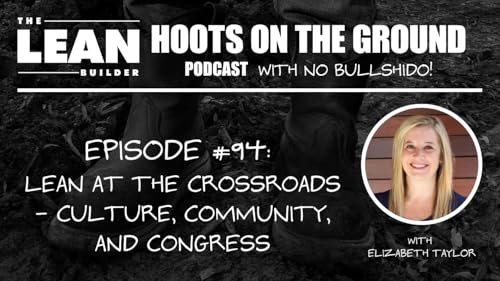
  • Lean at the Crossroads: Culture, Community, and Congress with Elizabeth Taylor (Episode 94)
    Mar 3 2026
    Lean at the Crossroads: Culture, Community, and Congress with Elizabeth Taylor (Episode 94) In this heartfelt and high-energy episode of Hoots on the Ground with No Bullshido, Adam Hoots sits down with Elizabeth Taylor, National Director of Lean at JE Dunn Construction and 2026 LCI Congress Co-Chair, to talk about leadership, culture, and what it really means to build community in construction. Elizabeth shares her journey from project management to Lean coaching, including her AMAZING Lean experience on the Williston Rec Center project in North Dakota, where living onsite and stumbling through The Last Planner System® created lifelong relationships and a powerful example of what Lean culture can truly look like. The conversation dives deep into: • The difference between Lean tools and Lean culture • Why relationships accelerate project performance • How to move from "doing Lean" to being a Lean organization • The importance of field-first thinking and supporting trade workers • What it takes to lead at scale inside a national construction firm Elizabeth also opens up about personal loss, vulnerability, and how the Lean community has supported her during one of the most difficult seasons of her life. This episode goes beyond business, it's about humanity, leadership courage, and creating intentional spaces where people belong. Check out Elizabeth illustrating true vulnerability, live in person as she handles the questions from Hoots. They also preview the 2026 LCI Congress in Atlanta, themed "Lean at the Crossroads: Building the Future Together." Elizabeth shares insights into this year's four tracks: 1. Next Generation Delivery Integration 2. Field First Lean: Tools, Flow & Daily Improvement 3. Becoming a Lean Organization Through Culture & Learning 4. Whole Team, Whole Project Integration If you've ever wondered what Congress looks like behind the curtains, whether your story is worth sharing, this episode is your sign to step up. Abstracts are due Thursday, March 5th. Don't wait. Submit to speak here: https://congress.leanconstruction.org/abstract-submission/ This one is part Lean strategy, part leadership masterclass, and part reminder that we can't do life, or construction, alone. Key Takeaways: • Lean Is More Than Tools: Last Planner may start the journey, but culture and trust sustain it. • Relationships Drive Results: Teams that cook dinner together and problem-solve together build projects differently. • Vulnerability Is Leadership: Real culture change starts when leaders model openness and humanity. • Field First Matters: Trade workers carry the weight of poor systems—Lean must serve them. • Lean at Every Level: Personal, project, organizational, and industry-wide transformation are all connected. • Congress Is Community: LCI isn't just about sessions—it's about conversations, connection, and shared growth. ABOUT HOOTS ON THE GROUND PODCAST: The Lean Builder's absolutely, positively NO Bullshido podcast. Join host Adam Hoots and his guests as they dig deep into the topics that matter most to those in the field. With stories from the trenches, lessons learned, and plenty of laughter, this podcast is for the men and women doing the hands-on work of construction. RESOURCE LINKS MENTIONED IN THIS EPISODE: • Lean Construction Institute (LCI) Congress 2026 — Atlanta, GA • JE Dunn Construction National Lean Program • Signia Hotel and conference Center (LCI Congress 2026 venue area) GUESTS FEATURED IN THIS EPISODE: • Elizabeth Taylor — National Director of Lean, JD Dunn Construction | 2026 LCI Congress Co-Chair (https://www.linkedin.com/in/elizabethmckiernan/) • Adam Hoots — Host/Producer of Hoots on the Ground and Lean builder focused on respect for craft and field leadership (https://www.linkedin.com/in/adamhoots/) EPISODE QUOTES (paraphrased): • "Lean tools are easy to grab onto. Culture is what makes them work." • "You can't tell me it won't work. I've seen it work." • "We're all just humans doing construction." • "We can't do this thing called life alone." • "Don't say 'we can't.' That's where the work starts." • "Make it visual. Make it simple. That's how you get everybody on the same page."
    Show More Show Less
    47 mins
adbl_web_anon_alc_button_suppression_c
No reviews yet