Episodes

  • The Diving Bell & The Butterfly
    Jan 2 2026

    Send us a text

    What does it mean to be free?

    In this short episode of Hope is Kindled, we journey into Jean-Dominique Bauby’s unforgettable memoir The Diving Bell and the Butterfly. Struck by locked-in syndrome after a massive stroke, Bauby was able to move only his left eyelid; and yet, through blinks alone, he dictated a work of breathtaking beauty and courage.

    This is not just a story of suffering, but of imagination, resilience, and hope. Bauby reminds us that while the body may fail, the human spirit can still soar. His “diving bell” was his body, heavy and immobile, but his mind, his butterfly, remained free to wander through memory, dream, and love.

    We’ll explore Bauby’s writing through psychological and philosophical lenses, connecting his reflections to works like Night, Papillon, The Odyssey, The Brothers Karamazov, and more. Along the way, we’ll discover how even in confinement, hope can be kindled into something eternal.

    Support the show

    Show More Show Less
    8 mins
  • Last Men Out
    Jan 2 2026

    Send us a text

    This is a pivotal episode of Hope is Kindled, and one of the most poignant we’ve ever recorded.

    Thanks to Bob Drury and Tom Clavin, Last Men Out takes us to back in time to bear witness of the final hours of the Vietnam War, at the moment when the helicopters lifted, the embassy gates closed, and history moved on without resolution. This is not a story about victory. It is a story about duty when victory is no longer possible, and about what remains when a nation withdraws.

    Through historical, biographical, and psychological analysis, this episode examines the human cost of the withdrawal from Vietnam: the Marines who stayed to the very end, the allies left behind, the veterans who returned home to silence and misunderstanding, and a society struggling to process moral failure, loss, and abandonment.

    We also explore what comes after disaster, looking at figures like Frederick Downs Jr. (The Killing Zone) as examples of long-term moral response: lives shaped not by closure, but by responsibility carried forward over decades. Here, hope is not triumph. It is presence. It is integrity. It is the refusal to forget.

    This episode speaks directly to our obligation to remember, to care for our veterans, and to confront the consequences of war honestly—without romanticism and without evasion.

    Last Men Out reminds us that hope does not always arrive as rescue. Sometimes it arrives as restraint. Sometimes it arrives as witness. And sometimes, it arrives simply in the choice to stay human when everything else is falling apart.

    This is an episode about endings, and about what they demand of us.

    Support the show

    Show More Show Less
    17 mins
  • Night by Elie Wiesel
    Jan 2 2026

    Send us a text

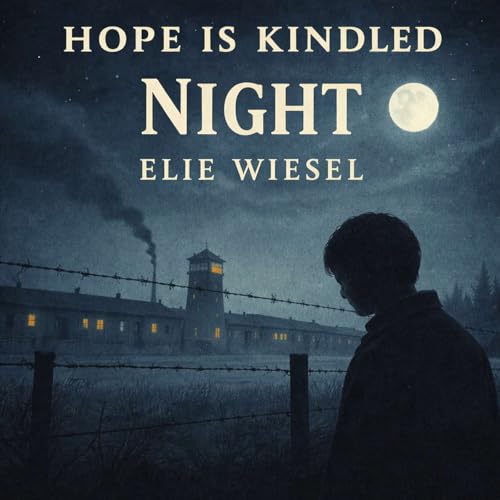
    There are some books that resist hope—not because they lack meaning, but because they refuse comfort. Night by Elie Wiesel is one of those works. It confronts us with the Holocaust not as distant history, but as lived reality: a world where cruelty was systematized, faith was tested to its breaking point, and survival itself became an act of resistance.

    In this deeply serious episode of Hope is Kindled, we wrestle honestly with the question: How do you look for hope in a story shaped by such overwhelming darkness? We do not rush the answer. We do not soften the horror. Instead, we sit with it.

    Through historical, biographical, psychological, and comparative analysis, we explore how Wiesel’s determination to survive, to remember, and to bear witness became one of the most enduring forms of hope imaginable. Hope here is not optimism. It is not rescue. It is the refusal to let suffering be erased or forgotten.

    This episode also includes a clear condemnation of antisemitism and genocidal hatred in all forms, and an affirmation of solidarity with Jewish friends, families, and communities. Remembering Night is not passive, it is a moral responsibility.

    Night teaches us that hope does not always look like light. Sometimes it looks like endurance. Sometimes it looks like memory. And sometimes, it looks like the courage to tell the truth so that the world cannot look away again.

    Support the show

    Show More Show Less
    13 mins
  • FLOW by Mihaly Csikszentmihalyi
    Dec 31 2025

    Send us a text

    What keeps a human being whole when the world feels chaotic, overwhelming, or fractured?

    In this episode of Hope is Kindled, we explore Flow: The Psychology of Optimal Experience by Mihaly Csikszentmihalyi, a groundbreaking work that asks not how to be happy, but how to remain engaged, present, and meaningful in the face of uncertainty.

    Drawing on Csikszentmihalyi’s life and research, shaped by war, dislocation, and the search for purpose, we examine what “flow” really is (and what it is not): not hustle, not escapism, not constant joy, but the deep human capacity to give attention to something that matters.

    Along the way, we connect Flow to the works we’ve encountered throughout Hope is Kindled: The Odyssey, Frankenstein, 1984, Dickens, Dostoevsky, Gandhi, and more, showing how attention, craft, and moral intention shape the human condition. We also wrestle honestly with the limits of flow, asking what happens when skill and focus are separated from compassion and ethics.

    At its heart, this is an episode about hope, not as optimism, but as practice. About choosing engagement over numbness, participation over withdrawal, and meaning over despair, one small act at a time.

    Hope, as it turns out, may not save the world.

    But it can help us show up fully within it.

    Support the show

    Show More Show Less
    12 mins
  • Always Coming Home
    Dec 31 2025

    Send us a text

    What does hope look like when it isn’t loud, triumphant, or driven by conquest?

    In this episode of Hope is Kindled, we return to Always Coming Home by Ursula K. Le Guin, a deeply unconventional and quietly radical work that imagines a future shaped not by domination, but by relationship, memory, and care.

    Blending biography, history, psychology, and comparative literary analysis, this episode explores Le Guin’s vision of the Kesh people, a culture that values belonging over power, continuity over conquest, and voice without requiring validation. Along the way, we connect Always Coming Home to the wider Hope is Kindled journey, from The Odyssey and Walden to Frankenstein, Flow, and A Wrinkle in Time.

    This episode is also personal. Revisiting this book returns us to a time of maturation, an earlier, more optimistic moment, when Le Guin’s work helped affirm that a quieter voice, a reflective style, and a patient way of seeing the world were not weaknesses, but strengths. Her writing didn’t just imagine a better future; it made space for becoming more fully oneself.

    Always Coming Home reminds us that hope doesn’t always arrive as a breakthrough. Sometimes it arrives as a return, to values we once knew, to ways of living that honor restraint, listening, and care, and to the belief that even after loss, we can still find our way home.


    Support the show

    Show More Show Less
    17 mins
  • A Wrinkle in Time
    Dec 29 2025

    Send us a text

    What if love, imperfect, emotional, stubborn love, really is the strongest force in the universe?

    In this episode of Hope is Kindled, we take a deep and thoughtful journey into A Wrinkle in Time by Madeleine L’Engle, a story many of us first encountered as children and only later realized was asking some of the most profound questions literature can ask.

    Through close story and character analysis, historical and biographical context, psychological insight, and rich comparisons to works like The Odyssey, Frankenstein, 1984, Doctor Who, and Stranger Things, we explore how this deceptively simple novel confronts fear, conformity, and the loss of self—and why it insists so fiercely on hope.

    With the final season of Stranger Things airing now, A Wrinkle in Time feels especially timely. Its warnings about sameness, control, and comfort at the cost of humanity echo loudly today, as does its quiet, defiant belief that what saves us is not power or intellect, but connection.

    At the heart of the episode is one radical idea:
    Love is something you do.

    Not sentimental love.
    Not easy love.
    But love chosen in the face of fear—and carried, imperfectly, into the dark.

    This is an episode about light that does not deny darkness, hope that does not wait to be rescued, and the daily courage it takes to remain human.

    Support the show

    Show More Show Less
    24 mins
  • A Christmas Carol
    Dec 25 2025

    Send us a text

    Tonight on Hope is Kindled, we step into the snow-dusted streets of Victorian London and revisit one of the most enduring stories ever told: A Christmas Carol. Through Dickens’ words, and the many ways this story has echoed through popular culture, we explore why Ebenezer Scrooge’s journey still speaks to us today.

    This episode blends literary insight, cultural reflection, and heartfelt analysis as we look at kindness, accountability, redemption, and the quiet hope that lives inside second chances. From timeless passages on the page to beloved adaptations across generations, we ask why this story never stops mattering, and what it still asks of us.

    We must now and forevermore remember, if the Ghost of Christmas Yet to Come stands near us tonight, it is not to condemn, but to invite us, to soften what has grown hard, to heal what has been divided, and to remember that even small acts of goodness can change the shape of what lies ahead.

    This episode is dedicated to my friend Mike, who always believed in me and helped me to believe in myself.

    Support the show

    Show More Show Less
    39 mins
  • Fear & Loathing in Las Vegas
    Nov 18 2025

    Send us a text

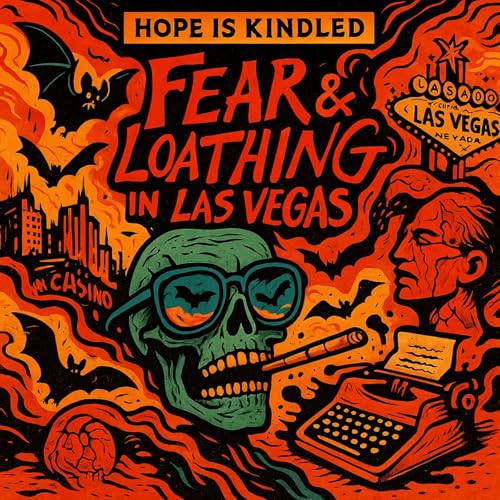
    In this scorching, psychedelic plunge into Hunter S. Thompson’s Fear and Loathing in Las Vegas, we chase the ghost of the American Dream through burning desert highways, casino neon, shattered illusions, and chemical weather systems that would make lesser souls fold. Along the way, David Bowie drifts in like a starman whispering that identity is transformation; Charles Bukowski limps along beside us, cigarette lit, reminding us that what matters most is how well we walk through the fire; and Thompson himself, mad saint of the freak kingdom, howls warnings and benedictions in equal measure.

    This is an episode for the bruised, the disillusioned, the heartbroken, and the secretly hopeful.
    A pilgrimage for anyone who still wonders if the American Dream survived the wreckage of the Twentieth Century—or if it slipped out the back door somewhere near Barstow. Together, we follow the smoke trails of rebellion, reinvention, despair, humor, and that stubborn ember of hope that refuses to die.

    Strange. Beautiful. Chaotic.

    A cocktail of Bowie’s stardust, Bukowski’s grit, and Thompson’s gasoline.
    And beneath it all, the quiet truth: maybe the Dream isn’t dead—maybe it’s just waiting for those brave or crazy enough to keep looking for it.

    Support the show

    Show More Show Less
    30 mins