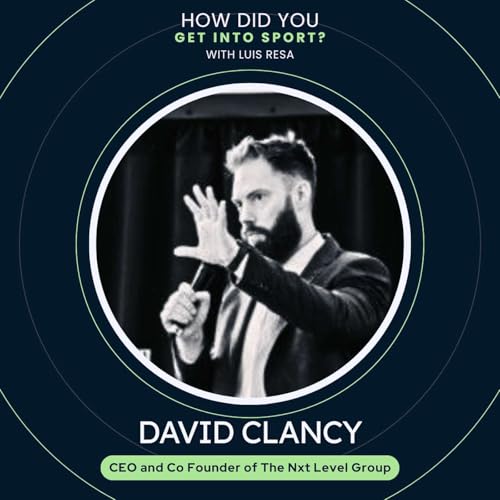
How did you get into sport? cover art

How did you get into sport?

How did you get into sport?

Written by: Luis Resa
Listen for free

This is the “How did you get into sport?” podcast where we explore the ins and outs of working in high performance sport.

These are conversations with leaders in the industry about their journey and most importantly how they got to where they are. Working in professional sport is one of the most sought after yet highly competitive industries with limited professional organisations offering opportunities to work at the highest level of their respective sports.

This podcast was created on the back of countless conversations with a diverse range of experienced professionals overly frustrated yet still highly motivated to work in their dream role and asking the question “How did you get to work in professional sport and what did you have to do to get there?” Host Luis Resa is a Sports Physiotherapist who has worked in various elite professional organisation both in Australia and internationally.

In each episode, Luis has deep conversations with Sports Physiotherapist, S&C coaches, Head coaches, High Performance Managers and other leaders in the field of elite sport to discuss what it takes to excel in the world of sport as well as diving deeply into the intricacies of what got their foot in the door of some of the world’s most desirable roles.

Please subscribe to the podcast and leave a review. In the meantime, enjoy a deep conversation and learn the specific do’s and don’ts of both securing and surpassing expectations in the field of high performance sport.

© 2026 How did you get into sport?
Careers Economics Hygiene & Healthy Living Personal Success Physical Illness & Disease
Episodes
  • Alicia Edge - Lead Performance Dietician Australian Women's National Football Team (Matildas) & CEO Compeat Performance.
    Jun 17 2026

    Send us Fan Mail

    Alicia is one of Australia's leading sports dietitians, with nearly two decades of experience working at the highest levels of elite sport. Her career has spanned the Australian sporting landscape, supporting athletes across a wide range of Olympic and Paralympic programs through the Australian Institute of Sport, while also consulting for organisations including the NSW Waratahs, FIFA, and Football Australia. For more than seven years, Alicia has played a key role within Football Australia, most notably as Lead Performance Dietitian for the Matildas during their historic 2023 FIFA Women's World Cup campaign and the 2026 AFC Women's Asian Cup. In this conversation, we explore the realities of nutrition in elite sport, from fuelling performance and recovery to navigating the challenges of implementing evidence-based nutrition in complex high-performance environments. Alicia shares why behavioural science can often be just as important as nutritional science when it comes to creating meaningful and lasting change in athletes. This is also a conversation about balance, resilience, and leadership. Alicia reflects on building a career at the highest level of international sport while navigating the demands of motherhood, family life, and running her own business.


    Highlights from the episode…

    • Alicia shares her desire to go into sports nutrition during an era where the space was very new and there were not an abundance of roles in the industry.
    • We discuss the turnover of dieticians in the industry and the challenge for some dieticians to even get full time work after graduating.
    • After two previous attempts to secure a role at the AIS, she was successful on her third attempt and talks about the gaps she had to fill that eventually led to her securing a role.
    • Her time at the AIS and how services were structured, funded and allocated to specific athletes in sports.
    • The chase for lean muscle mass in athletes. Does body composition actually correlate with performance? and what Alicia does with the women’s national team.
    • An athletes “relationship with food” and how this has more of an impact on decisions around nutritional choices than most other factors.
    • The decision of stepping away from sport to start a family and the accompanying doubt of whether she will ever get back into the world high performance sport.
    • When it comes to nutrition and high performance sport. What matters most “nutrition science” or “behavioural science”?
    • Alicia provides an unprecedented insight into what's involved when providing nutritional support for the Matildas before and during major tournaments.
    • “Covert Monitoring”…What monitoring tools Alicia uses to evaluate adequate dietary intake for performance and minimising negative connotations associated with nutritional monitoring.
    • Managing the tension of being away from family all while doing the best job you can do in the role…how do you do that?
    • Compeat performance what it’s all about and how it is changing the way dietician support is delivered affordably and at scale.


    People mentioned:

    • Louise Burke: https://www.linkedin.com/in/louise-burke-61923411/
    • Matt Whalan: https://www.linkedin.com/in/matt-whalan-5b59a939/
    • Carmen Colomer: https://open.spotify.com/episode/1Mn5jKSrO7mgzfrW9rEURC

    Alicia Edge contact details:

    • LinkedIn: https://www.linkedin.com/in/alicia-edge/
    • Compeat Performance: https://www.compeatperformance.com/about-us/
    • Instagram: https://www.instagram.com/alicia_j_edge/


    Host: Luis Resa

    Contact me on:

    • LinkedIn: https://www.linkedin.com/in/luis-resa-a975196b/
    • Email: luis.resa@outlook.com

    Thanks for listening and please leave a review. If you would like more information on anything mentioned in this episode simply send me an email.

    Show More Show Less
    1 hr and 33 mins
  • Hamish Macauley - Lead Physiotherapist, Ireland Men's National Rugby Team.
    May 29 2026

    Send us Fan Mail

    Hamish is an Australian Sports Physiotherapist who has worked at the pinnacle of rugby across the globe. Over the course of his career, he has held Head Physiotherapist roles with the ACT Brumbies (Super Rugby), the Australian National Rugby Team (Wallabies) and currently serves as Lead Physiotherapist for the world number three-ranked Ireland Men’s Rugby Team. Beyond rugby, Hamish also spent three years in the AFL as Head Physiotherapist for the Geelong Football Club. In this conversation, we explore the differences and similarities between club and international rugby, including how injuries are managed, the systems used to collaborate with coaches, medical staff, and performance teams, and the logistical demands that come with operating in both environments. From humble beginnings working in a private clinic in country Australia, his first opportunity in professional sport came through a referral from a local farmer in his community, a moment that would ultimately launch a career spanning countries, sports, and working with the elite of world sport.


    Highlights from the episode…

    • On the back of the 6 Nations, Hamish provides an insight into the prestige of the competition and Ireland winning the “Tripple Crown”.
    • Why Hamish chose to go down the pathway of sports physio after initially commencing a Bachelor of Education.
    • How Hamish got his introduction in pro sport with the ACT Brumbies (Super Rugby) through the help of a local farmer.
    • We discuss Hamish’s opportunities in sport and the unspoken factors that lead to securing roles beyond just focusing on building your technical competency.
    • The unique structure of Rugby Australia had in place for club physiotherapist and national team physiotherapist to improve collaboration and continuity of systems, clinical practice and athlete care.
    • The differences in working as a club physiotherapist and a national team physiotherapist regarding schedules, roles, responsibilities, challenges, etc.
    • The challenges of managing players who may have conflicting demands between club and national team.
    • Hamish shares the incredible systems that exist in Irish Rugby that have improved collaboration and collective decision making between club and country.
    • Why he was let go from the Wallabies and how it felt the following 2.5 year not working directly in sport.
    • How Hamish secured a role in a new sport with one of the most successful clubs in AFL history, Geelong Cats.
    • The scale, resources and staff set up in the AFL in comparison to international Rugby.
    • With the long hours, travel, pressure and relentless push to be better day in day out, over many years…Did you ever experience burnout?
    • How Hamish was able to secure a one of the most prestigious roles in international Rugby and his move from Australia to Europe to join Ireland Rugby.


    People mentioned:

    • Byron Field: https://open.spotify.com/episode/4z8bihACHtSMwpC844wCkQ
    • Tim McGrath: https://open.spotify.com/episode/73xkOCQlyT1RJ0u9s3ybdE
    • Mark Young: https://open.spotify.com/episode/17aAXmr5EdiTtxfqs1D1Zn


    Hamish McCauley contact details:

    • LinkedIn: https://www.linkedin.com/in/hamish-macauley-13944365/


    Host: Luis Resa

    Contact me on:

    • LinkedIn: https://www.linkedin.com/in/luis-resa-a975196b/
    • Email: luis.resa@outlook.com

    Thanks for listening and please leave a review. If you would like more information on anything mentioned in this episode simply send me an email.

    Show More Show Less
    1 hr and 38 mins
  • David Clancy - How to get a job in pro sport...Literally! Co-founder & CEO of The Nxt Level Group.
    May 14 2026

    Send us Fan Mail

    David is the Co-Founder and CEO of The Nxt Level Group, a company specialising in identifying and placing top talent across some of the world’s biggest sporting organisations, including the English Premier League, NFL, NBA, NWSL, and La Liga, to name a few. What makes David’s journey particularly unique is that he hasn’t just operated in recruitment he’s lived the world of high performance. With over 15 years’ experience as a sports physiotherapist working with elite teams and athletes, he brings a rare perspective to the industry. His experience extends even further, from working as a rehabilitation specialist with Isokinetic Medical Group, to co-founding multiple businesses, authoring a book, and hosting a podcast where he interviews high performers across sport, business, the arts, and the military. In this conversation, David shares practical insights on securing a role in high-performance sport, while also opening up about his own journey filled with extreme highs, setbacks, and the ongoing challenge of balancing family, purpose, and fulfilment. It’s this combination of lived experience and honest reflection that positions David to offer valuable insight into not just getting a role in sport, but also thriving within it.


    Highlights from the episode…

    • After an eclectic childhood and an initial interest in journalism, how David eventually fell into physiotherapy and built a career across some of the biggest organisations and teams in the world.
    • Where did David get this courage to feel confident in the various roles and fields he's succeeded in?
    • How David avoided being “institutionalised” and his ability to pivot away from a 15 year + career in sports physiotherapy and still thrive beyond his skill set as a physio.
    • His initial transition out of “conventional employment” to “entrepreneurship” was met with never-ending challenges and what David did to help him persevere through those tough times.
    • The common tension of building a career filled with personal fulfilment and purpose; and also doing what’s best for your family.
    • What do you want out of your career? A questions that often most don't ask and why it's important.
    • David is directly involved in the recruitment of top talent for some the most well respected sports organisation. He shares what separates the people who go on to secure roles to those who don’t.
    • The specific questions practitioners should ask when applying for roles in sport.
    • Once in the role, what David advises candidates and organisations to focus on in the first 30-90 days to maximise a successful transition.
    • What David advises sporting organisations to do to attract top talent to their teams.
    • Having achieved a lot across various domains what has been the cost of your ambition?


    People mentioned:

    • Cameron Steel: https://www.linkedin.com/in/cameron-steele-1a719926/
    • James Allen: https://www.linkedin.com/in/james-allen-4627503b/
    • Martin Seligman: https://positivepsychology.com/perma-model/

    David Clancy contact details:

    • LinkedIn: https://www.linkedin.com/in/davidmdclancy/
    • Nxt Level website: https://thenxtlevelgroup.com
    • David Clancy website: https://davidclancy.com


    Host: Luis Resa

    Contact me on:

    • LinkedIn: https://www.linkedin.com/in/luis-resa-a975196b/
    • Email: luis.resa@outlook.com

    Thanks for listening and please leave a review. If you would like more information on anything mentioned in this episode simply send me an email.

    Show More Show Less
    1 hr and 17 mins
adbl_web_anon_alc_button_suppression_t1
No reviews yet