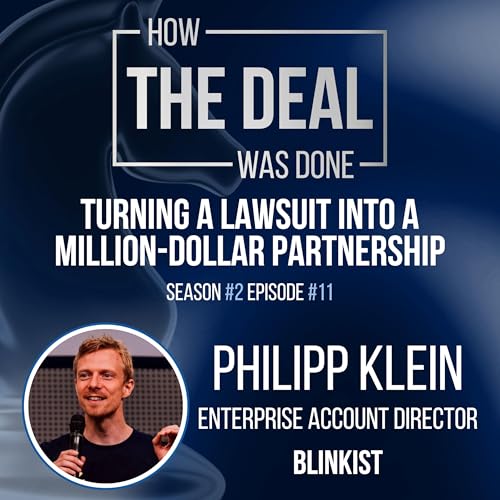
How the Deal was Done | Enterprise Sales Podcast cover art

How the Deal was Done | Enterprise Sales Podcast

How the Deal was Done | Enterprise Sales Podcast

Written by: Matthew Klingner | Andrew Kappel
Listen for free

About this listen

How the Deal was Done: Fast-paced interviews with top sellers & leaders. Each week we sit down with the best enterprise sales executives and Founders to unpack transformational deals & discuss the mindsets, strategies, and actions of world class performers.Matthew Klingner | Andrew Kappel Economics
Episodes
  • S2E11: Philipp Klein: From Legal Threats to a $1M Win
    May 19 2026

    How the Deal Was Done
    Episode: Philipp Klein, From Legal Threats to a $1M Win
    Guest: Philipp Klein, Enterprise Account Director Companies: Blinkist | CoachHub Industry: Learning & Development / HR Tech
    Episode Summary
    Philip Klein joined CoachHub as one of its first five employees in 2019. In this episode, he walks through one of the most dramatic enterprise deals in the company's history — a nearly seven-figure coaching platform sale to Booking.com that spanned two years, survived a legal threat, and navigated a global pandemic.
    Key Moments in the Deal
    1. The Lead Came from an SDR Philipp credits the shared-room culture of celebrating every small win as the foundation that made the deal possible. That buzz and collective energy often makes up for what early-stage teams lack in formal training.


    2. Qualifying for Transformation, Not Just Interest CoachHub's calendar was full of the wrong meetings — coaching enthusiasts who wanted to coach 10–15 people. Booking.com's team was different: they asked how CoachHub could scale and weren't scared of big numbers.


    3. Reframing the Demo Request Rather than handing over access to an immature product, Philipp asked prospects to articulate what they actually needed to evaluate. That unlocked 4–5 additional stakeholder meetings that competitors — who just sent the login — likely never got.


    4. The Legal Crisis Days after signing the pilot, Booking.com went dark, then sent a formal email threatening legal action over a data privacy dispute. Philip's response: mapped stakeholders on LinkedIn, escalated to senior management, and brought in the CEO and Chief Legal Officer to a recovery meeting. The CLO's command of data privacy law reestablished credibility and broke the impasse.


    5. COVID as an Unexpected Catalyst When the pandemic froze Booking.com's business, CoachHub kept dialing. They proposed a small global pilot — 15 senior decision-makers at HQ — to stay relevant and transition from vendor to strategic partner. When budgets unfroze, they were first in line.


    6. Closing the Big Deal By late 2020, the close was — in Philip's words — the easier part. Financial incentives pulled the deal from December to November, and implementation meetings were already in stakeholders' calendars before the signature. The deal closed itself through the gate they'd built.
    Quotable Moments


    "The signature is basically just a gate the customer has to go through. Otherwise they cannot get to the next room."
    "You don't build confidence from successes. You build it from a mixture of successes and failures."


    "The difficult groundwork is what we did before. The big close was actually the easier part."
    Resources & Links
    Connect with Philipp

    • LinkedIn: https://www.linkedin.com/in/philippklein/
    • Case study video: Search "CoachHub Booking.com" to see the video he negotiated into the contract


    How the Deal Was Done drops weekly. Subscribe wherever you listen to podcasts

    Show More Show Less
    1 hr and 31 mins
  • S2E10: Ron Masi, Orchestrating a 7-Figure Deal to Perfection
    May 11 2026

    Ron Masi - Linkedin

    Ron spent 10 years selling ink on paper before moving into SaaS in 2015. He built his enterprise game the hard way — through coaches, mentors, and a lot of swing-and-miss — until he had a system for running deals at a level most AEs never reach.

    This episode is about a deal he's never forgotten. Not because of the size, but because of the execution. Every piece moved on purpose. The research, the internal alignment, the mind maps, the 90-minute demo that didn't show a single feature — it all came together and they walked out knowing they'd won.

    What you'll take away:

    How to build a deal dossier that actually changes how you sell, how to run an internal team across a complex opportunity without being in every room, and what it looks like when a demo stops being a demo and becomes a story.

    On research:

    "We highlighted every page of the CEO's book. We knew everything about them first."

    On internal selling:

    "Some people want to run really fast with you. Some people want to go slow. You have to think about how you're going to set this up."

    On not connecting the dots for the customer:

    "Never let the customer have to connect the dots. You need to connect them as much as possible."

    On the demo:

    "We didn't show the platform. We told them a story. We maybe clicked on four things. Maybe."

    On the win:

    "There was no possible way the people coming next were going to do that."

    On the feeling:

    "It's like an energy you don't even understand. Like if you played sports and you're in the zone — the basket was as big as the ocean."

    People Mentioned:

    • Jamal Reimer — Mega deal coach, mentor to Ron
    • Brian Burns — Sales coach, introduced Ron to mind mapping & "map to money"
    • Dennis Sorensen — Mentor, taught Ron how to unpack annual reports & 10-Ks
    • Mind mapping — Core tool Ron used to organize deal strategy and move pieces as the deal evolved


    Show More Show Less
    1 hr and 18 mins
  • S2 Ep 9: Scott Knights, Global Top Performer at Proofpoint
    May 5 2026

    Scott Knights — Major Account Manager at Proofpoint
    The Episode
    Scott Knights is a Major Account Manager at Proofpoint in Melbourne, managing some of the company's largest enterprise accounts across ANZ.

    This episode centers on how Scott inherited an account where the platform was "just working" — a comfortable situation that most AEs leave alone — and turned it into a full-scale platform transformation by convincing 30+ stakeholders across a parent organization to adopt a new vision for human-centric security.

    The account had been running the same Proofpoint deployment since the mid-2010s, nearly a decade without strategic evolution. You'll walk away with a clear picture of how to re-enter a dormant account, build a vision-led business case, and orchestrate internal and external stakeholders without losing anyone along the way.
    Key Quotes:
    On the most dangerous thing a customer can tell you:

    "The first bit of feedback was, hey, everything's great, but there's not really any further opportunity here. And that's kind of really interesting because I think that's the place that AI cannot disrupt."


    On qualifying out before the customer falls in love with the solution:

    "I said, look, we can definitely solve this. But it's going to cost approximately X. Are you comfortable and confident that your executive or senior leadership are going to sign off on this? And in the end, you could sort of see that that particular individual hadn't kind of really thought through the commercial value of what they were trying to achieve."


    On what the job actually is:

    "It's as much of a orchestrator as it is as a technology evangelist. If I look at one of my customers, there's 30 odd stakeholders within the parent org — from security and strategy and architectural teams, through to operational teams, through to legal and vendor managers and procurement."

    On the culture that quietly kills deals:

    "If the culture between teams kind of goes a bit off and starts to become even a little bit dysfunctional — people getting agitated with one another, blame or frustration being vented on calls — the wheels can very quickly fall off after that."


    On what to do when a stakeholder pushes back:

    "Seek first to understand and then be understood. What's going on for that person? What's the concern? What's the gap they're trying to solve for? And then once I understand that, I can go, okay, well, how do we solve this together?"

    On the mindset behind everything:

    "I'm just a very average guy. There is nothing exceptional about who I am or what I bring. But it's determination or diligence or just putting in that little bit of effort every day — it adds up. The success is just a natural outcome of that value creation."
    Referenced in the episode:


    Strategic Coach — Dan Sullivan's entrepreneurial mindset framework; Scott studies his work extensively — strategiccoach.com

    Eat That Frog! — Brian Tracy — tackling your single most important task first; Scott keeps this on his desk

    The Dip — Seth Godin — when to push through hard seasons and when to move on

    Books by Kazuo Inamori — Founder of Kyocera; philosophy of asking "what is the right thing to do as a human being?" in every business decision; most titles in Japanese, English translations available

    Servant Leadership — Robert K. Greenleaf — Scott's explicit North Star for how he approaches customer relationships

    Enterprise Sales Community — Founded by Jamal Reimer; global network of senior enterprise sellers — referenced as transformative to his own career


    Connect with Scott:
    LinkedIn — Scott Knights, Major Account Manager, Proofpoint, Melbourne

    Show More Show Less
    1 hr and 22 mins
adbl_web_anon_alc_button_suppression_c
No reviews yet