• BioCulture
    Jan 13 2026

    This is episode two, recorded at Eco Nomic Futures in San Francisco. Not a conference exactly—more a meeting point. Where conversations crossed paths around food, land, economics, and what happens when systems lose their connection to life.

    Tate Chamberlin is joined by Jacob Huhn and Warinkwi Flores. This episode is called BioCulture.

    It's about systems—the ones we live inside now, and the ones that came before them. Indigenous economies were relational, not extractive. Land, food, and water weren't commodities. They were responsibilities. Those systems didn't fail. They were interrupted.

    From there, the conversation moves into the present. Food as product. Life as data. Supply chains so long and familiar, they disappear. Corn becomes a way to see how meaning gets stripped as things move farther from their origins.

    We talk about data, the rights of nature, and economies embedded within life—not separate from it. A reminder that the future isn't something we have to invent. It's something we already know how to return to.

    Stay with us.

    Show More Show Less
    43 mins
  • Heart of the Heartland
    Dec 19 2025

    Today, we're somewhere that feels both familiar and overlooked at the same time—Arbor Day Farm in Nebraska City, Nebraska. The kind of place people call flyover country, a place many don't think twice about, even as the people who live here are quietly shaping a future the rest of us will eventually feel.

    I'm Tate Chamberlin, talking with Jeff Yost, Chris Harris, and Huascar Medina—three voices who don't see the Heartland as an accident of birth, but a choice. A commitment. A belief that local decisions should be made… well, locally. By the people who actually walk these streets, and raise their kids here, and imagine what this place could become.

    Because if you really want to understand a community, you don't just start with the data. You start with the people who see it up close—teachers, shop owners, artists, local organizers—the ones who understand the rhythms of a place in a way reports never quite catch. The people who can show you what a community is actually like, not just what it looks like on paper.

    And right now, these towns—these counties—are in motion. Old systems giving way to new ones. A moment where risk tolerance suddenly matters. Where one wrong move can feel fatal. And the arts—the artists—help us inch forward anyway. They make us brave in ways spreadsheets never will.

    There's also the quieter story: young people leaving for opportunities somewhere else, communities slowly thinning out, the talent and energy of a place drifting outward like smoke. And the equally powerful force coming behind it—the massive transfer of land and assets from one generation to the next, often to heirs who don't live here anymore. The early signs of a company-town future, unless something different takes hold.

    And somewhere inside all of this—inside the questions about belonging and the future of work and what makes a place worth staying in—is the story we're following today. Not an invitation. A moment. A snapshot. A look at how the Heartland, by choice, is writing its next chapter in real time.

    Show More Show Less
    59 mins
  • First Nations Economic Compact
    Dec 5 2025

    Turtle Island.
    Before there were countries—before anyone called this land the United States, or Canada, or Mexico—this was Turtle Island. A continent of nations, overlapping territories, trade routes stretching farther than modern highways, and relationships thousands of years old.

    Today, that history is being carried forward by contemporary Indigenous leaders at Fort Mason—San Francisco's skyline in the backdrop, summit banners hanging over a conversation that reaches far beyond the city around it.

    This is the First Nations Economic Compact.

    You're in a conference room that usually sounds like quarterly forecasts, and suddenly Chief Redman is talking about an economic conversation older than all of that—older than the 1763 Royal Proclamation, older than colonial regulatory systems, older than the borders that now cut through nations whose trade routes once ran uninterrupted across the continent.

    Long before GDP, First Nations had their own economic indicators: ecological balance, kinship networks, sustainable yields, inter-nation reciprocity. Systems the Doctrine of Discovery tried to erase. Systems that survived genocide, forced relocations, and treaties—signed, coerced, or never signed at all.

    And yet: the nations remain.
    The economies remain.
    The knowledge remains.

    Here, leaders are talking about restoring ancient trade corridors, sharing resources through ancestral law, and building a bio-economy centered on stewardship and community resilience. While modern governments argue over tariffs and trade wars, First Nations are putting forward something older and more future-ready: a sovereign economic compact drawn from traditional trade logic and built for today's global market.

    "If someone doesn't want to deal with Canada or the United States… they can deal directly with First Nations," Chief Redman says. It isn't a request. It's a reminder.

    Suddenly, this summit doesn't sound like policy talk—it sounds like nations dusting themselves off and reintroducing themselves. Not as stakeholders. Not as interest groups. But as governments.

    This is what reconnection sounds like.
    What continuity sounds like.
    What a continent remembering itself sounds like.

    Tate Chamberlin is with Chief Redman. Stay with us.

    Music by Supaman

    Show More Show Less
    32 mins
  • Nutrition Centered Economy
    Nov 19 2025

    Every town has one.
    A school.
    A cafeteria.
    A lunch line.
    And somewhere in that line, a kid is staring down a plastic tray of food that — for millions — might be the only real meal they get that day.

    We don't often think of it this way, but the school meal program is the largest restaurant chain in the United States. Seven billion meals a year. Forty million kids. Bigger than Subway. Bigger than McDonald's. Which makes it the biggest opportunity we have to change how we eat, how we grow food, and how we think about nourishment.

    When we let the system run on the cheapest, most processed calories, the cost shows up in hospital bills, chronic illness, and communities that can't afford to be healthy. In one of the richest countries in the world, eating clean, non-toxic food has somehow become a luxury. But it shouldn't be. Healthy food should be a right.

    So how did we get here? How did we build a system where the things that keep us healthy are the hardest to afford, while the things that make us sick are everywhere and cheap? Maybe it lives in the subsidies and programs meant to stabilize agriculture — systems that now keep us tied to old ideas of what food should look like.

    Take cattle ranching: once the backbone of rural life, now caught between an industrial model that demands scale and a regenerative one that demands patience — and risk. Four companies control most of the meat market, while the people who tend the land have the least power to change it.

    This episode, Tate Chamberlin talks with Nora Latorre, R.C. Carter, and Katie Stebbins — people working to shift the food system from the inside out. From how we feed our kids to how we nourish entire communities.

    Because we are what we eat. And maybe the way we feed our children is the clearest reflection of the future we're willing to build.

    Show More Show Less
    59 mins
  • State of Journalism
    Oct 31 2025

    Once upon a time, journalism started with a letter nailed to a tree—or a door. Some declaration, some warning, some truth someone wanted heard. And people would gather in the square to listen. News wasn't just information; it was a shared experience.

    Then came the daily paper. Then the evening broadcast. News once a day—steady, dependable. Until it wasn't. Now it's constant. Twenty-four hours. Push notifications. Feeds that never stop refreshing. And somewhere in all that, we started to wonder—what's the difference between fact and opinion anymore? Between storytelling and spin?

    In this episode, Tate Chamberlin talks with "Sleevs" Emily Messner, Joey Young, and Chris Denson about the evolution of journalism—from editorial boards and ad sales to freelancers, podcasts, and algorithms. How we depict what's true, and whether journalism can still sustain itself.

    Because while we were putting this episode together, the press corps was literally packing up and leaving the Pentagon—a small headline that somehow says everything about where we are right now.

    So… is there a future in journalism? Or do we have to make one, even if there isn't?

    It's Dispatch from the Heartland, join us, won't you?

    Show More Show Less
    53 mins
  • Human Migration and Displacement- Part Two
    Sep 29 2025

    Here's the thing about leaving. Sometimes you plan it for years — a better job, an education, a shot at something bigger. Other times it happens overnight. Governments fall. Food disappears. You run.

    This episode of Dispatch from the Heartland is about human migration and displacement — one of the oldest patterns of our species. Moving for survival. Moving for hope. Moving because staying is no longer possible. It's trauma. It's hope. It's a blank page.

    In this episode, Tate Chamberlin sits down with Zohra Zori, Lucy Petroucheva, and Angela Eifert to talk about displacement, belonging, and the slow learning curve of new cultures. We'll look at the mistakes, the forgiveness, and the "othering" that happens when you're new. We'll talk about refugee camps that stretch on for years, the difference between sustainability and dependence, and the unspoken emotions you carry when you leave everything behind.

    This is a space for vulnerability. For beginning again. For understanding sovereignty even when choice has been stripped away. Because right now, families are uprooted. Cultures are colliding. Dreams are being carried across borders. And even in movement — even in loss — we hold on to the hope of a better life.

    This is Dispatch from the Heartland. Join us, won't you?

    Show More Show Less
    59 mins
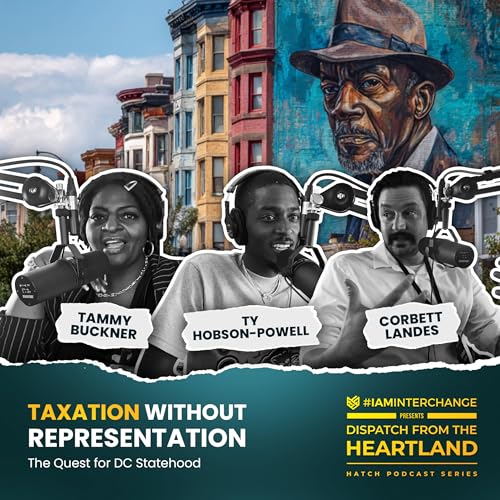
  • Taxation Without Representation- The Quest for DC Statehood
    Aug 28 2025

    Washington, D.C. isn't just a backdrop of monuments and marble. It's a living, breathing city—home to more than 700,000 people who work, who raise kids, who build their lives here. Known for decades as Chocolate City, D.C. carries a proud history of Black culture and resilience. And yet, unlike every other city in the United States, its residents watch democracy without fully taking part in it.

    They pay billions in federal taxes. They serve in the military. And still, they live under taxation without representation—the very injustice that fueled the Boston Tea Party and launched the American Revolution. More than two centuries later, the capital of the United States remains the only city where that founding demand is still denied.

    And here's the twist—this federal district is saturated with law enforcement. Dozens of agencies with arresting authority overlap in the same small space: the Metropolitan Police, Capitol Police, DEA, FBI, Secret Service, Park Police, Transit Police. And more recently, the National Guard and ICE. A city layered with power, yet stripped of the most basic power its people should hold—the right to representation in Congress.

    This is Dispatch from the Heartland. In today's episode, Ty Hobson Powell brings urgency and fire to the fight for DC statehood, making the case to Corbett Landes and Tammy Buckner that it's time for the capital to finally become the 51st state. This isn't just politics. It's about identity, equality, and the unfinished promise of democracy in the United States.

    We're at Arbor Day Farm in Nebraska—join us, won't you?"

    Show More Show Less
    49 mins
  • Food Security
    Jul 31 2025

    A vacant lot, once overlooked and forgotten amid the rush of urban life, now pulses with vibrant life—flowers bloom where concrete once stood, vegetables sprout in neglected corners, and hope takes root in every crack. Yet, even these transformed spaces remain fragile—vulnerable to neglect, gentrification, or future development that could erase their resurgence. Similarly, rural farmland faces its own challenges—fragile soils, unpredictable weather, and the razor-thin margins that make farming a constant gamble. While innovative crops like perennial wheat show promise for creating more resilient and sustainable agriculture—reducing the need for replanting and conserving water—convincing farmers to take risks with such unproven techniques remains a significant hurdle. It's a story of resilience—rooted in the earth and driven by community spirit—connecting urban renewal with rural perseverance in the shared pursuit of food security and sustainability.

    Today, we're sharing stories of communities confronting climate change, dismantling systemic barriers, and working tirelessly to ensure equitable access to healthy food—because food security is fundamental to a thriving society. Tate Chamberlin is joined by Nancy Williams, Founder of No More Empty Pots, Rachel Stroer, President of the Land Institute, and Miranda Miller Klugesherz, Executive Director of the Kansas Food Action Network. Together, we'll reflect on personal experiences, systemic issues, and the collective power driving meaningful change.

    We're at Arbor Day Farms in Nebraska—join us, won't you?

    Show More Show Less
    58 mins