• PTAB Reckoning: Power, Policy, and the Future of Patent Enforcement
    Jan 19 2026

    Send us a text

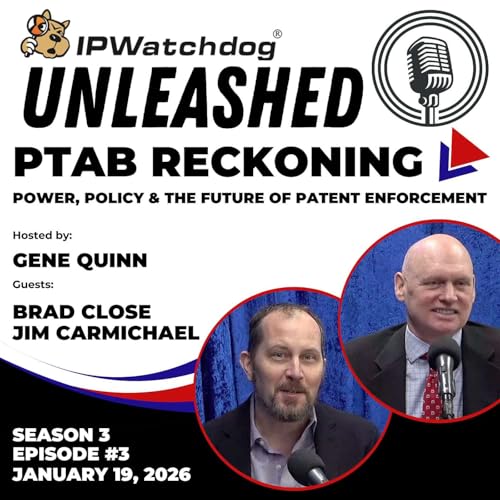
    In this edition of IPWatchdog Unleashed, Gene Quinn hosts a comprehensive discussion with Jim Carmichael, a former judge on the Board of Patent Appeals and Interferences, and Brad Close, Executive Vice President of Transpacific IP. The trio explores the current state of the Patent Trial and Appeal Board (PTAB), examining recent changes, the impact on patent owners and litigation, and the historical context of patent law and why the PTAB was created. They delve into the roles of non-practicing entities (NPEs), the integrity of the re-examination process, and the inefficiency of the patent litigation system. This detailed conversation sheds light on the complexities of patent enforcement, the economics of defending patents, and the broader legal landscape affecting innovators and patent practitioners.

    Visit us online at IPWatchdog.com.

    You can also visit our channels at YouTube, LinkedIn, X, Instagram and Facebook.

    Show More Show Less
    50 mins
  • Pioneering Innovations and Legacy: A Conversation with Inventor Gil Hyatt
    Jan 12 2026

    Send us a text

    This week on IPWatchdog Unleashed, Gene Quinn sits down with prolific inventor Gil Hyatt, exploring his innovative journey and aspirations to leave a lasting legacy. Gil, known for his significant contributions to the field of electrical engineering and microcomputers, shared insightful anecdotes about his early days, his pioneering work in artificial intelligence, and his ambitions to benefit future generations.

    Throughout the discussion, Gene and Gil tackled the controversies surrounding the perception of inventors like Hyatt as "patent trolls." Clarifying this mischaracterization, Hyatt explained that while his patents were widely licensed, he never instigated lawsuits for patent infringement—rather the lawsuits he was involved in often came from companies seeking invalidation for strategic advantage.

    One of the key highlights of the conversation was Gil's creation of a non-profit AI Foundation, which is aimed at advancing AI technology and bolstering U.S. economic interests. This non-profit organization is set to hold Gil's substantial portfolio of AI patent applications, which cover his pioneering work dating back to the 1980s, and includes groundbreaking claims in artificial intelligence that could revolutionize sectors like education, manufacturing, and trade.

    Throughout the conversation Gil discusses the spirit of the American dream, and how the Foundation, operating in consultation with the Trump Administration, intends to leverage AI in support of trade negotiations, offering favorable licensing to U.S. companies while using patent rights to block foreign imports that violate the AI manufacturing process patents at the International Trade Commission.

    Visit us online at IPWatchdog.com.

    You can also visit our channels at YouTube, LinkedIn, X, Instagram and Facebook.

    Show More Show Less
    44 mins
  • Behind the Scenes with Renee Quinn: From Humble Beginnings to Industry Leadership
    Jan 5 2026

    Send us a text

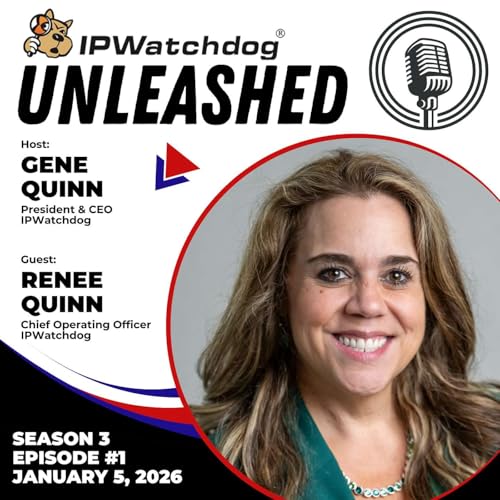
    This week on IPWatchdog Unleashed our host Gene Quinn, the founder of IPWatchdog is joined by the beautiful and talented Renee C. Quinn, his wife and business partner. Renee, a marketing and e-commerce expert, shares her journey into the world of intellectual property, her insights on doing business as a serial entrepreneur, and her stories from the past two decades as she and Gene built IPWatchdog into the media company it is today. We explore Renee's entry introduction to intellectual property, personal stories and business lessons. We discuss how like many innovators, she did not initially recognize her own creativity as “IP.” That realization came only after exposure—after seeing how problem-solving, tinkering, and practical ingenuity translate into protectable assets. And, yes, she is a patented inventor, she runs and monetizes IPWatchdog, and she is increasingly working in front of the curtain moderating panels and webinars. So, please join us for this special edition of IPWatchdog Unleashed.

    Visit us online at IPWatchdog.com.

    You can also visit our channels at YouTube, LinkedIn, X, Instagram and Facebook.
    Show More Show Less
    45 mins
  • 2025 in Focus: Voices, Ideas, and the Road Ahead
    Dec 29 2025

    Send us a text

    In this episode of IPWatchdog Unleashed we take a stroll down memory lane to look back on some of the conversations we had with guests during 2025 that were for one reason or another moments that stood out. This is not a "best o 2025" per se, and the pieces of conversations we pull together were not always chosen because they dealt with hard hitting substantive IP issues, although some do.

    We begin our journey through 2025 with our conversation with Judge John Holcomb, who is a federal district court judge for the Central District of California. Judge Holcomb was one of our keynote speakers at IPWatchdog LIVE 2025, where he and Gene had a fireside chat style conversation, which was our podcast episode for March 10, 2025. In the piece of our conversation selected Gene asked him about how he became a judge and specifically about how he got onto the radar of those advising the President who to nominate. Judge Holcomb also discusses his judicial philosophy, retelling the tale of three umpires chatting after a game.

    We also remember an emotional conversation with Sherry Knowles, a breast cancer survivor who talked with us about the journey of life saving drugs from lab to market. We talk with Henry Hadad about music, creativity and who is the greatest guitarist of all time. We cover what it means to be innovative with Patrick Kilbride, how intellectual property empowers with WIPO Director General Daren Tang, the shocking reasons why Americans pay more for pharmaceuticals with Corey Salsberg, the petitioner's perspective about what changes are being made to the PTAB with Scott McKeown, and the never ending fight against fakes, dupes and counterfeits with Gina Johnson.

    Visit us online at IPWatchdog.com.

    You can also visit our channels at YouTube, LinkedIn, X, Instagram and Facebook.

    Show More Show Less
    56 mins
  • Patent Reset: 2025’s Pivotal Moments and What Comes Next
    Dec 22 2025

    Send us a text

    2025 was punctuated by a structural reset for the U.S. patent system. What unfolded was not incremental reform, but a coordinated shift driven by leadership change, policy realignment, economic pressure, and accelerating adoption of AI—all converging to reshape how patents are examined, challenged, monetized, and managed. This week on IPWatchdog Unleashed we explore the biggest changes and trends that impacted the patent and innovation industry during 2025, with host Gene Quinn (IPWatchdog) and guest Fran Cruz (Juristat).

    At the center of this reset was new leadership at the United States Patent and Trademark Office, which acted as the catalyst for most of the downstream change. With a renewed mandate to reduce backlog, improve patent quality, and modernize operations, the agency moved decisively—putting speed, accountability, and strategic coherence front and center.

    One of the most consequential outcomes was the aggressive recalibration of post-grant proceedings at the Patent Trial and Appeal Board. The result has been a measurable shift away from IPRs. Patent owners gained leverage as challengers faced friction for the first time in years.

    At the same time, 2025 delivered the strongest pro-eligibility signals in over a decade. Through guidance updates, precedential decisions, examiner reminders, and MPEP revisions, the USPTO laid the groundwork for a more predictable and innovation-aligned approach to §101—particularly for software and AI-enabled inventions. While courts ultimately control the doctrine, the agency made clear it intends to examine inventions with an eye toward real-world utility.

    Economic realities also forced behavioral change. Significant USPTO fee increases—combined with corporate cost-cutting—pushed in-house teams to rethink portfolio strategy. The year saw sharper filing discipline, aggressive maintenance-fee pruning, fewer RCEs, and closer scrutiny of outside counsel spend. In-house teams became more data-driven, more prescriptive, and more strategic—reshaping firm-client dynamics in the process.

    Overlaying all of this was the rapid normalization of AI. The USPTO accelerated internal AI pilots to improve prior-art searching and examination efficiency, while practitioners increasingly adopted AI tools for drafting, searching, and analysis. What was experimental at the start of 2025 became table stakes by year-end. Firms and teams that failed to adapt are falling behind—and quickly.

    The year also surfaced tension points that will define the next phase: workforce and examiner culture shifts, changes to interview incentives, uncertainty around patent legislation, and renewed pressure on university patents and the Bayh-Dole Act framework. These unresolved issues signal that while the reset has begun, the system is still in motion.

    So, join us for a wide ranging conversation about the biggest moments of 2025 and what this likely means for the future.

    Visit us online at IPWatchdog.com.

    You can also visit our channels at YouTube, LinkedIn, X, Instagram and Facebook.

    Show More Show Less
    1 hr and 23 mins
  • 101 Crossroads: Can the USPTO Fix What the Courts and Congress Won’t?
    Dec 15 2025

    Send us a text

    This week on IPWatchdog Unleashed we present a three-way conversation about patent eligibility between Gene Quinn, the founder of IPWatchdog.com, and patent attorneys and IPWatchdog Advisory Committee members John Rogitz and Clint Mehall.

    Under Director John Squires, the Patent Office is attempting to restore discipline and structure to the Section 101 inquiry, with the office earlier this month having updated the Manual of Patent Examining Procedures (MPEP) in light of a recent decision by Squires in Ex parte Desjardins, where it was decided that improvements to the training of a machine learning technology were patent eligible. Thus, the Patent Office is emphasizing real-world technological improvements, requiring examiners to engage with the specification, and rejecting overbroad “abstract idea” characterizations—particularly for AI and machine-learning inventions.

    At the same time the Patent Office is taking action, the Federal Circuit continues to inject uncertainty into the system. The CAFC refuses to define the term “abstract idea,” they continue to decide patent eligibility matters without claim construction, and panel-dependent outcomes are the norm. This is not doctrinal confusion—it is a judicial choice that enables early case dismissal while undermining the patent statute and harming innovators.

    Bottom line that comes from this conversation is that the USPTO is moving in the right direction, but without meaningful judicial or legislative correction of Section 101, these reforms can only go so far. A patent system that cannot protect modern technology cannot sustain long-term innovation.

    Visit us online at IPWatchdog.com.

    You can also visit our channels at YouTube, LinkedIn, X, Instagram and Facebook.

    Show More Show Less
    58 mins
  • The Slow Death of AIA Trials: A Look at the PTO’s ‘One-and-Done’ Rule Package
    Dec 8 2025

    Send us a text

    On this episode of IPWatchdog Unleashed, Gene Quinn sits down with one of the leading PTAB practitioners and strategist Scott McKeown to unpack the USPTO’s controversial “one-and-done” PTAB rule package. With more than 10,000 comments filed and over 700 individual commenters weighing in, the proposal has become a flashpoint for questions that go way beyond discretionary denial and AIA trials.

    Gene and Scott drill down on what USPTO Director John Squires is actually trying to accomplish, why the Office is now wrapping aggressive policy changes in “fairness” rhetoric, why some view this proposed rules package to be an effort at de facto legislation, and why former Members of Congress who wrote the AIA are now publicly objecting to the rules package. They also flag the real-world impact on small and mid-size companies, the growing risk that the PREVAIL Act and PERA will now be dead on arrival, and what this latest PTAB fight tells us about a broken Congress, an overactive administrative state, and a patent system that simply can’t deliver quiet title.

    Visit us online at IPWatchdog.com.

    You can also visit our channels at YouTube, LinkedIn, X, Instagram and Facebook.

    Show More Show Less
    1 hr and 2 mins
  • Real Talk About Patent Practice, Passing the Patent Bar, AI and More
    Dec 1 2025

    Send us a text

    Join Gene Quinn and John White in this episode of IPWatchdog Unleashed as they delve into the intricacies of passing the Patent Bar and its latest updates. With over two decades of friendship and collaboration in the patent industry, Gene and John share personal anecdotes, discuss the shifting phases of the patent exam, and scrutinize the impact of artificial intelligence on the exam and exam preparation. They then pivot for the second half of the conversation to more broadly discuss AI and how it is being used, and perhaps how it should be used, in patent practice. They also explore the importance of staying current with legal changes, the shortcomings of relying on AI for legal accuracy, and provide valuable insights for both veteran practitioners and newcomers to the field. Tune in for an enriching conversation that combines professional expertise, personal experiences and that singular brand of humor Gene and John bring to the topic.

    Visit us online at IPWatchdog.com.

    You can also visit our channels at YouTube, LinkedIn, X, Instagram and Facebook.

    Show More Show Less
    54 mins