

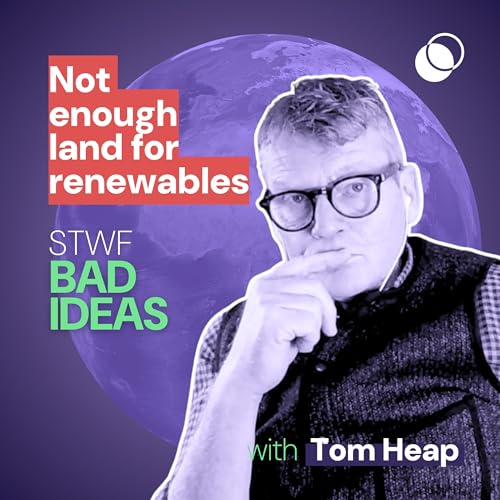
Bad Idea #42 "not enough land for renewables" with Tom Heap
Failed to add items
Add to cart failed.
Add to wishlist failed.
Remove from wishlist failed.
Follow podcast failed
Unfollow podcast failed

Bad Idea #42 "not enough land for renewables" with Tom Heap
-
Narrated by:
-
Written by:
About this listen
Is there really not enough land for renewables?
In this conversation, Mark Lynas sits down with Tom Heap—BBC Countryfile presenter, Radio 4's Rare Earth co-host, and author of Land Smart: How to Give People and Nature the Space to Thrive—to tackle one of the most important yet least discussed environmental issues: land use.
Heap makes the case that there's plenty of space for solar (and wind has minimal footprint), especially since solar excels at multifunctional use—combining with housing, car parks, farming, and floating on water bodies. The real land crisis? Livestock occupies a third of Earth's land and over half of agricultural land, delivering 6-16 times less protein per acre than crops. Meanwhile, biofuels require 50-100 times more land than solar for the same energy output, making aviation's biofuel dreams a land use nightmare.
But the conversation goes deeper: rewilding's evolution from absolutist vision to pragmatic spectrum, why regenerative farming must avoid yield penalties, and the troubling vibe shift in climate politics. Despite renewables now being cheaper than fossil fuels and China's coal use peaking, environmental issues have dropped down the political agenda. Heap argues we're in a trough, not permanent decline—but only if we keep talking about it and bust the myths that disempowers action.
🧠 Topics Discussed:
⚡ Land requirements for solar vs nuclear vs wind (solar is tiny, shareable)
🌾 Livestock's massive footprint: 1/3 of Earth's land, half of agricultural land
🌱 Biofuels disaster: 50-100x less efficient than solar per area
✈️ Aviation biofuels would require America's entire land area just for domestic flights
🐑 Sheep-wrecked hills: green deserts masquerading as countryside
🌿 Rewilding evolution: from absolutist to spectrum, avoiding food footprint export
🥩 Regenerative farming challenge: needs yield parity or risks overseas displacement
🧬 Gene editing progress: crops partnering with fungus for nitrogen, holy grail of nitrogen-fixing cereals
🇨🇳 Pakistan's grid death spiral: behind-the-meter solar boom crashing legacy infrastructure
🌍 Climate vibe shift: why environmental issues dropped off the agenda despite tech wins
📊 Pluralistic ignorance: 66% support climate action but think they're a minority (actually believe it's 40%)
🚗 Myth busting: rich countries driving less since 2005, renewables now cheaper, others ARE acting
⚖️ Slavery analogy: decades-long progressive fights face backlash during insecurity (French Revolution parallel to Ukraine war)
👨🏫 Guest Bio:
Tom Heap is a regular presenter on BBC One's Countryfile and co-presenter of Radio 4's Rare Earth. He's author of Land Smart: How to Give People and Nature the Space to Thrive and co-creator of the 39 Ways to Save the Planet podcast and book.
📚 Recommended Reading:
● Land Smart: How to Give People and Nature the Space to Thrive — Tom Heap ● 39 Ways to Save the Planet — Tom Heap & Dr. Tamsin Edwards ● Research on land use efficiency per energy type ● Studies on pluralistic ignorance in climate action
💬 Quote Highlights:
"We're moving to a world for the first time in human history where we can have more energy while burning less stuff." — Tom Heap
"To power inland flights of America on biofuels, you need the entire land area of America." — Tom Heap
"66% of people globally support climate action and would give 1% of income—but they believe they're a minority at 40%. This pluralistic ignorance is profoundly disempowering." — Tom Heap
"The fact that cleaner energy is now cheaper is a huge deal. That penny is just beginning to drop." — Tom Heap
🌐 About WePlanet:
WePlanet is a global citizen and science movement challenging bad ideas and championing evidence-based solutions for climate, nature, and human progress. Learn more at weplanet.org
📥 Join the Conversation
💬 Email: podcast@weplanet.org
📩 Subscribe: weplanet.org/podcast
👁️ Follow: @weplanetint