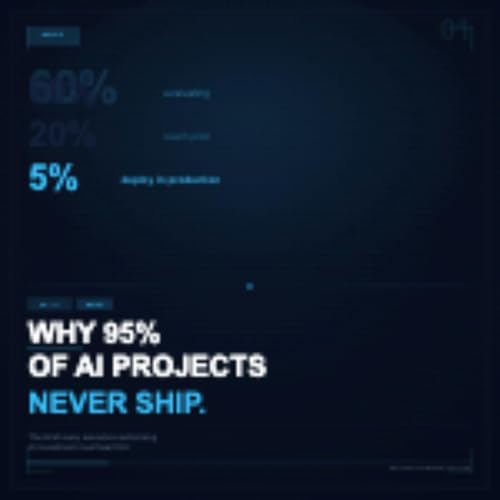
The 95 percent failure rate in enterprise AI deployment is not a headline. It is a diagnostic. And the diagnosis, examined in full technical and organisational depth, points to a specific set of conditions that are present in virtually every organisation that fails to cross the pilot-to-production threshold — and absent in virtually every organisation that does.
This deep dive is the most comprehensive episode in this series. It takes the structural argument developed in the earlier episodes and builds it into a complete framework: the specific architectural conditions that prevent production AI, the technical failures that emerge when AI is deployed without them, the organisational design patterns that characterise successful AI deployment, and the roadmap from where most enterprises currently are to where they need to be.
We begin with the data layer — the single most common cause of AI failure in production — examining the specific data quality conditions that reliable AI requires and the specific failure modes that emerge when those conditions are not present. We go deep on semantic decay, the phenomenon by which data moved out of its native ERP context loses the business logic that gives it meaning, and why this is the primary reason that AI systems built on data lake architectures consistently underperform AI systems built on zero-copy, in-context architectures.
We then examine the architectural patterns of successful AI implementations: the canonical data model that standardises enterprise financial data before any AI system acts on it; the Intelligence Hub — the exclusive AI integration point at which all agents connect, ensuring no model accesses data below the canonical layer; the governance framework that makes agentic AI accountable through cryptographically verifiable audit trails; and the event-driven infrastructure that enables real-time AI operation without synchronous coupling to ERP systems.
We address the organisational dimension in depth: the governance structures that allow agentic AI to operate safely, the human roles that remain essential in an automated AI environment — exception handling, parameter governance, escalation judgment — and the capability development that finance and technology teams need to govern rather than just use AI systems.
We close with the Internet of Agents — the distributed, specialised agent ecosystem that represents the mature destination of enterprise AI — and work backward from that destination to identify the specific investments in data architecture, governance infrastructure, and organisational capability that are required to reach it from where most organisations currently stand.
Keywords: enterprise AI production failure deep dive, why AI fails in production complete guide, enterprise AI data architecture requirements, semantic decay AI enterprise deep dive, zero copy AI architecture enterprise, canonical data model AI production, Intelligence Hub AI integration, Layer 4 exclusivity AI architecture, agentic AI governance enterprise, Internet of Agents enterprise finance, AI audit trail cryptographic, enterprise AI event driven architecture, AI production readiness checklist, enterprise AI organisational design, finance AI agents production, enterprise AI compounding advantage, AI from pilot to production complete
About the Host
Rıdvan Yiğit is the Founder & CEO of RTC Suite — the world's first Autonomous Compliance and Payment Intelligence platform, built natively on SAP BTP and operating across 80+ countries.
Connect with Rıdvan:
🔗 linkedin.com/in/yigitridvan✉
ridvan.yigit@rtcsuite.com
📞 +90 545 319 93 44
Learn more about RTC Suite:
🌐 rtcsuite.com


 21 mins
 22 mins
 15 mins
 2 mins