Episodes

  • Why Who You Are Affects How You Think
    Apr 22 2026

    “When people come to view attitudes and opinions towards, say, political policies or issues as relevant to their identities, they become more extreme in their attitudes,” says Christian Wheeler, the StrataCom Professor of Management and Professor of Marketing at Stanford Graduate School of Business. “I become more positive or negative towards an issue the moment it becomes relevant to who I view myself as being.”

    Wheeler’s research offers insight into our increasingly polarized politics. However, his work has also yielded ideas for bridging divisions — beginning with how we listen to each other and how we see the people we disagree with.

    The moment we see someone as an individual rather than a category, we become more likely to find common ground. “Instead of viewing you as a Democrat or a Republican, I can view you as an individual,” Wheeler recommends. “Anything that humanizes you and moves you away from this simple category will help me to view you as an individual and less as just an interchangeable member of a category.”

    How much do your opinions define who you are? Tell us more at ifthenpod@stanford.edu.


    Related Content:

    • Christian Wheeler faculty profile
    • In a Polarized World, an Open Mind Can Hurt Your Reputation
    • You May Not Be Who You Think You Are
    • Class Takeaways — How to Build Connection Through Better Listening


    Chapters:

    00:00:02 Tattoos, identity, & personal evolution

    00:03:26 Introduction

    00:03:59 Why identity matters

    00:04:56 Identity relevance & its implications

    00:08:03 Why openness to the other side gets punished

    00:10:57 Identities vs. opinions

    00:13:53 The power of individuation

    00:15:53 How to break the cycle of polarization

    00:19:41 Organizational applications

    00:23:26 Conclusion


    If/Then, from Stanford GSB, features conversations with faculty that explore how their research deepens our understanding of business and leadership.

    See Privacy Policy at https://art19.com/privacy and California Privacy Notice at https://art19.com/privacy#do-not-sell-my-info.

    Show More Show Less
    25 mins
  • The Paradox of Masculinity
    Apr 8 2026

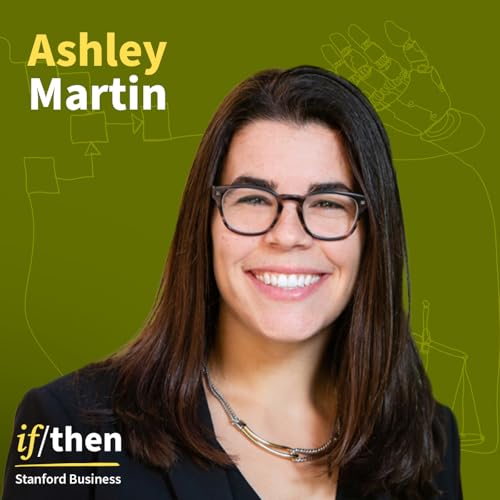
    “Masculinity is my new frontier,” says Ashley Martin, an associate professor of organizational behavior at Stanford Graduate School of Business. Martin, whose work examines why gender plays such a central role in how we perceive and make sense of others, has been looking at how traits associated with masculinity are simultaneously organizationally rewarded even as they’re personally harmful to men.

    “We spend a lot of time talking about gender inequality through the lens of women’s disadvantage,” she says. “I think that many of the problems that we’re seeing today… are actually bound up in masculinity.”

    What impact do you think masculinity and femininity have on our work and our world? Tell us more at ifthenpod@stanford.edu.


    Related Content:

    • Ashley Martin faculty profile
    • Is that Self-Driving Car a Boy or a Girl?
    • Why Taking Gender Out of the Equation Is So Difficult


    Chapters:

    00:00 How movies shape our ideas about masculinity

    04:02 Introduction

    05:15 How Ashley Martin got into studying gender

    05:58 When gender is removed from hiring

    07:10 The “pet rock” study

    10:35 The universal use of gender

    13:02 Gendering objects

    15:12 How masculinity affects men

    18:13 The current implications of Martin’s research

    20:41 What healthier models of masculinity might look like

    23:47 Ashley’s next frontier: masculinity, material culture, and social problems

    25:07 Conclusion


    If/Then, from Stanford GSB, features conversations with faculty that explore how their research deepens our understanding of business and leadership.

    See Privacy Policy at https://art19.com/privacy and California Privacy Notice at https://art19.com/privacy#do-not-sell-my-info.

    Show More Show Less
    27 mins
  • What We Actually Learn From Experience
    Mar 25 2026

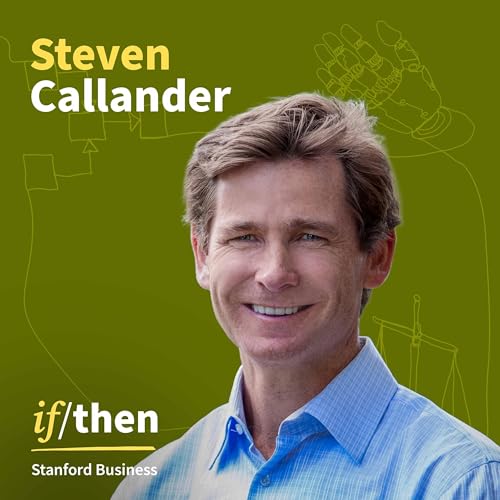
    Steven Callander has spent years building a mathematical framework to answer the question of how people learn from experience. “Here in Silicon Valley, the expression that you learn from failure is very widespread and very intuitive. But the question is… what do you learn? How do you optimally learn from that experience?”

    In this episode, Callander, the Herbert Hoover Professor of Public and Private Management and Professor of Political Economy at Stanford Graduate School of Business, explains the hidden, deceptively simple logic of correlated learning — and it may change how you think about finding the right job, the right market, or the right strategy.

    “It fascinates me and I can't stop thinking about it,” he says.

    Has theory made an impact on your life? Tell us more at ifthenpod@stanford.edu.


    Related Content:

    • Steven Callander faculty profile
    • How to Turn Old Ideas Into Creative Solutions to Modern Problems
    • What We’re Still Learning from Silicon Valley’s Bank Collapse


    Chapters:

    00:00 Ann Miura-Ko on learning and the search for patterns in Venture capital

    02:51 Introduction

    05:23 What is correlated learning?

    06:40 Where does this research apply in the real world?

    09:28 Brownian Motion

    12:45 Steven Callander’s Framework

    15:25 Examples of correlated learning when seeking expert advice

    20:53 Applying correlated learning

    23:57 Why correlated learning research?

    24:51 Conclusion


    If/Then, from Stanford GSB, features conversations with faculty that explore how their research deepens our understanding of business and leadership.

    See Privacy Policy at https://art19.com/privacy and California Privacy Notice at https://art19.com/privacy#do-not-sell-my-info.

    Show More Show Less
    26 mins
  • How Dating and Sports Explain the Job Market
    Mar 11 2026

    Seemingly unrelated activities — like taking a soccer penalty kick or crafting an online dating profile — involve an embedded economics.

    “Understanding and applying economic logic can be valuable in pretty much any job or any other endeavor in your life,” says Paul Oyer, a professor of economics at Stanford Graduate School of Business.

    On this episode, Oyer digs into the shared economic logic of online dating and the labor market, explains why pro athletes and sports fans think like economists, and explores how AI has reduced the beneficial friction that was once a part of job searches.

    Got a question about the economics of dating, sports, or the job market? Ask us at ifthenpod@stanford.edu.

    Related Content:

    • Paul Oyer faculty profile
    • Utility Player: Paul Oyer Explains How Economics Can Make Sports More Fun


    Chapters:

    00:00 Strategic decision-making in air traffic control

    03:06 Introduction

    03:27 Why sports are a useful lens for understanding economics

    09:53 Why economics matters far beyond money

    10:54 Economics & online

    14:36 Applications of game theory

    16:54 How AI is reshaping hiring and the labor market

    22:25 The labor market challenge economists still have not solved

    24:18 Conclusion

    If/Then, from Stanford GSB, features conversations with faculty that explore how their research deepens our understanding of business and leadership.

    See Privacy Policy at https://art19.com/privacy and California Privacy Notice at https://art19.com/privacy#do-not-sell-my-info.

    Show More Show Less
    25 mins
  • If/Then Returns: Season Three
    Mar 4 2026

    When should we leap instead of take the obvious next step? Why do we instinctively see gender everywhere? When do our opinions begin to feel less like ideas and more like our identity?

    If/Then, from Stanford Graduate School of Business, is back with a new season of sharp, surprising conversations that deepen our understanding of business and leadership.

    Each episode brings you into the room with a Stanford GSB faculty member as they discuss their research and how it challenges conventional wisdom, sharpens judgment, and reframes the way we approach complex decisions.

    Join us on Wednesdays for a new season of If/Then.

    What do you want to hear on If/Then? Email us at ifthenpod@stanford.edu.

    See Privacy Policy at https://art19.com/privacy and California Privacy Notice at https://art19.com/privacy#do-not-sell-my-info.

    Show More Show Less
    1 min
  • GSB at 100: "The Moment"
    Dec 22 2025

    This week on If/Then we’re sharing an episode of GSB at 100, a limited audio series created especially for Stanford Graduate School of Business’s Centennial. GSB at 100 presents a scrapbook of memories, ideas, and breakthroughs as Stanford GSB celebrates its first century and looks around the corner to what the next 100 years may hold.

    On this episode of GSB at 100, you’ll experience Centennial Day, hear Dean Sarah A. Soule honor the past, celebrate the present, and look to what the future may hold. GSB at 100 depicts a school defined not only by its innovation and impact, but by its people: curious students, devoted faculty, and accomplished staff — a community of thinkers, dreamers, and doers.


    Learn more about the Stanford GSB Centennial

    See Privacy Policy at https://art19.com/privacy and California Privacy Notice at https://art19.com/privacy#do-not-sell-my-info.

    Show More Show Less
    29 mins
  • GSB at 100: "The Experience"
    Nov 26 2025

    This week on If/Then we’re sharing an episode of GSB at 100, a limited audio series created especially for Stanford Graduate School of Business’s Centennial. GSB at 100 presents a scrapbook of memories, ideas, and breakthroughs as Stanford GSB celebrates its first century and looks around the corner to what the next 100 years may hold.


    On this episode of GSB at 100, you’ll step inside the classrooms where teaching sparks transformation.


    Learn more about the Stanford GSB Centennial

    See Privacy Policy at https://art19.com/privacy and California Privacy Notice at https://art19.com/privacy#do-not-sell-my-info.

    Show More Show Less
    29 mins
  • GSB at 100: "The Spirit"
    Nov 12 2025

    This week on [If/Then or View From The Top] we’re sharing an episode of GSB at 100, a limited audio series created especially for Stanford Graduate School of Business’s Centennial. GSB at 100 presents a scrapbook of memories, ideas, and breakthroughs as Stanford GSB celebrates its first century and looks around the corner to what the next 100 years may hold.


    On this episode of GSB at 100, you’ll hear from the dedicated and accomplished staff members who work behind the scenes to make Stanford GSB a community unlike anywhere else in the world.


    Learn more about the Stanford GSB Centennial

    See Privacy Policy at https://art19.com/privacy and California Privacy Notice at https://art19.com/privacy#do-not-sell-my-info.

    Show More Show Less
    25 mins