Impact Newswire cover art

Impact Newswire

Impact Newswire

Written by: Impact Newswire
Listen for free

About this listen

The world moves fast. Too fast.

Crises trend for a moment… then disappear. Headlines fade. Attention shifts. But the people living those realities? They don’t get to scroll past.

The Fading Causes Podcast by Impact Newswire is where forgotten stories come back to life.

Hosted by global humanitarian Mukesh Kapila, this podcast goes beyond the noise to uncover the issues the world has stopped talking about — from silent humanitarian crises to overlooked injustices shaping millions of lives.

Each episode brings you raw, unfiltered conversations with frontline voices, changemakers, and global thinkers who are fighting battles long after the spotlight has moved on.

This isn’t just another podcast.

It’s a wake-up call.

Because what fades from the headlines should never fade from humanity.

New episodes. Real stories. Global impact.

Follow @Impact.newswire and visit www.impactnews-wire.com.

Copyright 2021 Impact Newswire
Politics & Government
Episodes
  • How Did Rape Become a Weapon of War in Sudan with Rahmet Elfikhi - Fading Causes with Mukesh Kapila
    Apr 6 2026

    In this episode, Rahmet Elfikhi exposes one of the most brutal realities of Sudan’s war: rape not as a byproduct of conflict, but as a deliberate, systematic weapon.


    Her documentary, Land of Victims, forces into the open what is often hidden behind statistics and diplomatic language—survivors’ voices. Women, men, and children recount acts of violence carried out with chilling normalcy, in a conflict where the human body has become a battlefield. These are not isolated crimes. They are patterns.


    The conversation confronts uncomfortable truths. Why is sexual violence so pervasive in Sudan’s war? How do stigma and culture silence survivors while shielding perpetrators? And why have global institutions, designed to prevent such atrocities, repeatedly failed to act?


    Elfikhi also reveals the cost of telling these stories—the fear, the ethical dilemmas, and the emotional toll of documenting trauma at close range. Yet, amid the horror, there is defiance. Survivors speak, often at great personal risk, refusing to be erased.

    Show More Show Less
    41 mins
  • Fading Causes with Mukesh Kapila - How Honest is the Global Humanitarian Lottery? with Thomas Byrnes
    Mar 25 2026

    EPISODE 17: How Honest is the Global Humanitarian Lottery? with Thomas Byrnes


    In a world where crises seem endless and compassion sometimes feels exhausted, what does humanitarianism really mean today? In this episode, you may feel weary of hearing humanitarians lament funding shortages, but is the real story less about how much money exists and more about how the system chooses to use it? And if fatigue has set in, what truths have we stopped questioning?


    The conversation turns to the financial architecture behind humanitarian action, a subject that quietly determines who gets help and who is left waiting. Host Mukesh Kapila speaks with Thomas Byrnes, a sharp observer and insider who has witnessed the machinery of aid up close. Is the humanitarian system broken, or is it functioning exactly as designed? And if the structure itself drives the outcomes, what does that mean for the millions whose survival depends on it?


    From exchange rate losses in conflict zones to agencies competing for the same pool of funds, Byrnes has seen how incentives shape decisions that can carry life or death consequences. When organizations speak the language of collaboration but operate in a zero-sum environment, can true partnership exist? Has humanitarianism expanded so far beyond its original life-saving mandate that it now struggles to define its own boundaries? And when rhetoric and reality diverge, who holds the system accountable?


    As wars intensify, disasters multiply, and resources tighten, difficult choices are no longer theoretical, they are operational. Who decides which crises are prioritized and which are quietly sidelined? Are we measuring real human need, or merely what the system believes it can afford to address? And perhaps the most unsettling question of all: if the money exists globally, is humanitarian aid treated as a moral obligation or simply an optional act of generosity?

    Show More Show Less
    49 mins
  • Fading Causes with Mukesh Kapila - Is Democracy Still Worth Defending? with Francesc Badia Dalmases
    Mar 25 2026

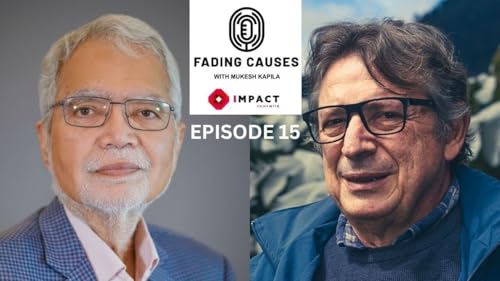
    EPISODE 15: Is Democracy Still Worth Defending? with Francesc Badia Dalmases


    If only 7 percent of the world lives in a full democracy, is the model already failing? Is this model still worth defending if it cannot deliver justice, equality, and survival?


    In this episode of Fading Causes, Mukesh Kapila sits down with veteran journalist Francesc Badia Dalmases to examine what happens when global crises slip from the headlines, not because they are resolved, but because the world has grown tired of looking at them.


    Francesc has spent decades reporting from places where history rarely announces itself with a clear ending. Wars cool rather than conclude; humanitarian emergencies become permanent backdrops. Together, they trace how conflicts are reframed, downgraded, or quietly abandoned by international media and policymakers alike. When suffering becomes routine, does it cease to be news? And who decides when a crisis has outlived its moment?


    What remains unresolved is whether AI will hollow out democratic agency or, paradoxically, force its reinvention. The Gen Z uprisings from Nairobi to Dhaka, from Belgrade to Seoul, may signal not the death of democracy, but a refusal to inherit one that feels rigged, remote and unresponsive. If technology is rewriting how power is contested, will democracy adapt, or will it be outpaced by the very generation meant to save it?

    Show More Show Less
    45 mins
adbl_web_anon_alc_button_suppression_c
No reviews yet