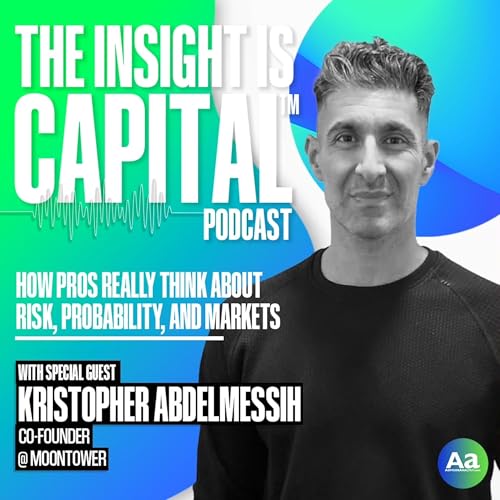
Insight is Capital™ Podcast cover art

Insight is Capital™ Podcast

Insight is Capital™ Podcast

Written by: AdvisorAnalyst.com
Listen for free

About this listen

The official podcast of AdvisorAnalyst.com, publisher of actionable market and investment insight, commentary, analysis and practice management for investment professionals and investors.2016-2024 AdvisorAnalyst.com | All rights reserved. Economics Leadership Management & Leadership Personal Finance Politics & Government
Episodes
  • Why Millions of Canadians Never Make it to Financial Advice
    Jan 9 2026
    In this episode of Insight Is Capital, host Pierre Daillie sits down with Mélanie Valcin, President and CEO of United for Literacy, and Matthew Latimer, Executive Director of the Federation of Independent Dealers, for a powerful conversation at the intersection of literacy, financial advice, and economic inclusion.Together, they unpack a sobering reality: one in five working-age Canadians struggles with basic literacy, a barrier that quietly cascades into poor financial outcomes, limited access to advice, workforce stagnation, and rising social costs. Valcin shares on-the-ground stories from communities across Canada—food banks, mining towns, and correctional facilities—illustrating how targeted, trust-based literacy programs can rapidly transform lives. Latimer brings the financial lens, explaining how low financial literacy leaves Canadians vulnerable to costly mistakes, scams, and long-term retirement risk, while also constraining the reach and effectiveness of professional financial advice.The conversation makes a compelling case that literacy—reading, digital, and financial—is not a “soft” social issue, but core economic infrastructure, and argues for a coordinated national strategy that brings together government, educators, industry, and financial advisors themselves.3 Key Takeaways• Literacy Is Economic Infrastructure Improving literacy by just 1% could add $60–$90 billion to Canada’s GDP, while simultaneously reducing pressure on social services and the justice system.• Financial Literacy Gaps Lock People Out of Advice Fewer than two-thirds of Canadians can answer basic questions about interest, inflation, or diversification—leaving millions unable to engage confidently with advisors, savings tools, or retirement planning.• Local, Human-Centered Solutions Work Literacy programs succeed when they meet people where they are—community centers, workplaces, food banks—and when advisors and professionals use clear language instead of jargon.Chapters00:00 – Why Literacy Is Canada’s Hidden Economic Crisis Pierre sets the stage: literacy as a foundation for financial and social participation.02:20 – Meet the Guests: Literacy and Financial Advice Collide Introductions to Mélanie Valcin and Matthew Latimer.05:20 – One in Five Canadians Can’t Read at a Functional Level The scale of the problem—and why it’s getting worse.12:40 – How Community-Based Literacy Programs Change Lives Real-world examples from food banks and workplaces.15:10 – A Mining Town Story: Literacy as Career Mobility How six weeks of digital literacy unlocked advancement.21:00 – Literacy, Incarceration, and Systemic Inequality Why access—not effort—is often the missing link.29:50 – Financial Literacy: The Cost of Not Understanding Money RRSPs, TFSAs, and the silent damage of confusion.33:30 – Scams, AI, and the Rising Risk to Retirement Security Why low literacy magnifies modern financial threats.40:30 – Clear Language and the Role of Advisors How advisors can bridge the gap through education and outreach.45:15 – A Call to Action: National Strategy & Community Involvement Why Canada needs a coordinated literacy push—now.#FinancialLiteracy #LiteracyMatters #AccessToAdvice #CanadianEconomy #InvestorEducation #FinancialInclusion #RetirementPlanning #ClearLanguage #EconomicOpportunity #InsightIsCapital
    Show More Show Less
    50 mins
  • How Pros Really Think About Risk, Probability, and Markets with Kris Abdelmessih
    Dec 29 2025

    In this wide-ranging and intellectually rich conversation, host Pierre Daillie sits down with veteran options trader, market maker, and probabilistic thinker Kris Abdelmessih for a deep exploration of how markets really work beneath the surface—and how investors can think more clearly in a world dominated by uncertainty, noise, and emotion. Drawing on more than two decades of experience spanning Susquehanna International Group, proprietary commodity trading, and portfolio management at Parallax, Abdelmessih explains why options markets reveal truths that stock prices alone cannot, how poker shaped his understanding of risk and decision-making, and why probabilistic thinking—not prediction—separates professionals from amateurs. The discussion moves seamlessly from trading pits and market structure to behavioral bias, prediction markets, volatility, and education, culminating in a thoughtful explanation of Moontower, Abdelmessih’s platform designed to help investors understand whether options are cheap, expensive, or inappropriate for a given thesis. This episode is less about “what to buy” and more about how to think—about risk, information, and the difference between being right and making money.

    🔑 Three Key Takeaways1️⃣ Options Markets Are the True Information Market

    Stock prices are two-dimensional snapshots. Options markets, by contrast, embed the market’s full probability distribution—revealing not just where investors think prices may go, but how violently and under what conditions. This makes options markets a powerful lens for understanding hidden risks and asymmetric outcomes.

    2️⃣ Good Decisions Can Still Lose—And That’s the Point

    Drawing parallels between poker and trading, Abdelmessih emphasizes that outcomes are noisy, even when decisions are sound. Professionals focus on expected value, risk sizing, and repeatability, not short-term wins or losses. This mindset is critical for surviving low-signal environments like financial markets.

    3️⃣ Prediction Markets and Volatility Thinking Will Matter More

    Markets aggregate information better than opinions. From CEO resignations to geopolitical outcomes, prices often reveal consensus faster—and more accurately—than pundits. Understanding volatility, probability, and conditional outcomes will become increasingly important as prediction markets and derivatives continue to evolve. ⏱️ Timestamped Chapters

    01:15 – Kris Abdelmessih’s career path: SIG, commodities, Parallax

    05:10 – From Cornell to trading floors: curiosity as a career catalyst

    24:30 – Poker, probability, and Bayesian thinking at Susquehanna

    29:20 – Why being “right” doesn’t matter in markets

    37:00 – Market making vs. portfolio management: different risk shapes

    43:00 – Trading oil, gas, and the chaos of pit trading

    48:00 – Why specialization is both powerful and dangerous

    58:30 – What Moontower is—and why most investors misuse options

    1:02:00 – How options reveal hidden distributions in stock prices

    1:08:00 – Prediction markets, truth, and market-based consensus

    More on Kris Abdelmessih

    Kris Abdelmessih on Linkedin - https://www.linkedin.com/in/kristopher-abdelmessih-63b1b1/

    Moontower.ai - https://www.moontower.ai/

    Moontower Substack - https://moontower.substack.com/

    #OptionsTrading#MarketStructure#ProbabilisticThinking#Volatility#RiskManagement#BehavioralFinance#PredictionMarkets#InvestingMindset#FinancialEducation#InsightIsCapital

    Show More Show Less
    1 hr and 23 mins
  • AGF's David Stonehouse: A Narrower Path Forward for Markets in 2026
    Dec 22 2025

    In this episode of Insight Is Capital, host Pierre Daillie sits down with David Stonehouse, Interim CIO and Head of North American Specialty Investments at AGF Investments, for a wide-ranging but grounded discussion on what lies ahead for investors as the cycle matures.

    Stonehouse frames 2026 as a constructive but narrower environment—one supported by global monetary easing, rising fiscal stimulus, and resilient earnings growth, yet constrained by elevated valuations, softer labor markets, and geopolitical uncertainty. The conversation carefully unpacks how tariffs have shifted from an economic “earthquake” to a lingering aftershock, why inflation fears may be overstated near-term, and how investors can think about regional diversification beyond a heavily concentrated U.S. market.

    Rather than offering bold predictions, the discussion emphasizes flexibility, balance, and readiness—highlighting why equal-weight equity exposure, selective credit, emerging markets, and a strategic cash buffer may matter more than ever as uncertainty rises but opportunity persists.

    🔑 3 Key Takeaways

    • 2026 looks constructive—but with less room for error. Global easing cycles, fiscal stimulus, deregulation, and healthy earnings support risk assets, but elevated valuations and optimistic sentiment increase vulnerability to shocks.
    • Tariffs are no longer a shock, but still a drag. The biggest tariff surprise is behind us; clarity—not resolution—matters most now, allowing businesses and consumers to adapt even as trade frictions persist.
    • Diversification and optionality matter more than conviction. With U.S. equities richly valued after a long run, Stonehouse sees relative opportunity in emerging markets, Japan, and potentially Canada—while cash provides flexibility if volatility returns.

    ⏱️ Timestamped Chapters

    • 00:00 – Markets heading into 2026: momentum with less margin for error

    • 02:00 – David Stonehouse’s career path and investment philosophy

    • 03:00 – The six macro tailwinds shaping 2026

    • 08:00 – Tariffs: from economic earthquake to manageable aftershocks

    • 12:00 – Labor markets, immigration, AI, and the “no-hire, no-fire” economy

    • 17:00 – Fiscal stimulus, affordability pressures, and the K-shaped economy

    • 22:00 – Central banks, bond markets, and the myth of ‘new QE’

    • 31:00 – Inflation, disinflation, and long-term yield risks

    • 38:00 – Why equities can still rise—but valuations matter

    • 43:00 – Regional opportunities: U.S., Canada, emerging markets, Japan

    • 52:00 – Portfolio positioning: equities, fixed income, credit, and cash

    • 55:00 – Final thoughts on risk, resilience, and flexibility

    #InsightIsCapital #MarketOutlook2026 #MacroInvesting #PortfolioStrategy #AGFInvestments #DavidStonehouse #CentralBanks #TariffsAndTrade #EquityMarkets #FixedIncome #EmergingMarkets #AdvisorInsights

    Copyright © AdvisorAnalyst

    Show More Show Less
    56 mins
No reviews yet