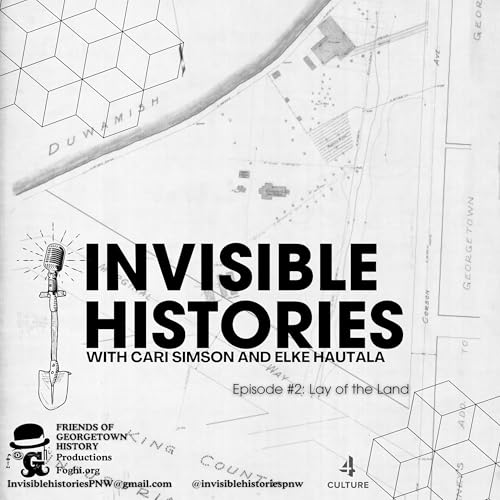
Invisible Histories cover art

Invisible Histories

Invisible Histories

Written by: Cari Simson Elke Hautala
Listen for free

About this listen

The Invisible Histories podcast unearths lost Pacifc NW stories, hidden histories, and forgotten places, and viscerally connects the public to experiences from the past. The monthly episodes unearth some cool, creepy and hopefully meaningful connections for people alive today.


www.invisible-histories.com


Read our latest newsletter!


Our Instagram account shares images from each episode, @invisiblehistoriesPNW


We are always looking for “invisible histories” of the Pacific NW so if you have a good story idea please reach out at invisiblehistoriespnw@gmail.com.


Recorded at Works Progress Cooperative www.worksprogress.coop


Edited by Elke Hautala


Listen Notes


2025

Hosted on Acast. See acast.com/privacy for more information.

Cari Simson Elke Hautala
Social Sciences True Crime World
Episodes
  • Introducing "Invisible Histories"
    Dec 29 2023

    Welcome to “Invisible Histories” exploring Seattle’s lost stories. In this podcast we explore lost stories of marginalized people, hidden histories of forgotten places, and generally unearth some cool, creepy and hopefully meaningful connections for people living and working in the Seattle area and beyond.


    In our first series we explore the ‘lost’ Potter’s Field, a cemetery established in 1876 on land next to the King County Poor Farm and Hospital in what is now the Georgetown neighborhood. In just over 30 years over 3,260 people were buried there; people who due to lack of money, family or other connections had nowhere else to go when they died. In 1912 the Army Corps of Engineers embarked on the ambitious “Duwamish Canal,” turning the river’s meandering curves into a 5-mile shipping channel and turning “useless mudflats” into industrial land. The Duwamish Cemetery aka “Potter’s Field” was erased from maps and memories, covered with industrial businesses and all 3260 human remains were exhumed and cremated. Find out about who was buried there and what happened to their ashes.


    Subscribe and keep listening wherever you get your podcasts.

    Check out our landing page

    Our Instagram account will share images from each episode, @invisiblehistoriesPNW


    We are always looking for “invisible histories” of the Pacific NW so if you have a good story idea please reach out at invisiblehistoriespnw@gmail.com.

    Our podcast music is from Samuel Coleridge Taylor's (1875 - 1912) Funeral March, Op. 79 Nº 3 (from Othello, Incidental Music)

    Recorded at Works Progress Cooperative www.worksprogress.coop

    Edited by Elke Hautala

    2023

    Cari Simson and Elke Hautala formed Invisible Histories to visually and viscerally connect the public to experiences from the past. Their Invisible Histories podcast unearths diverse local stories and forgotten places. www.invisible-histories.com

    Hosted on Acast. See acast.com/privacy for more information.

    Show More Show Less
    3 mins
  • Unearthing the "Lost" Potter's Field
    Jan 2 2024
    Hello -- and welcome to “Invisible Histories” exploring Seattle’s lost stories, with Cari and Elke - Episode #1In this podcast we explore lost stories of marginalized people, hidden histories of forgotten places, and generally unearth some cool, creepy and hopefully meaningful connections for people living and working in the Seattle area and beyond. In our first series we explore the ‘lost’ Potter’s Field, also known as the Duwamish Cemetery established in 1876 on land next to the King County Poor Farm and Hospital in what is now the Georgetown neighborhood. In just over 30 years over 3,260 people were buried there; people who due to lack of money, family or other connections had nowhere else to go when they died. In 1912 the Army Corps of Engineers embarked on the ambitious “Duwamish Canal,” turning the river’s meandering curves into a 5-mile shipping channel and turning “useless mudflats” into industrial land. The Duwamish Cemetery aka “Potter’s Field” was erased from maps and memories, all 3260 human remains were exhumed and cremated, and covered with industrial businesses .In Episode #1 Elke and Cari share their research experiences, and why this story of finding the lost cemetery is connected to many aspects of Seattle's growth and development.Subscribe and keep listening where you get your podcastsRead our latest newsletter!Show notes at Our landing page Our Instagram account will share images from each episode, @invisiblehistoriesPNWWe are always looking for “invisible histories” of the Pacific NW; please reach out at invisiblehistoriespnw@gmail.com.Our podcast music is from Samuel Coleridge Taylor's (1875 - 1912) Funeral March, Op. 79 Nº 3 (from Othello, Incidental Music)Recorded at Works Progress CooperativeEdited by Elke Hautala2023Resources:Friends of Georgetown History: www.foghi.orgHistoryLink article about GeorgetownKing County Archives: https://kingcounty.gov/en/legacy/depts/records-licensing/archives4Culture: https://www.4culture.org/ King5 Evening's coverage of the Potter's Field: https://www.king5.com/article/entertainment/television/programs/evening/seattle-georgetown-cemetery-mystery-missing-bodies-remains-graves/281-4a5f7ebf-c596-4ab8-8c22-54727e5af11fPaul Dorpat - Seattle Waterfront historyhttps://pauldorpat.com/2009/07/09/seattle-waterfront-history-chapter-7/Cari Simson and Elke Hautala formed Invisible Histories to visually and viscerally connect the public to experiences from the past. Their Invisible Histories podcast unearths diverse local stories and forgotten places. www.invisible-histories.com Hosted on Acast. See acast.com/privacy for more information.
    Show More Show Less
    44 mins
  • Lay of the Land
    Jan 3 2024
    Welcome to Invisible Histories - Episode #2In this podcast we explore lost stories of marginalized people, hidden histories of forgotten places, and generally unearth some cool, creepy and hopefully meaningful connections for people living and working in the Seattle area and beyond. In this episode we go way back in time, to share the perspective of a character that rarely gets to tell its story — the land itself — how the cemetery removal was an example of forced industrialization and this progress at all costs mentality; contextualizing the land in Georgetown, and the existing death and burial practices of the time, as well as how there was an evolution of infrastructure as Seattle became what we like to think of as modern city in the early 1900s.Unearth the history of the land around the Potter’s Field with us and explore a glimpse of the old Seattle. This formerly out-of-the-way place that held the dead from the early days of Washington Territory up through Statehood in 1887, was erased from maps and memories as Seattle entered the Modern era.Featuring Elizabeth Davis PhD and music by Kevin MacLeod in a special introduction.Subscribe and keep listening wherever you get your podcasts.Read our latest newsletter!Check out our landing pageOur Instagram account will share images from each episode, @invisiblehistoriesPNWWe are always looking for “invisible histories” of the Pacific NW so if you have a good story idea please reach out at invisiblehistoriespnw@gmail.com.Our podcast music is from Samuel Coleridge Taylor's (1875 - 1912) Funeral March, Op. 79 Nº 3 (from Othello, Incidental Music)Recorded at Works Progress Cooperative www.worksprogress.coopEdited by Elke Hautala2023Resources:Elizabeth Davis, PhD: https://ess.uw.edu/people/elizabeth-davis/Samuel Coleridge Taylor: (1875 - 1912) Funeral March, Op. 79 Nº 3 (from Othello, Incidental Music) https://en.wikipedia.org/wiki/Samuel_Coleridge-Taylor RH Thompson: https://en.wikipedia.org/wiki/Reginald_H._Thomson The King County Indigent Remains program https://kingcounty.gov/en/dept/dph/health-safety/medical-examiner/indigent-remains-program The King County Medical Examiner's Office unidentified remains. https://kingcounty.gov/en/dept/dph/health-safety/medical-examiner/unidentified-remains Cari Simson and Elke Hautala formed Invisible Histories to visually and viscerally connect the public to experiences from the past. Their Invisible Histories podcast unearths diverse local stories and forgotten places. www.invisible-histories.com Hosted on Acast. See acast.com/privacy for more information.
    Show More Show Less
    1 hr and 3 mins
No reviews yet