• APEX Express – 1.22.26 – What Is Community Safety?
    Jan 22 2026
    APEX Express is a weekly magazine-style radio show featuring the voices and stories of Asians and Pacific Islanders from all corners of our community. The show is produced by a collective of media makers, deejays, and activists. On this episode, host Miata Tan speaks with three guests from the Coalition for Community Safety and Justice (CCSJ), a leading community-based resource providing direct victim services for Asian Americans in San Francisco. They unpack CCSJ’s approach to policy change, community advocacy, and public education, and reveal how their Collective Knowledge Base Catalog captures lessons from their work. Important Links: Community Safety and Justice (CCSJ) CCSJ Collective Knowledge Base Catalog CCSJ‘s four founding partners are the Chinatown Community Development Center, Chinese for Affirmative Action, Chinese Progressive Association, and Community Youth Center. Transcript: [00:00:00] Miata Tan: Hello and welcome. You are tuning into APEX Express, a weekly radio show, uplifting the voices and stories of Asian Americans. I am your host, Miata Tan, and today we are focusing on community safety. The Coalition for Community Safety and Justice, also known as CCSJ, is the leading community-based resource in providing direct victim [00:01:00] services for Asian Americans in San Francisco. The four founding partners of the Coalition are Chinatown Community Development Center, Chinese for Affirmative Action, Chinese Progressive Association, and the Community Youth Center. You might have heard of some of these orgs. Today we are joined by three incredibly hardworking individuals who are shaping this work. First up is Janice Li, the Coalition Director. Here she is unpacking the history of the Coalition for Community Safety and Justice, and the social moment in which it was formed in response to. Janice Li: Yeah, so we formed in 2019 and it was at a time where we were seeing a lot of high profile incidents impacting and harming our Asian American communities, particularly Chinese seniors. We were seeing it across the country due to rhetoric of the Trump administration at that time that was just throwing, oil onto fire and fanning the flames. [00:02:00] And we were seeing those high profile incidents right here in San Francisco. And the story I’ve been told, because I, I joined CCSJ as its Coalition Director in 2022, so it says a few years before I joined. But the story I’ve been told is that the Executive Directors, the staff at each of these four organizations, they kept seeing each other. At vigils and protests and rallies, and it was a lot of outpouring of community emotions and feelings after these high profile incidents. And the eds were like. It’s good that we’re seeing each other and coming together at these things, but like, what are we doing? How are we changing the material conditions of our communities? How are we using our history and our experience and the communities that we’ve been a part of for literally decades and making our communities safe and doing something that is more resilient than just. The immediate reactive responses that we often know happen [00:03:00] when there are incidents like this. Miata Tan: And when you say incidents could you speak to that a little bit more? Janice Li: Yeah. So there were, uh, some of the high profile incidents included a Chinese senior woman who was waiting for a bus at a MUNI stop who was just randomly attacked. And, there were scenes of her. Fighting back. And then I think that had become a real symbol of Asians rejecting that hate. And the violence that they were seeing. You know, at the same time we were seeing the spa shootings in Atlanta where there were, a number of Southeast Asian women. Killed in just completely senseless, uh, violence. And then, uh, we are seeing other, similar sort of high profile random incidents where Chinese seniors often where the victims whether harmed, or even killed in those incident. And we are all just trying to make sense of. What is happening? [00:04:00] And how do we help our communities heal first and foremost? It is hard to make sense of violence and also figure out how we stop it from happening, but how we do it in a way that is expansive and focused on making all of our communities better. Because the ways that we stop harm cannot be punitive for other individuals or other communities. And so I think that’s always been what’s really important for CCSJ is to have what we call a holistic view of community safety. Miata Tan: Now you might be wondering, what does a holistic view and approach to community safety look like in practice? From active policy campaigns to direct victim service support, the Coalition for Community Safety and Justice offers a range of different programs. Janice Li, the Coalition Director, categorizes this work into three different [00:05:00] buckets. Janice Li: It is responding to harm when it occurs, and that’s, you know, really centering victims ...
    Show More Show Less
    1 hr
  • APEX Express – 1.15.26 – Chat with Authors
    Jan 15 2026
    A weekly magazine-style radio show featuring the voices and stories of Asians and Pacific Islanders from all corners of our community. The show is produced by a collective of media makers, deejays, and activists. Tonight’s Host Miko Lee speaks with authors who have used their personal lives to tell their stories. They both talk and write about trauma, joy and resilience but in two very different ways. First up she chats with Chanel Miller. Many folx might know of Chanel’s best selling first book Know My Name which expands on the powerful victim impact letter she wrote to Brock Turner who brutally sexually assaulted her on the Stanford Campus. We talk about her latest work – two delightful books for young people. Then Miko talks with Kazu Haga who weaves his spiritual practice and trauma healing with a deep lineage of nonviolent social change. In his books, Fierce Vulnerability and Healing Resistance he shares with us his personal journey and offers some insightful visions for our current tumultuous world. Links to the Author’s work: Kazu Haga  Fierce Vulnerability Kinship Lab, Chanel Miller Chanel Miller The Moon Without Stars Purchase Chanel’s books at East Wind Books and Kazu’s books at Parallax Press SHOW TRANSCRIPT APEX Opening: Apex Express. Asian Pacific Expression. Community and cultural coverage. Music and calendar. New visions and voices. Coming to you with an Asian Pacific Islander point of view. It’s time to get on board the Apex Express. Miko Lee: Good evening. Welcome to apex express. This is your host, Miko Lee. Join us as you hop along the apex express. Tonight I speak with authors who have used their personal lives to tell their stories. They both talk and write about trauma, joy, and resilience, but in two very different and distinct ways. First up, I chat with Chanel Miller. Many folks might know of Chanel’s bestselling first book Know My Name, which expands on the powerful victim impact letter she wrote to Brock Turner, who brutally sexually assaulted her on the Stanford campus. But tonight we talk about her latest work, two delightful books for young people. And then I talk with Kazu Haga, who weaves his spiritual practice and trauma healing with a deep lineage of nonviolent social change. In his books Fierce vulnerability and Healing Resistance, he shares with us his personal journey and offers some insightful visions for our current tumultuous world. First off, listen to my conversation with Chanel Miller. Welcome, author Chanel Miller to Apex Express. Chanel Miller: Thank you so much for having me. It’s a delight to be here with you. Miko Lee: I’m really excited to talk to you, and I wanna start with my first question, which I ask all of my guests, which is, who are your people and what legacy do you carry with you? Chanel Miller: Oh, I have so many people. Today, you’re my people who continue to help guide me forward. I grew up in the Bay Area and I feel like honestly all of my books are attempts at saying thank you to the people who raised me, the English teachers in my public schools. For helping me stay aligned with myself and never letting me drift too far. And so even though I tell very different stories for different demographics, I think if you look at the root of everything that I write, it’s gratitude because they are the people who protected my voice in the first place. Miko Lee: Thank you so much. So we’re talking about your third book. Your first book was amazing. Know my name, which is really powerful memoir about surviving sexual assault at Stanford, and this incredible public reclamation of your voice. And then you move from that very personal, internal, very adult work to your second book, which was so lovely and sweet. Magnolia Woo unfolds it all, which was an illustrated book set New York about a little girl and her friend who reunite people with their lost socks. From this all the way to this young person’s book and your latest book, the Moon Without Stars, your second, YA novel is based in middle school. So talk to me a little bit about this journey from personal memoir to elementary school to middle school books. Chanel Miller: Yeah, so like you said, the first book was so internal and gutting to write. I knew I needed. Something that would help me breathe a little easier and get in touch with playfulness again. I wrote Magnolia Woo Unfolds it all. It’s perfect for kids ages seven to 12. My goal was just to enjoy the process of writing and story making. And it was confusing because I thought if I’m not, you know, during the memoir, I would be like crying while I was writing and it was just taking everything out of me. And I was like, if I’m not actively upset. Is the writing even good? Like, like, you know, does it count? And it turns out, yes, you can still create successful stories and have a good time. So I did that book for myself really. And the kid in me who always wanted to, who was always, writing stories ...
    Show More Show Less
    1 hr
  • APEX Express – 1.08.26 – Magical Realism and AAPI Short Films
    Jan 8 2026
    Think about the histories of your family or memories from your past. What if you recounted them with a dash of magic? What happens when we infuse our stories on film with some magical realism? Tonight’s edition of APEX Express features three filmmakers who created magical realism short films centering AAPI women. Listen to directors Cami Kwan, Dorothy Xiao, and Rachel Leyco discuss their films and experiences behind the scenes with host Isabel Li. Cami Kwan: Website | Instagram | Seed & Spark Dorothy Xiao: Website | Instagram Rachel Leyco: Website | Instagram Transcript 00:01 [INTRO] Isabel: You’re tuned into Apex Express on KPFA. Tonight’s edition is all about stories. Think about the histories of your family or memories from your past. Now, what if you recounted them with a dash of magic? What happens when we infuse our stories on film with some magical realism? I’m your host, Isabel Li, and today we have three very special guests, Cami Kwan, Dorothy Chow, and Rachel Leyco. All of them are AAPI filmmakers who received the Julia S. Gouw Short Film Challenge grant from the Coalition of Asian Pacifics and Entertainment and have created short films featuring AAPI stories with magical realism. My first guest of the night is Cami Kwan, a Chinese-American director specializing in stop-motion animation who directed the short film Paper Daughter. Hi Cami, welcome to APEX Express! Cami: Hello, thank you so much for having me. Isabel: How do you identify and what communities do you consider yourself a part of? Cami: So I identify as a queer Asian American woman um and I am a descendant of immigrants, of Chinese immigrants. um Then the communities that I am part of, part of the queer community, part of the Los Angeles community, part of the Chinese American and Asian American community, part of the mixed race community and part of the stop-motion animation and independent artist community. Isabel: I’m so excited to talk to you about your upcoming short film, Paper Daughter, a gothic stop-motion animated Chinese-American fairy tale about a young woman grappling with the guilt of using the identity of a deceased girl to immigrate to the US via Angel Island in 1926, which is such a fascinating concept. Can you tell our listeners a little bit about how you came up with this story and the historical specificity behind it? Cami: Absolutely, yeah. So like I mentioned, I’m the child of immigrants, descendants of immigrants rather. So my great grandparents immigrated to the US from China. My great grandfather came over in 1916 and my great grandma came over in 1926. And so I’ve always grown up knowing the story of Angel Island and knowing the story about the paper sons and paper daughters who had to find any way into the United States that they could. And so they were forced to, you know, take on the identities of other people. And those stories have always stuck with me, you know, like it’s very personal. Angel Island means a lot to me and my family. And just the extreme measures that people have always had to take just for the chance at a better life have always been really meaningful to learn about. just the like, I’ll use romances in like the art movement, like romantic. It’s very romantic and kind of fairy tale-ish, the idea of having to take on a new identity and pretend to be somebody that you’re not. And often those identities would be people who had passed away, and then those families had then sold those identities or given those identities to new people. And so it’s so interesting the idea of being like the last person to know somebody so deeply, but you’ll never get to meet them and you’ll never be able to thank them or repay what they sacrificed for your future. And that’s kind of how I feel as a descendant of immigrants. The sacrifice that my family made for me was made so long ago that there’s no way for me to ever pay it back. And I didn’t really get a say in whether I received that sacrifice or not. And I think a lot of descendants of immigrants kind of have to struggle with this. What does it mean for us to be given this new chance at the cost of somebody who came before us? And so that’s all of that kind of rolled up into this 14-minute film. Isabel: You describe your film as being in a gothic style? Can you describe what this looks like and why gothic? Cami: The subject matter is just so naturally gothic. It’s dealing a lot with death and a lot with guilt and those big capital R romantic subjects and stuff. My day job, my day-to-day job is working in stop-motion animation directing mostly like children’s series and mostly toy related stuff. And so I spent so much of my time in the happy brighter like birthday party storyline kind of like space. But what really made me want to be a filmmaker in the first place were all these like heavier themes, these bigger themes, films by Guillermo del Toro and like Tim Burton and Henry Selig and Hayao ...
    Show More Show Less
    1 hr
  • APEX Express – January 1, 2026 – The Role of the Artist in Social Movements
    Jan 1 2026
    A weekly magazine-style radio show featuring the voices and stories of Asians and Pacific Islanders from all corners of our community. The show is produced by a collective of media makers, deejays, and activists. Tonight’s show features Asian Refugees United and Lavender Phoenix in conversation about art, culture, and organizing, and how artists help us imagine and build liberation. Important Links: Lavender Phoenix: Website | Instagram Asian Refugees United: Website | Instagram | QTViệt Cafe Collective Transcript: Cheryl: Hey everyone. Good evening. You tuned in to APEX Express. I’m your host, Cheryl, and tonight is an AACRE Night. AACRE, which is short for Asian Americans for Civil Rights and Equality is a network made up of 11 Asian American social justice organizations who work together to build long-term movements for justice. Across the AACRE network, our groups are organizing against deportations, confronting anti-blackness, xenophobia, advancing language justice, developing trans and queer leaders, and imagine new systems of safety and care. It’s all very good, very important stuff. And all of this from the campaigns to the Organizing to Movement building raises a question that I keep coming back to, which is, where does art live In all of this, Acts of resistance do not only take place in courtrooms or city halls. It takes place wherever people are still able to imagine. It is part of how movements survive and and grow. Art is not adjacent to revolution, but rather it is one of its most enduring forms, and tonight’s show sits in that very spirit, and I hope that by the end of this episode, maybe you’ll see what I mean. I;d like to bring in my friends from Lavender Phoenix, a trans queer API organization, building people power in the Bay Area, who are also a part of the AACRE Network. This summer, Lavender Phoenix held a workshop that got right to the heart of this very question that we’re sitting with tonight, which is what is the role of the artist in social movements? As they were planning the workshop, they were really inspired by a quote from Toni Cade Bambara, who in an interview from 1982 said, as a cultural worker who belongs to an oppressed people, my job is to make the revolution irresistible. So that raises a few questions worth slowing down for, which are, who was Toni Cade Bambara? What does it mean to be a cultural organizer and why does that matter? Especially in this political moment? Lavender Phoenix has been grappling with these questions in practice, and I think they have some powerful answers to share. So without further ado, I’d like to introduce you to angel who is a member of Lavender Phoenix. Angel: My name is Angel. I use he and she pronouns, and I’m part of the communications committee at LavNix. So, let’s explore what exactly is the meaning of cultural work. Cultural workers are the creators of narratives through various forms of artistic expression, and we literally drive the production of culture. Cultural work reflects the perspectives and attitudes of artists and therefore the people and communities that they belong to. Art does not exist in a vacuum. You may have heard the phrase before. Art is always political. It serves a purpose to tell a story, to document the times to perpetuate and give longevity to ideas. It may conform to the status quo or choose to resist it. I wanted to share a little bit about one cultural worker who’s made a really big impact and paved the way for how we think about cultural work and this framework. Toni Cade Bambara was a black feminist, cultural worker, writer, and organizer whose literary work celebrated black art, culture and life, and radically supported a movement for collective liberation. She believed that it’s the artist’s role to serve the community they belong to, and that an artist is of no higher status than a factory worker, social worker, or teacher. Is the idea of even reframing art making as cultural work. Reclaimed the arts from the elite capitalist class and made clear that it is work, it does not have more value than or take precedence over any other type of movement work. This is a quote from an interview from 1982 when Toni Cade Bambara said, as a cultural worker who belongs to an oppressed people, my job is to make revolution irresistible. But in this country, we’re not encouraged and equipped at any particular time to view things that way. And so the artwork or the art practice that sells that capitalist ideology is considered art. And anything that deviates from that is considered political, propagandist, polemical, or didactic, strange, weird, subversive or ugly. Cheryl: After reading that quote, angel then invited the workshop participants to think about what that means for them. What does it mean to make the revolution irresistible? After giving people a bit of time to reflect, angel then reads some of the things that were shared in the chat. Angel: I want my art to point out ...
    Show More Show Less
    47 mins
  • APEX Express – 12.25.25 – A Conversation with Lavender Phoenix: The Next Chapter
    Dec 25 2025
    APEX Express is a weekly magazine-style radio show featuring the voices and stories of Asians and Pacific Islanders from all corners of our community. The show is produced by a collective of media makers, deejays, and activists. APEX Express and Lavender Phoenix are both members of Asian Americans for Civil Rights and Equality (AACRE). AACRE focuses on long-term movement building, capacity infrastructure, and leadership support for Asian Americans and Pacific Islanders committed to social justice. To learn more about Lavender Phoenix, please visit their website. You can also listen to a previous APEX Express episode honoring Lavender Phoenix’s name change. Miata Tan: ​[00:00:00] Hello and welcome. You are tuning in to APEX Express, a weekly radio show uplifting the voices and stories of Asian Americans. I am your host, Miata Tan. And before we get started, I wanted to let you know that this show was recorded on December 16th, 2025. Things may have changed by the time you hear this. I also wanted to take a moment to acknowledge [00:01:00] some recent gun violence tragedies, not only in the US but globally. As you might be able to tell from my accent, I’m Australian. Over the weekend, 15 people were killed in Sydney, on Bondi Beach in a mass shooting. The likes not seen in 30 years. Australia’s gun control laws are different to the US in a number of ways that I won’t get into right now, but this massacre is one of the few we’ve seen since the nineties. In the US we’ve also seen the shooting at Brown University where two of their students were killed by a still active shooter. It’s strange. Guns and weapons are horrific. Tools used to take the life of people every day globally. An everyday occurrence now brings a degree of complacency. Although you personally might not have been [00:02:00] impacted by these recent shootings, the wars going on abroad, or government attacks on immigrant communities, and ICE deportation cases taking place here in America, the impact of horrific acts of violence have ripple effects that spread across this country and world. Careless violence motivated by hate for another be that racially charged conflicting ideologies. It’s all awful. And I, and I guess I wanted to acknowledge that here at the top of this episode. Profound hatred and judgment toward others is not only incredibly sad, it’s self-defeating. And I don’t mean to sound all preachy and I understand it’s December 25th and perhaps you’re sick of the sound of my voice and you’re about to change the station. In all honesty, I, I would’ve by [00:03:00] now. It’s easy to tune out suffering. It’s easy to tune out violence, but if you’re still listening. Today, as many of us are gathering for the holiday ,season, whether or not you believe in a higher power or acknowledge that big guy in a red suit that brings kids presents, I invite you to sit with some of these thoughts. To acknowledge and reflect on the violence that exists around us, the hatred and dehumanization. We as humans are capable of feeling toward one another. Let’s just sit here for a moment with that uncomfortability. Now. Think, what can I do today to make another’s life [00:04:00] just that tiny bit brighter? Okay. Now to reintroduce myself and this show, my name is Miata Tan and this is APEX Express. A show that honors Asian American communities far and wide, uplifting the voices of artists, activists, organizers, and more. We have two incredible guests today from Lavender Phoenix, a Bay Area based organization supporting queer and trans Asian and Pacific Islander youth. I really enjoyed my conversation with these two, and I’m sure you will as well. And a quick note throughout both of these conversations, you’ll hear us referring to the organization as both Lavender Phoenix and it’s very cute nickname Lav Nix. Without further ado, here’s [00:05:00] my conversation with Yuan Wang, the outgoing director at Lavender Phoenix. Miata Tan: Yuan, thank you so much for joining us today. Would you be able to share a little bit about yourself with our listeners to get started? Yuan Wang: Yeah. I’m so excited to be here. My name is Yuan. My pronouns are she, and they, and I’m actually the outgoing executive director of Lavender Phoenix. You’re catching me on my second to last week in this role after about four years as the executive director, and more years on our staff team as an organizer and also as a part of our youth summer organizer program. So this is a really exciting and special time and I’m really excited to reflect about it with you. Miata Tan: Yay. I’m so excited. I’d love for you to give us an overview of Lavender Phoenix and the work that y’all do, what communities you support, Yuan Wang: Lavender Phoenix was founded about 21 years ago, and we are based in the Bay [00:06:00] Area. We’re a grassroots organization that builds the power of transgender non-binary and queer Asian...
    Show More Show Less
    1 hr
  • APEX Express – December 4, 2025
    Dec 4 2025
    A weekly magazine-style radio show featuring the voices and stories of Asians and Pacific Islanders from all corners of our community. The show is produced by a collective of media makers, deejays, and activists. The post APEX Express – December 4, 2025 appeared first on KPFA.
    Show More Show Less
    1 hr
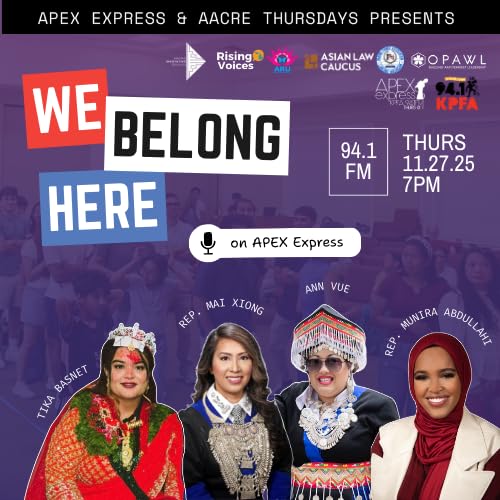
  • APEX Express – November 27, 2025 – We Belong Here: Bhutanese & HMoob Americans in the Struggle Against Statelessness
    Nov 27 2025
    A weekly magazine-style radio show featuring the voices and stories of Asians and Pacific Islanders from all corners of our community. The show is produced by a collective of media makers, deejays, and activists. Important Links We Belong Here campaign page We Belong Here Partner organizations: Asian Law Caucus |Asian Refugees United | Hmong Innovating Politics | Hmong Family Association of Lansing | Rising Voices Transcript Nina Phillips: Hello and welcome. You are tuning into APEX Express, a weekly radio show uplifting the voices and stories of Asian Americans. I’m your host Nina Phillips, and tonight we are doing something a little different. Earlier this month on Monday, November 3rd, communities of Hmong and Nepali speaking, Bhutanese Americans, fellow immigrants and allies, gathered together at a virtual [00:01:00] community event called We Belong Here. The goal: to shed light on the continued detainment and deportation of immigrant communities in the United States and the specific challenges faced by Bhutanese, Hmong, and Southeast Asian folks. Tika Basnet: When, uh, my husband got detained on April 8, I took one week after to reach out Aisa and she told me, Hey Tika, come forward, you know, your story is powerful. People need to know your story. Nina Phillips: That was the voice of Tika Basnet. Her husband, Mohan Karki is a Nepali speaking Bhutanese refugee from Ohio who has spent months in ICE detention, trapped in legal limbo. Tika has been working tirelessly to bring her husband home and shared her story with us at We Belong Here. Tonight, we are bringing you a recording of this virtual community gathering. You’ll hear more from Tika about the Free Mohan Karki campaign and from Ann Vue, [00:02:00] the spouse of Lue Yang, a Hmong community leader from Michigan, who is also currently detained and facing deportation. Ann is leading the movement to Bring Lue Home, and we’ll be sharing more later about how you can get involved as well and support both of these campaigns. You will also hear from state representatives of Michigan and Ohio, the music and spoken word performance of Asian Refugees United, and community tools and resources that a vital in helping to keep our immigrant loved ones safe. The host of this community event was Miko Lee, APEX producer, and a voice that you might be familiar with. Alrighty, without further ado, here’s Miko. Miko Lee: We belong here. What we recognize right now is there’s almost. 60,000 people being held in detention right now, immigrants that are being held in detention. It is a pandemic that is happening in our country that’s impacting all of our people, and we need [00:03:00] to be able to take action. Tonight we’re talking very specifically, not with this 60,000 people that are in detention now, but just two of those stories, so that you can get a sense of what is happening in the Bhutanese and Hmong communities and what’s happening right now, and to talk about those particular stories and some actions you can take. First I wanna recognize that right now we are on native lands, so all of us except our original indigenous people, are from other places and I’d invite you to go into the chat and find your native land. I am speaking with you from the unceded Ohlone land, and I wanna honor these ancestors, these elders that have provided for us and provided this beautiful land for us to be on. So I invite you to share into the chat your name, your pronoun, and also what indigenous land you are living on right now in this Native American Heritage Month. Thank you so much to all of you that have joined [00:04:00] us. We are really seeing the impact of this administration on all of our peoples, and particularly tonight in terms of the Hmong and Nepali speaking, Bhutanese communities. These are communities that have been impacted, specifically refugee communities that have been impacted in incredible detrimental ways by this administration. And tonight what we really wanna do is talk to you about what is going on in our communities. We wanted to make sure we translated so that we have as much access into our communities as possible because we wanna be as inclusive of our world as we can. We Belong Here is focusing on the fact that all of us belong here. We belong in this land, and we are telling these stories tonight in the context of these sets of people particularly that have so many similarities in terms of Hmong folks who worked with our US government and worked with our US military during the Vietnam War and then came [00:05:00] here as refugees and stayed in this country to the Nepali speaking Bhutanese folks, who left their country from ethnic cleansing and then went into refugee camps and now took refuge in the United States. So these are all stories that are impactful and powerful, and it’s really what it means to be American. we have come from different places. We see these attacks on our people. right now I would like to bring to ...
    Show More Show Less
    1 hr
  • APEX Express – 11.20.25 – Artist to Artist
    Nov 20 2025
    A weekly magazine-style radio show featuring the voices and stories of Asians and Pacific Islanders from all corners of our community. The show is produced by a collective of media makers, deejays, and activists. Powerleegirl hosts, the mother daughter team of Miko Lee, Jalena & Ayame Keane-Lee speak with artists about their craft and the works that you can catch in the Bay Area. Featured are filmmaker Yuriko Gamo Romer, playwright Jessica Huang and photographer Joyce Xi. More info about their work here: Diamond Diplomacy Yuriko Gamo Romer Jessica Huang’s Mother of Exiles at Berkeley Rep Joyce Xi’s Our Language Our Story at Galeria de la Raza Show Transcript Opening: [00:00:00] Apex Express Asian Pacific expression. Community and cultural coverage, music and calendar, new visions and voices, coming to you with an Asian Pacific Islander point of view. It’s time to get on board the Apex Express. Ayame Keane-Lee: [00:00:46] Thank you for joining us on Apex Express Tonight. Join the PowerLeeGirls as we talk with some powerful Asian American women artists. My mom and sister speak with filmmaker Yuriko Gamo Romer, playwright Jessica Huang, and photographer Joyce Xi. Each of these artists have works that you can enjoy right now in the Bay Area. First up, let’s listen in to my mom Miko Lee chat with Yuriko Gamo Romer about her film Diamond Diplomacy. Miko Lee: [00:01:19] Welcome, Yuriko Gamo Romer to Apex Express, amazing filmmaker, award-winning director and producer. Welcome to Apex Express. Yuriko Gamo Romer: [00:01:29] Thank you for having me. Miko Lee: [00:01:31] It’s so great to see your work after this many years. We were just chatting that we knew each other maybe 30 years ago and have not reconnected. So it’s lovely to see your work. I’m gonna start with asking you a question. I ask all of my Apex guests, which is, who are your people and what legacy do you carry with you? Yuriko Gamo Romer: [00:01:49] Oh, who are my people? That’s a hard one. I guess I’m Japanese American. I’m Asian American, but I’m also Japanese. I still have a lot of people in Japan. That’s not everything. Creative people, artists, filmmakers, all the people that I work with, which I love. And I don’t know, I can’t pare it down to one narrow sentence or phrase. And I don’t know what my legacy is. My legacy is that I was born in Japan, but I have grown up in the United States and so I carry with me all that is, technically I’m an immigrant, so I have little bits and pieces of that and, but I’m also very much grew up in the United States and from that perspective, I’m an American. So too many words. Miko Lee: [00:02:44] Thank you so much for sharing. Your latest film was called Diamond Diplomacy. Can you tell us what inspired this film? Yuriko Gamo Romer: [00:02:52] I have a friend named Dave Dempsey and his father, Con Dempsey, was a pitcher for the San Francisco Seals. And the Seals were the minor league team that was in the West Coast was called the Pacific Coast League They were here before the Major League teams came to the West Coast. So the seals were San Francisco’s team, and Con Dempsey was their pitcher. And it so happened that he was part of the 1949 tour when General MacArthur sent the San Francisco Seals to Allied occupied Japan after World War II. And. It was a story that I had never heard. There was a museum exhibit south of Market in San Francisco, and I was completely wowed and awed because here’s this lovely story about baseball playing a role in diplomacy and in reuniting a friendship between two countries. And I had never heard of it before and I’m pretty sure most people don’t know the story. Con Dempsey had a movie camera with him when he went to Japan I saw the home movies playing on a little TV set in the corner at the museum, and I thought, oh, this has to be a film. I was in the middle of finishing Mrs. Judo, so I, it was something I had to tuck into the back of my mind Several years later, I dug it up again and I made Dave go into his mother’s garage and dig out the actual films. And that was the beginning. But then I started opening history books and doing research, and suddenly it was a much bigger, much deeper, much longer story. Miko Lee: [00:04:32] So you fell in, it was like synchronicity that you have this friend that had this footage, and then you just fell into the research. What stood out to you? Yuriko Gamo Romer: [00:04:41] It was completely amazing to me that baseball had been in Japan since 1872. I had no idea. And most people, Miko Lee: [00:04:49] Yeah, I learned that too, from your film. That was so fascinating. Yuriko Gamo Romer: [00:04:53] So that was the first kind of. Wow. And then I started to pick up little bits and pieces like in 1934, there was an American All Star team that went to Japan. And Babe Ruth was the headliner on that team. And he was a big star. People just loved him in ...
    Show More Show Less
    1 hr