• AIE Europe Debrief + Agent Labs Thesis: Unsupervised Learning x Latent Space Crossover Special (2026)
    Apr 23 2026
    Today, we check in a year after the first Unsupervised Learning x Latent Space Crossover special to discuss everything that has changed (there is a lot) in the world of AI. This episode was recorded just after AIE Europe, but before the Cursor-xAI deal.Unsupervised Learning is a podcast that interviews the sharpest minds in AI about what’s real today, what will be real in the future and what it means for businesses and the world - helping builders, researchers and founders deconstruct and understand the biggest breakthroughs.Thanks to Jacob and the UL production team for hosting and editing this!Jacob Effron* LinkedIn: https://www.linkedin.com/in/jacobeffron/* X: https://x.com/jacobeffronFull Episode on Their YouTubeWe discuss:* swyx’s view from the center of the AI engineering zeitgeist: OpenClaw, harness engineering, context engineering, evals, observability, GPUs, multimodality, and why conference tracks now reveal what matters most in AI* Whether AI infrastructure has finally stabilized: why “skills” may be the minimal viable packaging format for agents, why infra companies have had to reinvent themselves every year, and why application companies have had an easier time surviving model volatility* The vertical vs. horizontal AI startup debate: why application companies can act as the outsourced AI team for enterprises, why some horizontal companies still matter, and why sandboxes may be the clearest reinvention of classic cloud infrastructure for the AI era* The “agent lab” playbook: starting with frontier models, specializing for your domain, then training your own models once you have enough data, workload, and user behavior to justify the cost and latency savings* Why domain-specific model training is real, not just marketing: how companies like Cursor and Cognition can get users to choose their in-house models, and why search, domain specialization, and distillation are becoming more important* Open models, custom chips, and alternative inference infrastructure: why swyx has turned more bullish on open source, why non-NVIDIA hardware is suddenly getting real attention, and why every 10x speedup can unlock new product experiences* What it means to sell to agents instead of humans: why agent experience may mostly just be good developer experience by another name, why APIs and docs matter more than ever, and how pretraining-data incumbents are compounding advantages in an agent-first world* Why memory and personalization may become the next big wedge: today’s models mostly reward frequency of mentions, but in the future, swyx expects product choice to be shaped much more by personalized memory systems* The state of the AI coding wars: why coding has become one of the largest and fastest-growing categories in AI, how Anthropic, OpenAI, Cursor, and Cognition have all ridden the wave, and why the category may still have more room to run* Capability exploration vs. efficiency: why the industry is still in a token-maxing, experiment-heavy phase where people are rewarded for spending more rather than less* Claude Code vs. Codex and the strange stickiness of coding products: why first magical product experiences may matter more than expected, and why the bigger mystery may be why only a few names have emerged as real winners so far* What the end state of the coding market might look like: two major players, a longer tail of niche products, and possible disruption if Microsoft, Mistral, xAI, or the Chinese labs push harder into coding* Where application companies still have room against the labs: why frontier labs are trying to expand into verticals like finance and healthcare, but still leave space for focused companies that own the workflow and the last mile* Why coding may be a preview of every other AI market: the first category to truly go parabolic, the clearest example of foundation model companies colliding with application companies, and a template for how future vertical AI markets may develop* Why AI valuations now feel unbounded: from billion-dollar ARR products built in a year to trillion-dollar market caps, swyx and Jacob unpack how the AI market has broken traditional startup intuitions about scale and durability* Consumer AI vs. coding AI: why ChatGPT’s consumer category may have plateaued on frequency and product design, while coding continues to feel like a daily-use category with real momentum* The next product frontier beyond coding: consumer agents, computer use, and “coding agents breaking containment,” with swyx’s thesis that 2025 was the year of coding agents and 2026 may be the year they begin to do everything else* Whether foundation models are really killing startup categories: why swyx is less worried for early founders, more worried for mid-size startups and traditional SaaS, and why building something ambitious may now be the best job interview for a frontier lab* AI vs. SaaS and the internal culture war around adoption: the tension between AI-native ...
    Show More Show Less
    55 mins
  • Shopify’s AI Phase Transition: 2026 Usage Explosion, Unlimited Opus-4.6 Token Budget, Tangle, Tangent, SimGym — with Mikhail Parakhin, Shopify CTO
    Apr 22 2026
    Early bird discounts for the San Francisco World’s Fair, the biggest AIE gathering of the year, end today - prices will go up by ~$500 tonight so do please lock in ASAP!From near-universal AI tool adoption inside Shopify to internal systems for ML experimentation, auto-research, customer simulation, and ultra-low-latency search, Mikhail Parakhin joins us for a deep dive into what it actually looks like when a 20-year-old, $200B software company goes all-in on AI. We cover why Shopify has become much more vocal about its internal stack, what changed after the December model-quality inflection, and why the real bottleneck in AI coding is no longer generation, but review, CI/CD, and deployment stability.We also go inside Tangle, Tangent, SimGym, which are three major AI initiatives that Shopify is doing to make experimentation reproducible, optimization automatic, customer behavior simulatable, and search and catalog intelligence faster and cheaper at scale. Along the way, Mikhail explains UCP, Liquid AI, and why token budgets are directionally right but often measured badly, why AI-written code can still increase bugs in production, what makes Shopify’s customer simulation defensible, and what he learned from the Sydney era at Bing.We discuss:* Mikhail’s path from running a major Microsoft business unit spanning Windows, Edge, Bing, and ads to becoming CTO of Shopify* Why Shopify is talking more publicly about AI now, and why staying at the frontier has become necessary for the company* Shopify’s internal AI adoption curve, the December inflection, and why CLI-style tools are rising faster than traditional IDE-based tools* Why Jensen Huang is directionally right on token budgets, but raw token count is still the wrong way to evaluate engineering output* Why the real unlock is not more agents in parallel, but better critique loops, stronger models, and spending more on review than generation* Why AI coding can still lead to more bugs in production even if models write cleaner code on average than humans* Why Shopify built its own PR review flow, and why Mikhail thinks most off-the-shelf review tools miss the point* How PR volume, test failures, and deployment rollback are becoming the real bottlenecks in the agent era* Why Git, pull requests, and CI/CD may need a new metaphor once code is written at machine speed* What Tangle is, and how Shopify uses it to make ML and data workflows reproducible, collaborative, and production-ready from the start* Why Tangle is different from Airflow, and why content-addressed caching creates network effects across teams* What Tangent is, and how Shopify is using auto-research loops to optimize search, themes, prompt compression, storage, and more* Why Tangent is becoming a democratizing tool for PMs and domain experts, not just ML engineers* Why AutoML finally feels real in the LLM era, and where auto-research still falls short today* Why Tangle, Tangent, and SimGym become much more powerful when combined into one system* What SimGym is, why simulated customers only work if you have real historical behavior, and why Shopify’s data gives it a moat* How SimGym evolved from comparing A/B variants to telling merchants what to change on a single live storefront to raise conversions* Why customer simulation is so expensive, from multimodal models to browser farms to serving and distillation costs* How Shopify models merchant and buyer trajectories, runs counterfactuals, and thinks about interventions like discounts, campaigns, and notifications* Why category-level behavior is so different across commerce, and why ideas like Chinese Restaurant Processes are showing up again in practice* Shopify’s new UCP and catalog work, including runtime product search, bulk lookups, and identity linking* Why Shopify is using Liquid AI, and why Mikhail sees it as the first genuinely competitive non-transformer architecture he has used in practice* Where Liquid already works inside Shopify today, from low-latency query understanding to large-scale catalog and Sidekick Pulse workloads* Whether Liquid could become frontier-scale with enough compute, and why Shopify remains pragmatic and merit-based about model choice* Who Shopify is hiring right now across ML, data science, and distributed databases* The Sydney story at Bing, why its personality was not an accident, and what Mikhail learned from deliberately shaping AI character early onMikhail Parakhin* LinkedIn: https://www.linkedin.com/in/mikhail-parakhin/* X: https://x.com/MParakhinTimestamps00:00:00 Introduction: Mikhail Parakhin, Microsoft, and Shopify00:01:16 Why Shopify Is Talking More About AI00:02:29 Internal AI Adoption at Shopify and the December Inflection00:06:54 Token Budgets, Jensen Huang, and Why Usage Metrics Can Mislead00:10:55 Why Shopify Built Its Own AI PR Review System00:12:38 AI Coding, More Bugs, and the Real Deployment Bottleneck00:14:11 Why Git, PRs, and CI/CD May Need to Change for Agents00:18:24 Tangle: ...
    Show More Show Less
    1 hr and 12 mins
  • 🔬 Training Transformers to solve 95% failure rate of Cancer Trials — Ron Alfa & Daniel Bear, Noetik
    Apr 20 2026
    Today, we explain this piece of “clickbait” from our guest!TL;DR: 95% of cancer treatments fail to pass clinical trials, but it may be a matching problem — if we better understood what patients have which tumors which will respond to which treatments, success rates improve dramatically and millions of lives can be saved — with the treatments we ALREADY have.See our full episode dropping today:Why Big Pharma is licensing AI ModelsTolstoy famously wrote, ‘All healthy cells are alike; each cancer cell is unhappy in its own way.’ Or something like that. Cancer might be the most misunderstood disease out there. It’s not one disease, it’s a family of diseases. Hundreds, maybe thousands, of unique diseases each with its own underlying biology. With this lens, saying you’ll “cure cancer” is like saying you’ll solve legos.We keep hearing AI will cure cancer, but sadly it may not be so easy. Today’s guests — Ron Alfa and Daniel Bear from Noetik — thinks they can use AI to break through a core bottleneck in the treatment development process.GSK recently signed a $50M deal for their technology that also includes an (undisclosed) long-term licensing deals for Noetik’s models like the recently announced TARIO-2, an autoregressive transformer trained on one of the largest sets of tumor spatial transcriptomics datasets in the world. Whole-plex spatial transcriptomics is the richest way to read a tumor, and approximately ~0% of cancer patients going through standard care ever get one — and TARIO-2 can now predict an ~19,000-gene spatial map from the H&E assay every patient already has. Most big AI plays in BioTech have focused on discovery, and usually result in an in-house development effort (meaning tools companies usually become drug companies). This deal stands out in that it is a software licensing deal, and represents a commitment to a platform rather than a drug. With attention on other software tools for drug development (see the Boltz episode and Isomorphic for example), it is starting to look like the appetite of Pharma for biotech tools has finally started to grow. Why the sudden interest?Cancer is hardBiology is hard, cancer is harder. But despite this, we’ve made incredible progress. So many cancers that would have been death sentences twenty years ago are routinely survivable. It used to be our main strategy was just chemotherapy — poison you and hope the tumor dies before you do. Now, there are many treatments that actually kill a tumor and leave the rest of you intact! Immune checkpoint inhibitors like Keytruda and Opdivo target the defenses of dozens of tumor types. CAR-T therapy adds modified T-cells to your blood that can target B-cell malignancies very accurately. Antibody Drug Conjugates such as Trastuzumab combine a drug with an antibody, allowing it to target very specific (cancer) cells. We truly live in marvelous times.With that said, we still have a long way to go. For every type of cancer with a miracle treatment, we have many more that are still death sentences. The world spends $20-30 billion a year trying to cure cancers, with hundreds of clinical trials yearly.Yet, progress is slow with a 95% failure rate in clinical trials.The lab doesn’t translate to the clinicAre we leaving something on the table? Enter Noetik and Ron Alfa. Ron’s core thesis is that many of these “failed” treatments actually work! But we’re not looking at the right patients with the right tumors. If only we had a way to really understand the unique types of cancer biologies and which patients will respond to which treatments, we might be able to show a much higher success rate. Millions of lives (and billions of dollars) may ride on this.The Hard part: Blind Faith in Data CollectionRon and Noetik had the conviction to spend almost two years just collecting data. Lots, and lots, and lots, of data. Noetik has acquired thousands of actual human tumors, and collects a large multimodal dataset of hundreds of millions of images that allows them to create a detailed map of the cell makeup in the local environment. These are real human tumors, not frankenstein mouse models or immortal cell lines.This data is then fed into a massive self-supervised model, creating a “virtual cell”. This model has a deep understanding of cancer biology — Noetik has worked carefully to show it can distinguish different types of tumors. Maybe even tumors we didn’t identify as distinct previously! More recently they figured out how to scale up their model and data, and see no limit in their scaling laws!Noetik’s models can simulate how a patient will respond to experimental treatments. They are working with partners to test promising drugs that were demonstrated to be safe, but not effective. If these models work as hoped, Noetik will bring new cancer treatments to patients without developing a new drug! Their models will also guide the discovery process towards drugs that are more likely ...
    Show More Show Less
    1 hr and 25 mins
  • Notion’s Token Town: 5 Rebuilds, 100+ Tools, MCP vs CLIs and the Software Factory Future — Simon Last & Sarah Sachs of Notion
    Apr 15 2026
    For all those who missed out on London, see you in Miami next week!Notion, the knowledge work decacorn, has been building AI tooling since before ChatGPT, with many hits from Q&A in 2023 and unified AI in 2024 and Meeting Notes in 2025. At the end of their last Make user conference, Ryan Nystrom teased Notion 3.0’s Custom Agents - and they are finally embracing the Agent Lab playbook!Sarah Sachs and Simon Last of Notion join us for a deep dive into how Notion built Custom Agents, why it took years and multiple rebuilds to get right, and what it means to turn a productivity tool into an agent-native system of record for enterprise work.We go inside the product, engineering, evals, pricing, and org design decisions behind one of the most ambitious AI product efforts in software today — from early failed tool-calling experiments in 2022 to agent harnesses, progressive tool disclosure, meeting notes as data capture, and the long-term vision for software factories and agentic work.We discuss:* Sarah and Simon’s path to launching Notion Custom Agents, and why the feature was rebuilt four or five times before it was ready for production* Why early agent attempts failed: no tool-calling standard, short context windows, unreliable models, and too much complexity exposed to the model* The “Agent Lab” thesis: not just wrapping a model, but understanding how people collaborate and building the right product system around frontier capabilities* How Notion thinks about roadmap timing: not swimming upstream against model limitations, but also building early enough that the product is ready when the models are* Why coding agents feel like the kernel of AGI, and how Notion is thinking about “software factories” made up of agents that spec, code, test, debug, review, and maintain codebases together* How Sarah runs AI engineering at Notion (“notes from Token Town”): objective-setting over idea ownership, low-ego teams comfortable deleting their own work, and a culture designed to swarm around fast-changing opportunities* The “Simon Vortex,” company hackathons, and why security gets pulled in early rather than late* How Notion organizes AI: core AI capabilities and infrastructure, product packaging teams, and a broader company mandate that every product surface must increasingly work for both humans and agents* Why prototypes have become much easier to build internally, and how “demos over memos” changes product development inside a tool the whole company already uses every day* Notion’s eval philosophy: regression tests, launch-quality evals, and “frontier/headroom” evals that intentionally only pass ~30% of the time so the company can see where model capabilities are going* What a “Model Behavior Engineer” is, and why Notion treats eval writing, failure analysis, and model understanding as a distinct function rather than just software engineering* The changing role of software engineers in the age of coding agents, and why the new job looks less like typing code and more like supervising a rigorous outer system of agents, PRs, and verification loops* How the “software factory” should work: specs, self-verification, bug flows, subagents, and minimizing human intervention while preserving the invariants that matter* A live walkthrough of a Notion Custom Agent handling coworking space tenant applications by triaging email, enriching applicants with web search, and writing structured data into a Notion database* How agents compose inside Notion: shared databases as primitives, agents invoking other agents, “manager agents” supervising dozens of specialized agents, and memory implemented simply as pages and databases* Notion’s take on MCP vs CLI: why Simon is bullish on CLI’s self-debugging nature, where MCP still makes sense, and how Sarah thinks about capability, determinism, permissioning, and pricing alignment* The evolution of Notion’s internal agent harness: from early JavaScript coding agents, to custom XML, to Markdown and SQL-like abstractions, to tool definitions, progressive disclosure, and a much shorter system prompt* Why Notion cares about teaching “the top of the class,” building for sophisticated operators rather than abstracting away too much capability for everyone* How agent setup works today: agents that can configure themselves, inspect their own failures, and edit their own instructions — with guardrails around permissions* How Notion prices Custom Agents: credits as an abstraction over tokens, model type, serving tier, web search, and future sandbox costs; why usage-based pricing was necessary; and how “auto” tries to match the right model to the right task* Why Notion is not eager to train a foundation model, where they do fine-tune and optimize today, and why retrieval/ranking is one of the most important investment areas as more searches come from agents rather than humans* Why Meeting Notes became one of Notion’s strongest growth loops: ...
    Show More Show Less
    1 hr and 17 mins
  • Extreme Harness Engineering for Token Billionaires: 1M LOC, 1B toks/day, 0% human code, 0% human review — Ryan Lopopolo, OpenAI Frontier & Symphony
    Apr 7 2026
    We’re proud to release this ahead of Ryan’s keynote at AIE Europe. Hit the bell, get notified when it is live! Attendees: come prepped for Ryan’s AMA with Vibhu after.Move over, context engineering. Now it’s time for Harness engineering and the age of the token billionaires.Ryan Lopopolo of OpenAI is leading that charge, recently publishing a lengthy essay on Harness Eng that has become the talk of the town:In it, Ryan peeled back the curtains on how the recently announced OpenAI Frontier team have become OpenAI’s top Codex users, running a >1m LOC codebase with 0 human written code and, crucially for the Dark Factory fans, no human REVIEWED code before merge. Ryan is admirably evangelical about this, calling it borderline “negligent” if you aren’t using >1B tokens a day (roughly $2-3k/day in token spend based on market rates and caching assumptions):Over the past five months, they ran an extreme experiment: building and shipping an internal beta product with zero manually written code. Through the experiment, they adopted a different model of engineering work: when the agent failed, instead of prompting it better or to “try harder,” the team would look at “what capability, context, or structure is missing?”The result was Symphony, “a ghost library” and reference Elixir implementation (by Alex Kotliarskyi) that sets up a massive system of Codex agents all extensively prompted with the specificity of a proper PRD spec, but without full implementation:The future starts taking shape as one where coding agents stop being copilots and start becoming real teammates anyone can use and Codex is doubling down on that mission with their Superbowl messaging of “you can just build things”.Across Codex, internal observability stacks, and the multi-agent orchestration system his team calls Symphony, Ryan has been pushing what happens when you optimize an entire codebase, workflow, and organization around agent legibility instead of human habit.We sat down with Ryan to dig into how OpenAI’s internal teams actually use Codex, why the real bottleneck in AI-native software development is now human attention rather than tokens, how fast build loops, observability, specs, and skills let agents operate autonomously, why software increasingly needs to be written for the model as much as for the engineer, and how Frontier points toward a future where agents can safely do economically valuable work across the enterprise.We discuss:* Ryan’s background from Snowflake, Brex, Stripe, and Citadel to OpenAI Frontier Product Exploration, where he works on new product development for deploying agents safely at enterprise scale* The origin of “harness engineering” and the constraint that kicked off the whole experiment: Ryan deliberately refused to write code himself so the agent had to do the job end to end* Building an internal product over five months with zero lines of human-written code, more than a million lines in the repo, and thousands of PRs across multiple Codex model generations* Why early Codex was painfully slow at first, and how the team learned to decompose tasks, build better primitives, and gradually turn the agent into a much faster engineer than any individual human* The obsession with fast build times: why one minute became the upper bound for the inner loop, and how the team repeatedly retooled the build system to keep agents productive* Why humans became the bottleneck, and how Ryan’s team shifted from reviewing code directly to building systems, observability, and context that let agents review, fix, and merge work autonomously* Skills, docs, tests, markdown trackers, and quality scores as ways of encoding engineering taste and non-functional requirements directly into context the agent can use* The shift from predefined scaffolds to reasoning-model-led workflows, where the harness becomes the box and the model chooses how to proceed* Symphony, OpenAI’s internal Elixir-based orchestration layer for spinning up, supervising, reworking, and coordinating large numbers of coding agents across tickets and repos* Why code is increasingly disposable, why worktrees and merge conflicts matter less when agents can resolve them, and what it really means to fully delegate the PR lifecycle* “Ghost libraries”, spec-driven software, and the idea that a coding agent can reproduce complex systems from a high-fidelity specification rather than shared source code* The broader future of Frontier: safely deploying observable, governable agents into enterprises, and building the collaboration, security, and control layers needed for real-world agentic workRyan Lopopolo* X: https://x.com/_lopopolo* Linkedin: https://www.linkedin.com/in/ryanlopopolo/* Website: https://hyperbo.la/contact/Timestamps00:00:00 Introduction: Harness Engineering and OpenAI Frontier00:02:20 Ryan’s background and the “no human-written code” experiment00:08:48 Humans as the bottleneck: systems thinking, ...
    Show More Show Less
    1 hr and 13 mins
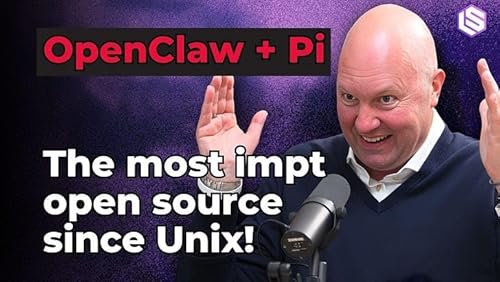
  • Marc Andreessen introspects on The Death of the Browser, Pi + OpenClaw, and Why "This Time Is Different"
    Apr 3 2026
    Fresh off raising a monster $15B, Marc Andreessen has lived through multiple computing platform shifts firsthand, from Mosaic and Netscape to cofounding A16z. In this episode, Marc joins swyx and Alessio in a16z’s legendary Sand Hill Road office to argue that AI is not just another hype cycle, but the payoff of an “80-year overnight success”: from neural nets and expert systems to transformers, reasoning models, coding, agents, and recursive self-improvement. He lays out why he thinks this moment is different, why AI is finally escaping the old boom-bust pattern, and why the real bottleneck may be less about models than about the messy institutions, incentives, and social systems that struggle to absorb technological change.This episode was a dream come true for us, and many thanks to Erik Torenberg for the assist in setting this up. Full episode on YouTube!We discuss:* Marc’s long view on AI: from the 1980s AI boom and expert systems to AlexNet, transformers, and why he sees today’s moment as the culmination of decades of compounding technical progress* Why “this time is different”: the jump from LLMs to reasoning, coding, agents, and recursive self-improvement, and why Marc thinks these breakthroughs make AI real in a way prior cycles were not* AI winters vs. “80-year overnight success”: why the field repeatedly swings between utopianism and doom, and why Marc thinks the underlying researchers were mostly right even when the timelines were wrong* Scaling laws, Moore’s Law, and what to build: why he believes AI scaling laws will continue, why the outside world is messier than lab purists assume, and how startups can still create durable value on top of rapidly improving models* The dot-com crash and AI infrastructure risk: Marc’s comparison between today’s AI capex boom and the fiber/data-center overbuild of 2000, plus why he thinks this cycle is different because the buyers are huge cash-rich incumbents and demand is already here* Why old NVIDIA chips may be getting more valuable: the pace of software progress, chronic capacity shortages, and the idea that even current models are “sandbagged” by supply constraints* Open source, edge inference, and the chip bottleneck: why Marc thinks local models, Apple Silicon, privacy, trust, and economics all point toward a major role for edge AI* American vs. Chinese open source AI: DeepSeek as a “gift to the world,” why open models matter not just because they’re free but because they teach the world how things work, and how open source strategies may shift as the market consolidates* Why Pi and OpenClaw matter so much: Marc’s claim that the combination of LLM + shell + filesystem + markdown + cron loop is one of the biggest software architecture breakthroughs in decades* Agents as the new “Unix”: how agent state living in files allows portability across models and runtimes, and why self-modifying agents that can extend themselves may redefine what software even is* The future of coding and programming languages: why Marc thinks software becomes abundant, why bots may translate freely across languages, and why “programming language” itself may stop being a salient concept* Browsers, protocols, and human readability: lessons from Mosaic and the web, why text protocols and “view source” mattered, and how similar principles may shape AI-native systems* Real-world OpenClaw use: health dashboards, sleep monitoring, smart homes, rewriting firmware on robot dogs, and why the most aggressive users are discovering both the power and danger of agents first* Proof of human vs. proof of bot: why Marc thinks the internet’s bot problem is now unsolvable via detection alone, and why biometric + cryptographic proof of human becomes necessaryTimestamps* 00:00 Marc on AI’s “80-Year Overnight Success”* 00:01 A Quick Message From swyx* 01:44 Inside a16z With Marc Andreessen* 02:13 The Truth About a16z’s AI Pivot* 03:29 Why This AI Boom Is Not Like 2016* 06:33 Marc on AI Winters, Hype Cycles, and What’s Different Now* 10:09 Reasoning, Coding, Agents, and the New AI Breakthroughs* 12:13 What Founders Should Build as Models Keep Improving* 16:33 AI Capex, GPU Shortages, and the Dot-Com Crash Analogy* 24:54 Open Source AI, Edge Inference, and Why It Matters* 33:03 Why OpenClaw and PI Could Change Software Forever* 41:37 Agents, the End of Interfaces, and Software for Bots* 46:47 Do Programming Languages Even Have a Future?* 54:19 AI Agents Need Money: Payments, Crypto, and Stablecoins* 56:59 Proof of Human, Internet Bots, and the Drone Problem* 01:06:12 AI, Management, and the Return of Founder-Led Companies* 01:12:23 Why the Real Economy May Resist AI Longer Than Expected* 01:15:53 Closing ThoughtsTranscriptMarc: Something about AI that causes the people in the field, I would say, to become both excessively utopian and excessively apocalyptic. Having said that, I think what’s actually happened is an enormous amount of ...
    Show More Show Less
    1 hr and 16 mins
  • Moonlake: Causal World Models should be Multimodal, Interactive, and Efficient — with Chris Manning and Fan-yun Sun
    Apr 2 2026
    We’ve been on a bit of a mini World Models series over the last quarter: from introducing the topic with Yi Tay, to exploring Marble with World Labs’ Fei-Fei Li and Justin Johnson, to previewing World Models learned from massive gaming datasets with General Intuition’s Pim de Witte (who has now written down their approach to World Models with Not Boring), to discussing the Cosmos World Model with with Andrew White of Edison Scientific on our new Science pod, to writing up our own theses on Adversarial World Models. Meanwhile Nvidia, Waymo and Tesla have published their own approaches, Google has released Genie 3, and Yann LeCun has raised $1B for AMI and published LeWorldModel.Today’s guests have a radically different approach to World Modeling to every player we just mentioned — while Genie 3 is impressive, its many flaws demonstrate the issues with their approach - terrain clipping, noninteractivity (single player, no physics/no objects other than the player move), and maximum of 60 second immersion. Moonlake AI (inspired by the Dreamworks logo) is the diametric opposite - immediately multiplayer, incredibly interactive, indefinite lifetime, capable of MANY different kinds of world models by simulating environments, predicting outcomes, and planning over long horizons. This is enabled by bootstrapping from game engines and training custom agents: In Towards Efficient World Models, Chris Manning and Ian Goodfellow join Fan-Yun in explaining why their approach to efficiency with structure and casuality instead of just blind scaling is sorely needed:SOTA models still show physical or spatial understanding glitches, such as solid objects floating in mid-air or moving “inside” other solid objects.If the goal is to plan for the next action, how often is a high-resolution pixel view necessary for modeling the world? Our bet is that there is a disproportionately large share of economically valuable tasks where such detail is not required. After all, humans with a wide variety of sensory limitations have little difficulty doing almost everything in the world. Furthermore, for a large number of purposes, describing a scene or a situation in a few words of language (“the car’s tires squealed as it cornered sharply”) is sufficient for understanding and planning.Experiments also show that humans only partially process visual input in a top-down, task-directed way, often making use of abstracted object-level modeling. In almost all cases, partial representations combined with semantic understanding are sufficient.…If the goal is to facilitate the understanding of causality in multimodal environments, then the world model—whether it is used in the virtual world or the physical world—must prioritize properties such as spatial and physical state consistency maintained over long time periods, and an ability to evolve the world that accurately reflects the consequences of actions. That’s what Moonlake is building.Game engines are the right starting point abstraction to efficiently extract causal relationships, and building the interfaces and community (including their new $30,000 Creator Cup) to kickstart the flywheel of actions-to-observations.We were fortunate enough to attend their sessions at GDC 2026 (the Mecca of Game Devs), and were impressed by the huge variety and flexibility of the worlds people were building with Moonlake’s tools already! Live videos on the pod.Full Video Pod on YouTube!Timestamps00:00 Benchmarking Gets Hard00:47 Meet Moonlake Founders01:26 Why Build World Models03:12 Structure Not Just Scale05:37 Defining Action Conditioned Worlds07:32 Abstraction Versus Bitter Lesson14:39 Language Versus JEPA Debate20:27 Reasoning Traces And Rendering Layer37:00 Gameplay Over Graphics38:02 Fiction Rules And World Tweaks39:15 Code Engines Beat Learned Priors41:10 Diffusion Scaling Limits43:23 Symbolic Versus Diffusion Boundary46:14 Platform Vision Beyond Games50:24 Spatial Audio And Multimodal Latents54:23 NLP Roots Hiring And Moon Lake NameTranscript[00:00:00] Cold Open[00:00:00] Chris Manning: Think this whole space is extremely difficult as things are emerging now. And I mean, it’s not only for world models, I think it’s for everything including text-based models, right? ‘cause in the early days it seemed very easy to have good benchmarks ‘cause we could do things like question answering benchmarks.[00:00:20] But these days so much of what people are wanting to do is nothing like that, right? You’re wanting to get some recommendations about which backpack would be best for you for your trip in Europe next month. It’s not so easy to come up with a benchmark, and it’s the same problem with these world models.[00:00:41] Meet the Founders[00:00:41] swyx: Okay. We’re back in the studio with Moon Lake’s, two leads. I, I guess there’s other founders as well, but, sun and Chris Manning. Welcome to the studio.[00:00:54] Fan-yun Sun: Thanks. Thanks, Chris. Thanks ...
    Show More Show Less
    1 hr and 7 mins
  • Mistral: Voxtral TTS, Forge, Leanstral, & what's next for Mistral 4 — w/ Pavan Kumar Reddy & Guillaume Lample
    Mar 30 2026
    Mistral has been on an absolute tear - with frequent successful model launches it is easy to forget that they raised the largest European AI round in history last year. We were long overdue for a Mistral episode, and we were very fortunate to work with Sophia and Howard to catch up with Pavan (Voxtral lead) and Guillaume (Chief Scientist, Co-founder) on the occasion of this week’s Voxtral TTS launch:Mistral can’t directly say it, but the benchmarks do imply, that this is basically an open-weights ElevenLabs-level TTS model (Technically, it is a 4B Ministral based multilingual low-latency TTS open weights model that has a 68.4% win rate vs ElevenLabs Flash v2.5). The contributions are not just in the open weights but also in open research: We also spend a decent amount of the pod talking about their architecture that combines auto-regressive generation of semantic speech tokens with flow-matching for acoustic tokens (typically only applied in the Image Generation space, as seen in the Flow Matching NeurIPS workshop from the principal authors that we reference in the pod).You can catch up on the paper here and the full episode is live on youtube!Timestamps00:00 Welcome and Guests00:22 Announcing Voxtral TTS01:41 Architecture and Codec02:53 Understanding vs Generation05:39 Flow Matching for Audio07:27 Real Time Voice Agents13:40 Efficiency and Model Strategy14:53 Voice Agents Vision17:56 Enterprise Deployment and Privacy23:39 Fine Tuning and Personalization25:22 Enterprise Voice Personalization26:09 Long-Form Speech Models26:58 Real-Time Encoder Advances27:45 Scaling Context for TTS28:53 What Makes Small Models30:37 Merging Modalities Tradeoffs33:05 Open Source Mission35:51 Lean and Formal Proofs38:40 Reasoning Transfer and Agents40:25 Next Frontiers in Training42:20 Hiring and AI for Science44:19 Forward Deployed Engineering46:22 Customer Feedback Loop48:29 Wrap Up and ThanksTranscriptswyx: Okay, welcome to Latent Space. We’re here in the studio with our gues co-host Vibh u. Welcome. Thanks. Excited for this one as well as Guillaume and Pavan from Mistral. Welcome. Excited to be here.Guillaume: Thank you.swyx: Pavan. You are leading audio research at Ms. Charles and Guam, your chief scientist.Announcing Voxtral TTSswyx: What are we announcing today where we’re coordinating this release with you guys?Guillaume: Yeah, so we are releasing box trial TTS. So it’s our first audio model that generates speech. It’s not our first audio model. We had a couple of releases before we had one in the summer that was a box trial, our first audio model, but it’s was like transcription models. A SR like a few months later we released some update on top of this, supporting more languages.Also a lot of table stake features for our customers context biasing ization. Time stamping and the transcription. We will start some real time model that can transcribe not just at the end of the, you just don’t need to fill your entire audio file, but that can also come in [00:01:00] real time. And here, this is the natural extension in the audio.So basically speech generation. So yeah. So we support nine languages. And this is a pretty small model 3D models. So very fast. And also status is the same level at the best model, but it’s much more efficient in terms of cost and also much in terms of cost. It’s also much to only a fraction of the cost of parking competitors.They, and we are also releasing the way that this modelswyx: yeah. Mainly linked, not, yeah. What’s the decision? Factor him.Guillaume: It’s a good question.Pavan: Ooh.swyx: Yeah. For provide any other sort of research notes to add on whatPavan: we maybe we’ll dive into it later in the forecast too.Architecture and CodecPavan: But it’s a novel architecture that we develop inhouse.We traded on several internal architectures and ended up with a auto aggressive flow matching architecture. And also have a new in-house neural audio codec. Which, converts this audio into all point by herds latent [00:02:00] tokens, semantic and acoustic tokens. And yeah, that’s that’s their new part about this model and we’re pretty excited that it’s, it came out with such good quality and Jim was mentioning. Yeah, it’s a three B model. It’s based off of the TAL model that we actually released just a few months back and insert trunk and mainly meant for like the TTS stuff, but they need text capabilities are also there. Yeah.swyx: So there’s a lot to cover.I always I love any, anything to do with novel encodings and all those things because I think that’s obviously I creates a lot of efficiency, but also maybe bugs that sometimes happen. You were previously a Gemini and you worked on post training for language models, and maybe a lot of people will have less experience with audio models just in general compared to pure language.What did you find that you have to revisit from scratch as you joined this trial and started doing this? At leastUnderstanding...
    Show More Show Less
    49 mins