• Cuba, Iran & Venezuela — A New World Order? Energy, Regime Shifts, and Trump’s Strategic Reset
    Feb 12 2026

    Cuba signals it’s ready to talk. Iran shows flexibility on nuclear talks. Venezuela undergoes dramatic political change. Are we witnessing a strategic realignment in the Western Hemisphere and the Middle East? In Episode 86, Steve Gibson breaks down what could be a profound geopolitical reset.

    In Logic Dictate Hot Topics — Episode 86, host Steve Gibson examines major developments involving Cuba, Iran, and Venezuela—and asks whether we are entering a fundamentally different geopolitical era.

    🇨🇺 Cuba: Fuel Crisis and a Willingness to Engage

    The Wall Street Journal recently reported that Cuban President Miguel Díaz‑Canel signaled willingness to engage with President Trump as the island confronts severe fuel shortages and deepening economic crisis.

    Reuters reports that Cuba has announced rationing measures amid worsening shortages, with blackouts intensifying and fuel reserves strained.

    Cuba produces roughly 40,000 barrels per day of low‑quality crude—largely used to power aging electricity plants.

    Steve asks: Is this the moment where sustained pressure leads to negotiation?

    🇮🇷 Iran: Protests and Nuclear Talks

    Simultaneously, Reuters reports that U.S. and Iranian officials are showing signs of flexibility in nuclear discussions amid regional tensions and internal unrest.

    Broader reporting highlights ongoing protests and geopolitical strain surrounding Tehran’s posture.

    What happens if Iran steps back from nuclear escalation and re‑enters structured global energy markets?

    🇻🇪 Venezuela: Political Shift and Energy Implications

    Reuters reports that Venezuela enacted an amnesty law following Nicolás Maduro’s capture and U.S.‑backed ouster, with Vice President Delcy Rodríguez serving as interim president.

    If Venezuela stabilizes politically and expands oil production alongside Iran, the consequences for:

    • Global oil prices
    • Russia’s energy leverage
    • China’s influence in Latin America
      could be significant.

    What This Episode Explores

    • Are we witnessing coordinated strategic pressure reshaping hostile regimes?
    • How expanded oil output from Venezuela and Iran could affect global energy markets
    • Why lower oil prices weaken Russia’s geopolitical leverage
    • The Western Hemisphere security implications if Cuba normalizes relations
    • Whether this shift rebalances China’s access to energy resources

    Disclaimer: This episode is geopolitical commentary and analysis, not investment or policy advice.

    📘 Learn more about the philosophy behind Logic Dictate:
    https://www.logicsdictate.com


    📕 Read Logic’s Dictate for only $0.99:
    https://amzn.to/4oAo6AJ


    Show More Show Less
    3 mins
  • Synthetic Intelligence Update — Amazon’s AI Spending Surge, 16,000 Layoffs, and AI in Your Personal Life
    Feb 9 2026

    On February 6, 2026, two headlines capture the Synthetic Intelligence moment: Amazon is pouring unprecedented money into AI infrastructure while cutting thousands of jobs—and meanwhile, more people are turning to AI like “Claude” for personal guidance. In Episode 85, Steve Gibson connects the dots: money flows, job loss, data centers, error rates, and the future you’re living in right now.

    In Logic Dictate Hot Topics — Episode 85, host Steve Gibson delivers a Synthetic Intelligence update (Feb 6, 2026) based on two major themes showing up in mainstream coverage:

    1) The corporate reality: AI investment up, jobs down

    Amazon is signaling a dramatic acceleration in AI infrastructure investment—while simultaneously trimming labor. Amazon disclosed organizational reductions impacting ~16,000 roles, and its leadership has framed ongoing restructuring as a push to reduce layers and bureaucracy.
    At the same time, Amazon’s own guidance points to enormous 2026 capital investment tied to “seminal opportunities like AI,” with expected ~$200 billion in capex.

    Steve highlights the historic inversion here: in prior eras, huge corporate spending often meant more hiring. In the synthetic intelligence era, we’re watching massive investment coincide with large-scale white-collar reductions—and that tension is reshaping the economy.

    2) The personal reality: AI is becoming a “life advisor”

    A separate Wall Street Journal feature reflects a different shift: people are increasingly integrating AI into personal decision-making—sometimes treating AI assistants as trusted advisors.
    Steve discusses what this trend reveals about human behavior, dependency, and the reality that these systems still produce errors—sometimes harmless, sometimes consequential.

    What this episode explores

    • Why Steve calls it Synthetic Intelligence (not just “AI”)
    • Amazon’s investment vs. layoffs as a signal of a broader economic transition
    • Why data centers + power demand are the under-discussed foundation of SI
    • The “inevitable error rate” problem (hallucinations, inaccuracies, distorted outputs) and why humans still matter
    • What workers and families should do now to adapt—skills, career planning, and awareness

    Disclaimer: Commentary and analysis only. Not financial, employment, or legal advice.

    Learn more about the philosophy behind Logic Dictate:

    https://www.logicsdictate.com

    📘 Read Logic’s Dictate for only $0.99:

    https://amzn.to/4oAo6AJ
    Show More Show Less
    6 mins
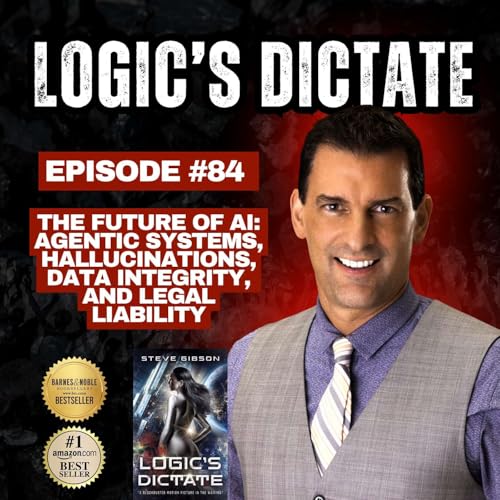
  • The AI Landscape — From “Artificial” to Synthetic Intelligence, Agentic AI, Energy Demand, Jobs, and AI Law
    Feb 8 2026

    AI isn’t just a new app—it’s a new era. In Episode 84, Steve Gibson maps the AI landscape from basic “deterministic” computing to generative and agentic systems—and introduces a new framing: synthetic intelligence. Then he connects the dots to what matters most: energy, jobs, politics, medicine, military power, and law.

    SEO-Optimized Podcast Description (Show Notes)

    In Logic Dictate Hot Topics — Episode 84, host Steve Gibson delivers a wide-angle breakdown of the AI landscape and introduces a concept he believes we should start using more often: synthetic intelligence (SI)—because the outputs and agency we’re seeing today are no longer “artificial” in any meaningful sense; they’re real results produced by man-made systems.

    Steve begins by clarifying the evolution:

    • Deterministic computing (predictable outputs: calculators, traditional programs)
    • Generative AI (probabilistic outputs that can create text, images, and ideas)
    • Agentic AI / Agentic SI (systems that don’t just generate an answer—they take actions: booking, executing tasks, operating robotics)
    • The next rungs he explores conceptually: autonomous SI (initiates tasks without prompts) and the philosophical/legal cliff-edge of sentient SI (self-awareness and “personhood” questions)

    From there, Episode 84 goes beyond definitions and into real-world impact:

    • The energy footprint of AI: data centers, continuous power demand, and the policy fights this will trigger
    • Employment disruption and opportunity: where AI replaces work, where it creates new industries, and why “data integrity” becomes a major human job category
    • The persistent problem of hallucinations / wrong answers—and why high-quality data pipelines matter
    • The future politics of productivity: what happens if robotics + SI reduce the need for human labor at scale
    • The upside: potential SI-driven leaps in medicine, including faster discovery and improved healthcare outcomes
    • The risk: SI in military systems, drones, and autonomous decision loops—and why guardrails must come before deployment
    • A preview of what Steve will cover more deeply on his upcoming legal-focused channel: copyright, patents, AI authorship, product liability, torts, insurance, and who is responsible when AI causes harm

    Disclaimer: This episode is educational and commentary-based. Nothing here is legal advice, medical advice, or investment advice.

    Learn more about the philosophy behind Logic Dictate:
    https://www.logicsdictate.com

    📘 Read Logic’s Dictate for only $0.99: https://amzn.to/4oAo6AJ

    Show More Show Less
    1 hr and 3 mins
  • Tax the Rich—and Become Poorer? Billionaire Taxes, Capital Flight, and Why Incentives Matter
    Feb 5 2026

    “Tax the rich” sounds simple—until the tax base leaves. In Episode 83, Steve Gibson explains why billionaire taxes can shrink revenue, discourage growth, and make states poorer, not richer—and why history keeps proving this point.

    In Logic Dictate Hot Topics — Episode 83, host Steve Gibson takes on a popular political slogan—“tax the rich”—and asks a harder question: does it actually work?

    Steve reacts to recent discussions around billionaire or wealth taxes—including proposals in California and New York City—and argues that when governments target high earners with punitive tax policies, the predictable result is capital flight, lower tax revenue, and weaker economic activity.

    This episode challenges the assumption that higher marginal tax rates automatically mean more money for public services. Steve explains why high earners already contribute substantially through consumption, investment, employment, and sales taxes, and why meritocracy and incentives matter for a healthy economy.

    Topics covered in Episode 83:

    • Why billionaire and wealth taxes often drive people—and revenue—out of a state
    • How high earners already pay more through spending, hiring, and investment
    • The difference between fair taxation and punitive taxation
    • Why extreme marginal tax rates discourage productivity and risk‑taking
    • Historical examples: President Kennedy and President Reagan lowering tax rates and seeing stronger economic performance
    • Why governments should incentivize growth, not punish success
    • How creative, targeted government involvement can work—without heavy‑handed control

    Note: This episode is political and economic commentary, not financial or tax advice.

    Learn more about the philosophy behind Logic Dictate:
    https://www.logicsdictate.com

    📘 Read Logic’s Dictate for only $0.99: https://amzn.to/4oAo6AJ

    Show More Show Less
    5 mins
  • Democrats Can Do Better — Border Security, ICE Reallocation, Legalization-by-Registration, and a Real Healthcare Plan
    Feb 4 2026

    Democrats don’t have to lose by default—and they don’t have to copy Trump to compete. In Episode 82, Steve Gibson lays out a pragmatic, voter-ready blueprint: secure the border, reduce enforcement chaos, offer a lawful registration pathway for hardworking undocumented immigrants, and build a serious healthcare alternative that cuts costs.

    In Logic Dictate Hot Topics — Episode 82, host Steve Gibson argues that Democrats can offer a compelling alternative to Trump-era policies—but only if they stop relying on slogans and start presenting practical, measurable solutions.

    Building off his recent discussion of President Trump’s Wall Street Journal tariffs op-ed, Steve says Democrats need to respond with policy creativity that improves daily life—especially around immigration enforcement, cost of healthcare, and institutional trust.

    Steve’s proposed Democratic “path forward” includes three major pillars:

    1) Immigration: Order at the border + realism inside the country

    • Reallocate ICE resources to the southern border
    • Finish border infrastructure and tighten future enforcement to reduce incentives for unlawful entry
    • Create a registration pathway for hardworking undocumented immigrants already here:
      • show willingness to contribute
      • learn English
      • obey laws
      • pay a fee (including via payment plan) as a structured admission process
    • Continue targeting violent criminals and those committing additional offenses

    2) Culture & messaging: Drop the “mandatory ideology” politics

    Steve argues Democrats don’t need a “woke agenda” as a requirement of the party brand—and that moving back to fundamentals is how they win trust again (a critique echoed by prominent Democrats like Rahm Emanuel in recent commentary).

    3) Healthcare: Build a parallel system that forces prices down

    • Build federally supported, means-tested medical centers in major metro areas (then expand)
    • Provide basic care and urgent services with clearer cost controls
    • Add liability reforms (caps/immunity structures) so the model can function sustainably
    • Use these centers to apply price discipline to care delivery and prescription access
    • Push for more aggressive FDA access pathways for patients with terminal diagnoses who want to opt into higher‑risk therapies

    Note: This episode is political commentary and general discussion—not legal advice or medical advice.

    Learn more about the philosophy behind Logic Dictate:
    https://www.logicsdictate.com

    📘 Read Logic’s Dictate for only $0.99: https://amzn.to/4oAo6AJ

    Show More Show Less
    8 mins
  • Was Trump Right on the Economy? Tariffs, Growth, Inflation & What the Numbers Really Show
    Feb 3 2026

    President Trump claims his tariff policies “brought America back,” but was he right? In Episode 81, Steve Gibson breaks down Trump’s recent Wall Street Journal op‑ed, examines key economic indicators—growth, inflation, deficits, trade, jobs—and asks: do the numbers back up the claim?

    In Logic Dictate Hot Topics — Episode 81, host Steve Gibson responds to President Donald J. Trump’s op‑ed in The Wall Street Journal titled “My Tariffs Have Brought America Back.” In that piece, Trump argues that critics predicted economic collapse from tariffs, but the opposite has occurred: strong growth, low inflation, tightened deficits, and renewed investment in U.S. manufacturing and production.

    Steve unpacks each claim and asks listeners to look beyond headlines:

    • What did Trump say about tariffs and growth?
    • Did the stock market crash? (No — it hit new highs under his policy.)
    • Is inflation falling? (Recent data shows core inflation trending down.)
    • Did trade and budget deficits really shrink? (Trump claims dramatic improvements.)
    • What about jobs and worker incomes? (Trump asserts real income gains.)
    • How do these claims compare to economic realities and critical analyses?

    Steve also explores the broader context:

    • Pre‑tariff predictions of recession and inflation that didn’t materialize — at least not yet
    • Why some analysts warn tariffs can increase costs for consumers and distort trade patterns
    • Whether the economy’s performance benefits average families around the kitchen table

    This episode is commentary and interpretation based on public commentary and data — not financial advice. Steve invites listeners to engage with the numbers, question narratives, and decide for themselves how they think about economic leadership and policy.

    Learn more about the philosophy behind Logic Dictate:
    https://www.logicsdictate.com

    📘 Read Logic’s Dictate for only $0.99: https://amzn.to/4oAo6AJ

    Show More Show Less
    7 mins
  • Is ICE Evil? Immigration Enforcement, Use of Force, Accountability, and a Balanced Approach
    Jan 30 2026

    Two tragic deaths, viral outrage, and one loaded question: “Is ICE evil?” In Episode 80, Steve Gibson argues we can demand better training and accountability without abandoning immigration law—or demonizing every officer doing a dangerous job.

    In Logic Dictate Hot Topics — Episode 80, host Steve Gibson addresses the rising political rhetoric asking whether ICE (Immigration and Customs Enforcement) is “evil” in light of recent deadly encounters.

    Steve argues that tragedy and accountability matter—and that questions about restraint, training, leadership, and oversight are legitimate. But he pushes back on blanket demonization: calling ICE inherently evil ignores the reality of high-risk enforcement work, where officers may face threats, weapons, and volatile situations that can lead to mistakes and catastrophic outcomes.

    Episode 80 calls for a balanced framework:

    • Investigate incidents seriously and transparently
    • Improve training and management where negligence or mismanagement exists
    • Reject demagoguery that labels immigration enforcement as morally evil
    • Enforce immigration laws while acknowledging the system needs reform

    Steve also reiterates an immigration policy position he supports: creating a structured, lawful program for hardworking undocumented immigrants already in the U.S. to pursue citizenship through a regulated process—potentially including a fee—while restoring order and legitimacy to enforcement.

    This episode is commentary and analysis, not legal advice.

    Learn more about the philosophy behind Logic Dictate:
    https://www.logicsdictate.com

    📘 Read Logic’s Dictate for only $0.99: https://amzn.to/4oAo6AJ

    Show More Show Less
    3 mins
  • Dartmouth’s Degree Debate: Is College Worth the Cost in the Age of AI?
    Jan 29 2026

    A Dartmouth op-ed asks if a four-year degree is worth it—but it dodges the real comparison: college vs. trade school vs. direct-to-work. In Episode 79, Steve Gibson breaks down the true ROI question, the cost problem, and why higher ed needs to return to fundamentals—fast.

    In Logic Dictate Hot Topics — Episode 79, host Steve Gibson responds to a Wall Street Journal opinion piece by the President of Dartmouth College discussing whether a four-year degree is worth it. Steve argues the piece misses the central issue: the real question isn’t whether college is “good” in the abstract—it’s whether a four-year degree is worth it compared to alternatives like trade school, technical training, or building a career in fields (like software and other skilled roles) that may not require a traditional degree.

    Steve also tackles the financial reality: when a degree can approach hundreds of thousands of dollars, the opportunity cost is enormous—money that could otherwise be saved, invested, or used to build a career without debt.

    Key themes in this episode include:

    • The real comparison: four-year degree ROI vs. alternatives
    • Why testing and measurable standards still matter
    • How meritocracy and diversity can coexist—without lowering standards
    • Why universities should emphasize equal opportunity, not equal outcomes
    • The uncomfortable truth about political posturing on campus
    • Why “make college affordable” begs the question: who created the cost crisis?
    • Why this debate gets even sharper in the age of artificial intelligence (and what Steve calls “synthetic intelligence”)

    Learn more about the philosophy behind Logic Dictate:

    https://www.logicsdictate.com
    https://amzn.to/4oAo6AJ

    Show More Show Less
    6 mins