Making Bright Ideas Work cover art

Making Bright Ideas Work

Making Bright Ideas Work

Written by: Sunrise Labs
Listen for free

About this listen

Join Sunrise Labs on the Making Bright Ideas Work podcast to discuss the ins and outs of bringing medical devices to life, and their impact on the industry and beyond.

© 2023 Making Bright Ideas Work
Biological Sciences Hygiene & Healthy Living Science
Episodes
  • Medtech Development Strategy: Leveraging Local Resources with Global Networks
    Jun 7 2021

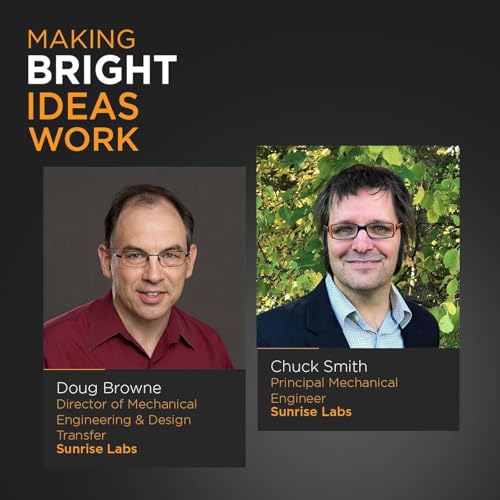
    The success of a medical device development project is dependent on running an efficient development program. In many cases, using local expert engineering talent can greatly improve the time to market and your competitive advantage in the marketplace. 

    Leveraging local expert support can augment your team’s capabilities and provide a focused effort in problem-solving, prototyping, and testing. When outsourcing product development you don’t just benefit from that team’s internal resources, you can be connected with an international network of proven vendors. 

    It’s critical to select a strong partner with deep experience in sourcing, cost estimating, and design transfer to the right manufacturer. Having a trusted expert with a full spectrum of capabilities and expertise will empower your team to execute a program at the right time and at the right price. 

    Follow us @SunriseLabsInc, LinkedIn, YouTube
    Email Us: info@sunriselabs.com

    Thanks for listening!

    Show More Show Less
    55 mins
  • Continuous Integration & Automated Testing; When, Where, Why, and How ~ with Jim Turner and Mike Goulet
    Jan 9 2021

    No one loved group projects in school, but working together as a team is important at any level of business.

    Working in a team always can be complicated, but that’s especially true when developing engineering services for medical devices, said Mike Goulet, Program Manager and Principal Software Engineer at Sunrise Labs. That’s why developing processes that run on their own, like continuous integration and automated testing, is critical.

    “One benefit and one real challenge in medical device development is … controlling the tools that are used to develop the software. One of the projects I was on recently, I think there must be 20, 30, 40 maybe 50 if you add it all up – [there were] so many tools involved in that build of software between compilers, handwritten tools, off-the-shelf products, repositories, testing tools,” Goulet said.

    “When you’ve got 20 developers, and you say, ‘This is how you’re supposed to develop the software, and these are the tools and configurations you’re supposed to use,’ it’s really, really important you do it in a very specific way because we have to control the inputs and outputs.”

    That’s especially true in an industry like the heavily regulated medical device space. With continuous integration, all members of the team can find the right tools all in one place.

    Keeping everyone on the same page and making sure the software stays in compliance is among the benefits of deploying continuous integration and automated testing, and, as Jim Turner, Director of Software Engineering at Sunrise Labs, noted, it’s an opportunity to make sure work isn’t repeated or undone, saving time and money for the client.

    “The concept is not too hard, but entropy is at work. You get developers, you get five people together, and you don’t have control over what they’re going to do – you’ll have a mess on your hands very shortly,” Turner said. “So, think about the universe wanting to break apart. So does your code, ultimately, so you’ve got to put the processes together to bring it back.”

    Follow us @SunriseLabsInc, LinkedIn, YouTube
    Email Us: info@sunriselabs.com

    Thanks for listening!

    Show More Show Less
    36 mins
  • Quality Assurance Teams and Building a Foundation of Trust ~ with Spenser Zawasky and Trisha Bouthout
    Nov 10 2020

    Quality assurance is a critical component in the product development and manufacturing process. For medical devices, it’s paramount.

    Sunrise Labs’ Spencer Zawasky, Principal Quality Engineer and Test Manager, and Trisha Bouthot, Director of Quality & Test, spoke about the importance of building a foundation of trust within quality assurance teams and with clients.

    Bouthot said there are many factors involved to build a foundation of trust within a quality assurance team. Idea and knowledge sharing are critical components in this team trust formula.

    “As an organization, we share a lot of knowledge. We have many lunch and learns and technical sharing sessions. And as a quality department, we meet multiple times a week and share in our experiences. There is so much power in knowledge transfer,” Bouthot said. “It really helps our team to be efficient.”

    Empowerment is another element Bouthot said helps build trust within a team.

    “Allowing people within a team to own their tasks and own their responsibilities puts forth a better product,” Bouthot said, “than they would if it was, say, me directing them to do something my way. I feel like it’s my job to guide them and remove obstacles for them so that they can be much more productive.”

    Trust built the medical device industry.

    “A quality assurance team enforces that trust,” Zawasky said. “We’re the ones who have to honor that trust in a way I don’t think is quite as prominent to the developers in an organization.”

    Follow us @SunriseLabsInc, LinkedIn, YouTube
    Email Us: info@sunriselabs.com

    Thanks for listening!

    Show More Show Less
    37 mins
No reviews yet