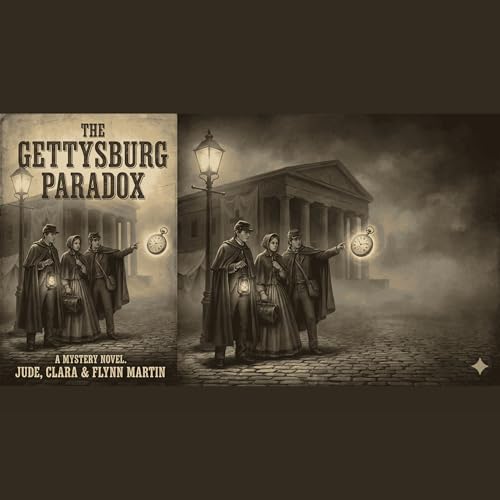
• Chapter One: The Thunder That Wasn’t Thunder
    Jan 15 2026
    Flynn Martin woke to the smell of smoke and the taste of dirt. His cheek pressed against something cold and wet—leaves, he realized, as his eyes fluttered open. Dead leaves, brown and rotting, carpeting a forest floor he didn’t recognize. His head throbbed like someone had stuffed a bass drum inside his skull and was pounding out a rhythm only pain could hear. Where am I? He pushed himself up on shaking arms, and that’s when he heard it—a sound like thunder, but wrong somehow. Too sharp. Too close together. And underneath it, something worse: screaming. Flynn scrambled backward, his sneakers slipping on the damp ground. Through the trees, maybe two hundred yards away, he could see smoke rising in thick gray columns. Figures moved through the haze—running, falling, some of them not getting back up. That’s not thunder, his brain finally supplied, catching up to what his ears already knew. Those are gunshots. Another boom, louder than the rest, shook the ground beneath him. Flynn threw himself behind a massive oak tree, pressing his back against the rough bark, breathing so hard he thought his lungs might burst. Think, he commanded himself. Think, think, think. The last thing he remembered was Papa’s workshop. The converted barn behind his grandfather’s farmhouse in rural Pennsylvania, cluttered with tools and wire and pieces of equipment Flynn couldn’t name. Clara had been there, holding a wrench, her dark braids swinging as she leaned over something mechanical. And Jude—where was Jude? Flynn squeezed his eyes shut, trying to grab hold of the memory, but it slipped away like water through his fingers. He risked a glance around the tree trunk. The battle—because that’s what it was, he understood now, an actual battle—seemed to be moving away from him, the sounds of combat drifting eastward. But the smoke still hung thick in the air, and somewhere in the distance, a horse screamed. I need to move. Flynn forced his legs to work, staying low as he crept through the underbrush in the opposite direction of the fighting. Branches scratched at his face and caught at his jacket—his favorite blue hoodie, now torn at the sleeve and covered in mud. He didn’t care. He just needed to get away, find somewhere safe, figure out what was happening. That’s when he saw the wreckage. It lay in a small clearing, scattered across the forest floor like the remains of some mechanical beast. Twisted copper pipes. Shattered glass that caught the weak sunlight filtering through the leaves. A control panel, cracked down the middle, still sparking weakly. Flynn’s heart stopped. He knew that control panel. He’d watched Papa build it over the past three months, carefully soldering each connection while explaining the theory behind temporal displacement in terms a twelve-year-old could almost understand. “The key is the caesium oscillator,” Papa had said, his wild white hair sticking up at odd angles as it always did when he was excited. “It creates a frequency that, when properly amplified, can theoretically punch a hole in the fabric of spacetime itself.” Flynn had nodded like he understood. He mostly didn’t. But he understood enough to know that what lay scattered before him now was the remains of Papa’s time machine. And that meant— “Clara,” Flynn whispered. Then louder: “CLARA! JUDE!” No answer. Just the distant pop-pop-pop of gunfire and the rustle of wind through branches. Flynn dropped to his knees beside the wreckage, searching frantically through the debris. Papa’s leather journal—ruined, the pages soaked with something that might have been rain or might have been worse. A pocket watch, its face shattered, hands frozen at 3:47. The brass housing of the caesium oscillator itself, dented but somehow still intact. But no Clara. No Jude. No Papa. They could be anywhere, Flynn realized, and the thought hit him like a physical blow. Anywhen*.* A twig snapped behind him. Flynn spun, grabbing the first thing his hand found—a length of copper pipe, bent but solid—and raised it like a weapon. The man who emerged from the trees was tall and thin, dressed in a blue uniform coat that hung loose on his bony frame. His face was gaunt, shadowed by a beard that looked like it hadn’t seen a razor in weeks, and his eyes were the pale gray of old ice. A rifle was slung over his shoulder, and a red-stained bandage wrapped around his left hand. “Easy there, son,” the man said, holding up his good hand, palm out. “I ain’t looking to harm you.” Flynn didn’t lower the pipe. “Who are you?” “Corporal Thomas Whitfield, 20th Maine Volunteer Infantry.” The man’s eyes swept over Flynn, taking in his strange clothes, his muddy sneakers, the copper pipe clutched in his white-knuckled grip. “Question is, who are you? And what in the name of the Almighty are you doing out here dressed like that?” Flynn’s mind raced. 20th Maine. Civil War. But which battle? Which day?...
    Show More Show Less
    14 mins
  • Chapter Two: The Girl in the Barn
    Jan 15 2026
    Clara Martin had always been the practical one. When Jude got lost in his books and Flynn got lost in his video games, Clara was the one who remembered to feed the dog, who set reminders for homework assignments, who made sure everyone had their lunch boxes before the bus came. Being the middle child didn’t mean being the least responsible—at least not in the Martin family. But nothing in twelve years of practical experience had prepared her for waking up in the middle of the nineteenth century. She’d been alone when she came to, lying in a field of tall grass with the sun beating down on her face and the sound of distant explosions rattling her teeth. It had taken her twenty minutes to find the road, another hour to find the farm, and every second of that time she’d spent fighting down the panic that threatened to swallow her whole. Flynn and Jude are out there somewhere, she’d told herself over and over. You’ll find them. You just have to stay calm. Easier said than done when cannons were firing in the distance and soldiers in blue were streaming past in organized chaos, some of them staring at her jeans and sneakers like she’d dropped down from the moon. Now she sat on an overturned crate in the Weikert barn, wrapping bandages around the arm of a young Union private who couldn’t have been more than seventeen. His name was James, and he kept apologizing for the blood he was getting on her hands. “It’s fine,” Clara said for the fourth time. “Really. It doesn’t bother me.” This was a lie. It bothered her a lot. But what was she supposed to do—refuse to help? “Where’d you say you were from again?” James asked, wincing as she tied off the bandage. “Pennsylvania.” At least that part was true. “Near… Harrisburg.” “City girl, huh?” James tried to smile, but it came out more like a grimace. “Never been there myself. Always wanted to, though. Hear they’ve got theaters and everything.” Clara was trying to formulate a response when the barn door swung open and a figure rushed in, silhouetted against the bright afternoon sun. “Clara!” She knew that voice. She’d know it anywhere. “Flynn!” She was off the crate and running before she could think, throwing her arms around her brother so hard she nearly knocked him over. “Oh my Goodness, Flynn, I thought—I didn’t know if—” “I’m okay.” Flynn hugged her back just as fiercely. “I’m okay. Are you hurt? What happened? Where’s Jude?” Clara pulled back, shaking her head. “I don’t know. I woke up alone in a field. I haven’t seen him. I haven’t seen anyone except—” She stopped. “Wait. Have you seen Jude?” “No.” Flynn’s face was pale under the dirt and scratches. “I woke up near the battle. Found what’s left of the time machine. It’s destroyed, Clara. Completely destroyed.” The practical part of Clara’s brain filed that information away for later panic. Right now, they had more immediate problems. “Mrs. Weikert told me something weird,” Flynn continued, lowering his voice even though James and the other wounded soldiers were too far away to hear. “About a letter. She said you had a letter?” Clara had almost forgotten about the letter. She reached into the pocket of her jacket—her favorite denim jacket, now covered in grass stains and splashes of blood that weren’t hers—and pulled out the folded document. The paper was old, brownish at the edges, and part of one corner had been burned away. But the writing was still legible: elegant, looping script that Clara couldn’t read no matter how hard she squinted. “I found it in my pocket when I woke up,” she said. “I don’t know where it came from. I don’t remember picking it up.” Flynn took the letter, unfolding it carefully. His eyes scanned the text, and Clara watched his face go from confused to shocked to something close to afraid. “This is dated July 4th, 1863,” he said slowly. “Three days from now.” “How is that possible? We just got here.” “I don’t know. But Clara—” Flynn looked up at her. “This letter is warning President Lincoln about an assassination attempt. Here, at Gettysburg. On Independence Day.” Clara’s stomach dropped. “But Lincoln wasn’t assassinated at Gettysburg. Everyone knows that. He was killed at Ford’s Theatre in 1865.” “Exactly.” Flynn folded the letter and handed it back to her. “So either this letter is a fake, or…” “Or something changed,” Clara finished. “Something changed the timeline.” They stared at each other, the weight of that possibility hanging between them. “We need to find Jude,” Flynn said finally. “And we need to figure out where this letter came from. But first, we need to—” “Children.” They both jumped. Mrs. Weikert stood in the barn doorway, her face grim. Beside her was a man Clara hadn’t seen before: tall, broad-shouldered, wearing a Union officer’s uniform with a general...
    Show More Show Less
    14 mins
  • Chapter Three: The Confederate Camp
    Jan 17 2026
    Jude Martin woke in darkness, and for a moment he thought he was dead. Then the pain hit—a throbbing ache in his skull, a burning sensation across his ribs, the sharp protest of muscles that had been pushed far beyond their limits—and he decided that death probably wouldn’t hurt this much. He was lying on something scratchy. Straw, his brain supplied after a moment. He was lying on straw, in near-total darkness, and somewhere close by, someone was groaning. Jude tried to sit up. The world spun. He lay back down. Okay, he thought. One thing at a time. Where am I? He could hear voices outside—low, murmured conversations in accents he didn’t quite recognize. Southern, maybe? And underneath the voices, other sounds: the creak of wagon wheels, the stamp of horses, the distant pop of what he was pretty sure was gunfire. Memories came back in fragments. Papa’s workshop. The time machine humming to life. Clara’s face, lit up with excitement. Flynn’s voice saying something Jude couldn’t quite remember. And then— Nothing. Just blackness, and the smell of smoke, and a sensation like falling through infinite space. “You awake over there, son?” Jude’s whole body tensed. The voice came from somewhere to his left, rough and tired but not unkind. “Who’s there?” A chuckle. “Could ask you the same question. But I’ll go first. Name’s Private William Tucker, 15th Alabama Infantry. Currently a prisoner of the United States Army, same as you—except I know how I got here, and I got a suspicion you don’t.” Jude’s eyes were adjusting to the darkness now. He could make out shapes: the walls of a barn, the slats of light coming through gaps in the wooden boards, the form of a man sitting against the opposite wall with his legs stretched out in front of him. “I’m not a prisoner,” Jude said automatically. “That so?” Tucker sounded amused. “Then why are you locked in a barn surrounded by Union guards?” Fair point. Jude pushed himself up again, slower this time, fighting through the dizziness. “Where are we?” “Few miles east of Gettysburg, best I can tell. Yanks picked us up after yesterday’s fighting—me and about thirty others.” Tucker paused. “And you. Though damned if anyone knows where you came from.” “I don’t understand. I’m not a soldier. I’m fourteen.” “Didn’t say you were a soldier, son. Said you were a prisoner. Two different things.” Tucker shifted, and Jude heard him wince. “Yanks found you unconscious near the creek, dressed in clothes nobody’s ever seen before. They figured you were a Reb spy—young ones make the best scouts, they say. Brought you here with the rest of us.” Jude’s head was pounding, but pieces were starting to fall into place. The time machine had malfunctioned. He’d been thrown into the past—Civil War, obviously, probably Gettysburg based on what Tucker had said. But he’d landed behind Confederate lines, and now the Union thought he was a spy. Which meant Clara and Flynn were somewhere else. Maybe somewhere close, maybe not. And he had no way to find them. “I’m not a spy,” Jude said. “Figured as much. No offense, but you don’t exactly look the type.” “What do I look like?” Tucker was quiet for a moment. “Lost,” he said finally. “Scared. Looking for someone.” Jude felt tears prick at his eyes and blinked them back furiously. “My brother and sister. We got separated.” “Ah.” Tucker’s voice softened. “That’s hard. This war’s separated a lot of families. I’ve got two boys back home—seven and nine. Haven’t seen them in eight months.” “I’m sorry.” “Me too.” A long pause. “What’s your name, son?” “Jude. Jude Martin.” “Well, Jude Martin, here’s the situation as I see it. We’re locked in this barn until the Yanks figure out what to do with us. Tomorrow, maybe the day after, they’ll probably march us to some prison camp up north. Your brother and sister—if they’re out there, and if they’re looking for you—they’d have to find you before then.” “That’s not a lot of time.” “No. It’s not.” Jude pulled his knees up to his chest, wrapping his arms around them. His jacket pocket crinkled, and he remembered—Papa’s backup notes. A small notebook, thin enough to fit in a pocket, containing simplified versions of the equations and schematics needed to operate the time machine. Papa had insisted they each carry one, “just in case.” Just in case of exactly this, apparently. Jude pulled out the notebook. Even in the dim light, he could make out Papa’s handwriting, cramped but legible. Most of it didn’t make sense to him—he was smart, but he wasn’t a genius… temporal mechanics wasn’t exactly covered in ninth-grade science—but there was one section he remembered Papa explaining: EMERGENCY BEACON: The caesium oscillator contains a low-power transmitter that can be activated manually. If separated from the...
    Show More Show Less
    11 mins
  • Chapter Four: Reunions and Revelations
    Jan 20 2026
    Jude was jolted awake by the barn door banging open, harsh sunlight flooding in and making him shield his eyes. A Union sergeant stood in the doorway, rifle at the ready, his face set in hard lines. “On your feet, Rebs! Roll call!” Tucker caught his eye as they shuffled into line. A tiny nod, barely perceptible. The message was away. The sergeant walked down the line and stopped as he reached Jude. “Well, well. The little spy is awake.” “I’m not a spy,” Jude said automatically. “Shut up.” The sergeant’s eyes swept over him, “You were found in Confederate territory, dressed like nothing anyone’s ever seen, with papers in your pocket we can’t make heads or tails of. If you’re not a spy, what are you?” A time traveler would probably not go over well. “I’m just a kid,” Jude said. “I got lost. My brother and sister—” “Save it for the interrogation.” The sergeant jerked his head at two guards. “Take this one to Lieutenant Harris. Colonel wants answers before we move these prisoners north.” They dragged him out of the barn and across a muddy yard to a tent where a thin-faced officer sat behind a camp desk, papers spread before him. “Sit,” Lieutenant Harris barked as he finished whatever he was reading, then turned those cold eyes on Jude. “Your name?” “Jude Martin.” “Where are you from, Jude Martin?” “Pennsylvania.” “Which part of Pennsylvania?” Jude hesitated. Their home was near Harrisburg, but he didn’t know if saying that would help or hurt. “Near… near Philadelphia.” “You don’t sound sure.” “I got hit on the head. Things are fuzzy.” Harris’s expression didn’t change. “The papers we found in your pocket. What are they?” “Notes. For school. Science class.” “Science class.” Harris repeated the words like they tasted bad. “These notes contain diagrams and equations we’ve never seen. Cesium oscillator and ‘temporal displacement theory.’ Care to explain ?” Jude’s heart was hammering. “I don’t—I can’t—” “You’re going to tell me the truth, boy. I don’t have time for games. You can cooperate now, or I can make things… uncomfortable. Your choice.” The tent flap rustled, and a new voice cut through the tension: “Lieutenant Harris. A word?” Jude turned. A tall man stood in the entrance, dressed in the simple uniform of a Union colonel, his beard full and dark, his eyes kind despite the exhaustion around them. Harris jumped to his feet. “Colonel Chamberlain! Sir, I wasn’t expecting—” “Clearly.” Chamberlain stepped into the tent, his gaze moving from Harris to Jude and back again. “I’ve been looking for this prisoner. He’s needed for questioning at the Weikert farm.” Harris’s face went red. “With respect, sir—” “My orders come from General Meade himself.” Chamberlain cut him off. “The prisoner will accompany me. You can file a complaint if you like, but I suspect the general has more pressing concerns at the moment.” Harris looked like he wanted to argue, but something in Chamberlain’s expression stopped him. “Yes, sir. Of course, sir.” “Good.” Chamberlain gestured to Jude. “Come with me, Mr. Martin. Your brother and sister are waiting.” Jude was shaking as they walked away from Harris’s tent, past rows of Union soldiers preparing for another day of battle, toward a horse tied to a nearby post. “How did you find me?” he managed. “Flynn—Clara—are they—” “They’re safe at the Weikert farm.” Chamberlain helped him mount behind the saddle. “A young Confederate drummer arrived this morning with your message. Brave boy—made it through five miles of enemy territory in the dark.” He swung up in front of Jude. “Your sister figured out the beacon from your grandfather’s notes. They’ve been trying to activate it all morning.” “The oscillator—” “Is damaged, I’m told, but possibly repairable.” Chamberlain kicked the horse into a trot. “We have bigger concerns, though. The letter your sister carried—the one warning of the assassination plot—there have been developments.” “What kind of developments?” Chamberlain was quiet for a moment, the only sounds the clop of hooves and the distant rumble of cannon fire. “The battle continues,” he said finally. “Tomorrow will be the worst of it—a massive assault on our center that we’re calling the great cannonade. Thousands will die. And somewhere in the chaos, someone is planning something that will change the course of history.” “The assassination.” “Yes. But not just that.” Chamberlain turned his head slightly, his voice dropping. “Last night, one of my scouts intercepted a Confederate courier. He was carrying orders—orders that reference you by name, Jude. You and your siblings.” The world seemed to tilt. “That’s impossible. We’ve only been here a day.” “And yet there it is.” Chamberlain’s jaw ...
    Show More Show Less
    16 mins
  • Chapter Five: Pickett’s Charge
    Jan 27 2026

    July 3rd dawned hot and still. Clara woke to the Union Army stirring—the “decisive day” had arrived. Jude and Flynn were already hunched over their grandfather’s notes.

    “The note from ‘M,'” Jude said without preamble. “The handwriting is familiar. I’ve seen it before.”

    “Later,” Clara urged. “We have to find the machine parts before the fighting moves south to Cemetery Ridge. It’s a risk we have to take.”

    A single cannon boomed, then another. The bombardment had begun.

    General Chamberlain arrived an hour later, face drawn. “My regiment is moving to the center,” he said. He had arranged for Mrs. Weikert, a local who knew the terrain, to guide them to the crash site. “Godspeed,” he told them. “I’ll find you when this is over—if I can.”

    Clara watched him walk toward the guns. In her history, he became a hero and a governor. Here, he was just a man walking into a storm of lead.

    The walk to the woods took an hour under a sky thundering with the “biggest bombardment of the war.” Amidst the underbrush, they found the debris. After twenty minutes of searching, Flynn emerged from a thicket holding a battered copper cylinder.

    “The temporal stabilizer!” Jude grabbed it. “Without this, any window we open would collapse.”

    They salvaged what they could—gears, wires, and crystals—though the field generator was still missing. “I can work with this,” Jude said, cautiously optimistic. “I need a day to assess it.”

    Suddenly, a primal roar rose from the south.

    “Pickett’s Charge,” Mrs. Weikert whispered. “The infantry assault has begun.”

    From the tree line, the fields were a nightmare. Clara had read the statistics, but the reality was soul-crushing: neat gray lines of men shattering under artillery, smoke choking the air, and the terrible screams of twelve thousand soldiers marching into a “High Water Mark” that looked more like a mass grave.

    By evening, the guns fell silent. The siblings huddled in the hayloft above a barn-turned-hospital. Chamberlain appeared at the top of the ladder, looking like a ghost, his uniform blackened by powder.

    “It’s over,” he rasped. “Lee is broken. But I lost thirty-three men today.”

    After a heavy silence, Jude asked to see the General’s diary. He compared it to the assassination warning.

    “Look at the capital T,” Jude pointed out. “Your hand has a small hook at the top. The letter doesn’t. And the pressure is lighter. It’s a forgery.”

    “But why forge a warning about an assassination that hasn’t happened?” Clara asked.

    “To distract us,” Jude realized. “We’ve been so focused on Lincoln that we haven’t asked how the Confederates knew we were here, or who ‘M’ is. Someone wanted us looking the wrong way.”

    Chamberlain’s eyes grew grave. “I’ll have my scouts look for agents. You finish that machine. But be careful—whoever did this is watching you.”

    As the General left, the siblings settled into the hay. Outside, the farm was finally quiet, but Clara stayed awake, staring at the rafters.

    Whoever you are, she thought, we’re going to find you.

    Show More Show Less
    5 mins
  • Chapter Seven: The Thornton Farm
    Jan 29 2026

    The sun was setting as they approached the Thornton farm.

    It lay hidden in a hollow between two hills, a small white farmhouse with smoke rising from the chimney. Charlie, the Confederate drummer boy, had given them the name: Margaret Thornton. M.

    “She’s home,” Jude said quietly.

    They’d left Charlie at the prisoner camp with strict instructions to tell no one. General Chamberlain had provided horses and a pass through Union checkpoints, though he expected a full report by morning.

    The front door opened before they reached the porch.

    The woman who stepped out was perhaps sixty, her gray hair pulled back severely, her face lined with intelligence and calculation.

    “I wondered when you’d come,” Margaret Thornton said. “The Martin children. I’ve been expecting you.”

    The interior of the farmhouse was surprisingly technological. Strange devices cluttered every surface, and a large humming machine dominated the back wall.

    “You’re from the future,” Jude said.

    “2039, to be precise. I was a historian—specializing in the Civil War and time travel.” Mrs. Thornton settled into a chair. “Your grandfather and I were colleagues once, before our disagreements became irreconcilable.”

    “The Thornton Paradox,” Jude said. “Papa named it after you.”

    “After my research, yes. William sees time travel as a tool for observation. I see it as something more—a tool for correction.”

    “Correction of what?”

    “History’s mistakes.” Her eyes gleamed. “The Union victory set in motion a century of suffering. I came back to give the Confederacy a fighting chance—to change the trajectory.”

    “By preserving slavery?” Clara felt sick.

    “By creating a different path. A Confederate victory would have led to negotiated peace, gradual modernization.” Mrs. Thornton’s voice was passionate. “I’ve studied the alternatives. My way leads to a better future.”

    “That’s insane,” Flynn said.

    “Your grandfather thought so too. That’s why he sent you to interfere.” She smiled coldly. “But he made mistakes. Sent you to the wrong moment.”

    “The forged letter,” Jude said. “The assassination warning—you wrote it to distract us.”

    “A necessary misdirection while I completed my real work.” She shook her head. “It didn’t work as well as I’d hoped. Lee lost anyway.”

    “Then what’s Operation Independence?”

    Mrs. Thornton moved to the humming machine. “Tomorrow’s finale. Not assassination—revelation. President Lincoln will receive documents from the future, proving that Union victory leads to a century of division. Documents that might convince him to seek peace instead.”

    Clara’s mind raced. This wasn’t murder—it was manipulation. Even if they stopped her tomorrow, she’d simply try again. Unless…

    “Your machine,” Clara said. “If we destroy it, you’re stranded. No more messages. Your plan falls apart.”

    Mrs. Thornton laughed. “You’re welcome to try.”

    Clara drew Chamberlain’s pistol. Mrs. Thornton lunged for the controls. Flynn dove forward. And Jude, acting on instinct, grabbed a heavy brass cylinder and hurled it at the machine’s central housing.

    The impact rang like a bell. The hum rose to a scream.

    “No!” Mrs. Thornton shouted. “You fools!”

    The machine exploded.

    Clara woke to ringing ears and destruction.

    The farmhouse was demolished—walls collapsed, roof caved in, Mrs. Thornton’s machine reduced to twisted metal. But Flynn was alive, bleeding from a cut on his forehead. And Jude—pinned under a beam, his leg bent at a terrible angle, but breathing.

    “Mrs. Thornton?” Flynn asked as they freed Jude.

    Clara looked around. The woman was gone.

    “We need to get back,” Jude gasped. “Tell Chamberlain. The documents she was planning to give Lincoln—they might still be out there.”

    They carried Jude to the horses and rode for the Weikert farm, knowing they’d stopped Mrs. Thornton’s immediate plan but not the woman herself.

    And somewhere out there, her “asset” was still waiting.

    Show More Show Less
    6 mins
  • Chapter Eight: Independence Day
    Feb 1 2026

    July 4th, 1863, dawned clear and hot.

    Clara hadn’t slept. The asset—whoever Mrs. Thornton had recruited to deliver her documents to Lincoln—was still unknown. And the President would arrive within hours.

    “We watch everyone,” Clara told Chamberlain. “Every person who gets close to Lincoln. Every document that changes hands.”

    The ceremony was held in the town square, thousands gathered to honor the dead and celebrate victory. Lincoln himself was taller than Clara expected, his face lined with weariness, his dark eyes missing nothing.

    The speeches began. General Meade spoke of bravery. General Howard described the victory’s significance. Clara watched every face, every movement.

    Then Lincoln rose to speak.

    His voice carried across the square—words about sacrifice and unity that Clara half-remembered from history class. And as he spoke, she saw it.

    A young officer edging through the crowd toward the platform. His movements too purposeful, too directed. He was carrying something.

    “Flynn. Two o’clock. The lieutenant.”

    Flynn’s eyes found him. “He’s got documents.”

    Clara didn’t hesitate. She pushed through the crowd, closing the distance. The officer reached the platform’s edge just as Lincoln finished.

    “Mr. President! Documents from the War Department! Urgent!”

    Lincoln’s hand reached out—

    Clara crashed into the officer, sending them both sprawling. The portfolio flew from his hands, papers scattering everywhere. Guards rushed forward.

    “He’s an assassin!” Clara shouted. “Check the documents!”

    Chaos erupted. Guards held them both at gunpoint while soldiers gathered the papers. Then Chamberlain appeared, holding Papa’s notes.

    “Sir, these papers aren’t from the War Department. They’re fabrications from the future—designed to manipulate your decisions.”

    Lincoln read everything in silence—the forged letter, the temporal mechanics notes, the intercepted messages. Then he looked at Clara.

    “You’re one of the travelers from another time.”

    “Yes, sir.”

    “And you came to protect me?”

    “To protect history, sir.”

    Lincoln smiled. “Then perhaps we should talk.”

    In a small room in the Gettysburg town hall, they told Lincoln everything. The time machine. Mrs. Thornton. The paradox. The President listened without interrupting.

    “This Mrs. Thornton believed she was fixing history,” he said finally. “Making a better future.”

    “She was wrong,” Clara said firmly.

    “Perhaps. But history is not simple, children. Who can say with certainty what path leads to the best outcome?”

    “We know the Union wins,” Jude said. “We know slavery ends. We know the nation survives. Those are facts worth protecting.”

    Lincoln smiled that weary, wondering smile. “You remind me of my own sons. Young, fierce, absolutely convinced the world can be made better.” He stood. “Perhaps that’s what we need most.”

    “What will you do with the documents?” Clara asked.

    “Destroy them. Such things would only cause confusion.” He moved to the door. “As for Mrs. Thornton—I’ll have my people watch for her. But I suspect she’s retreated to try again.”

    “We’ll stop her,” Clara said. “Whatever it takes.”

    “I believe you will.” Lincoln paused. “But remember—this is not your battle to fight permanently. You have your own future to return to. History will remember this day as a victory. Let it remember you as heroes who went home.”

    He left. The room fell silent.

    “He’s right,” Flynn said. “We need to focus on the beacon. Get home.”

    Clara wanted to argue. But looking at Jude’s pale face, at everyone’s exhaustion…

    “Okay. We focus on going home.”

    “And if Mrs. Thornton tries anything else?”

    “Then we stop her again. That’s what Martins do.”

    Show More Show Less
    5 mins
  • Chapter Nine: The Beacon
    Feb 1 2026
    The next two days blurred together. Jude worked constantly on the salvaged machine parts despite his broken leg. Flynn served as his hands, following detailed instructions. Clara ran between them and Chamberlain, gathering supplies. “Mrs. Thornton?” she asked on July 5th. “No sign. We’ve searched everywhere. It’s as if she’s vanished.” “She hasn’t vanished. She’s waiting for us to leave.” By evening, the beacon was ready—a crude brass cylinder housing the repaired caesium oscillator, connected to a telegraph battery through salvaged components. When Jude activated it, the oscillator hummed to life. “Is it working?” Flynn asked. “The signal is transmitting. If Papa’s monitoring…” Jude shook his head. “All we can do is wait.” “How long?” “Hours. Days. Maybe—” A flash of light cut through the barn. Brilliant white radiance filled the hayloft. When Clara lowered her hand, a figure stood in the center of the light. “Papa!” He looked exactly as she remembered—wild white hair, wrinkled face, workshop apron splattered with grease. “Three of my favorite people!” His voice bellowed. “I found you.” Clara threw herself into his arms. Flynn and Jude were right behind her. “How long?” Clara asked. “Three weeks. The longest of my life.” Papa released them, crouching beside Jude. “You’re hurt.” “It’s healing.” he said “Mrs. Thornton is here,” Clara said. “She came to change history.” Papa’s expression went cold. “Margaret. I should have known.” He stood. “Where is she?” “We destroyed her machine, but she escaped.” “Then she’s stranded. Without equipment, she can’t do more damage immediately.” His voice was grimly satisfied. “I’ll deal with her after I get you home.” “Can you open a window for all of us?” “It’s already open—but it won’t hold long. We need to go now.” They made their way outside. The window hung in the farmyard—a shimmering rectangle showing Papa’s workshop in 2025. “Martins.” They turned. Chamberlain stood at the edge of the property, Mrs. Weikert beside him. “You’re leaving,” Chamberlain said. “We have to.” Clara felt tears coming. “But we won’t forget you.” “Nor we you.” Chamberlain extended his hand to Papa. “You’ve raised remarkable grandchildren.” “They come by it honestly.” Papa shook his hand. “Thank you for protecting them.” Flynn stepped through the window first, vanishing into 2025. Then Jude. Clara paused at the threshold for one last look. Mrs. Weikert waved. Chamberlain touched his hat in salute. And the fields of Gettysburg stretched out under summer stars, quiet at last. Clara stepped through. The workshop looked exactly the same. Home. Papa closed the window and turned to face them. “Now. Tell me everything.” They did—the whole story. Papa’s face grew darker with each detail. “Margaret was always brilliant,” he said when they finished. “Too brilliant for her own good. She became convinced her way was the only way.” “She’s still back there,” Jude said. “Stranded.” “Without her machine, she’s trapped. But she won’t stay trapped forever—Margaret is resourceful.” Papa’s voice was firm. “But dealing with her is my responsibility now, not yours.” “But—” “No buts, Clara. You’ve saved President Lincoln and protected history. Let that be enough.” Clara wanted to argue, but she was exhausted. They all were. “What happens now?” Flynn asked. “You go home to your parents. Rest. Recover.” Papa smiled. “And then, when you’re ready, we’ll talk about what comes next.” “What does come next?” “That’s up to you. Time travel is dangerous and unpredictable. But it’s also necessary—there are things in history that need protecting, mysteries that need solving.” “You need us,” Clara said slowly. “I need people I can trust. People who are brave and clever and good.” Papa looked at each of them. “People like you.” “We’ll think about it,” Clara said. They walked out into the summer evening—their own time, their own world. The farmhouse lights glowed warmly. Their parents’ car was in the driveway. “Do you think he’s right?” Flynn asked. “That we’ll do this again?” Clara looked back at the workshop. “I don’t know. But whatever comes next, we’ll face it together.” She smiled. “That’s what Martins do.” THE END …for now. Epilogue: Echoes in Time Six months later Clara was finishing homework when the letter arrived. Ordinary envelope, ordinary stamp. But the return address made her heart stop: J.L. Chamberlain Brunswick, Maine November 1863 She tore it open. Dear Miss Martin, I hope this finds you well. Sending correspondence across time is something I never imagined attempting, but your grandfather assures me it is possible. The mystery we uncovered is not yet solved. Mrs. Thornton remains at large—sightings in...
    Show More Show Less
    8 mins