Masonic Authors' Guild International cover art

Masonic Authors' Guild International

Masonic Authors' Guild International

Written by: Masonic Authors' Guild International
Listen for free

About this listen

Welcome to the Masonic Authors’ Guild International (MAGI), where each week two historians review and critique books and other productions focused on Freemasonry, as well as discuss broader issues in historical research. Our mission is to promote the highest professional and academic standards in Masonic research, education, and publications. These podcasts begin the Guild’s mission by reviewing those that do, or do not, uphold high academic standards, and explain why they do, or do not.Masonic Authors' Guild International
Episodes
  • A European Entrancement: Animal Magnetism among the Russian Nobility . . . : An Interview with Prof. ROB COLLIS
    May 18 2026

    Enjoy the First Seven Minutes of this Eleventh Episode of THE WIDE MASONIC WORLD - Join hosts Robert Cooper and Mark Tabbert for a in-depth conversation with Prof. Rob Collis, Ph.D.. He is an Assistant Professor of History at Drake University, Des Moines.

    Prof. Collis teaches European and global history, specializing in Russian history (particularly in the eighteenth century) and the history of Western esotericism. He also teaches a course on world history since 1750 and a Cold War Through Film class that examines movies from the 1940s to the 1980s from both sides of the Iron Curtain. Since 2023, Collis has also been supervising students in their Capstone research papers on European history.

    On 18 August 1784, Ivan Sergeevich Bariatinskii, the Russian ambassador

    to France, wrote a report to Empress Catherine II, on her orders, about

    Franz Anton Mesmer and animal magnetism.1 The ambassador’s despatch

    was written a mere seven days after the presentation of a report to King

    Louis XVI by a specially-appointed Royal Commission composed of

    five scientists of the French Academy of Sciences (Benjamin Franklin,

    Antoine Lavoisier, Joseph-Ignace Guillotin, Jean d’Arcet and Michel-

    Joseph Majault). These five eminent figures signed their names to a report

    that largely dismissed the purported curative powers touted by Mesmer.

    . . . . the brief dalliance with forms of animal magnetism in 1786

    foreshadowed (as did early expressions of romanticism) the more sustained

    challenge to Enlightenment ideals that occurred in the post-Napoleonic

    era in the Russian Empire and Europe as a whole: a spiritual curiosity and

    anxiety that emboldened individuals to seek unorthodox and personal

    channels to the divine; a heightened sense of the unexplored potential of

    the realm of the unconscious within the human mind; and a willingness

    to embrace unconventional methods of healing that drew on older theories

    of occult philosophy. An understanding of this initial, albeit fleeting,

    attraction to animal magnetism among the Russian nobility in the 1780s

    provides an essential grounding for further studies that can examine the

    resurgence of interest in the varied forms of animal magnetism in the

    decades after 1815, which has yet to receive in-depth scholarly attention.

    Show More Show Less
    8 mins
  • A European Entrancement: Animal Magnetism among the Russian Nobility in France and St Petersburg, 1784–1787 - SHORT
    May 11 2026

    . . . . the brief dalliance with forms of animal magnetism in 1786

    foreshadowed (as did early expressions of romanticism) the more sustained

    challenge to Enlightenment ideals that occurred in the post-Napoleonic

    era in the Russian Empire and Europe as a whole: a spiritual curiosity and

    anxiety that emboldened individuals to seek unorthodox and personal

    channels to the divine; a heightened sense of the unexplored potential of

    the realm of the unconscious within the human mind; and a willingness

    to embrace unconventional methods of healing that drew on older theories

    of occult philosophy. An understanding of this initial, albeit fleeting,

    attraction to animal magnetism among the Russian nobility in the 1780s

    provides an essential grounding for further studies that can examine the

    resurgence of interest in the varied forms of animal magnetism in the

    decades after 1815, which has yet to receive in-depth scholarly attention.

    ROBERT COLLIS, Ph.D. is an Assistant Professor of History at Drake University, Des Moines.

    He teaches European and global history, specializing in Russian history (particularly in the eighteenth century) and the history of Western esotericism. He also teaches a course on world history since 1750 and a Cold War Through Film class that examines movies from the 1940s to the 1980s from both sides of the Iron Curtain. Since 2023, Collis has also been supervising students in their Capstone research papers on European history.

    Show More Show Less
    21 mins
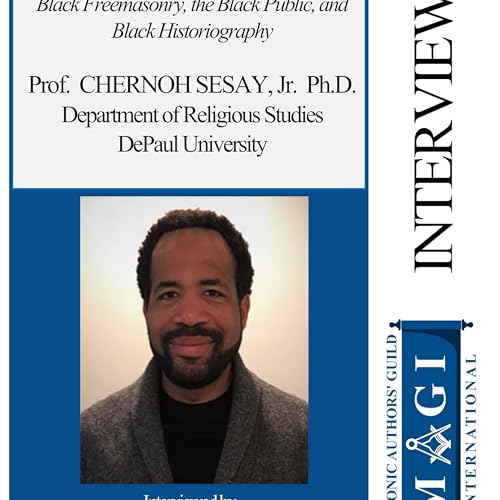
  • The Dialectic of Representation: Black Freemasonry, the Black Public, and Black Historiography: An Interview with Prof. CHERNOH SESAY, Jr. - SHORT
    May 4 2026

    Enjoy the first Eight Minutes of the Tenth Episode of THE WIDE MASONIC WORLD - Join hosts Robert Cooper and Mark Tabbert for a in-depth conversation with Prof. Chernoh M. Sesay Jr., Ph.D.. He is a Professor of Religious Studies at DePaul University, Chicago.

    The investment of African American Freemasonry in abolition, respectability,

    and literacy reflected an anxious intersection between dissent and incorporation.

    Furthermore, although the first black lodge represented a small and self-selected

    group, black Masonic thought described black identity in the broadest descriptive and

    discursive terms. In seeming paradox, the desire of black Freemasons to be respectable

    also reflected their demand for recognition as a function of abolitionism and

    historiographical revision. In consequence, the earliest African American lodge of

    Freemasons labored to occupy two opposing positions simultaneously, that of a

    counter-public and that of a universal public. This essay examines this tension to

    argue that the same traits that made black Freemasonry unique and novel- its narrow

    self-selection, its abolitionist origins, and its arguments in print- also structured its

    conscious drive to represent African Americans in debates about freedom, racial

    equality, and Masonic history.

    Published in The Journal of African American Studies, September 2013, Vol. 17, No. 3 (September2013), pp. 380-398

    Assoc. Prof. Chernoh M. Sesay, Jr., Ph.D. is an historian of the Black Atlantic and of colonial North American and antebellum United States history whose research focuses on the intersection of religion, black political thought, identity, and community formation. He is currently completing a book manuscript entitled Black Boston and the Making of African-American Freemasonry: Leadership, Religion, and Community in Early America. In this study, the early development of black Freemasonry, from its founder, Prince Hall, to its prominent antebellum member, David Walker, becomes a prism through which to consider various relationships between religion, gender, community, and interracial and black politics. He is also exploring how different forms of nineteenth and twentieth-century African American historicism were comprised of aligned and competing theological and secular concerns. He has published a book chapter in addition to articles in the New England Quarterly, the Journal of African American Studies, and the Forum for European Contributions to African American Studies. In addition to book reviews written for the Massachusetts Historical Review, H-Net Law, the Journal of the Early Republic, and the Journal of American History, Dr. Sesay has also written for Black Perspectives, the scholarly blog of the African American Intellectual History Society.


    Show More Show Less
    8 mins
adbl_web_anon_alc_button_suppression_c
No reviews yet