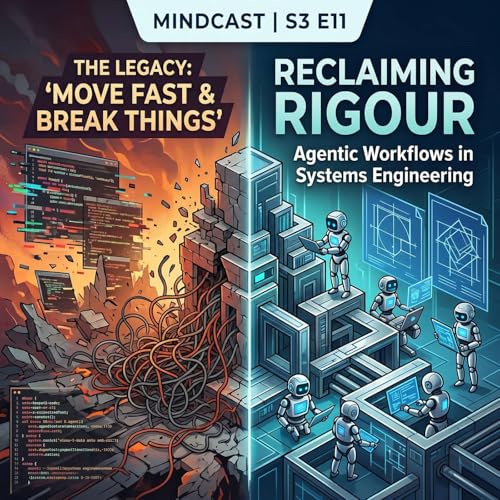
• Reclaiming Rigour | The Impact of Agentic Workflows on Systems Engineering
    May 8 2026

    Send us Fan Mail

    The Epistemological Crisis of "Move Fast and Break Things" and the Agentic SolutionI.

    The Problem: The Legacy of "Move Fast and Break Things"

    • The Paradigm: For over a decade, the software development industry has prioritized velocity and rapid iteration with the mantra to "move fast and break things". This focused on immediate execution and feature shipping over extensive architectural planning and long-term maintainability.
    • The Fallout: This ideology has caused a "slow-motion disaster" across global digital infrastructure, resulting in poorly performing, finicky legacy systems. These systems are burdened by high costs to replace and massive security vulnerabilities.
    • Calcified Fixes: Undocumented, temporary fixes have, over time, "calcified into permanent, load-bearing architectural walls," frustrating replacement efforts.

    II. The Demand for Rigor in Critical Systems

    • The Critique: Organizations like the International Council on Systems Engineering (INCOSE) argue there is an irreconcilable conflict between pure agile executions and the rigorous demands of critical systems engineering.
    • Life-Threatening Failure: In safety-critical domains (e.g., aerospace, medical devices, energy grids), the high defect rate of hyper-agile environments is unacceptable; lack of rigor results in catastrophic, life-threatening failure. For example, INCOSE noted a poorly calibrated ventilator could destroy a patient's lungs.
    • The Balance: The historical difficulty was balancing commercial demand for velocity with the ethical and operational mandate for safety. Rigorous systems engineering (extensive documentation, verification) was often viewed as an archaic bottleneck.
    • Modern Philosophy: The industry is moving past reckless abandonment, aiming to create environments that are "safe to fail," where failure triggers continuous improvement and root cause analysis.

    III. AI's Initial Impact vs. The Agentic Shift

    • Early AI as an Accelerator: Initial generative AI coding assistants worsened the crisis by acting as hyper-accelerators for the existing "move fast" mentality. They increased code volume but failed to improve structural rigor.
    • The Oversight: Early autoregressive models lacked persistent memory and holistic architectural awareness, enabling engineers to "break things faster" by producing code that lacked non-functional requirements like systemic security and compliance.
    • The Agentic Paradigm: Agentic workflows introduce a fundamental paradigm shift by using a multi-agent coordination model. AI acts as a control plane, orchestrating cross-team work, maintaining long-term contextual memory, and autonomously managing traceability.
    • The Potential: Agentic systems have the architectural potential to reintroduce "deterministic rigor" into software engineering, potentially reconciling the chaotic speed of the modern industry with the stringent, verifiable demands of traditional systems engineering.
    Show More Show Less
    13 mins
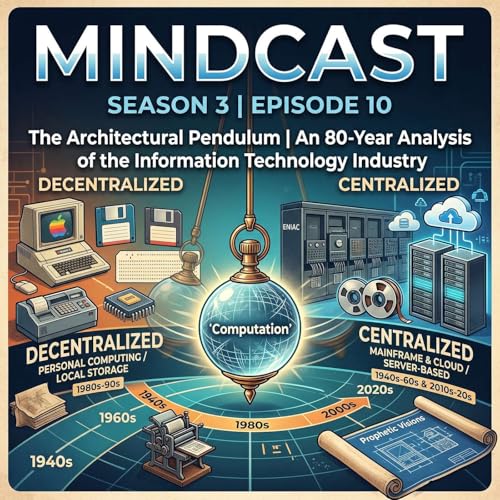
  • The Architectural Pendulum | An 80-Year Analysis of the Information Technology Industry
    May 6 2026

    Send us Fan Mail

    The Metamorphosis of Computing Architecture

    The trajectory of the Information Technology (IT) industry over the past eight decades represents one of the most profound, accelerated, and pervasive periods of technological evolution in the history of human civilisation. From the colossal, room-sized calculating engines of the 1940s to the ubiquitous, invisible infrastructure of modern hyper-scale cloud computing, the mechanisms by which humanity manages, processes, and disseminates information have undergone continuous revolution. This 80-year span is characterised not merely by the exponential increase in raw computational power, a phenomenon largely quantified and predicted by Moore’s Law, but by a violent, cyclical oscillation in underlying architectural philosophy. The industry has relentlessly swung back and forth between paradigms of centralised control and decentralised empowerment, continuously seeking the optimal balance between administrative efficiency, financial cost, security, and user autonomy.

    At the very heart of this historical evolution lies a fundamental, unresolved debate regarding the optimal locus of computational processing and data storage. Early computing was strictly centralised by necessity through the mainframe computer. The advent of the microprocessor democratised computing, distributing processing power and localised storage directly to the desktop via the Personal Computer (PC). However, as local networking matured, an architectural counter-revolution emerged in the 1990s. Championed by industry titans at IBM, Oracle, and Sun Microsystems, this movement argued fiercely that the "thin client" paired with a large, centralised back-end server represented the objectively superior enterprise architecture, heavily criticising the PC's localised storage and processing model as a financial and operational failure.

    Today, the total dominance of cloud computing appears, at first glance, to be a complete vindication and realisation of this centralised, thin-client vision. Yet, the modern cloud is vastly more nuanced than its predecessors, encompassing highly distributed edge networks, containerised micro-services, and elastic scalability. Simultaneously, the sheer breadth of software services and the fundamental manner in which humanity now manages information have triggered what can only be described as a "silent reformation". Much like the printing press altered the structural conditions of intellectual life and religious understanding during the Renaissance, the contemporary IT ecosystem has fundamentally rewritten the rules of commerce, communication, and human cognition. Astonishingly, the blueprints for this modern reality were not accidental; they were explicitly predicted, theorised, and mapped out by a handful of visionaries between 1945 and 1963. This podcast provides an exhaustive, granular examination of the IT industry's architectural shifts, the historic battle between local and server-based computing, and the prophetic visions that charted the course of this ongoing silent reformation.

    Show More Show Less
    26 mins
  • The Economics of Artificial General Intelligence | Capital Expenditures, Labour Cannibalisation, and the "Agent" Imperative
    May 1 2026

    Send us Fan Mail

    The pursuit of Artificial General Intelligence (AGI) has definitively transitioned from an exploratory computer science endeavor into a macroeconomic imperative driven by unprecedented financial commitments. Driven by leading technology conglomerates and heavily financed by complex debt instruments and venture capital, the generative artificial intelligence industry is currently executing the most aggressive infrastructure build-out in the history of global commerce. Yet, beneath the technological optimism lies a stark, mathematically rigid reality: the capital expenditures required to sustain and scale these models far exceed the revenue-generating capacity of traditional software-as-a-service (SaaS) and consumer subscription models.

    This structural deficit has catalyzed a profound strategic pivot among the leaders of the AI race. Unable to achieve a sustainable return on investment (ROI) through standard enterprise licensing or individual subscriptions, the industry has fundamentally reoriented its commercial thesis. The overarching objective is no longer to provide tools that merely augment human productivity; rather, it is to develop autonomous "AI agents" capable of wholly subsuming human employee roles. By positioning AGI as a direct substitute for human capital, technology providers intend to capture the trillions of dollars currently allocated to global corporate payrolls, thereby shifting enterprise investment away from human employees and redirecting it toward AI infrastructure suppliers.

    This comprehensive podcast analyses the financial mechanics driving this shift, the failure of the subscription model, the resulting cannibalisation of human payrolls to fund infrastructure, the existential economic implications of AGI on wage equilibrium, and the growing empirical evidence that the current generation of AI agents remains functionally incapable of executing this labour-replacement mandate, threatening a broader macroeconomic crisis.

    1. The AI Cost Curve Nobody's Talking About | by Praveer Concessao | Mar, 2026 | Medium, accessed on April 16, 2026, https://medium.com/@85.pac/the-ai-cost-curve-nobodys-talking-about-53e8071150c8
    2. U.S. GDP growth is being kept alive by AI spending 'with no guaranteed return,' Deutsche Bank says : r/Economics - Reddit, accessed on April 16, 2026, https://www.reddit.com/r/Economics/comments/1px8uc8/us_gdp_growth_is_being_kept_alive_by_ai_spending/
    3. AI isn't replacing jobs. AI spending is - Fast Company, accessed on April 16, 2026, https://www.fastcompany.com/91435192/chatgpt-llm-openai-jobs-amazon


    Show More Show Less
    16 mins
  • The Mechanics of Performative Uncertainty | Negotiating Pax Transactionalis and the Strategic Architectures of Allied Response
    Apr 28 2026

    Send us Fan Mail

    The contemporary geopolitical landscape has undergone a profound structural and philosophical paradigm shift in executive statecraft, characterised by the systematic weaponisation of erratic behaviour, rapid contradictions, and intentional informational saturation. Far from indicating administrative chaos or a breakdown in executive function, this approach represents a highly structured, behaviourally optimised, and aggressively executed doctrine of negotiation. Rooted deeply in the abrasive, zero-sum commercial real estate tactics of the 1980s, this methodology has evolved into a comprehensive framework for both international diplomacy and domestic consolidation. The resulting environment—increasingly termed Pax Transactionalis, replaces the historical stability of relational alliances with the performative uncertainty of mercantile exchange, leaving institutional allies and domestic regulators trapped in a perpetual cycle of rapid-fire crises.

    This comprehensive podcast deconstructs the mechanics of this reality distortion field. It investigates the underlying cognitive levers that make these tactics successful, including the Anchoring Effect, the strategic deployment of "truthful hyperbole," and the psychological exploitation inherent in the Illusory Truth Effect. Furthermore, the analysis explores the tactical fluidity of "flooding the zone", a methodology designed to induce systemic exhaustion among institutional adversaries and the public electorate. Finally, the report investigates the resulting clash between transactional and relational politics on the global stage, detailing how allied nations and institutional partners are developing complex strategic architectures, such as strategic autonomy, strategic indispensability, and firm boundary-setting, to survive the disorienting "washing machine" of modern coercive diplomacy.

    Show More Show Less
    17 mins
  • The Epistemic Shift #2 | Deep Research Artificial Intelligence as a Catalyst for Socratic Inquiry and Family Co-Learning
    Apr 24 2026

    Send us Fan Mail

    The integration of foundational Large Language Models and autonomous agentic workflows into the daily fabric of domestic and educational life represents a profound paradigm shift in cognitive development and sociological structures. Historically, the acquisition of knowledge during the formative years of childhood has been heavily mediated by human caregivers. This traditional pedagogical mediation is characterised by inherent social friction, shared discovery, and the frequent, necessary admission of epistemic limitations—most notably encapsulated in the phrase, "I don't know". As artificial intelligence rapidly evolves from passive search mechanisms into proactive, conversational, and seemingly omniscient entities, this foundational human limitation is being systematically eradicated from the developing child's informational ecosystem.

    However, alongside the documented risks of cognitive offloading and the atrophy of critical evaluation skills, a counter-paradigm is emerging that fundamentally redefines the human-computer interaction model. This new paradigm positions artificial intelligence not as an infallible oracle dispensing instant facts, but as an interactive "thinking partner" capable of facilitating boundless, iterative journeys of discovery. When deployed within the family unit through the structured framework of Joint Media Engagement, artificial intelligence possesses the potential to transcend the static limitations of traditional media. It moves beyond the simple "Ctrl-F" fact-retrieval mechanism, offering a dynamic, highly personalised environment for collaborative exploration. This comprehensive analysis explores the systemic societal impacts of artificial synthetic certainty, the neurobiology of productive struggle, the juxtaposition of bounded media versus deep research workflows, and the pedagogical frameworks required to transform artificial intelligence into an engine of profound, interactive intellectual development for the modern family.


    Show More Show Less
    19 mins
  • The Trajectory of Software Development | From Physical Mnemonics to Ambient Intelligence
    Apr 22 2026

    Send us Fan Mail

    The evolution of software engineering is fundamentally a history of cognitive offloading and architectural abstraction. Over the past five decades, the discipline has transformed from a labour-intensive process of manual hardware instruction into a high-level orchestration of intelligent, ambient systems. This historical trajectory can be precisely characterised by four distinct programming paradigms, each defined by the feedback loop between the human developer and the computational machine. By tracking this journey, from the rigid, paper-bound assembly mnemonics of the late 1980s, through the advent of visual notation and deterministic background compilation, and culminating in the probabilistic, data-intensive Artificial Intelligence collaborations of the modern era—a profound narrative of human-computer interaction emerges. The machine has steadily evolved from a passive, unyielding recipient of logical dictation into an active, collaborative partner in the creative engineering process.

    To establish a structural foundation for this analysis, the evolution of the developer feedback loop across these four paradigms can be categorized by observing the shifts in primary interfaces, feedback latency, error detection modalities, and the evolving role of the developer. The data mapping this transition demonstrates a continuous reduction in the latency of the developer feedback loop, shifting the human role from manual hardware instruction to high-level architectural orchestration.

    This podcast provides an exhaustive, rigorous analysis of this technological continuum. It examines the hardware constraints, operating system architectures, interface mechanics, and psychological shifts that have characterised each era of software development. By analysing the historical specificities of legacy systems such as the DEC PDP-11 and the ICL George operating systems, tracing the advent of secondary visual notation through colour line printers and syntax highlighting, exploring the deterministic background compilation of the third paradigm, and culminating in the data-intensive, AI-driven collaborative environments of the modern era, this analysis codifies the complete trajectory of the modern developer experience.


    Show More Show Less
    18 mins
  • The Active Intelligence Paradigm | Why the Artificial Intelligence Revolution Eclipses the Transistor, PC, and Smartphone Eras
    Apr 17 2026

    Send us Fan Mail

    The history of modern computing is frequently narrated as a seamless continuum of escalating capability, beginning with the silicon substrate of the transistor, maturing through the ubiquitous architecture of the personal computer, and culminating in the omnipresent connectivity of the smartphone. Yet, a rigorous historical and economic analysis reveals that these antecedent technologies, while foundational, share a fundamental ontological limitation: they are inherently passive tools. Furthermore, their historical emergence was anything but overnight. They stuttered into existence over decades, their trajectories heavily impeded by manufacturing bottlenecks, geopolitical protectionism, and zero-sum commercial litigation. The current revolution in artificial intelligence (AI) represents a foundational break from this historical pattern. By birthing a synthetic, active cognitive entity capable of autonomous reasoning and functioning as an engine of scientific discovery, AI eclipses previous technological paradigms in both its unprecedented velocity of adoption and its profound capacity for both existential opportunity and risk.

    Show More Show Less
    21 mins
  • The Human Substrate | Navigating the Cognitive Divergence and Our Role as the Glue Between AI Context Windows
    Apr 15 2026

    Send us Fan Mail

    The defining characteristic of the contemporary technological era is a fundamental, structural inversion of the relationship between human cognition and machine computation. For decades, the prevailing paradigm positioned artificial intelligence as a seamless extension of human capability, a highly advanced tool designed to augment a biologically fixed intellect. However, the rapid architectural evolution of Large Language Models (LLMs) and autonomous multi-agent systems has exposed a profound reality: artificial intelligence, despite its vast computational capacity, is inherently stateless, contextually blind, and devoid of continuous meaning. As the technical boundaries of machine memory expand at an exponential rate, it is the human operator who has become the critical "middleware" of the digital ecosystem. Humans function as the contextual glue, meticulously stitching together disparate, isolated windows of artificial reasoning to create coherent, goal-directed outcomes.

    This dynamic is not merely a poetic metaphor; it is an architectural and neurobiological reality. As machine capabilities scale into millions of tokens, human attentional endurance is demonstrably contracting, creating a profound asymmetry. To successfully navigate this new epoch, it is critical to rigorously examine the mechanics of machine context, the severe cognitive toll of automated delegation, the hidden costs of human-AI interaction, and the emerging agentic frameworks that seek to transform human operators from task executors into strategic orchestrators. Understanding why humanity remains indispensable requires a deep dive into both the limitations of synthetic reasoning and the irreducibly of biological intent.


    Show More Show Less
    14 mins