Episodes

  • Community College of Baltimore County
    Jan 30 2026

    Listen in as assistant professors Theresa Robinson and Melissa Lebowitz from the Community College of Baltimore County share the latest updates on their programs. From receiving a Feds2Eds grant to develop programming for displaced government workers to enter the teaching workforce to the Degrees to Succeed partnerships with nine institutions, CCBC is making great strides throughout educator preparation. They also have mock classrooms being set up on both the Essex and Catonsville campuses with all the latest technology that they expect to be ready for use this spring.

    Also discussed is how AI can be responsibly and ethically used in the classroom. This includes incorporating assignments that require the use of AI to create rubrics or to create letters that can be compared to one's own version.

    The conversation also turns to how the Baltimore County Public School System has created two programs to introduce middle school/junior high students to community college instructors, administrators, and athletes who look like them in order to show that their futures are wide open.

    Show More Show Less
    40 mins
  • Lone Star College
    Jan 16 2026

    In this first episode of 2026 NACCTEP chats with Rebecca Saiz - Executive Director of Lone Star College Educator Preparation Program, Dr. Christina Puente - Department Chair, and Dr. JeQuila Broussard - Lead Field Supervisor from Lone Star College about how they've transitioned from a checklist driven evaluation system for teacher candidates to a reflective system. This new method allows the college supervisor to become a coach guiding and encouraging the teacher candidates on their journey to becoming an effective teacher. As part of the transition, a common vocabulary comes into play so that both the supervisors and the teachers can communicate successes, expectations, and room for improvement, or "Glow, Grow, and Go" as they've termed it.

    A further discussion of this system will be held at an interactive roundtable during the NACCTEP Pre-Conference in New Orleans on the afternoon of February 19, 2026. For further information on the 2026 NACCTEP Pre-Conference, please visit https://www.nacctep.org/professional-development-events/2026-pre-conference

    Show More Show Less
    30 mins
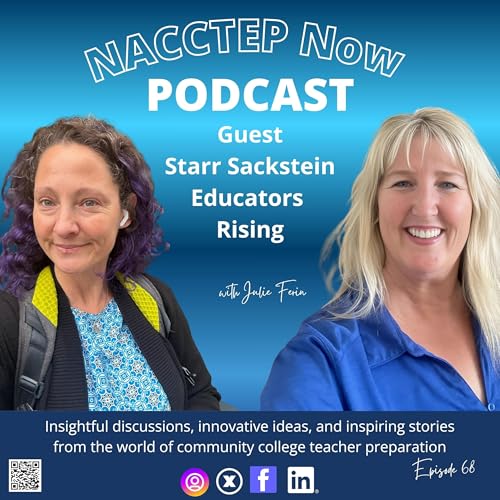
  • Starr Sackstein of Educators Rising
    Dec 19 2025

    In this episode we hear from Starr Sackstein of Educators Rising. Ms. Sackstein is a National Board Certified teacher with over 20 years experience in education. In addition to numerous books which you can find in the NACCTEP Book List, Ms. Sackstein also writes a column for the Kappan Magazine called Career Confidential.

    Ms. Sackstein shares the extensive ways that Educators Rising introduces potential teachers to the field beginning in middle school and high school and supporting their continued studies in college as well. From curriculum, to micro-credentials, to scholarships and competitions at the state and national levels, Educators Rising helps students explore the teaching field.


    mssackstein.com

    Kappanonline.org

    Kappanonline.org/category/career-confidential/

    NACCTEP Book List

    Show More Show Less
    46 mins
  • Dr. Scott Bailey of the American College of Education
    Oct 31 2025

    Dr. Scott Bailey, Assistant Provost of Education Programs at the American College of Education (ACE) joins us to discuss the partnership between ACE and Rio Salado College, specifically in regards to educator preparation students. Dr. Bailey praises the enthusiasm that Rio Salado has for their partnership and how that is reinforced by the collaborative and seamless nature of what ACE offers students completing Rio Salado's teacher preparation post-bacc programs. Through this partnership, students moving on to ACE for a masters degree in education are able to complete the degree in as little as one year and for well under $10k.

    The other benefits of ACE's education programs, both at the masters and doctoral levels, is that they are designed and taught by educators for educators. This allows students to have confidence not only in the applicable nature of what they are learning, but also in knowing that their instructors understand the day-to-day challenges of being a teacher. To learn more about ACE and their many degree offerings, please visit ACE.edu.

    Show More Show Less
    27 mins
  • Dr. Melodie Baker of Impact Stats
    Oct 17 2025

    In this episode we hear from Dr. Melodie Baker of Impact Stats on how community colleges can use data to adapt and continuously improve educator preparation programs. Of particular interest is the teaching of math. With many candidates unable to pass the math portion of licensing exams, even if they've taken developmental math courses, there is clear evidence that focusing on a co-requisite model is more effective in boosting the math skills of teacher candidates and of all students.

    Data can also be used to identify equity gaps in academics as well as funding areas and allowing colleges to address these issues. This is critical at the community college level which can have such a positive impact on diversifying and localizing the teacher workforce. You can learn more about Impact Stats and their work at impactstats.org.

    Show More Show Less
    31 mins
  • Literacy Partners Project
    Oct 3 2025

    Stacy Wilson and Dr. Alex Arreguin, both of whom are English faculty at Mesa Community College in Arizona, created the Literacy Partners Project out of a sense of curiosity for what their English 101 and 102 students were learning in other courses. Specifically, if their students were able to use the concepts they were teaching to complete coursework in history, science, math, and other courses. As they met with instructors from other disciplines they adapted a concept that Dr. Elizabeth Wardle from Miami University of Ohio had implemented.

    By developing a series of writing across disciplines frameworks that included utilizing threshold concepts, knowledge transfer, and decoding the disciplines, they were able to not only develop student success initiatives, but also apply these frameworks to program and college departments. On the faculty development side, they used the decoding the disciplines approach to bring together colleagues from different disciplines and departments to work together to help solve the challenges each faced by offering new perspectives.

    Show More Show Less
    1 hr and 1 min
  • Indigenous Education Organizations & Tribal Colleges
    Sep 19 2025

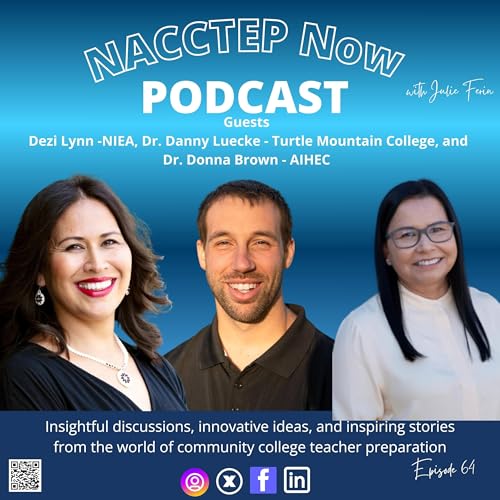
    We welcome the perspectives of Dezi Lynn, Educator Initiative Manager for the National Indian Education Association - NIEA, Dr. Donna Brown, Vice President of Sponsored Programs for the American Indian Higher Education Consortium - AIHEC, and Dr. Danny Luecke, Secondary Math Education Faculty at Turtle Mountain College, on the nuances of Indigenous Teacher Preparation. Each of our guests share their journeys to becoming teachers and to their current positions.

    Listen in as we learn how native cultures and languages are honored in teacher preparation programs. Numerous books and resources are mentioned throughout this episode and can be found on the NACCTEP Book List. Additionally, the NIEA offered a series of webinars over the late spring to early summer of 2025 that can be found on their website at https://www.niea.org/webinars

    Show More Show Less
    50 mins
  • CUNY Series - Dr. Anthony E. Munroe of Borough of Manhattan Community College
    Sep 12 2025

    For the Borough of Manhattan Community College episode in NACCTEP Now's CUNY series we talk with President Dr. Anthony E. Munroe. As the largest undergraduate school in the CUNY system as well as one of the largest Hispanic Serving Institutions in the Northeast, BMCC is situated in lower Manhattan near Wall Street, the United Nations, and where the World Trade Center once stood. The location is "a prime position to develop educators with a global perspective."

    Partnerships with local performing arts centers help future educators to learn how to incorporate art into the classrooms and lessons, the A in STEAM. On the STEM side, BMCC started a Women in STEM program to encourage and mentor women entering the field, as well as being a part of the New York HSI STEM Hub and the Pipeline Opportunity for Intercollegiate STEM Education with NYU. In BMCC's teacher education programs, integrated technology is emphasized so that future teachers can seamlessly incorporate new and future technologies into their classrooms. Some practicum and student teaching placements include co-teaching and designing lessons for both hybrid and fully online settings.

    Additionally, Dr. Munroe shares that BMCC is "an environment where every student feels seen, valued, and supported, regardless of [their] background." Part of this includes programs specifically for first generation students as well as programs such as the New York State Opportunity Promise Program which provides free tuition for students over the age of 25 attempting their first college degree and the CUNY Reconnect Program which waives tuition and fees for students over 25 who are returning to complete a degree they had previously started and stepped away from.

    Show More Show Less
    23 mins