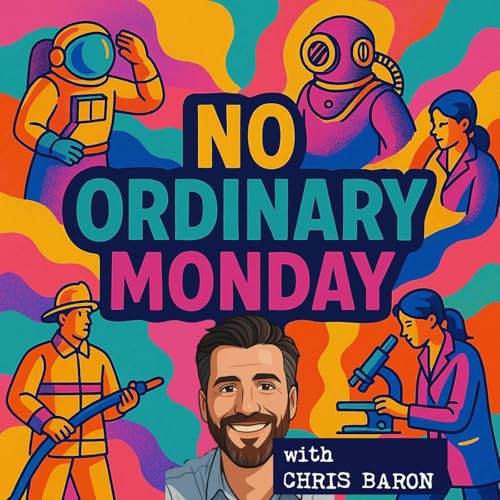
No Ordinary Monday cover art

No Ordinary Monday

No Ordinary Monday

Written by: Chris Baron
Listen for free

About this listen

The No Ordinary Monday podcast brings you the most incredible tales from people's working lives. Each week, we meet someone whose work is anything but ordinary - they may be clearing landmines, blowing up movie sets, or exploring uncharted caves.

We dive into the how, the why, and a life-defining moment they’ve experienced on the job. Whether it’s spine-tingling, hilarious, or just plain jaw-dropping, their stories will challenge what you thought a “career” could be—and maybe even change the way you think about your own.

Chris Baron
Social Sciences
Episodes
  • Surviving Afghanistan and Other War Zone Stories (Foreign News Correspondent) - PART TWO
    May 3 2026

    Melanie Marshall spent over 20 years as a BBC foreign news journalist and war correspondent, covering the most volatile conflict zones on the planet. This is part two of her conversation on No Ordinary Monday, and this is where she shares her No Ordinary Monday story.


    Afghanistan. 2012. Melanie and her team are unembedded, crisscrossing the country in low profile vehicles, operating in 10-minute windows on the streets of Kandahar before the Taliban can mark their position. They have access most journalists never get. A general who writes poetry. A warlord who lets them join his morning workout.


    But at the end of three weeks, the roads back to Kabul are so dangerous that even the NGOs won't travel them. What Melanie decides that day is something that still gives her a pit in her stomach.


    After the story, the conversation goes somewhere just as compelling. Melanie talks about what two decades of witnessing war up close actually does to a person, why she still believes humanity is not doomed to its darkest impulses, and what she saw at a car bomb site in Syria that she will never forget. She also shares her practical advice for anyone who wants to break into foreign news today, including why a degree is not what you think it is, why your biggest competition is not who you think it is, and why an ethos matters more than a CV.


    This is Part 2 of a two-part conversation. If you haven't listened to Part 1 yet, start there.


    Connect with Melanie:

    WEBSITE: melaniemarshall.com

    LINKEDIN: linkedin.com/in/melanie-marshall-237a641

    YOUTUBE: ⁠youtube.com/@MDMarshall⁠

    TIKTOK: @melaniemspeaks

    X/Twitter: @mdmarshall

    SUBSTACK: substack.com/@imrama


    CREDITS

    Guest: Melanie Marshall. Former BBC Foreign News Journalist and Producer, Hostile Environment Specialist, 20+ years covering conflict zones across Afghanistan, Iraq, Yemen, Tunisia and beyond.

    Host, Producer and Editor: Chris Baron

    Music: Music_Unlimited and Saavane

    Sound effects: Pixabay and FreeSound

    Podcast Access: ⁠https://pods.link/noordinarymonday⁠


    SUPPORT US - NOM is a 100% independent show. Help us keep the lights on by buying us a coffee (or a beer) - ⁠https://buymeacoffee.com/noordinarymonday⁠. We're deeply grateful for any level of support.

    SHOW US SOME LOVE - click five-stars on whatever platform you're on, and leave us a review, or tell a friend about the show.

    WANT TO BE A GUEST? You can submit your own career story through our website at ⁠www.noordinarymonday.com⁠, or email us at ⁠hello@noordinarymonday.com⁠.


    Topics: foreign news journalism, BBC, war zone reporting, hostile environment journalism, conflict reporting, Afghanistan, Taliban, unembedded journalism, Kandahar, Kabul, buskashi, risk assessment, decision making under pressure, storytelling, press freedom, resilience, hope

    Show More Show Less
    47 mins
  • Mooning Islamic State and Other War Zone Stories (Foreign News Correspondent) - PART ONE
    Apr 27 2026

    Melanie Marshall spent over 20 years as a BBC foreign news journalist and war correspondent, covering the most volatile conflict zones on the planet. Afghanistan, Iraq, Yemen, Tunisia, Honduras. Her job was to get the team in, get the story out, and get everyone home safely. No playbook. Just problem solving under pressure, sometimes under fire.


    What most people don't see when they turn on the news is everything that happened before those two minutes of footage aired. The permissions that were never granted. The checkpoints that wouldn't budge. The moments where the only way through was to outlast whoever was standing in your way.


    In this episode Melanie pulls back the curtain on what war zone journalism and foreign news production actually looks like from the inside. She talks about negotiating access to an MS-13-controlled prison in Honduras, staring down the black flag of Islamic State in northern Iraq, and what two decades of conflict reporting taught her about staying present when everything around you is falling apart.


    This is Part 1 of a two-part conversation with a BBC war correspondent. Part 2 is where she shares her No Ordinary Monday story.


    Connect with Melanie:

    WEBSITE: melanieamarshall.com

    LINKEDIN: linkedin.com/in/melanie-marshall-237a641

    YOUTUBE: youtube.com/@MDMarshall

    TIKTOK: @melaniemspeaks

    X/Twitter: @mdmarshall

    SUBSTACK: substack.com/@imrama


    CREDITS

    Guest: Melanie Marshall. Former BBC Foreign News Journalist and Producer, Hostile Environment Specialist, 20+ years covering conflict zones across Afghanistan, Iraq, Yemen, Tunisia and beyond.

    Host, Producer and Editor: Chris Baron

    Music: Paulyudin, Music_Unlimited and Saavane

    Sound effects: Pixabay and FreeSound

    Podcast Access: https://pods.link/noordinarymonday


    SUPPORT US - NOM is a 100% independent show. Help us keep the lights on by buying us a coffee (or a beer) - https://buymeacoffee.com/noordinarymonday.

    We're deeply grateful for any level of support.

    SHOW US SOME LOVE - click five-stars on whatever platform you're on, and leave us a review, or tell a friend about the show. WANT TO BE A GUEST? You can submit your own career story through our website at www.noordinarymonday.com, or email us at hello@noordinarymonday.com.


    Topics: foreign news journalism, BBC, war zone reporting, hostile environment journalism, conflict reporting, news production, Iraq, Afghanistan, Honduras, MS-13, Islamic State, media industry, storytelling, press freedom, resilience

    Show More Show Less
    45 mins
  • How to Recruit a Spy (FBI Counterintelligence Agent)
    Apr 20 2026

    What does it take to get a foreign spy to help another country? According to Robin Dreeke, it has nothing to do with pressure, leverage or manipulation. It comes down to one thing, making the other person feel genuinely understood.

    Robin spent 22 years inside the FBI, eventually leading theBureau's elite Counterintelligence Behavioral Analysis Program. His primary mission was recruiting foreign intelligence officers to work as assets for the United States. Russian military intelligence. Diplomats at the UN. Sources buried so deep inside foreign networks that their existence will likely neverbe publicly acknowledged.

    Then came September 11th 2001. Robin was blocks away fromthe towers when they were hit. What he witnessed that morning, and what he was asked to do in the weeks and months that followed, changed the trajectory of his entire career.


    Within 24 hours of the attacks, Robin had pivoted his entire source network away from Cold War targets and toward a crisis no one had a playbook for. What came out of that pivot was a series of operations that Robin believes contributed to preventing conflict between nuclear powers, all builton the same foundation he had been quietly developing his entire career, the ability to make someone trust him with their life.

    In this episode Robin breaks down the human psychologybehind why people cooperate, what Russian intelligence officers and foreign diplomats actually wanted when they agreed to risk everything, and why the FBI agents who recruited the most valuable sources were almost never the ones you'dexpect.


    WEBSITE: robindreeke.com

    BOOKS: It's Not All About Me | The Code of Trust | SizingPeople Up | Unbreakable Alliances

    SOCIAL MEDIA: Instagram | LinkedIn | Youtube | X/Twitter: @rdreeke, Facebook: @PeopleFormula

    PODCAST: Hidden Killers with Tony Brueski (co-host)

    CREDITS:

    Guest - Robin Dreeke. Retired FBI Special Agent & Chiefof the Counterintelligence Behavioral Analysis Program, US Marine Corps Veteran, Bestselling Author & Human Behaviour Expert

    Host, Producer and Editor - Chris Baron

    Music - OpenMindAudio, Music_Unlimited and Saavane

    Sound effects - Pixabay and FreeSound

    Podcast Access - https://pods.link/noordinarymonday

    TOPICS: FBI counterintelligence, spy recruitment, 9/11eyewitness, building trust without manipulation, behavioral analysis, human motivation, national security, rapport building, active listening, confidential human sources, Cold War intelligence


    SUPPORT US - NOM is a 100% independent show. Help us keep the lights on by buying us a coffee (or a beer) - https://buymeacoffee.com/noordinarymonday. We're deeply grateful for any level of support.

    SHOW SOME LOVE - click five-stars on whatever platform you're on, and leave us a review, or tell a friend about the show.

    WANT TO BE A GUEST? You can submit your own career story through our website at www.noordinarymonday.com, or email us at hello@noordinarymonday.com.

    VISIT THE WEBSITE - Noordinarymonday.com

    SOCIALS - https://linktr.ee/Noordinarymonday

    Show More Show Less
    56 mins
adbl_web_anon_alc_button_suppression_c
No reviews yet