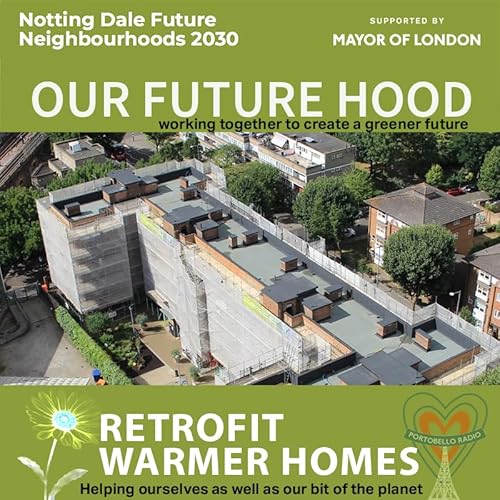
Our Future Hood cover art

Our Future Hood

Our Future Hood

Written by: Portobello Radio
Listen for free

About this listen

Our Future Hood is a series of shows produced by Portobello Radio to look at the ways community, council and social enterprises are working together in North Kensington to create a greener future for residents and at the same time saving some money and our bit of the planet. The shows look at issues like the zero waste kitchen, mindful gardening, better recycling and active travel with conversation, facts and tips. It is born out of the Notting Dale Future Neighbourhoods 2030 Project, supported by Mayor of London, which aims to develop a blueprint that can be replicated across London and the rest of the country.© 2024 Hygiene & Healthy Living Nature & Ecology Science Social Sciences
Episodes
  • Schools Lead The Way
    Jan 15 2026

    Notting Dale in RBKC is one of two wards chosen to develop solutions to create a greener future, as part of the Mayor of London’s Future Neighbourhoods 2030 programme. Schools are at the forefront of the project. How are they doing that? We asked pupils at Thomas Jones Primary School how local schools are leading the way on climate action — cutting emissions, improving air quality, and inspiring young people to care for the planet. Through the Future Neighbourhoods 2030 programme, schools are tackling climate change head-on — from solar energy and flood prevention to greening and clean air project.

    We brought together Headmasters David Sellens (Thomas Jones) and Ben McMullen (Avondale Park), Cllr Catherine Faulks, Lead Member for Family & Children's Services at RBKC, and Anca Giurgiu, senior manager Notting Dale Future Neighbourhoods Team to discuss how climate action can be practical, local, and deeply educational. By working together — schools, the Council, and the community — we’re creating greener, healthier learning environments for future generations.

    It’s inspiring to see how schools, the Council, and local partners are working together to make a real difference — not just in buildings and infrastructure, but in how young people think about the planet and their role in protecting it.

    Show More Show Less
    35 mins
  • Retrofit Warmer Homes
    Jan 15 2026

    In this episode, we examine how homes in Notting Dale are being retrofitted to be warmer and more energy efficient, helping ourselves as well as our bit of the planet. We brought together Cllr Johnny Thalassites, Lead Member for Environment and Planning at RBKC, James Caspell of Lancaster West Neighbourhood Team, Jill Brown who has recently stepped down as head of the Resident Association at Henry Dickens, and Mushtaq Lasharie CBE, chair of LWRA.

    In October 2019 the Royal Borough declared a “Climate emergency” and set a target for the Council’s own operations and buildings to achieve net zero emissions by 2030. This target includes emissions from Council owned social housing estates, schools and operational buildings, fleet activities, street lighting, waste collection and parks maintenance service. Housing accounted for 73% of the Council’s total emissions in 2022, and Notting Dale has 20% of the borough’s social housing.

    All three large estates in Notting Dale are over 50 years old: Henry Dickens was built in the early 50s; Lancaster West and Silchester were both constructed at the same time as the Westway, in the early 70s. They all have issues with inadequate insulation and the cost of energy supply. But residents have fought hard to preserve these homes and their communities, so knocking them down and rebuilding is not an option.

    We hear how community energy, local jobs, and innovation can shape the next phase of the drive to achieve net zero by 2030. It can be a disruptive process, but local homes are being made warmer and greener through retrofitting

    Show More Show Less
    40 mins
  • Flooding
    Jan 15 2026

    In this episode we are looking at flooding and in particular at the flash floods of July 2021 which had devastating effects on homes, businesses and schools. Portobello Road became a river in minutes and it became national news. We brought together Fiona Fleming-Brown from Portobello Flood Action Group and James Latham from RBKC to discuss the challenges and solutions, plus we talk to headmasters David Sellens (Thomas Jones) and Ben McMullen (Avondale Park) whose schools were flooded; to James Burton, the Council's tree expert, and to Sarah Cross of Lancaster West's Neighbourhood Team, who oversaw the creation of a rain garden in Verity Close.

    Climate change means London can expect more intense, heavy downpours, even if summers become drier overall. Kensington and Chelsea has the highest number of properties at risk of surface water and sewer flooding in the whole of London, especially basements. Notting Dale is particularly at risk. Water from other parts of London gravitates here and we have a high proportion of hard surfaces which feed the water into the Victorian drainage systems.

    Show More Show Less
    40 mins
No reviews yet