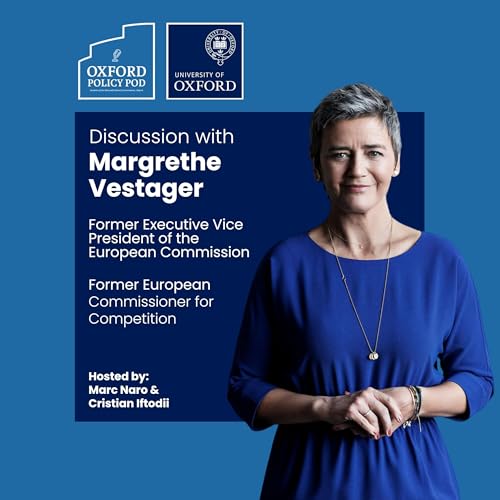
• Moving Europe Forward | Margrethe Vestager
    May 11 2026

    In this episode of the Oxford Policy Pod, Master of Public Policy students Marc Naro and Cristian Iftodii sit down with Margrethe Vestager, former Executive Vice-President of the European Commission and one of Europe’s leading voices on competition and digital policy.

    The conversation explores some of the defining challenges of our time — from artificial intelligence and climate change to economic security and the future of the international order. Drawing on her years at the heart of European decision-making, Margrethe Vestager shares her vision for how Europe can navigate technological transformation while defending democratic values and global cooperation.

    Recorded at the Blavatnik School of Government, University of Oxford.

    Show More Show Less
    40 mins
  • The Future of International Law | A Discussion with Professor Philippa Webb KC
    May 7 2026

    In a time when international law is increasingly being tested, challenged, and at times openly undermined, we speak with Professor Philippa Webb KC about the pressures facing the international legal order and the future of global governance. Drawing on her work across academia, legal practice, and international institutions, she reflects on whether the current moment represents a genuine crisis for international law, or part of a longer pattern of contestation and adaptation within the international system.

    The conversation explores the role of international courts in an era of selective state compliance, the tension between geopolitical realism and multilateral cooperation, and how institutions can remain effective and legitimate amid growing international instability. We also discuss technology’s impact on justice, the resilience of international institutions under strain, and her idea of “incremental creativity” — the belief that meaningful reform can still emerge from within existing legal frameworks, even during periods of profound uncertainty.

    Show More Show Less
    48 mins
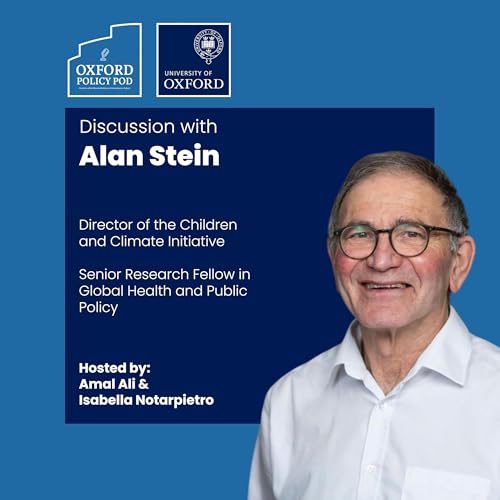
  • A Children-Focused Approach to Climate Policy | A Discussion with Alan Stein
    May 3 2026

    In this episode of the Oxford Policy Pod, MPP students Amal Ali and Isabella Notarpietro speak with Professor Alan Stein, Director of the Children and Climate Initiative and Senior Research Fellow in Global Health and Public Policy at the Blavatnik School of Government. An expert in early childhood development with over 300 scientific journal publications, Alan has worked throughout his career with children and families facing adversity. He has made major contributions from both scientific and clinical perspectives to understanding the relationship between parents in adversity and their babies.

    This episode explores the intersections between climate change and children’s health. Starting with a discussion of the unique ways in which climate change impacts children, both globally and across different regions, it then examines approaches to policymaking that foreground their experiences and incorporate their voices.

    The conversation also explores the Children and Climate Initiative, a groundbreaking new research and policy development collaboration led by Alan. The Initiative aims to show how climate change negatively impacts children’s health outcomes, anticipate where these effects will be most severe in the future and work with policymakers to translate these insights into policy responses. We discuss how the Initiative is contributing to increasing attention to the health impacts of climate change, particularly for children, on the global stage.

    Show More Show Less
    38 mins
  • Between Giants: How Small Caribbean States Can Respond to Global Shocks | Hon. Mark Brantley
    May 1 2026

    In this episode of the Oxford Policy Pod, MPP Student from Saint Lucia in the Caribbean, Rahym R. Augustin-Joseph, sits with Hon. Mark Brantley, Premier of Nevis, and Leader of the Opposition in the Federation of St. Kitts and Nevis, in the Eastern Caribbean.

    Premier Brantley serves as Premier of Nevis and Leader of the Opposition in the National Assembly of Saint Kitts and Nevis. Brantley previously held the post of Minister of Foreign Affairs from 2015 to 2022. Before entering politics, he built a career as an attorney engaged in international litigation.

    In this episode, we address the known fact, which is that the Caribbean and Small States, are deleteriously affected by global shocks between world powers, not of their making, such as climate change, wars, geopolitical tensions, policy shifts, and a growing rightward trend among states that affects migration, international multilateral assistance and the rules based order that have protected their sovereignty.

    However, one cannot as said in the Caribbean, ‘lay down and play dead’, but instead, the Caribbean must employ a suite of policy and diplomatic measures that can insulate them from these global shocks, while using these windows to transform their societies. This episode addresses some of these measures that Premier Brantley believes can be done, while still focusing on what he has attempted to do in Nevis to transform.

    Show More Show Less
    49 mins
  • A Discussion with Renato Godihno: Can Multilateralism end Global Hunger and Poverty
    Apr 28 2026

    In this episode of the Oxford Policy Pod, MPP students Cristian Iftodii and Ana Luiza Barbosa speak with Renato Domith Godinho, Director of the Support Mechanism of the Global Alliance Against Hunger and Poverty. A Brazilian diplomat with over twenty years of experience in multilateral governance, Renato has played a leading role in shaping international development cooperation, including in the reform of the UN Committee on World Food Security and the establishment of the Biofuture Platform. He now leads the Alliance's secretariat, based at FAO headquarters in Rome, coordinating the work of more than 200 members across 103 countries.

    The conversation explores whether multilateralism is still capable of solving the world's most persistent problems, and what it would take to move from political commitments to real outcomes for the hundreds of millions still living in hunger and extreme poverty. We discuss the design of the Alliance, the role of Brazil and the Global South in reshaping the development agenda, and the gap between what governments promise and what they deliver.

    Renato also reflects on the politics of hunger as a structural choice rather than an inevitability, the strengths and limits of the current multilateral architecture, and what an Alliance built around country leadership rather than donor priorities can achieve. The discussion closes with his thoughts on what the next decade of development cooperation should prioritise, and what role rising middle powers can play in shaping it.

    Show More Show Less
    37 mins
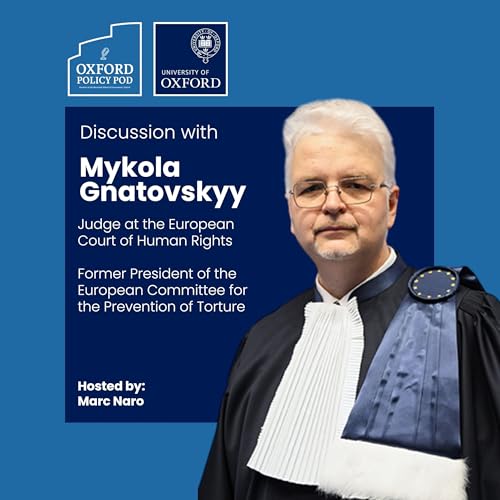
  • Can International Law Deliver Justice for Ukraine? with Judge Mykola Gnatovskyy (ECHR)
    Apr 13 2026

    In this episode of the Oxford Policy Pod, MPP student Marc Naro sits with Judge Mykola Gnatovskyy, Ukrainian Judge at the European Court of Human Rights.

    Judge Gnatovskyy was elected to the European Court of Human Rights in June 2022. He previously served as President of the Council of Europe's Committee for the Prevention of Torture, as an academic partner of the International Committee of the Red Cross, and as Associate Professor of International Law at the Taras Shevchenko National University of Kyiv.

    The conversation addresses the functioning of the European Court of Human Rights and the role of a judge within it, the evolving case law on Russia's accountability following the judgment in Ukraine and the Netherlands v. Russia of July 2025, and the legal implications of Russia's expulsion from the Council of Europe in 2022. It also examines the Special Tribunal for the Crime of Aggression established within the Council of Europe framework, the independence of international judges and the pressures they currently face, and the prospects for justice and reparation for the Ukrainian people.

    Show More Show Less
    51 mins
  • Politics, Platforms and Public Engagement | A discussion with Hannah Ferguson
    Apr 7 2026

    In this episode of the Oxford Policy Pod, MPP students Thenu Herath and Florence Guyomar speak with Hannah Ferguson, co-founder and CEO of Cheek Media Co, an Australian independent news commentary platform reshaping how people engage with politics and culture.

    Hannah is also the co-host of Big Small Talk and the bestselling author of Bite Back and Taboo. Her work spans journalism, law and media, with writing featured in outlets including The New York Times and The Guardian.

    The conversation explores how platforms are transforming political engagement and how Cheek Media bridges politics and pop culture to make public discourse more accessible. We explore the role of algorithms in shaping political engagement, the tension between engagement and quality, and the extent to which creators can push back against platform incentives. Hannah discusses the need for greater transparency and accountability in digital platforms, what effective regulation might look like, and her vision for the future of political media.

    Finally, the discussion turns to Hannah’s decision to run as an independent in the next federal election, including what it means to move from commenting on politics to participating in it.

    Show More Show Less
    18 mins
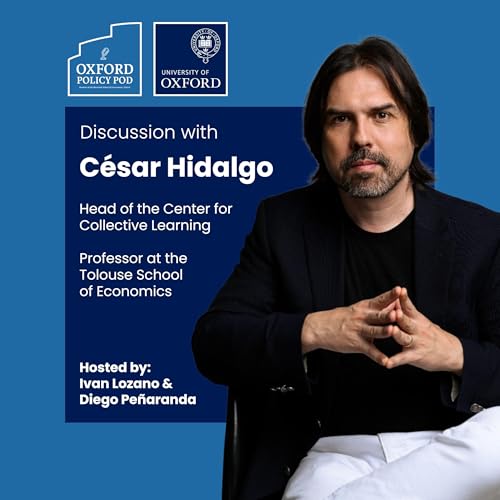
  • How Knowledge Drives Economic Growth | César Hidalgo
    Apr 3 2026

    In this episode of the Oxford Policy Pod, MPP students Diego Peñaranda and Iván Lozano speak with Professor César Hidalgo, a physicist, complexity scientist, and one of the leading thinkers on knowledge and development.

    Professor Hidalgo is a tenured professor at the Toulouse School of Economics and leads the Center for Collective Learning. He is widely recognized for co-developing the Economic Complexity Index and for his research on how knowledge shapes growth.

    The conversation explores his intellectual journey from physics to economics, and his central idea that development depends on expanding what societies know how to do. Drawing on his latest book, The Infinite Alphabet, Hidalgo explains how knowledge grows, spreads, and is sometimes lost, and what this means for public policy.

    The episode also discusses how countries can build capabilities, the role of talent and networks, and the potential impact of artificial intelligence on knowledge and decision-making.

    Show More Show Less
    54 mins