• How Do You Mobilise A Nation For Nature? (With Vicki Connor, Department of Conservation)
    Apr 15 2026

    How do you mobilise a nation for nature?

    Most New Zealanders say nature matters to them. But care alone isn’t creating the level of action needed to protect it.

    In this episode, we sit down with Vicki Connor, Chief Advisor Public Affairs at the Department of Conservation, for a deep dive into DOC’s “Always Be Naturing” campaign - the public-facing platform for its wider Mobilising for Nature programme.

    Informed by audience research, the campaign is built around a persistent challenge: if people already care, how do you turn that care into meaningful action at scale?

    The research also revealed a disconnect - most New Zealanders believe nature is doing relatively well. In reality, the situation is far more fragile, with 4,000+ native species threatened or at risk of extinction.

    We unpack what the campaign is actually trying to do, why DOC chose to broaden the frame from “conservation” to “naturing”, and how connection to nature can become a more accessible entry point for the people and businesses who care but don’t yet know where they fit in.

    We also explore more broadly how nature should be communicated in Aotearoa if we want to reach beyond the already-converted and make it easier for communities, businesses, and everyday people to participate.

    This conversation is especially relevant for people working in conservation, communications, behaviour change, community engagement, and anyone curious about where nature storytelling in New Zealand is heading next.

    Here are some of the key topics we discussed:

    • What Always be Naturing is and how it fits into DOC’s wider Mobilising for Nature programme
    • Why the gap between caring and doing is such a major challenge
    • How research and audience insights informed this campaign
    • Why DOC is focusing on connection, relevance, and everyday action
    • Reaching younger and urban audiences without losing the bigger picture
    • Changing perceptions about the state, role and value of nature in our everyday lives and society
    • And much more…

    Love the People Helping Nature Podcast? Get notified when new episodes go live - subscribe for emails here: https://ww.conservationamplified.org

    👩About Vicki:

    Vicki is a Londoner who proudly calls Wellington home these days. She’s spent her career working across communications, marketing, brand, and behaviour change programmes both in and out of the public sector. Nature and the environment are her thing. She spent five years as Director Communications and Engagement at the Ministry for the Environment, before heading to DOC as the Director of Customer Engagement. Now in the Chief Advisor role, Vicki works across Public Affairs and is leading DOC’s programme to mobilise New Zealanders for nature – a project she describes as the most exciting thing she has ever had the privilege to be a part of. Her happy place is getting sweaty in nature. Her favourite bird is the kaka, although she is quite partial to a blackbird.

    🔗Learn more:

    • Website: https://www.doc.govt.nz
    • Instagram: https://www.instagram.com/docgovtnz
    • Facebook: https://www.facebook.com/docgovtnz

    🎙️Learn more about the podcast at www.conservationamplified.org

    Show More Show Less
    39 mins
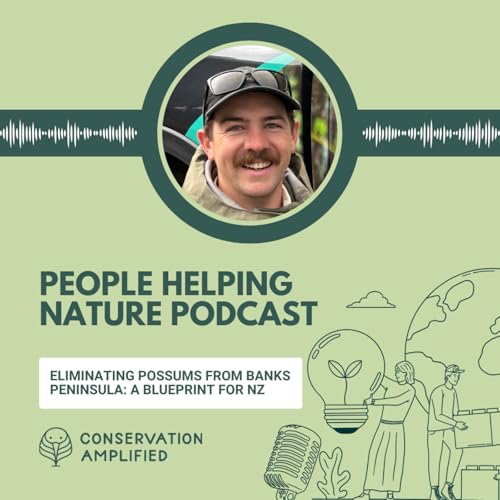
  • Eliminating Possums From Banks Peninsula: A Blueprint For NZ (with Ollie Rutland-Sims, Pest Free Banks Peninsula)
    Apr 6 2026

    Australian brush-tail possums are one of the most widespread and damaging introduced pests in Aotearoa New Zealand, with an estimated ~30 million around the country.

    They are wreaking havoc on both our native plants and animals, and they put pressure on our ecosystems, farms, and the wider economy. Most of the time, we respond by suppressing possum numbers. But on Banks Peninsula, a different approach is taking shape.

    In this episode, we sit down with Ollie Rutland-Sims from Pest Free Banks Peninsula to learn about their possum elimination programme: A bold mission, strategically working to drive possum numbers to zero in their area under the ethos that “offence is the best defence”.

    As Ollie explains, “we're now dealing with quite a legacy problem and a population that really, the only checks and balances on it are coming from human inputs”

    Ollie shares Pest Free Banks Peninsula’s 4-stage elimination strategy: Knock-down → mop-up → surveillance → and lastly the defence phase after a block of land has been declared possum-free.

    It’s an approach that’s working, with 5,800 hectares already declared possum-free - and could be used as blueprint for possum elimination throughout the country.

    We also talk about mindset and the need to constantly deliver professional, spot-on work for this elimination approach to work: Continuous learning about your target species and constant improvments are key to success.

    Amazingly the benefits of this mahi reach far beyond positive biodiversity and conservation outcomes, with local farmers, community, and the economy also gaining.

    This project shows that eliminating a pest species in an open system on the mainland is not only achievable but also an investment in the future.

    Here are some of the key topics we discussed:

    • Why brush-tail possums were introduced into NZ.
    • Why they’re such a big threat to our native flora and fauna.
    • The benefits of possum elimination vs. supression.
    • Their 4-phase elimination approach.
    • How reinvasions are managed in an open mainland system.
    • The long term cost savings of elimination vs. suppression.
    • The importance of social license and relationships with private landowners.
    • What to do when you see a possum on the Banks Peninsula.
    • And much more…

    Love the People Helping Nature Podcast? Get notified when new episodes go live - subscribe here: www.conservationamplified.org

    🧑‍🦱About Ollie:

    Ollie Rutland-Sims works for the Banks Peninsula Conservation Trust as an Operations Coordinator within their Pest Free Banks Peninsula program, leading field teams working toward landscape-scale possum elimination near Akaroa, Banks Peninsula. With a background in practical, boots-on-the-ground conservation, Ollie combines operational planning with hands-on experience in wildlife management. He’s passionate about improving field efficiency, supporting strong team culture, and delivering meaningful conservation outcomes for Aotearoa.

    🔗Learn more:

    • Website: https://www.pestfreebankspeninsula.org.nz
    • Report a possum: https://www.survey123.arcgis.com/share/b152f02a20e14959a80c97917cc669d1

    🎙️Learn more about the People Helping Nature Podcast at www.conservationamplified.org

    Show More Show Less
    40 mins
  • Australasian Bittern: An Apex Predator At The Brink Of Extinction (with Helen Jamieson, The Forest Bridge Trust)
    Mar 19 2026

    In this episode, we sit down with Helen Jamieson from The Forest Bridge Trust to explore one of Aotearoa New Zealand’s most elusive and lesser-known birds: the matuku-hūrepo, or Australasian bittern.

    Matuku-hūrepo are large, remarkable wetland birds - apex predators, masters of camouflage, and an indicator species of wetland health. But they are also in serious trouble. With less than 1000 remaining in New Zealand, it has been said that “we are the last generation that can save the bittern.”

    Helen shares what makes them so special, why they’re so hard to spot, and the major challenges they face - from habitat loss and declining food sources to car strikes and introduced predators.

    We also talk about why bittern can be such a powerful species for community conservation. When people understand what matuku-hūrepo are, how rare they are, and what they need to survive, they often want to help. That can mean restoring wetlands, getting involved in local projects, or taking part in the Great Matuku Muster - a nationwide citizen science effort to monitor booming males during the breeding season.

    Helen reminds us that she’s not a scientist or long-time species expert. She’s a caring local who became fascinated by bittern, got involved, and followed that curiosity into action. This is a conversation about a remarkable bird, the wetlands it depends on, and how communities can rally around both.

    Here are some of the key topics we discussed:

    • Matuku-hūrepo (Australiasian Bittern): their adaptations, threats, and conservation status
    • Why Matuku-hūrepo need healthy wetlands to thrive
    • Benefits of wetland restoration beyond threatened species conservation
    • How to activate a community in the name of conservation
    • How Helen got involved through The Forest Bridge Trust
    • The tiny wetland that Helen's family is restoring on their property, and what they're learning from it
    • The Great Matuku Muster - a nationwide initiative to monitor bittern numbers
    • And much more…

    Love the People Helping Nature Podcast? Get notified when new episodes go live - subscribe for emails here: https://www.conservationamplified.org

    👩About Helen:

    Helen has lived in the Matakana region for more than 13 years with her husband and their two daughters. She has a background in business and community projects and has also been involved in managing the Matakana Markets. Helen and her family have been actively controlling predators (rats, stoats, possums, wasps, etc.) and restoring the wetland on their own land.

    She began working with The Forest Bridge Trust in 2022 and is project manager for the DoC-funded project to facilitate community conservation to protect matuku hūrepo, tara iti and pāteke on Te Korowai O Te Tonga peninsula (South Head).

    🔗Learn more:

    • Website: https://www.theforestbridgetrust.org.nz
    • The Great Matuku Muster: https://lovebittern.com/take-action/the-great-matuku-hurepo-muster
    • Our tiny wetland (Helen’s project): https://www.facebook.com/profile.php?id=61581256861699
    Show More Show Less
    38 mins
  • Announcement: We're Cycling 2800+ km for Conservation!
    Mar 6 2026

    Today, we have a big announcement to share.

    This year, between June and August, we’re setting off on an 11-week conservation storytelling adventure - cycling the entire length of the Danube River. From its source in southern Germany all the way to the Danube Delta around the Romania-Ukraine border, we’ll be riding more than 2,800km in the name of conservation.

    We’re calling the journey Cycling for Conservation.

    Along the way, we’ll be carrying everything on our bikes, meeting conservationists and communities connected to the river, and sharing their stories as we go. The Danube is the world’s most international river, flowing through ten countries before reaching the Black Sea.

    For us, this is more than just an adventure. Our mission with Conservation Amplified and the People Helping Nature Podcast is to Make Conservation Mainstream, and we believe that adventure storytelling can help bring more people along for the journey and get them interested in conservation.

    We’ll be documenting the expedition through podcast episodes, social media content, YouTube, and our newsletter - sharing the people, projects, and wildlife we encounter along the way.

    If you’d like to follow along, make sure you’re following Conservation Amplified on social media, and sign up for our newsletter at www.conservationamplified.org.

    We’d love to have you along for the ride. 🚴‍♂️🌍

    Follow along here:

    • Subscribe for emails: https://www.conservationamplified.org
    • YouTube: https://www.youtube.com/@ConservationAmplified
    • Instagram: https://www.instagram.com/conservationamplified
    • Facebook: https://www.facebook.com/conservationamplified
    • TikTok: https://www.tiktok.com/@conservationamplified
    • LinkedIn: https://www.linkedin.com/company/conservation-amplified
    Show More Show Less
    11 mins
  • Why Kids Might Be The Ocean’s Best Hope (EP37 with Steve Hathaway, Young Ocean Explorers)
    Feb 19 2026

    Most of our relationship with the ocean happens on the surface. We sail it, fish it, surf it and photograph it. But beneath that glistening blue is a world many of us barely understand - and one that is changing fast.

    In this episode, we sit down with Steve Hathaway from Young Ocean Explorers to explore a powerful idea: if we help kids fall in love with the ocean, we can change how we treat it within a generation.

    After decades spent diving, filming and documenting marine life, Steve had a lightbulb moment when his daughter shared a short ocean video with her class. The reaction from those kids sparked what would become Young Ocean Explorers - a mission to reach every child in Aotearoa with hopeful, curiosity-driven ocean storytelling.

    We talk about eco-anxiety, the impact of screens, the decline of kelp forests, and why “out of sight, out of mind” has allowed marine degradation to accelerate. We also unpack how targeting kids can influence whole families, and why storytelling - not shame - is key to bringing more people along.

    Here are some of the key topics we discussed:

    • Why this generation are not just digital natives, but environmental natives living with real eco-anxiety
    • Steve’s personal journey to becoming an ocean advocate
    • How a school project helped launch Young Ocean Explorers
    • The power of storytelling and curiosity to spark lasting engagement
    • Why targeting teachers became a game-changing strategy
    • The “One Plus A Day” story and how kids can drive real-world behaviour change
    • Kelp forests, kina barrens and witnessing rapid ecosystem decline
    • Why we need courage and vision for marine protection
    • How to communicate conservation without alienating people
    • Practical advice for parents wanting to reconnect kids with nature
    • What it means to be a good ancestor for the ocean
    • And so much more…

    Love the People Helping Nature Podcast? Get notified when new episodes go live - subscribe for email updates here: www.conservationamplified.org

    🧑‍🦱About Steve:

    An ‘accidental’ underwater cameraman, Steve left his job as a builder nearly 20 years ago to share the stories of New Zealand’s underwater world. He traded hammering nails for swimming alongside orca and sharks, going on to film for some of the world’s most celebrated nature documentaries, including BBC’s Blue Planet II, Mammals, and Disney’s Emmy-winning Secrets of the Whales.

    In 2013, Steve and his then 12-year-old daughter, Riley, co-founded Young Ocean Explorers. What started as short stories for kids’ television has since evolved into an online platform and education resource, used by thousands of classrooms across Aotearoa to inspire the next generation of ocean guardians.

    🔗Learn more:

    • Website: https://www.youngoceanexplorers.com
    • Facebook: https://www.facebook.com/youngoceanexplorers
    • Instagram: https://www.instagram.com/youngoceanexplorers

    🎙️Learn more about the People Helping Nature Podcast at www.conservationamplified.org

    Show More Show Less
    57 mins
  • Less Than 1% Protected: The Truth About NZ’s Oceans (EP36 with Shaun Lee)
    Feb 6 2026

    Beneath the surface, Aotearoa New Zealand’s oceans are under growing pressure. We’re taking too much good stuff out, putting too much bad stuff in, and the system is warming faster than it can adapt - with dire consequences that are often overlooked and ignored.

    In this episode, we sit down with Shaun Lee for an honest conversation about the state of our marine environment. Despite being an ocean nation, less than 1% of our EEZ (exclusive economic zone) is fully or highly protected, placing us among the worst-performing countries globally.

    We are missing the UN benchmark that aims for 30% protection by 2030 BY FAR, and this is reflected in the declines we’re seeing in ocean health.

    While the picture is confronting and politically driven, there is genuine reason for hope. We also explore how marine ecosystems can recover when pressure is reduced, and how a combination of passive and active restoration shows promise in places like the Hauraki Gulf.

    Here are some of the key topics we discussed:

    • The overall state of Aotearoa NZ’s marine environment.
    • The key drivers of biodiversity decline and habitat loss.
    • Why NZ is one of the worst countries when looking at marine protected areas.
    • Why reconnecting to the past to understand what diversity we used to have is important to grasp what we have lost.
    • The importance of marine reserves for biodiversity and awareness.
    • The difference between passive and active restoration.
    • How active restoration fast-tracks ocean recovery + examples.
    • How citizen science can contribute to monitoring ocean health.
    • And so much more…

    Love the People Helping Nature Podcast? Get notified when new episodes go live - subscribe here: www.conservationamplified.org

    🧑‍🦱About Shaun:

    Shaun Lee is an Auckland-based environmental advocate and creative professional dedicated to marine restoration, pollution prevention, and large-scale ecological interventions within New Zealand’s coastal ecosystems. By leveraging his visual communication skills, he champions the protection and restoration of marine habitats. Shaun serves as a Trustee for several eNGOs, including the Revive Our Gulf Trust and the Northern New Zealand Seabird Trust.

    🔗Learn more:

    • Shaun’s blog: https://blog.shaunlee.co.nz/about
    • Shaun’s sea floor mapping platform: https://seafloor.nz
    • Hauraki Gulf Forum: https://gulfjournal.org.nz
    • Revive Our Gulf Trust: https://ww.reviveourgulf.org.nz
    • Northern NZ Seabird Trust: https://www.nzseabirdtrust.com

    🎙️About the podcast:

    The People Helping Nature podcast is brought to you by Conservation Amplified, a registered New Zealand charity.

    We are on a mission to help make conservation mainstream by amplifying the awesome stuff people are doing to help nature all around Aotearoa New Zealand.

    Find out more about Conservation Amplified at www.conservationamplified.org.

    Show More Show Less
    1 hr and 2 mins
  • Shorebird Conservation: Connecting Habitats, Countries & People (EP35 with Keith Woodley)
    Jan 24 2026

    In this episode, we sit down with Keith Woodley (MNZM) from Pūkorokoro Miranda Shorebird Centre, to unpack the incredible lifestyles of shorebirds, their habitats, and the work people are doing to protect them.

    Here are some of the key topics we discussed:

    • Shorebird adaptations and why some of them migrate from the Arctic Tundra to NZ.
    • The diverse range of shorebird habitats worldwide and in Aotearoa.
    • Ngutu Pare (Wrybill): their adaptations, life cycle, threats, and conservation activities.
    • The importance of braided rivers of the South Island and their restoration.
    • Kuaka (Bar-Tailed Godwit): their adaptations, life cycle, threats, and conservation activities.
    • Why North Korea is an important migratory shorebird stronghold.
    • Keith’s experiences travelling to North Korea for shorebird conservation.
    • The importance of international collaboration to protect migratory waterbirds.
    • And much more…

    Love the People Helping Nature Podcast? Get notified when new episodes go live - subscribe for emails here: https://www.conservationamplified.org

    🧑‍🦱About Keith:

    In 1993, while living on the Kapiti Coast, Keith Woodley stumbled into the role of resident manager at the Pūkorokoro Miranda Shorebird Centre, in the Firth of Thames. 32 years later, he is still there. With a degree in politics and history, this was not the future he envisaged. During this time, migratory birds have led him to numerous shorebird sites - in Australia, Indonesia, China, North and South Korea, and Alaska. There has emerged from these experiences, three books: Godwits: long-haul champions (2009), Shorebirds of New Zealand: Sharing the margins (2012) and In Pursuit of Champions: The Pūkorokoro Miranda Shorebird Centre story (2022).

    🔗Learn more:

    • Website: https://www.shorebirds.org.nz
    • Instagram: https://www.instagram.com/pukorokoro_miranda_shorebirds
    • Facebook: https://www.facebook.com/MirandaShorebirdCentre
    • The East Asian-Australasian Flyway Partnership website: https://eaaflyway.net
    • New Zealand Birds Wader Count: https://www.birdsnz.org.nz/schemes/national-wader-count

    🎙️About the podcast:

    The People Helping Nature podcast is brought to you by Conservation Amplified, a registered New Zealand charity.

    We are on a mission to help make conservation mainstream by amplifying the awesome stuff people are doing to help nature all around Aotearoa New Zealand.

    Because when people are aware, connected to the ecosystems around them and care enough to take positive action, only then will we see lasting change.

    Listen in and follow us to start or deepen your journey.

    Find out more about Conservation Amplified at www.conservationamplified.org.

    Show More Show Less
    46 mins
  • Inside Te Nukuao Wellington Zoo: How Modern Zoos Actually Work (EP34 with Karen Fifield)
    Dec 12 2025

    Zoos haven’t always looked like they do today. The role of a "good zoo" is now about playing a crucial role in conservation and advocacy for animals - locally, nationally, and globally.

    In this episode, we sit down with Karen Fifield, CEO of Te Nukuao Wellington Zoo and President of the World Association of Zoos and Aquariums (WAZA), to unpack what modern zoos do to protect wildlife beyond what you experience when visiting.

    Karen shares how Te Nukuao Wellington Zoo contributes through wildlife hospital care, specialist breeding programmes, fieldwork, and community support - and why transparency, animal welfare, and long-term thinking are essential if zoos are to maintain public trust.

    We explore how zoos work alongside community efforts, why some species are kept off display, how global animal welfare standards are set, and the role education plays in helping people take meaningful action for nature.

    It’s a wide-ranging conversation about animals, people, ethics, and responsibility - and why good zoos are becoming more important, not less, in a changing world.

    Here are some other key topics we discussed:

    • The role of storytelling and experience design when building zoo habitats
    • What Wellington Zoo does to support local community conservation efforts
    • How Wellington Zoo funds their important work
    • The very real threat of wildlife trafficking and why working together is critical in addressing it
    • Why it’s important to ‘think before you like’ social media content about wild animals interacting with humans
    • How to avoid visiting a bad zoo
    • Why being more sustainabile in our everyday lives is a way that everyone can help wildlife conservation
    • And much more…

    👩About Karen:

    Originally from Australia, Karen’s zoological career began at Taronga Conservation Society Australia and Zoos Victoria before she joined Te Nukuao Wellington Zoo in 2006. Alongside her Chief Executive role, she has also been the President of the Zoo and Aquarium Association Australasia (ZAA) and is currently the President of the World Association of Zoos and Aquariums (WAZA).

    In 2023, Karen was recognised as one of the Power 10 Zoo and Aquarium Blooloop Top 50 Influencers internationally, and in 2016 became a Member of the New Zealand Order of Merit MNZM for services to Business and Animal Welfare.

    Under Karen’s leadership, Te Nukuao has celebrated many achievements. In 2009, Te Kōhanga The Nest, a state-of-the-art veterinary hospital, opened. The Zoo was the first Toitū carbon zero-certified zoo in the world in 2013 and won the inaugural WAZA Environmental Sustainability Award in 2018.

    In 2024, Mana Whenua gifted the Zoo its te reo name, Te Nukuao Tūroa o Te Whanganui a Tara, which tells the story of the Zoo’s commitment to conservation and care for communities, wildlife and wild places.

    🔗Learn more:

    • Website: www.wellingtonzoo.com
    • WAZA website: www.waza.org

    🎙️Learn more about the podcast at www.conservationamplified.org

    Show More Show Less
    1 hr and 10 mins