• Episode 4: Reimagining a Good Life: Disability Justice, Peer Support, and Housing
    Feb 12 2026
    Episode Summary In this episode, Reimagining Disabled Futures explores what feminist recovery looks like through a disability justice lens, with a particular focus on peer support, housing, and collective care. Hosts Nashwa Lina Khan and Erin Dekker are joined by Dr. Jihan Abbas, a sociologist and disability studies scholar, to examine how capitalism, neoliberalism, and ableist systems shape disabled people’s ability to live well. The conversation highlights peer support as a foundational disability justice practice rooted in lived experience, mutual aid, and community knowledge. Dr. Abbas reflects on how peer support helps people navigate systems that are often inaccessible or harmful, while also validating experiences of ableism, poverty, racism, and gender-based violence. The episode also explores housing as more than shelter — positioning housing as a determinant of safety, care, and belonging. Through discussion of institutionalization, long-term care, and the ongoing impacts of COVID-19, the episode asks what it truly means to reimagine a “good life” beyond individual fixes and within collective, systemic change. Guest: Dr. Jihan Abbas Researcher, educator, and instructor in Disability Studies at Toronto Metropolitan University. Dr. Abbas’ work focuses on disability justice, social movements, housing, gender-based violence, and reimagining wellbeing beyond ableist and capitalist frameworks: Disability Studies Publications Key Topics Covered in the Episode: Disability Justice & Peer Support : Why peer support is central to disability justice and feminist recovery. How lived experience and mutual aid challenge professionalized, individual-focused systems. Peer spaces as sites of validation, connection, and collective survival. Reimagining a “Good Life” Unpacking how colonialism, white supremacy, and capitalism shape dominant ideas of wellbeing. Challenging ableist and exclusionary definitions of success, productivity, and independence. Centering intimacy, connection, choice, and dignity as essential components of living well. Housing, Capitalism, and Institutionalization Housing as a determinant of care, safety, and autonomy — not just a bed or shelter. The erosion of social housing and the financialization of housing in Canada. Increased institutionalization of disabled people through long-term care and group homes. Gender-Based Violence, Disability, and Housing How lack of choice and control in housing increases vulnerability to violence. The intersections of disability, dependency, and gender-based violence. Why housing justice must be central to feminist recovery efforts. COVID-19 and Feminist Recovery COVID-19 as an ongoing disability justice issue and mass disabling event. The impacts of long COVID and the rollback of public health protections. Increased isolation and risk for disabled women and gender-diverse people in a so-called “post-pandemic” world. About DAWN Canada DAWN Canada is a national feminist, cross-disability human rights organization that works to address systems of oppression. We focus on addressing issues of disability through our four pillars: research, education, policy and advocacy. DAWN’s mission to end the poverty, isolation, discrimination and violence experienced by women, girls and gender-diverse people who live with disabilities and/or are Deaf in Canada: https://dawncanada.net/ About the Feminist Recovery Project The Feminist Recovery Project is a key DAWN Canada research initiative exploring what recovery looks like through a feminist and disability justice lens. Resources & Further Reading Disability Visibility Project (founded by Alice Wong) DAWN Canada – Resources and Publications: https://dawncanada.net/resources-and-publications/ A special thank you to Dr. Jihan Abbas for sharing her insight, care, and expertise, and for her ongoing contributions to disability justice, housing justice, and feminist scholarship.
    Show More Show Less
    29 mins
  • Feminist Recovery, Lived Expertise, and What It Means to Live Well
    Jan 8 2026

    In this episode of Reimagining Disabled Futures, we explore feminist recovery through the lived experiences of women and gender-diverse people with disabilities participating in the Feminist Economic Recovery Project, part of Mapping Our Future: A 10-Year Vision for Change for Women with Disabilities.

    Through a facilitated group conversation, participants reflect on what it means to live well, the systemic barriers they face in accessing healthcare, housing, transportation, home care, and financial supports, and what a truly feminist approach to recovery could look like beyond COVID-19. Their reflections challenge narrow definitions of wellness and recovery, centering dignity, choice, care, and collective responsibility.

    This is the first of three special episodes sharing insights from focus group participants whose voices are shaping this national research.

    Why This Conversation Matters

    Feminist recovery cannot be separated from disability justice, economic security, and access to care. This conversation highlights how current systems often retraumatize, exclude, or exhaust disabled women and gender-diverse people — and why recovery must be reimagined as equity-focused, trauma-informed, and grounded in lived expertise.

    The episode speaks directly to policymakers, service providers, researchers, advocates, and community members working toward systems that allow people not just to survive, but to live well.

    Key Themes Explored

    • Living well as more than survival: connection, creativity, choice, and balance

    • Systemic barriers in healthcare, transportation, housing, and home care

    • Medical gaslighting, misogyny, racism, ableism, and transphobia in institutions

    • Financial precarity, disability benefits, CERB, ODSP, and bureaucratic harm

    • Aging with disability and gaps in supports for older women

    • Feminist recovery as equity, not a return to “normal”

    • Trauma-informed, person-centred approaches to care and support

    Notable Reflections

    Participants describe living well as having autonomy over time, access to community and care, and the ability to make choices that honour their health and personhood. Many speak to the exhaustion of navigating systems that require constant proof of need, where trust is broken through dismissal, disbelief, and administrative violence.

    Feminist recovery emerges as a collective responsibility — one that centres marginalized knowledge, invests in care infrastructure, addresses long-term impacts of COVID-19, and recognizes that what supports disabled women ultimately strengthens society as a whole.

    About the Feminist Economic Recovery Project

    The Feminist Economic Recovery Project examines how women and gender-diverse people with disabilities access essential services, housing, financial supports, and care. It centres lived experience to inform policy recommendations and systems change, with a focus on addressing gender-based violence, economic hardship, and systemic exclusion.

    Download the transcript.

    About DAWN Canada

    DAWN Canada is a national feminist, cross-disability human rights organization working to end poverty, isolation, discrimination, and violence experienced by women, girls, and gender-diverse people with disabilities and/or who are Deaf.

    DAWN’s work spans research, education, policy, and advocacy, grounded in disability justice, intersectional feminism, and community-led knowledge.


    Show More Show Less
    48 mins
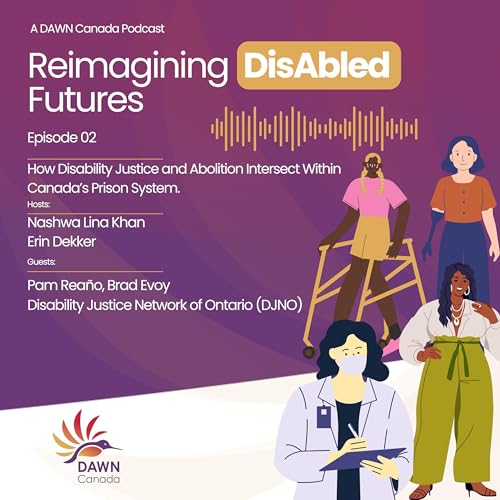
  • Episode 2: How Disability Justice and Abolition Intersect Within Canada’s Prison System
    Nov 7 2025

    Reimagining Disabled Futures Podcast

    A Podcast by (DisAbled Women Network) DAWN Canada that focuses on the intersection of disability, gender and social justice.

    Show Notes: Episode 2 - How Disability Justice and Abolition Intersect Within

    Episode Summary:This episode discusses incarceration, ableism, systemic violence and experiences of disablement within the criminal legal system. Listener discretion is advised.

    Hosts: (DAWN Canada):

    Erin Dekker, Former Junior Research Associate

    Nashwa Lina Khan, Senior Research Associate

    Guests (Disability Justice Network of Ontario (DJNO):

    Pam Reañ, Prison Project Lead, they/them

    Brad Evoy Executive Director, they/them

    Key Topics Covered in the Episode:

    Understanding Disability Justice and Abolition:

    – Why DJNO identifies as an abolitionist organization.

    – How prisons reproduce disablement, racial violence and colonial harm.

    Sites of Disablement:

    – Isolation, poor healthcare and segregation as forms of violence.

    – Most incarcerated people leave with new or worsened disabilities.

    Carcerality Beyond Prisons:

    – How punishment logics shape schools, long-term care and housing systems.

    – Links between local and global sites of disablement (e.g., Palestine).

    Community Care and Prevention:

    – Housing and mental-health supports as alternatives to incarceration.

    – Community accountability and solidarity as core to disability justice.

    About the Disability Justice Network of Ontario (DJNO): Website: https://djno.ca

    The Disability Justice Network of Ontario builds a world where disabled people are free to be and free to hold systems to account. Based in Hamilton, DJNO organizes fordisability justice through advocacy, education and abolitionist action.

    DJNO leads initiatives like the Enabling Justice Toolkit (https://enablingjustice.com), a resource supporting youth and adults navigating the criminal legal system, and programs that challenge ableism, racism and incarceration.

    About DAWN Canada: Website: https://dawncanada.net/

    DAWN (DisAbled Women’s Network) Canada is a national feminist cross-disability human rights organization that works to address systems of oppression. The organization is dedicated to promoting the rights and inclusion of women, girls and gender-diverse people with disabilities. Their work focuses on addressing systemic discrimination, advocating for equality, and advancing social, economic, and politicalinclusion. DAWN Canada provides research, programming, and advocacy initiatives rooted in intersectionality, emphasizing the unique experiences of Indigenous, Black, racialized, and LGBTQ2S+ individuals within the disability community.

    Additional Resources & Info:

    If you’re interested in learning more about DJNO’s advocacy and education work, visit https://djno.ca.

    DJNO Offers:

    1. Advocacy and Abolition Resources

    2. Community Education Programs

    3. Support Lines for Justice-Involved DisabledPeople

    4. Toolkits like Enabling Justice tonavigate the legal system

    Show More Show Less
    31 mins
  • Episode 1: What does “living well” mean?
    Oct 1 2025

    Reimagining Disabled Futures Podcast

    A Podcast by (DisAbled Women Network) DAWN Canada that focuses on the intersection of disability, gender andsocial justice.

    Show Notes: Episode 1 - Building Sustainable Livelihoods| Season 1

    “Living well is more than surviving” – Nashwa Lina Khan

    Episode Summary:

    In this episode, we talk about the Sustainable Livelihoods framework and how it helps people living on low incomes. Our guests explain how this approach is different from other poverty programs because it focuses on people’s strengths instead of their problems. We hear stories about the barriers people face when trying to get housing, food, money, andhealthcare. We also learn what “living well” means to different people and how personal and systemic issues affect their well-being.

    Hosts: (DAWN Canada):

    • Erin Dekker, Former Junior Research Associate
    • Nashwa Lina Khan, Senior Research Associate


    Guests (Sustainable Livelihoods Canada, SLC):

    • Vibhuti Mehra
    • Mary Ferguson

    Key Topics Covered in the Episode:

    Understanding Sustainable Livelihoods (SL):

    o What is the SL framework?

    o How does it differ from traditional povertyreduction strategies?

    Challenges & Strengths-Based Perspectives:

    o Exploring how people with low incomes navigate their daily lives and unique challenges they face.

    o How SLC is reframing issues from deficit-based thinking to a strengths-based approach to promote resilience and stability.

    Community Insights from Interviews:

    o Addressing obstacles to accessing housing, food, financial benefits, healthcare, and other essential resources.

    o Sharing experiences from community members and participants' lived experiences.

    What does “living well” mean?

    o Understanding individual and systemic factors that contribute to overall well-being.

    About Sustainable Livelihoods Canada: Website: https://slcanada.org/

    Sustainable Livelihoods Canada (SLC) works to support organizations and communities in adopting and implementing the Sustainable Livelihoods (SL) framework. They specialize in training, planning, coaching, and evaluation services to improve social and economic inclusion for marginalized individuals and communities.

    SLC's expertise areas include: Training and Education: Teaching frontline staff and organizations about the SL framework and how to operationalize it effectively.

    Evaluation and Research: Conducting evaluations to identify outcomes, assess multi-site research initiatives, and improve program implementation.

    Knowledge Mobilization: Sharing insights and strategies to ensure research and evaluation findings create real-world change

    Community Social & Economic Engagement: Strategies thatprioritize inclusion, poverty reduction, and systems change for marginalized groups.

    About DAWN Canada: Website: https://dawncanada.net/

    DAWN (DisAbled Women’s Network) Canada is a national feminist cross-disability human rights organization that works to address systems of oppression. The organization is dedicated to promoting the rights and inclusion of women, girls and gender-diverse people with disabilities.

    About the Feminist Recovery Project:

    The Feminist Recovery Project is one of DAWN Canada’s key research projects and explores how recovery strategies can be implemented through a feminist lens. This project examines the intersection of gender, economic equity, and social inclusion, focusing on rebuilding economic security for marginalized groups impacted by systemic inequities, including gender-based violence and economic exclusion. The Feminist Recovery Project seeks to:

    • Highlight community resilience through narratives.
    • Explore new models of social investment and community recovery strategies to combat systemic barriers and promote gender equity.
    • Center the lived experiences of women, gender-diverse individuals, and communities withintersecting identities to inform recovery efforts.
    Show More Show Less
    31 mins