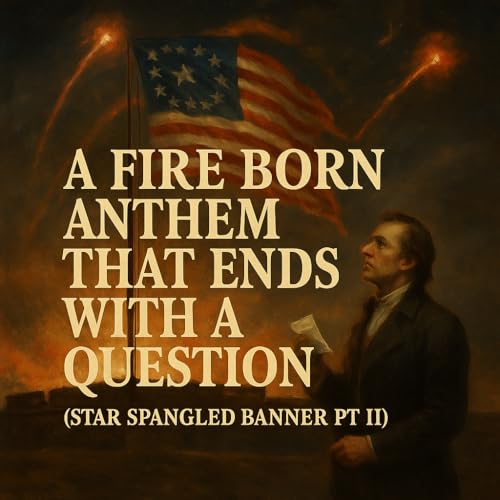
• A Fire Born Anthem That Ends With A Question (Star Spangled Banner Pt II)
    Dec 6 2025

    How & why was the Star Spangled Banner written, why does it end with a question, what was the battle like, and why does it still contain so much meaning for Americans today? It's a pretty good story... For 25 straight hours in 1814, British rockets and mortars hammered Fort McHenry—while a young nation waited to see if its flag, and its future, would survive the night. In part two of our Star-Spangled Banner series, the British march on Baltimore, and the 25-hour bombardment that lit up the sky over the harbor.

    From inside the fort, citizen-soldiers endured an unending storm of shells and rockets. Out in the bay, a Georgetown lawyer named Francis Scott Key watched it all (under-guard) from a British ship, unsure whether the flag he saw by bomb-light would still be flying at dawn. Because if it was lowered, then the American troops surrendered. Out of that fear and exhaustion came a private poem that, over a century later, became America’s national anthem.

    This episode explores not just the battle, but what the flag meant that night—and what perseverance has to do with the American experiment now. The anthem, Key’s question, and our politics today all meet on that rampart in Baltimore.

    Please consider supporting the show on Patreon! It would take so little from you but mean so much for the show. Head to: https://www.patreon.com/c/RemedialPolymath

    Full article + picture + maps + custom episode music: Star Spangled Banner Pt II

    If you missed part one on the origins of the war and the road to Baltimore, start there—then come back for the night the anthem was born. Click here for part one!

    Show More Show Less
    1 hr
  • Star-Spangled Origins: America’s Anthem and the War of 1812 (Pt 1)
    May 3 2025

    Why does The Star-Spangled Banner open with a question? Who wrote it—and during what war? In Part 1 of this two-part series, we uncover the wild, overlooked origins of America’s national anthem. From attempted invasions of Canada to the burning of Washington, D.C., this episode explores how a strange and nearly forgotten war—the War of 1812—gave birth to the Stars and Stripes’ most famous tribute. Whether you’re American or not, you’ll never hear the anthem the same way again.

    PLEASE PLEASE subscribe to Remedial Polymath and share this episode (and/or the others) with others on your social media, or just tell your friends about it!

    To read the article for this episode replete with images, the complete song from this episode, resource links, etc. just click here!

    Chapter Markers

    3:34 Introduction to The War of 1812 and how it led to the Star Spangled Banner

    7:22 Loose basics about the war

    10:46 The lead up to the war and the "other war" (The Napoleonic Wars)

    15:26 Impressment and Anglo-American tensions on the high seas

    23:16 The Canadian theater of war

    36:17 The American theater of war

    46:30 The battles on the Atlantic

    52:22 Conclusion and preview of part 2

    Show More Show Less
    56 mins
  • Water: You Don't Know S&!T About It
    Jun 25 2024
    Welcome to Episode 8 of Remedial Polymath, Water: You Don't Know S&!T About It Would you believe that the most common liquid on Earth is still magical and mysterious, that scientists still argue about its many odd traits, and that those traits are central to life on Earth? In this podcast episode, we delve into the fascinating properties of water, exploring its origins, molecular structure, and unique characteristics such as surface tension, density, and incompressibility. It may confuse you or instill wonder surrounding this substance you interact with each and every day. The episode highlights the Mpemba effect, discovered by a Tanzanian high school student, where hot water freezes faster than cold water. We discuss water's role as a universal solvent, its unheard-of heat retention, and its impact on Earth's climate. The episode also examines scientific debates on water's behavior at lower temperatures and the two-phase model of liquid water, blending scientific insights with philosophical reflections on water's enigmatic nature. To read the article for this episode (with images and sources) just head to Remedial Polymath's Water Episode Chapters & Times of Interest: Introduction/The Mysterious Beauty of Water (00:00:36) We introduce the episode, discussing the ordinary yet mysterious nature of water and the need to approach it with a beginner's mind. The Mpemba Effect (00:02:49) The story of Erastus Mpemba, a Tanzanian high school student who observed the Mpemba effect, where hot water freezes faster than cold water. Water's Origins (11:38) Exploration of the origins of Earth's water, including the role of comets and asteroids in delivering water to the planet. Molecular Structure of Water (00:17:53) An explanation of the covalent bonding and hydrogen bonds in water, and the unique shape and behavior of water molecules. Surface Tension, Density, and Incompressibility (00:23:25) The impact of water's high surface tension, density, and incompressibility on various aspects of life, including its role in sustaining life and its practical applications. Water as a Universal Solvent (00:25:55) Water's properties as a universal solvent and its crucial role in dissolving compounds for life and transportation. Water's Impact on DNA (00:27:33) Water's influence on DNA's structure and the crucial role it plays in maintaining the geometry of DNA. Water's Heat Retention and Climate Moderation (00:30:08) Water's ability to retain heat, its impact on climate moderation, and the role of oceanic currents in regulating temperature. Water's Expansion when Freezing (00:35:18) The mystery of water's expansion when freezing, its implications for life on Earth, and the potential consequences if ice didn't float. Supercooled Water and Crystallization (00:37:48) The unique behavior of supercooled water, its crystallization process, and the implications of water's unusual freezing properties. Ice's Impact on Climate and Life (00:41:10) The potential effects of ice sinking instead of floating, including its impact on global climate, freshwater systems, and life evolution. Water's Philosophical Significance (00:45:00) The philosophical implications of water's unique properties and its potential role in creating conditions for intelligent life. The Debate on Water's Behavior (00:47:19) The disagreement among scientists about the reasons behind water's behavior, particularly its hydrogen bonding and structural organization. The two-phase model of liquid water (00:51:16) Discussion of the two-phase model of liquid water, including the arrangement of water molecules and their densities. Computing power and the odd behavior of water (00:52:28) The impact of computing power on studying the odd behavior of water and the changes in water molecules to replicate its behavior. Hypothesis about water's density and anomalies (00:53:40) Hypothesis about the proportion of orderly and chaotic water molecules, its relationship with temperature, and the disagreement among scientists. Philosophy behind the science of water (00:54:51) The host's philosophical view on the chaos and order theory in understanding water's properties and its significance for life. Plato's tetrahedron and its symbolism (00:57:23) Discussion of the tetrahedron, its association with fire, and its interpretation in various cultures, including its representation of balance and harmony. Sacred geometry and the tetrahedron (00:59:59) The significance of the tetrahedron in sacred geometry, its representation of balance and transformation, and its connection to the duality of chaos and order. Conclusion (01:01:15) The host's reflection on the fascination with water, its magic, and the fulfillment of being intertwined with this essential molecule.
    Show More Show Less
    1 hr and 3 mins
  • Mussolini Pt II. The Allies Advantage: How Betrayal Led to Victory
    May 1 2024

    Mussolini Pt II. The Allies Advantage: How Betrayal Led to Victory

    In Dante's "Divine Comedy," the worst sin one could commit was betrayal. What does this have to do with World War Two? Mussolini loved to betray his neighbors, his compatriots, or, believe it or not, Hitler. He just kept committing betrayal no matter the horrible outcomes it gave him. Outcomes that would assure that the Nazis' lost and the Allies won the war in Europe.

    In this episode, we will explore exactly how Mussolini destroyed the Axis' chance of winning the war in Europe. Had he not intervened in the war, we might all be living in a different world. We - even those in Germany and Italy - should all be grateful for his proclivity for betrayal and his seemingly inescapable ability to act stupidly in war.

    It is a fascinating philosophical exercise filled with truly outlandish stories from WWII that you are probably unaware of.

    Join us on this rethinking of history and, generally, a wild ride.

    To read the article accompanying this, or any other, episode head to RemedialPolymath.com

    Please consider assisting (just a cup of coffee worth would be great!) the show by joining its Patreon at https://www.patreon.com/RemedialPolymath

    Thank you for your time and attention.

    Chapters of this episode:

    Introduction: 1:06

    Theodicy and Why Evil May Exist: 7:54

    Betrayal and Why it's Evil: 14:52

    The Importance of WWII on Your Life: 22:39

    Mussolini Switching from Neutrality to War: 31:50

    Mussolini's Betrayal and America Picking Sides: 45:53

    Mussolini's Invasion of Greece: 56:42

    The Delay of Operation Barbarossa: 1:13:27

    Mussolini's Misadventures in North Africa: 1:22:30

    How it All Ends for Mussolini: 1:32:24

    Conclusion: 1:42:52

    Show More Show Less
    1 hr and 54 mins
  • Mussolini Pt I. Exploring the Undervalued Ties Between Mussolini and Hitler Pre WWII
    Feb 5 2024

    Mussolini Pt I. Exploring the Undervalued Ties Between Mussolini and Hitler

    Benito Mussolini was the Fascist leader of Italy from 1922-1945. You may know that. What you may not know is that he had a bizarrely similar pre-WWII with Adolf Hitler. More than that, he basically paved a path for Hitler to follow. He did this through creating Fascism and then taking over his government. He also did this through atrocities he committed in two major wars in the 1930s; wars that included concentration camps, chemical weapons, and trying to eliminate a culture to make room for Italians (who rightfully deserved these lands because Italians were superior people). Many more examples are within this episode...

    How and why did this happen? What did the Nazis learn from Mussolini? Why isn't this information more well known? How was Benito able to get away with this all? Why didn't the world react quickly to stop the Italians? What does this say about the rest of the world at this time?

    We will explore all of these questions in part 1 of our exploration of Benito Mussolini and his influence on, and similarities with, Adolf Hitler and the Nazis.

    Please consider assisting (just a cup of coffee worth would be great!) the show by joining its Patreon at https://www.patreon.com/RemedialPolymath (Open for show topic & perk recommendations via Patreon)

    Thank you for your time and attention.

    Chapters of this episode:

    Introduction: 1:15

    Ways to Support the Show: 7:50

    Italy in WWI: 9:09

    Mussolini & Hitler's Early Experiences: 14:10

    Interesting & Important Anecdotes about their War Experiences: 21:12

    Early Political Post WWI Experiences: 30:40

    Pre-WWII Military Endeavors of Mussolini and what the Nazis Learned: 44:00

    Philosophical Influences of Mussolini on the Nazis: 1:08:55

    Conclusion: 1:21:10

    Show More Show Less
    1 hr and 27 mins
  • Seafood & Fishing Pt. II: Fishy Business - Sustainable Seafood Simplified
    Dec 9 2023

    Seafood & Fishing Pt. II: Fishy Business - Sustainable Seafood Simplified

    This is the second and final part of our exploration into seafood, fishing, and oceanic ecosystems. Here, we will explore the most popular seafood choices in the West and examine their sustainability, health implications, and contamination concerns. So, if you enjoy seafood, this episode will impart valuable information. We will also discuss ocean pollution in terms of heavy metals, plastic, sewage runoff, etc. We will also examine what exactly Omega-3 fatty acids are and why our brains and bodies love them.

    Let's be honest. We're destroying our oceans in more ways than one, but we continue to eat the food that lives in what is essentially the world's garbage dump. What are the implications of this behavior? Don't believe me about the absurdity of the situation we find ourselves in? Listen first and then make your judgment calls... 96% of the world's bluefin tuna are essentially gone. But we don't stop hunting them down. Now, we pay millions of dollars for a single tuna. And that is just one eye-watering statistic...

    It's a broken system! Please do yourself and your fellow humans a favor and listen to this episode along with part I. To read the article that accompanies this episode, just head to https://remedialpolymath.com/blogarticles.html

    Please consider assisting (just a cup of coffee worth would be great!) the show by joining its Patreon at https://www.patreon.com/RemedialPolymath (Open for show topic & perk recommendations via Patreon)

    Thank you for your time and attention.

    "Chapters" of this episode:

    Introduction: 1:06

    Health aspects of Omega-3s & fish overall: 5:28

    A look at oceanic pollution: 21:10

    The messy situation that is plastic pollution (microplastics, microfibers, and it's prevalence & toxicity) 33:30

    The vital differences between wild caught (a resource) fish and farmed fish (a commodity): 1:09:09

    Health information, tips, and sustainability of the most popular types of seafood: 1:18:44

    Health information, tips, and sustainability of the most popular types of sushi: 1:31:45

    Conclusion (what can we do to make things better?!): 1:53:38

    Show More Show Less
    2 hrs and 1 min
  • Fishing & Seafood, Pt. I. Ocean Waves with Oysters : Should We Eat Fish?
    Sep 22 2023

    Fishing & Seafood, A Deep Dive, Pt. I. Ocean Waves with Oysters : Should We Eat Fish?

    Think this is a boring topic? Consider this: half of the oxygen you breathe comes from the ocean, 93% of the carbon we create is absorbed by the ocean, tuna + dolphins + sharks could soon be a thing of the past.

    Even if you don’t eat fish, don’t live near the ocean, nor care about the creatures within it, what we are currently doing to the ocean affects you. In this episode, which is part I or a two part series, we will take a look at what we’re doing to our oceans and its marine life, the interesting history of fishing, hear a few fun stories about seafood and attempt to re-examine why humans are doing this to our planet.

    Hint: It’s not as simple as to just say “greed” is the culprit…

    To help make this show my day job and get extra perks please check out Please consider assisting (just a cup of coffee worth would be great!) the show by joining its Patreon at https://www.patreon.com/RemedialPolymath (Open for show topic & perk recommendations via Patreon)

    To read the written article that accompanies this podcast just head to https://remedialpolymath.com/

    If you prefer to use YouTube head to: https://www.youtube.com/channel/UCsYKDZQ6ZzEC5h77EtFpaXg

    To see the list of all platforms you can listen to the show head to: https://remedialpolymath.podbean.com/

    Show More Show Less
    2 hrs and 12 mins
  • The History, Philosophy, Effectiveness, and Potential Alterations of American Juries
    Apr 14 2023

    In this episode we take a look at the fascinating history of using a jury of one’s peers as the basis for deciding the outcome of a trial. Because (as long as you're American at least), you probably take this system of trial for granted. But it’s actually a very unique system. And the way it came to us is WILD. Just as important, what’s the philosophy behind it? Is it effective? Should it be changed or gotten rid of? We’ll explore those questions and more in this episode.

    Please consider assisting (just a cup of coffee worth would be great!) the show by joining its Patreon at https://www.patreon.com/RemedialPolymath (Open for show topic & perk recommendations via Patreon)

    To read the written article that accompanies this podcast just head to https://remedialpolymath.com/

    If you prefer to use YouTube head to: https://www.youtube.com/channel/UCsYKDZQ6ZzEC5h77EtFpaXg

    Please consider assisting the show by joining its Patreon at https://www.patreon.com/RemedialPolymath (Open for show topic & perk recommendations via Patreon)

    Show More Show Less
    1 hr and 8 mins