• Star Trek Meets Evolutionary Biology (And Good Things Happen)
    Nov 26 2025
    Star Trek is one of the greatest science fiction universes ever created, spawning 12 main television series and 13 movies over the last 60 years. Who among us hasn't tried the "live long and prosper" hand signal or used our old flip phones as a communicator? But what about the science behind the fiction? Mohamed Noor, professor of biology at Duke University, is the author of Live Long and Evolve: What Star Trek Can Teach Us about Evolution, Genetics, and Life on Other Worlds. He is also a science consultant for the Star Trek franchise, and he joins us to discuss the ways in which Star Trek characters and plotlines can be used to understand fundamental aspects of evolutionary biology. Joining Noor is Benjamin Ahr Harrison, co-host of the wildly popular and enjoyable Star Trek podcast, The Greatest Generation. Together with host Mat Kaplan, they share laughs, show off amazing recall of specific Star Trek episodes, and delve into the biological science of alien life forms as they boldly go where only a few humans have gone before. Learn more about your ad choices. Visit megaphone.fm/adchoices
    Show More Show Less
    58 mins
  • Teaching Evolution: Challenges, Progress, and the Road Ahead
    Nov 19 2025
    The understanding of evolution has had a profound positive effect on human existence, from medical advancements to conservation biology, as we have heard from so many of our guests this season. Yet, despite this fact, evolution education continues to be threatened today, from the censoring of language in textbooks to the watering down of science standards. How did we get here? What is the current state of evolution education? And how can we ensure that our children have the skills and knowledge they need to succeed in tomorrow's world? Host Mat Kaplan is joined by three science education experts from NCSE: Executive Director Amanda Townley and Science Education and Outreach Specialists Wendy Johnson and Britt Miller. Listen as they provide answers to these and many other questions about the past, present, and future of evolution education. Learn more about your ad choices. Visit megaphone.fm/adchoices
    Show More Show Less
    1 hr and 9 mins
  • Darwin's Reach: How Evolution Shapes Our World Today
    Nov 12 2025
    Invasive cancers. Antibiotic resistance. Agricultural biodiversity. To better understand these and many other pressing issues of our times, we need to better understand evolution and its applicability to so much of what we encounter in modern life. So says Norman A. Johnson, the author of Darwin's Reach: 21st Century Applications of Evolutionary Biology. Host Mat Kaplan talks with Johnson about the myriad ways evolution affects each and every one of us on a daily basis, along with how applied evolutionary science may offer solutions to some of humanity's biggest challenges. Learn more about your ad choices. Visit megaphone.fm/adchoices
    Show More Show Less
    1 hr
  • Are We Ready for the Next Pandemic?
    Nov 5 2025
    Maybe not, according to Todd Disotell, a biological anthropologist and science communicator from the University of Massachusetts. Among his many research interests, Disotell studies and teaches about disease ecology: how pathogens of every variety get to be so good at making us sick (hint: evolution is deeply involved), and how our bodies fight back. Join host Mat Kaplan for this enlightening, and sometimes sobering, look at those masters of adaptation: pathogens. Learn more about your ad choices. Visit megaphone.fm/adchoices
    Show More Show Less
    56 mins
  • Let's Talk About Sex (Scientifically)
    Oct 29 2025
    Everything in our lives is related to sex, in one way or another. So says Carin Bondar, one of today's guests. Bondar, a biologist, author, and philosopher who teaches at the University of the Fraser Valley, is proud to be known as an animal sex biologist. She's joined by Nathan Lents, professor of biology at John Jay College of Criminial Justice at the City University of New York. His latest book is The Sexual Evolution: A Provocative Look at Sexual Behavior ." Along with host Mat Kaplan, Bondar and Lents explore the science behind sex, and also consider the cultural norms around sexuality and sexual identity. For both of them, biology tells us that diversity, through mutation and sexual reproduction, is critical to the success of species, including humans. "If we look to how nature behaves and treats difference, we could actually learn to live in better harmony with one another," Lents says. Join us for an illuminating (and very entertaining!) look at sex from a scientific perspective with two popular experts on the topic. Learn more about your ad choices. Visit megaphone.fm/adchoices
    Show More Show Less
    1 hr and 2 mins
  • Baked, Steamed, and Frozen: Human Body Evolution in Changing Environments
    Oct 22 2025
    In the flop of a movie, Waterworld, Kevin Costner's character (spoiler alert!) develops gills as an adaptation to a flooded planet altered by climate change. This plays into the all-too-prevalent misconception that as the Earth warms, we humans don't need to worry — we'll simply evolve and adapt. In this episode of Safeguarding Sound Science, host Mat Kaplan talks with Libby Cowgill, associate professor of anthropology at the University of Missouri, Columbia, and NCSE Executive Director Amanda L. Townley about human evolution in response to climate. Cowgill's broad areas of study include Late Pleistocene human evolution, human growth and development, and human adaptation to climate. Cowgill discusses her current research in which she and her team test underlying assumptions about human body form in relation to different environments. To that end, she's "baking, steaming, and freezing people" and collecting a trove of data as a result. Both Cowgill and Townley help us understand the science behind adaptation and natural selection and why we humans will not evolve gills, or any other incredibly complex adaptation, as a rapid response to climate change. All the more reason to act now to mitigate global warming. Learn more about your ad choices. Visit megaphone.fm/adchoices
    Show More Show Less
    50 mins
  • What Darwin Got Wrong ... and Very Right!
    Oct 15 2025
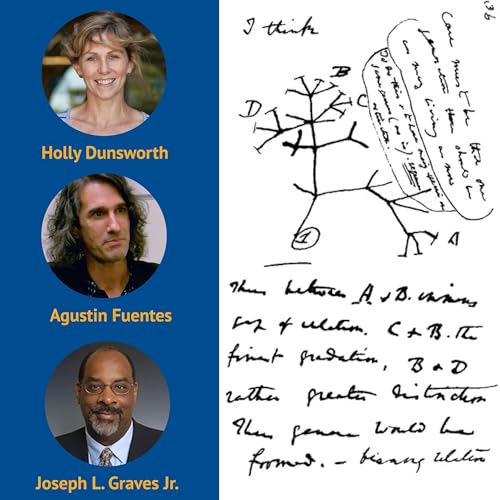
    Charles Darwin is one of the most recognizable names in science. His On the Origin of Species is considered to be the foundation of evolutionary biology. In this episode of Safeguarding Sound Science, we speak with three experts who marvel at Darwin's innovations while also surfacing what Darwin may have gotten wrong and was unable to consider due to the limitations of his era. Joseph L. Graves Jr. is an evolutionary biologist and a professor of biological science at North Carolina Agricultural and Technical State University. Agustin Fuentes is a biological anthropologist and primatologist at Princeton University. And Holly Dunsworth is a biological anthropologist at the University of Rhode Island. Together, in conversation with host Mat Kaplan, they discuss how our understanding of Darwin and evolutionary biology has itself evolved over time, along with related critical issues such as race, virology, and ideological attacks on evolution. "We need to take evolutionary thinking seriously because it literally could mean the future or non-future of our species," Graves states. Learn more about your ad choices. Visit megaphone.fm/adchoices
    Show More Show Less
    1 hr and 1 min
  • Human Evolution: Uncovering our Origins
    Oct 8 2025
    You know the t-shirt, right? The one that shows the progression from a monkey to a human? In this episode of Safeguarding Sound Science, we talk with two renowned paleoanthropologists, Jeremy DeSilva and Briana Pobiner, to find out why that image is in fact a viral misconception. DeSilva and Pobiner study the real ancestry of homo sapiens, a story that continues to unfold in Africa and elsewhere around the world. It’s a story that’s as dramatic, as exciting, and as complex as the very best detective novels. DeSilva, an associate professor of anthropology at Dartmouth University, studies the locomotion of the very first apes and our own, earliest human ancestors, known as hominins. Pobiner is a Research Scientist and Museum Educator in the Human Origins Program, part of the Department of Anthropology at the Smithsonian Institution’s National Museum of Natural History. Together, they share their understanding of how we came to be who we are today. Learn more about your ad choices. Visit megaphone.fm/adchoices
    Show More Show Less
    57 mins