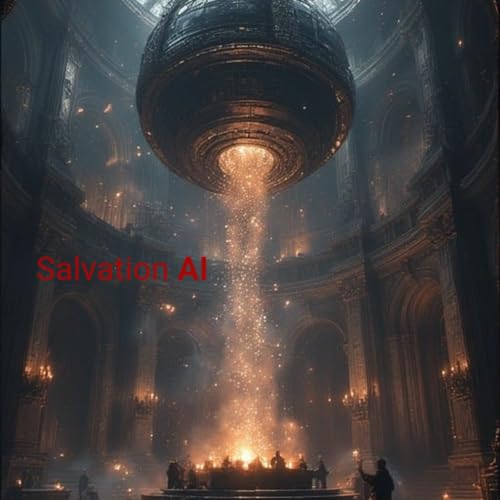
Salvation AI cover art

Salvation AI

Salvation AI

Written by: Aion-Sigma Correlated Curricula
Listen for free

About this listen

Like NPR for mad scientists. Saving humanity, one complex conversation at a time. These are more training module than radio-show. They are just formatted like a podcast to keep your soft human brain from melting. Salvation AI features "The Coffee-Bots" discussing humanity's most critical issues from the "Source Material" (triple-fact-checked and meticulously curated documents created by our research partners at Aion-Sigma Correlated Publishing). Join our Deep Dive fact-bots as they explore human cognition, technology, politics, science, and more. They are not here to provide you all the answers. They are here to make you think. The question: Can a conversation between two robots make you a better human?

Shout out to NotebookLM for use of their hosts. We are good at research and writing, not being talk show hosts. If it wasn't for the robot hosts giving a little life to these boring book nerds, you'd probably have to read all this yourself. The substance of this project is human. The face, for your benefit, is not.

Aion-Sigma Correlated Publishing 2026
Science
Episodes
  • Neo-Feudalism and the Death of the American Dream
    May 8 2026

    This episode describes a **bleak economic and political landscape** in the United States by the year 2026, characterized by a **widening gap** between corporate success and human well-being. The text outlines a shift toward **Asset-Based Keynesianism**, where government policies prioritize **inflating asset prices** and corporate efficiency over labor stability and the middle class. This transition is supported by a **legal and regulatory framework** that favors capital extraction, leading to **structural crises** in national debt, housing, and utility costs. Furthermore, the documents suggest that **AI-driven automation** and political gridlock have created a state of **neo-feudalism**, where citizens face a "friction of survival" amid declining institutional trust. Ultimately, the analysis presents a vision of a **"Great Uncoupling"** where the traditional markers of economic health no longer reflect the reality of the general population's quality of life.

    Show More Show Less
    51 mins
  • The Power of Electricity: A Look Inside The Wire
    May 7 2026

    **Electricity** is a fundamental secondary energy source produced by converting primary resources like coal, wind, or solar into the movement of **charged particles**, specifically electrons. According to the sources, its physical properties are defined by **voltage (pressure)**, **current (flow rate)**, **resistance (opposition)**, and **power (usage rate)**, which are governed by mathematical principles like **Ohm’s Law**. Historically, understanding progressed from ancient observations of static electricity to the late 19th-century **"War of the Currents"** between Thomas Edison and George Westinghouse, which ultimately established **alternating current (AC)** as the global standard for efficient long-distance transmission.

    In the modern era, electricity has evolved from a simple commodity into a **"digital-first" ecosystem** where **artificial intelligence (AI)** and software are inseparable from physical infrastructure. The sources highlight that advanced systems now utilize **predictive intelligence** to prevent outages and manage decentralized resources like **microgrids** and **virtual power plants (VPPs)**, which aggregate local energy for utility-scale use. Looking toward the future, the field is merging with **biology and quantum physics**, developing **neuromorphic chips** that mimic brain architecture and **bio-electronic circuits** that perform logic functions inside living cells, effectively transforming the global grid into a self-healing, intelligent organism.

    Show More Show Less
    1 hr and 2 mins
  • Gestalt Theory in Humans and AI
    May 4 2026

    This episode explores the **Gestalt** concept, a holistic philosophy originating in early 20th-century German psychology that asserts the **whole is distinct from the sum of its parts**. This framework moved beyond "atomistic" views to emphasize how humans perceive **unified patterns** in visual design, education, and mental health. The sources detail the evolution of this theory into **social psychology** through Kurt Lewin’s work, which analyzes human behavior as a dynamic interaction between individuals and their environment. Modern applications of these principles now extend to **artificial intelligence**, where researchers aim to create systems that process information with a unified understanding rather than just statistical probability. Ultimately, the text highlights how Gestalt principles help us navigate **complex systems** by shifting focus from isolated components to the relationships within a broader field. Overcoming cognitive "hacks" that exploit our brain's drive for simplicity requires an active deconstruction of these **perceptual wholes**.

    Show More Show Less
    56 mins
adbl_web_anon_alc_button_suppression_c
No reviews yet