Episodes

  • A Modern Wonder from Ancient Dunes: The Iconic Navajo Sandstone, Part 2
    Feb 17 2026
    ​​This episode of Science Moab continues the exploration of the Navajo sandstone with Marjorie Chan, Professor Emeritus at the University of Utah. The unique coloration of the sandstone is influenced by iron oxides that have analogies with the iron oxide 'blueberries' found on Mars and have implications for groundwater evidence on the planet. Margie elaborates on the concretions and weathering patterns within the Navajo sandstone and how these differ from the Wingate sandstone. We also discuss the challenges of geological research funding, the importance of fieldwork partnerships, and the significance of preserving natural geological features and educating the public on their value.
    Show More Show Less
    22 mins
  • A Modern Wonder from Ancient Dunes: The Iconic Navajo Sandstone, Part 1
    Feb 3 2026
    The majestic and iconic Navajo Sandstone has become ubiquitous in scenes from the Colorado Plateau. Margie Chan, Professor Emeritus at the University of Utah, has studied the Navajo Sandstone her entire career and we discuss the deposition and unique features of this Jurassic wind-blown sand. This ancient desert extended across much of Utah, Arizona, and Nevada, and combined different geological structures including dunes, lake deposits, and springs. In this first of a 2-part series, we talk about the key role that groundwater plays in the sediment deformation and coloring. The next episode delves into the role of iron in the Navajo sandstone and its connection to Mars.
    Show More Show Less
    21 mins
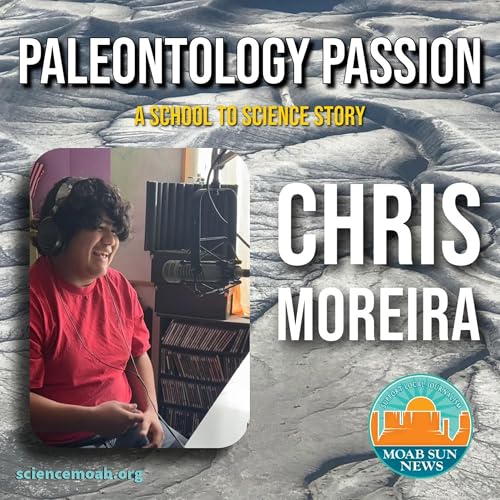
  • PALEONTOLOGY PASSION: A School to Science Story
    Jan 6 2026
    This show is part of a series exploring Science Moab’s School to Science Program, connecting students with scientists in the field, the lab, and beyond. This program began in 2021 and to date has mentored over 57 local students. In this episode, we talk with Chris Moriera, a recent graduate of the Grand County Student Career and Success Center and participant in the School to Science Program. Guest host Sasha Pereira explores Chris’s journey from high school to hands-on paleontology internships, his experiences with mentors and scientists, and the impact of these opportunities on his academic and career aspirations. Chris shares insights about the welcoming scientific community, the excitement of fieldwork, and the importance of mentorship. The episode also covers Chris’s achievements, including presenting research at a professional conference and earning a college scholarship. The conversation concludes with advice for students interested in science careers and Chris’s vision for making science accessible to future generations.
    Show More Show Less
    20 mins
  • Drylands: The Dark Horse of Carbon Cycling
    Dec 2 2025
    Drylands play a critical role in global ecosystems as well as the carbon cycle. We talk with ecologist Brooke Osborne about the fascinating world of biogeochemistry and dryland science. Covering 40% of the Earth's surface and hosting a third of the human population, heterogeneous drylands have low resource availability and therefore are highly sensitive to climatic changes. We discuss Brooke’s ongoing research into soil carbon storage and sequestration, particularly in the context of grazing practices and land management.
    Show More Show Less
    24 mins
  • Nanosaurs & Good Lore
    Nov 4 2025
    This show is part of a series exploring Science Moab’s School to Science Program, connecting students with scientists in the field, the lab, and beyond. In this episode, we talk with mentor Emily Lessner, paleontologist for the Bureau of Land Management, and Shadis McDaniel, a recent Grand County High School graduate. Shadis joined Emily on a couple of job shadows, both in the office and in the field.
    Show More Show Less
    16 mins
  • The Miracle of Lichen
    Oct 21 2025
    A lichen is a colony of algae or cyanobacteria living interactively with fungus and bacteria in a mutual or symbiotic relationship, but for Steve Leavitt, a lichen is a  hotspot of diversity and  an indicator of ecological health. Steve is in charge of one of the largest lichen collections in North America at BYU where he teaches and directs the Life Science Museum. But most of all, Steve loves his research and being outside. We talk with Steve about how the unique factors on the Colorado Plateau contribute to diverse lichen communities, how lichens can be used as indicators of air quality, and the impacts of climate change on their distribution. Steve explains how advancements in genetics have led to a step-change in the study of lichens and the broader implications of studying lichens for understanding life on Earth.
    Show More Show Less
    24 mins
  • Eureka at Cisco: Jurassic Mammals
    Oct 7 2025
    Brian Davis, an associate professor at the University of Louisville School of Medicine, loves looking for small fossils. His research focuses on early mammals, particularly teeth, jaws, and skull parts. Brian’s most recent discovery is a mammal fossil quarry in Cisco, Utah, part of the Morrison Formation dating back to the Jurassic period. The site has yielded small animal fossils, including some potentially significant early mammals that correlate with a nearby site in Fruita, CO. We discuss the complexities of fossil excavation, preservation, and the analysis process as well as the importance of student education.
    Show More Show Less
    22 mins
  • Dieback Dynamics
    Sep 16 2025
    Across the Colorado Plateau, pinyon-juniper ecosystems are facing more and more stress due to increasing heat and aridity. Today we talk with Seth Munson, a plant and ecosystem ecologist with the U.S. Geological Survey Southwest Biological Science Center in Flagstaff, Arizona. Seth’s research focuses on how dryland ecosystems respond to drought, wildfire, invasive species, and land-use to assist land management decision-making. He is currently working with the National Park Service to assess the areas of dieback of pinyon-juniper woodlands in the SE Utah Parks. The research involves both ground surveys and satellite imagery to create maps detailing the intensity and recovery of dieback over time.
    Show More Show Less
    21 mins