Episodes

  • The 10x Organization: Redesigning for the AI Era with Org Topologies
    Feb 26 2026

    In this episode, host Dave West sits down with Alexey Krivitsky and Roland Flemm to explore a systemic approach to enterprise agility and performance. As organizations scramble to integrate AI, many are finding that their current structures—riddled with silos, handoffs, and conflicting mandates—are simply not "fit for purpose".

    The authors of the new book they co-authored with Craig Larman, 10x Org Powered by Org Topologies, argue that to stay relevant in an AI-driven landscape, companies need a 10x improvement in adaptability and learning. They introduce Org Topologies (OT): a framework-agnostic method that uses mapping and assessment to make hidden organizational challenges transparent.

    In this episode, we discuss:

    • The 10x Performance Leap: Why organizations must reshape their structures before rolling out AI capabilities to avoid amplifying global inefficiencies.
    • OT Mapping: How to visualize value flows and dependencies to create a shared language for improvement.
    • The Mandate Problem: Understanding how organizational mandates impact team autonomy and the speed of delivery.
    • Beyond Scaling Frameworks: Why Org Topologies is unique in its ability to map and improve any existing framework, from SAFe to LeSS.
    • Practical Experimentation: How to start small with "change experiments" in tribes or release trains to test adaptive practices.

    Whether you are a leader navigating a complex digital transformation or a manager looking for a shared language to align your teams, this conversation provides a roadmap for elevating your organization’s performance through systemic design.


    Show More Show Less
    40 mins
  • The Company as a Product: Applying APOM to the Organizational Capabilities at Dyno Therapeutics
    Feb 19 2026

    This episode is a must-listen for COOs, Agile Coaches, and Business Leaders who want to bridge the gap between "technical agility" and "business agility."

    When startups grow, they often bring in "responsible adults" who implement traditional playbooks in Finance, HR, and Legal. While well-intentioned, these silos often create a "factory mindset" that undermines the very agility that made the company successful.

    In this episode, Dave West is joined by Tyson Bertmaring, VP Partnership Success at Dyno Therapeutics and Yuval Yeret, Professional Scrum Trainer, to discuss how Dyno Therapeutics is taking a different path. By applying the Agile Product Operating Model (APOM) to General & Administrative (G&A) functions, Dyno is treating its organizational capabilities as a product to be engineered, not a hierarchy to be managed.

    What you’ll learn:

    • The Stewardship Mindset: Moving from local optimization (like chasing $10k in interest income) to systemic value (ensuring vendor reliability).
    • The "Two Jobs" Challenge: Balancing "running the business" with "building a better system."
    • G&A as a Service: Identifying essential services—like talent acquisition and contracting—and developing them into exceptional "internal products."
    • More!

    Subscribe to the Professional Scrum Unlocked Substack for more insights on this episode and others!

    Show More Show Less
    50 mins
  • Scrum, AI, and the Real Costs: Q&A (Part 2)
    Feb 12 2026

    In Part 2 of this Q&A series stemming from questions in the webinar, Managing Your AI Teammate, Eric Naiburg continues the conversation with Darrell Fernandes, diving deeper into how AI is reshaping the way Scrum Teams work.

    Together, they explore practical applications of AI in Scrum — from drafting and refining user stories to strengthening Definitions of Done and improving Gherkin statements. Darrell shares how AI can help teams create clearer, more consistent, and testable backlog items, while also warning against over-reliance.

    Eric and Darrell examine AI’s impact on team dynamics, including how meeting-recording tools can summarize conversations, capture action items, and support retrospectives. They also address the human side of adoption: differing mental models, fear of change, and the critical role Scrum Masters play as enablers — not gatekeepers — of AI experimentation.

    Finally, they tackle a topic many teams overlook: total cost of ownership. As AI capabilities expand, Product Owners must understand infrastructure, data, and operational costs to avoid unintended financial consequences.

    If you're navigating how to thoughtfully integrate AI into your Scrum Team — balancing opportunity, risk, and cost — this episode offers practical insights and grounded guidance.

    Show More Show Less
    22 mins
  • Scrum Beyond Software: Improving Parent-Teacher Conferences at Carroll School
    Feb 5 2026

    How can Scrum improve something as complex—and personal—as parent-teacher conferences?


    In this episode of the Scrum.org Community Podcast, Dave West is joined by Andrew Nimmer, Assistant Head of the Carroll Upper School, part of The Carroll School, an independent Massachusetts school serving students with language-based learning differences. Together, they explore how a cross-functional team of educators and data specialists used Scrum to streamline and improve the parent-teacher conference experience across multiple campuses.

    Andrew shares what it’s like to apply Scrum outside of technology, the shift from “one-and-done” projects to continuous product development, and the importance of clear goals, product ownership, and incremental improvement. The result? More aligned communication, better use of student data, and a conference experience that delivers greater value for families and teachers alike.

    This conversation offers practical insights for anyone curious about applying Scrum in education—or any non-traditional environment.

    Show More Show Less
    39 mins
  • Agile at Enterprise Scale: Pega’s Journey Beyond Frameworks
    Jan 29 2026

    In this episode of the Scrum.org Community podcast, Dave West sits down with Brodie Green, Director of Agile Delivery Services at Pega, to unpack Pega’s two-decade-long agile evolution. From early whiteboard planning to experimenting with various scaling frameworks, Pega has continually adapted its approach as it scaled to over 6,000 employees worldwide.

    Brodie shares why Pega ultimately moved to a hybrid agile model, how continuous six-week planning replaced big-room quarterly events, and what they learned about shortening feedback loops across complex product portfolios. The conversation also explores how Pega’s Scrum Masters act as Agile Delivery Leads—shifting the focus from team facilitation to solving complex business problems and driving change at scale.

    The episode closes with practical insights on measuring impact, creating effective working agreements, and using AI as a true team-enabling capability rather than just a productivity tool.

    Show More Show Less
    39 mins
  • AI in Scrum: Value, Validation, and the Human Factor (Q&A -Part 1)
    Jan 15 2026

    In this Q&A episode, Eric Naiburg, COO of Scrum.org, is joined by Darrell Fernandes, Executive Advisor at Scrum.org to explore how AI is showing up in Scrum Teams today—and what it really takes to make it valuable.

    Drawing from questions raised during a recent webinar: Managing Your AI Teammate: Turning AI from Experiment to Strategic Partner, they discuss practical ways teams are using AI as a research assistant, DevOps helper, and development aid. They emphasize why Scrum’s iterative mindset is critical for working with AI, especially given how quickly models, capabilities, and limitations evolve.

    The conversation tackles common misconceptions about AI replacing people, the importance of validating AI outputs, and why teams should consider writing a “job description” for AI to clearly define expectations, measures of success, and accountability. Eric and Darrell also explore how AI may automate some work while creating entirely new roles and opportunities for professionals.

    This is Part 1 of an ongoing conversation focused on helping Scrum Teams thoughtfully integrate AI while staying grounded in empiricism, collaboration, and value delivery.


    Key Learnings

    • Why there is no single model for integrating AI into Scrum—and why experimentation matters
    • How Scrum’s inspect-and-adapt mindset applies directly to AI usage
    • Practical examples of AI as a research assistant, DevOps helper, and development tool
    • Why teams must validate AI outputs to manage bias, accuracy, and compliance
    • How defining a job description for AI helps measure effectiveness and valu
    • Why AI is better viewed as a teammate or tool, not a replacement for people
    • How AI may eliminate some tasks while creating new roles and opportunities

    Links

    Webinar - Managing Your AI Teammate: Turning AI from Experiment to Strategic Partner

    Whitepaper - The AI Teammate Framework: A Four-Step Framework for Product Teams

    Show More Show Less
    20 mins
  • Turning Project Chaos into Strategic Focus with Product Portfolio Thinking
    Jan 8 2026

    How do you manage a large portfolio of initiatives while driving real business value?

    In this episode of the Scrum.org Community Podcast, Dave West talks with Nabila Sattar Safdar about her experience leading the transition from a project-based to a product-based portfolio. Nabila shares how she reduced a backlog of over 100 projects to 30 strategic initiatives, aligned teams around value streams, and created a culture of learning and continuous improvement.

    Listeners will hear practical strategies for:

    • Partnering with leadership and steering committees to prioritize initiatives
    • Using data to inform decisions while balancing learning with delivery
    • Investing in team capability and training to close gaps
    • Taking a holistic view of people, technology, and customer outcomes


    Whether you’re a product leader, Scrum Master, or portfolio manager, this episode offers insights on how to make portfolio management more agile, strategic, and value-focused.


    Show More Show Less
    37 mins
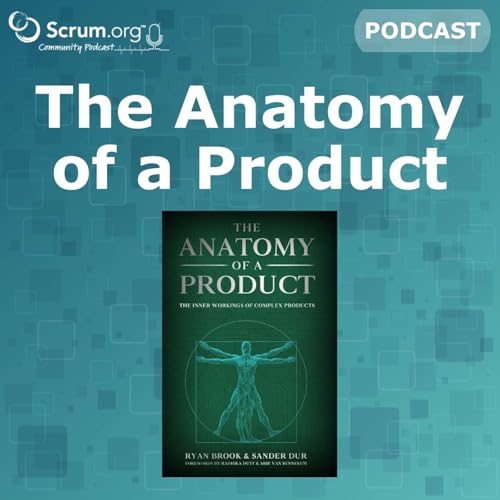
  • The Anatomy of a Product
    Dec 11 2025

    In this episode of the Scrum.org Community Podcast, host Dave West sits down with authors Sander Dur and Ryan Brook to explore their new book, The Anatomy of a Product—a practical field guide that uses the human body as a metaphor to demystify modern product management.

    Dave, Sander, and Ryan dive into why so many organizations still struggle to define and manage products effectively, and how this book helps bridge the gap between theory and real-world practice. They discuss treating products as living systems, the dangers of “marshmallow backlogs,” the need for evidence-driven decisions, and why continuous care and adaptation are essential for healthy products.

    The authors share insights from working with organizations like Miro, unpack common “product diseases,” and offer actionable guidance for Product Owners, product teams, and leaders seeking clarity in today’s complex environment.

    Listeners are invited to connect with the authors and join them at their book launch event in Amsterdam on January 13!

    Key Points

    Why the Book?
    Clarifies what a product is and offers a practical guide from definition to retirement.
    Human Body Metaphor
    Products are like living systems—interconnected, adaptive, and influenced by their environment.
    Theory vs. Practice
    Helps teams apply product concepts realistically, beyond Silicon Valley-style theory.
    Insights from real examples
    Real-world examples showing how to balance strategy, business thinking, and everyday product work.
    Backlog Health
    Avoid “marshmallow backlogs” by filtering work through strategic goals and focusing on value.
    Validation & Evidence
    Emphasizes validating ideas early and aligning efforts to outcomes, not just requirements.
    Product Health
    Introduces “product diseases” and how to diagnose and prevent common issues.

    Links:

    Book Launch event

    The Anatomy of a Product

    Show More Show Less
    30 mins