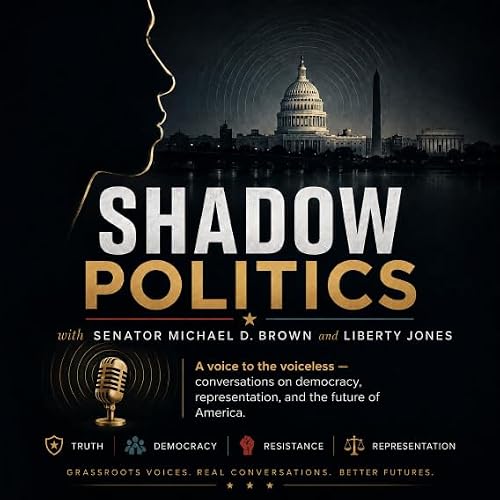
Shadow Politics with US Senator Michael D Brown cover art

Shadow Politics with US Senator Michael D Brown

Shadow Politics with US Senator Michael D Brown

Written by: BBS Radio BBS Network Inc.
Listen for free

About this listen

Shadow Politics is a grass roots talk show giving a voice to the voiceless. For more than 200 years the people of the Nation's Capital have ironically been excluded from the national political conversation. With no voting member of either house of Congress, Washingtonians have lacked the representation they need to be equal and to have their voices heard. Shadow Politics will provide a platform for them, as well as the millions of others nationwide who feel politically disenfranchised and disconnected, to be included in a national dialog. We need to start a new conversation in America, one that is more inclusive and diverse and one that will lead our great nation forward to meet the challenges of the 21st century. At Shadow Politics, we hope to get this conversation started by bringing Americans together to talk about issues important to them. We look forward to having you be part of the discussion so call in and join the conversation. America is calling and we're listening… Shadow Politics is about America hearing what you have to say. It's your chance to talk to an elected official who has spent more than 30 years in Washington politics. We believe that if we start a dialog and others add their voices we will create a chorus. Even if those other politicians in Washington don't hear you — Senator Brown will. He's on a mission to listen to what America has to say and use it to start a productive dialog to make our democracy stronger and more inclusive. If we are all part of the solution we can solve any problem.Copyright 2026 Senator Michael Brown Politics & Government
Episodes
  • Shadow Politics, April 26, 2026
    Apr 27 2026
    Shadow Politics with Senator Michael D. Brown and Co-host Liberty Jones Reclaiming Truth, Guest, Josh Levs on dismantling victim narratives and the formula for media literacy In this episode of Shadow Politics, former CNN lead fact-checker Josh Levs joins hosts to dissect the systemic collapse of media integrity. He explores how "clickbait politics" and memetic warfare have replaced objective journalism, offering a framework for citizens to reclaim the truth through curiosity and context. The Crisis of Mainstream Media and the Rise of Clickbait The American media landscape has shifted from being a "standard bearer" of truth to a fractured environment driven by engagement metrics. Josh Levs notes that mainstream outlets, including the New York Times, CNN, and the BBC, have frequently failed to correct factual errors or provide necessary context, leading to an all-time low in public trust. This decline is fueled by a corporate focus on short-term stock returns and "rage-bait" headlines designed to trigger emotional responses rather than inform the public. As trust erodes, audiences are increasingly turning to social media, which often acts as a breeding ground for unverified conspiracy theories and partisan echo chambers. Mechanics of Manipulation: Memetic Warfare and Victim Narratives Political extremists on both the far right and far left utilize sophisticated "memetic warfare"—the use of images and brief, emotionally charged messages—to bypass the conscious mind and influence the subconscious. This is often coupled with "victim narratives" based on the "Drama Triangle" (Victim, Villain, Hero). By casting their audience as victims and themselves as heroes, political figures and media outlets manipulate public sentiment to fuel hatred and radicalization. Levs points out that surveys show a growing acceptance of political violence across the spectrum, a reality often ignored by mainstream media because it does not fit their established partisan narratives. Building a Truth Counter-Movement The long-term solution to media manipulation lies in a "truth counter-movement" rooted in curiosity rather than opinion. Levs advocates for a shift in education—moving away from teaching children how to "debate" a side and toward teaching them how to investigate facts. By prioritizing instinctive curiosity and demanding "facts plus context," citizens can pressure the media to return to its essential societal role. Furthermore, the rise of independent voters suggests a potential for a centrist political coalition that could move beyond the hatred-driven duopoly of the current two-party system. The current crisis of truth is a result of both human nature and systemic media failures. However, by recognizing manipulation tactics like the "Drama Triangle" and insisting on a standard of "Facts + Context," individuals can navigate the noise. The path forward requires a collective commitment to curiosity and the courage to hold both media institutions and political leaders accountable to the reality of the facts.
    Show More Show Less
    57 mins
  • Shadow Politics, April 19, 2026
    Apr 20 2026
    Shadow Politics with Senator Michael D. Brown and Co-host Liberty Jones Navigating War, Narrative, and the Digital Divide This episode of Shadow Politics explores the escalating conflict in Iran, the systemic erasure of Indigenous history in American museums, and the widening socioeconomic gap exacerbated by Artificial Intelligence. Hosts Michael D. Brown and Liberty Jones challenge mainstream narratives, urging listeners to seek truth beneath political rhetoric and foster genuine human connection in a divided nation. The Iran Conflict and Diplomatic Isolation The discussion opens with a critical assessment of the ongoing war in Iran and the strategic instability surrounding the Straits of Hormuz. Senator Brown highlights a significant disconnect between administration claims of victory and the reality of continued naval attacks, suggesting that the U.S. is faltering on the diplomatic front. A primary critique is the lack of international consultation; by acting as a "singular actor" without the overwhelming post-WWII economic dominance it once held, the U.S. has left itself without allies in a "forever war" that suffers from a total lack of an exit strategy. Historical Revisionism and Indigenous Rights Liberty Jones shares her disillusionment with the Smithsonian National Museum of the American Indian, noting that the exhibits often present a sanitized narrative of "compromise" rather than the brutal reality of colonization. The hosts contrast these "passive" stories with the historical record of figures like General Howard and the ongoing disrespect signaled by the Washington Commanders' use of Indigenous imagery on helmets. They argue that America’s inability to be culturally sensitive stems from a mainstream narrative that avoids uncomfortable truths about the past. The AI Frontier: Progress vs. Deterioration The conversation shifts to the dual nature of technology, specifically Artificial Intelligence. While acknowledging AI's potential to cure diseases, the hosts express deep concern over "brain deterioration"—the loss of basic skills like mental math or addressing envelopes due to automation. More critically, they discuss how AI can be weaponized to exploit public ignorance through "alternative facts" and deepfakes, potentially reinforcing existing prejudices rather than expanding human knowledge. Social Fabric and the "Woke" Narrative The hosts analyze the weaponization of the term "woke," lamenting that a word meaning "to be aware" has been reframed as a pejorative. They argue that the current political climate thrives on "us vs. them" ideologies because they provide a false sense of belonging in an increasingly lonely, digital world. The segment concludes with a call for the Democratic party to stop "talking down" to voters and instead focus on genuine listening and empathy to bridge the divide. The episode serves as a sobering reminder that while technology and warfare evolve, the fundamental human need for truth and connection remains unchanged. By dismantling false narratives—whether they concern historical atrocities or modern military engagements—society can begin to move toward a more "sane" and inclusive future.
    Show More Show Less
    55 mins
  • Shadow Politics, April 12, 2026
    Apr 13 2026
    Shadow Politics with Senator Michael D. Brown and Co-host Liberty Jones Political Debate Against the Other Side of the Isle and Ideological Crossroads Guest, Noah Witherspoon - Floridian political activist of Turning Point USA On Shadow Politics, an intense and polarizing discussion featuring host Senator Michael D. Brown, co-host Liberty Jones, debating conservative organizer Noah Witherspoon. The dialogue serves as a microcosm of the current American political divide, touching on fiscal policy, constitutional interpretation, and the moral foundations of leadership. The conversation begins on a "homework assignment" given to Noah Witherspoon to justify conservative appeal to senior citizens. This quickly evolves into a heated debate over Donald Trump’s legacy, the validity of Critical Race Theory, and the legal nuances of birthright citizenship, highlighting a sharp contrast between institutional experience and emerging grassroots conservatism. The Conservative Case for Seniors and Fiscal Rebuttals Noah Witherspoon presented several arguments for why seniors should align with conservatism, focusing on economic security through the Tax Cuts and Jobs Act (TCJA) and the protection of Social Security. He highlighted the record-high VA budget of $488 billion projected for 2027 and the construction of over 450 miles of border wall as key successes. Senator Brown countered these points by arguing that the Republican party has historically sought to cut Social Security and that the current administration's focus on defense spending comes at the expense of essential social services like childcare. Urban Governance and the "Beautification" of D.C. A significant portion of the debate focused on the "Beautification Movement" in Washington, D.C. Liberty Jones questioned the ethics of spending 400 million on ball room renovations and 10 billion on D.C. aesthetics while cutting 120,000 households for elderly housing and 33,000 for people with disabilities. Noah defended these expenditures as necessary for the dignity of the nation's capital, while the Senator characterized private donations for these projects as "bribes" and criticized the incompetence of newly appointed judicial figures like Jeanine Pirro. Social Theory and Academic Influence The participants clashed over the role of Critical Race Theory (CRT) in academia. Noah characterized CRT as a "dangerous concept" that suggests racism is permanent within white society. In response, Liberty Jones, a sociology minor, argued that CRT is a structural analysis of systemic disparities, such as housing, rather than an attack on individuals. The Senator added that understanding the "prologue" of American history—including its darker chapters—is essential for future progress. Faith, Values, and the MAGA Slogan The dialogue concluded with a philosophical exploration of "Make America Great Again" and Christian values. The hosts argued that the MAGA slogan ignores historical periods of racial and gender-based oppression. Senator Brown challenged Noah to find "Christianity" in policies of retribution and military aggression, citing biblical passages on love and neighborliness. Noah maintained that Trump is a "builder" who is valiantly defending the country's foundations. The interview underscores a profound disconnect between the "facts" as perceived by different political factions. While Noah Witherspoon represents a highly articulate and researched new generation of conservatives, Senator Brown and Liberty Jones emphasize historical context and institutional integrity. The debate remains unresolved, reflecting the broader national struggle to define the "true" American identity and the proper interpretation of its founding documents..
    Show More Show Less
    59 mins
adbl_web_anon_alc_button_suppression_c
No reviews yet