• Earthrise & the Moment Change Happens – A Conversation with Frank White, Pt. 1
    Nov 24 2025

    The Episode

    Frank White has spent decades unpacking something astronauts struggle to describe — the instant you see Earth not as a place you stand on but as the vessel carrying all of us through space.

    In this first part, Frank traces the roots of the space age — Sputnik, Apollo, Earthrise — and how those shocks and images rewired our sense of ourselves. He shows how global conflict, national pride, and scientific leaps all converge in that fragile blue sphere rising over the lunar horizon.

    This isn’t just the story of a photograph.
    It’s how perspective becomes politics — and why seeing Earth from afar might be the cultural medicine we still need.

    Cosmic Timeline (Timestamps)

    [00:00:00] We are already in space — Earth as an organic spaceship
    [00:02:35] The letter to Wernher von Braun — and the reply that changed Frank’s life
    [00:07:30] Childhood rocketry, Sputnik fever, and realizing science might not be his path
    [00:09:40] Was von Braun the Elon Musk of his time?
    [00:11:40] Sputnik’s shock — and how it reshaped American education
    [00:14:50] A proxy war in orbit — why the Cold War made space urgent
    [00:16:56] Why today’s momentum (Starship, China, Artemis) feels eerily familiar
    [00:17:58] Kennedy’s lost vision: a joint U.S.–Soviet mission to the Moon
    [00:21:20] Are we culturally advanced enough for true cooperation?
    [00:23:00] The Overview Effect — one planet, no borders, and the danger of ignoring reality
    [00:26:10] Earthrise — context, chaos, and the emotional shock of 1968
    [00:29:38] How that single photo lifted a broken year
    [00:30:36] Will the next Moon landing matter? Yes — most people alive never saw Apollo
    [00:35:36] Images that birthed environmentalism — and how to bring the overview down to Earth
    [00:38:26] Why preaching doesn’t work — stories do
    [00:40:12] Urgency: 99 percent of species are gone — we’re not immune
    [00:41:44] A summit in orbit? Maybe start with the people who actually make policy
    [00:43:00] Markus wraps Part 1 — and sets the stage for Part 2

    Memorable Moments

    • “Don’t say going into space. We are in space — we always have been.”
    • “Ignoring the overview is like ignoring gravity.”
    • “Earthrise made a hard year feel possible again.”
    • “The more you preach, the more people harden their worldview against you.”
    • “We’re in a race against time — the Earth can be unforgiving.”

    Links to Explore

    • Frank White – The Overview Effect
    • Apollo 8: Earthrise Archive
    • Blue Marble Image (Apollo 17)

    Send us a text

    You can find us on Spotify and Apple Podcast!
    Visit us at SpaceWatch.Global, subscribe to our newsletters, and follow us on Li

    Send us a text

    You can find us on Spotify and Apple Podcast!

    Please visit us at
    SpaceWatch.Global, subscribe to our newsletters. Follow us on LinkedIn and Twitter!

    Show More Show Less
    45 mins
  • Two Days and a Half – How ESA Brought a Lost Mars Mission Back to Life
    Oct 30 2025

    The Episode

    In March 2022, Europe’s ExoMars Rosalind Franklin mission was only weeks from launch when it was suddenly grounded.
    Russia’s invasion of Ukraine ended years of cooperation, and left one of ESA’s most ambitious Mars projects without a ride, without partners, and without a plan.

    From inside ESA’s Mission Control in Darmstadt, Sara Melloni watched everything freeze. As Mission Operations Manager for Rosalind Franklin, she now leads the team bringing Europe’s Mars dream back to life, one simulation, one re-wiring, one sleepless night at a time.

    This is not just the story of a spacecraft.
    It’s the story of how science survives politics, and how belief can resurrect a mission thought lost.

    Cosmic Timeline (Timestamps)

    • [00:00:00] Opening – Markus recalls seeing the ExoMars rover and hearing its dramatic backstory
    • [00:01:45] Sara Melloni on writing a new chapter for Rosalind Franklin
    • [00:04:30] How the original 2018 mission fell apart and what ESA learned
    • [00:08:20] When geopolitics stops science – the shock after the 2022 suspension
    • [00:12:50] “Two days and a half” – the tightest window in mission control
    • [00:17:40] Inside ESOC – training, simulation, and the psychology of mission control
    • [00:23:15] How engineers dismantled, re-tested, and rebuilt a “frozen” mission
    • [00:29:10] The rover’s drill: reaching two meters down for traces of ancient life
    • [00:36:00] ESA’s global collaborations and the rebirth of European Mars exploration
    • [00:43:50] From crisis to creativity – what the ExoMars team taught ESA about adaptation
    • [00:49:00] Sara’s reflection on curiosity, machines, and the human mind
    • [00:54:20] Closing – why bringing Rosalind Franklin back matters for the future of Europe in space

    Memorable Moments

    • “We were ready to go, every checklist ticked, and then the war started.”
    • “Our Russian colleagues lost access to their bank accounts overnight. We all just froze.”
    • “Two days and a half. That’s all the time the landing platform will live before handing control to the rover.”
    • “If we stop using our brain, it will atrophy, machines can help us, but not replace our curiosity.”
    • “It’s a mission in limbo, but we’re bringing it back to life.”

    Links to Explore

    • ESA ExoMars Mission Overview

    • Rosalind Franklin Rover Testing at ESA

    • ESA Science Goals and Mission Phases

    Send us a text

    You can find us on Spotify and Apple Podcast!

    Please visit us at
    SpaceWatch.Global, subscribe to our newsletters. Follow us on LinkedIn and Twitter!

    Show More Show Less
    1 hr and 27 mins
  • Stop Chasing Ice: Why the First Moon Base Shouldn’t Be a Mine (with Pascal Lee)
    Oct 11 2025

    Dr. Pascal Lee, planetary scientist, Arctic field explorer, and professor at the KSU (Kepler Space University)


    He’s spent his life between two extremes, the frozen frontiers of the Arctic and the conceptual edges of space exploration. Few people connect fieldwork, engineering, and philosophy like Pascal does.

    What We Talk About

    This episode begins on the Moon — and ends light-years away.

    • Why the real space race isn’t who returns first, but who stays and builds.
    • The illusion of lunar gold: why water at the South Pole might be a scientific curiosity, not a resource economy.
    • Clavius Crater — and why this quiet spot near the lunar south is Pascal’s pick for humanity’s first real home off-world.
    • When exploration turns into strategy: the geopolitical race for lunar presence and what “claiming” actually means under the Outer Space Treaty.
    • Lessons from Antarctica — what a working lunar base could really look like, based on how we already live and explore at Earth’s poles.
    • The difference between a mine and a base, and why getting that wrong could derail the next era of exploration.
    • AI teammates: what happens when explorers aren’t just human anymore?
    • The rise of androids as extensions of ourselves. It this still us?
    • Interstellar travel: android crews carrying human DNA and recorded consciousness across centuries.
    • What happens when our “descendants” are made of carbon fiber instead of carbon flesh.

    Here’s what stayed with me:

    • We might be romanticizing the wrong things about the Moon.
      It’s not about ice — it’s about where we can survive, move, and build.
    • A mine isn’t a home. Exploration needs stability before exploitation.
    • Our future in space will likely be shared with machines that think — and maybe feel.
    • At some point, the question shifts from can we go there to who are we when we do?

    Pascal Said It Best

    “The race isn’t to touch the Moon again — it’s to set up the first base.”
    “A mine isn’t a base. Don’t confuse extraction with exploration.”
    “The biggest source of water on the Moon… is Earth.”


    To Explore

    • Pascal Lee / Mars Institute
    • SETI Institute (research partner)
    • KSU Course – The Moon & Its Exploration
    • NASA Artemis Program
    • Clavius Crater

    My Take

    Talking to Pascal Lee is like standing at the edge of a timeline that runs from the first lunar footprint to the last flicker of human DNA drifting between stars.
    He reminds us that technology is only half the story — the other half is what kind of species we want to be when machines start thinking with u

    Send us a text

    You can find us on Spotify and Apple Podcast!

    Please visit us at
    SpaceWatch.Global, subscribe to our newsletters. Follow us on LinkedIn and Twitter!
    Show More Show Less
    1 hr and 25 mins
  • The Ocean Isn’t Flat: ESA’s gravity maps, climate facts, and Earth’s hidden shape
    Sep 25 2025

    Guest: Robert Meisner, Earth Observation, ESA, ESRIN

    The Cosmic Scoop:
    In this eye-opening episode, Markus travels to ESRIN, ESA’s Earth Observation hub in Frascati near Rome, to sit down with Robert Meisner – a man who has spent nearly 40 years watching our planet from above. Together they dive into the hidden landscapes of the ocean surface, the secrets of gravity maps, and how satellites reveal the slow but relentless transformation of our world.

    From sea level rise and melting glaciers to the surreal beauty of satellite art, Robert explains why Earth observation isn’t just about data – it’s about giving our planet a voice. Along the way, he clears up climate myths, reminds us how science self-corrects, and points to the hope that comes from knowledge, action, and communication.

    Quotable Insights:

    • “We deliver the hard facts – like it or not. It’s not a matter of belief, it’s a matter of measurement.”
    • “Almost half of today’s sea level rise comes from the warming and expansion of the oceans.”
    • “The ocean surface is not flat – it’s a landscape of invisible hills and valleys shaped by gravity.”
    • “Science has its own cleansing system: if nobody can disprove you, chances are it matches reality.”

    Cosmic Timeline (Timestamps):

    • [00:00:00] Opening: Why the ocean surface is not flat
    • [00:03:00] What ESRIN does – ESA’s Earth Observation headquarters
    • [00:07:00] Satellites, orbits, and why 800 km matters
    • [00:10:00] Measuring ocean temperatures from space
    • [00:14:00] Accuracy, salinity, and the Gulf Stream as Earth’s energy conveyor belt
    • [00:17:30] Sea level rise – glaciers vs. thermal expansion
    • [00:21:00] Climate denial, hard facts, and science as a self-correcting system
    • [00:28:00] From drifting continents to ice ages – how new theories become accepted
    • [00:29:30] The artistic beauty of satellite data
    • [00:33:00] Melting glaciers, unstable Alps, and the thawing permafrost
    • [00:35:00] The GOCE mission and gravity maps – why oceans have hills
    • [00:43:00] Copernicus, Sentinel satellites, and Europe’s unique leadership
    • [00:47:00] CO₂ monitoring from space – the upcoming game changer
    • [00:49:00] Digital Twin Earth – simulating our planet’s future
    • [00:50:00] The human side: 40 years of watching Earth change
    • [00:54:00] Espresso for the mind – the art of science communication

    Links to Explore:

    • ESA Earth Observation
    • Copernicus Programme
    • Digital Twin Earth initiative

    Spread the Cosmic Love!
    If this conversation reshaped how you see our oceans, climate, and planet, share it with your friends, your students, your colleagues. The more people understand Earth as a living system, the more hope we can build for the generations to come.

    Send us a text

    You can find us on Spotify and Apple Podcast!

    Please visit us at
    SpaceWatch.Global, subscribe to our newsletters. Follow us on LinkedIn and Twitter!

    Show More Show Less
    59 mins
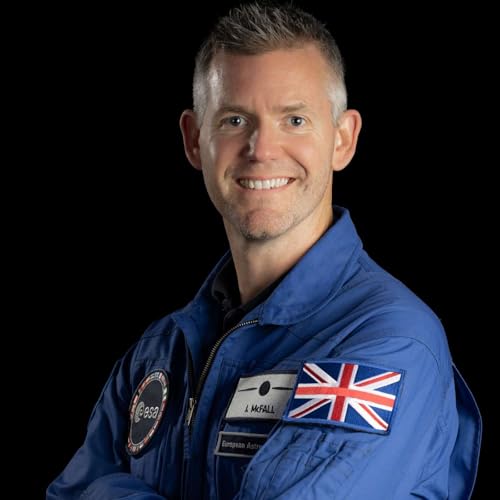
  • Who Needs Legs in Space? The Incredible Journey of John McFall
    Sep 11 2025

    John McFall — surgeon, Paralympic medalist, father of three, and ESA parastronaut selectee — joins Markus to explore how human spaceflight changes when we design for ability, not assumptions. From winter survival in the Pyrenees to EVA realities and cosmic radiation, John shares what it takes to open space to everyone.

    Cosmic Timeline

    [00:00:00] Squeezing life’s juice — John’s credo

    [00:03:00] Coffee breaks as medalist, surgeon, astronaut

    [00:06:00] Accident at 19 → sport, surgery, ESA call

    [00:09:00] Do we need legs in space?

    [00:12:20] Winter survival in Pyrenees snow caves

    [00:15:00] Basic training: survival, centrifuge, classrooms

    [00:24:00] Rethinking excellence — Apollo vs today

    [00:30:00] Why EVAs are brutally physical

    [00:33:00] Floating “prisons” & Skylab lessons

    [00:36:00] Pressure of being ESA’s first parastronaut

    [00:40:00] Designing space for adaptive bodies

    [00:44:00] ESA, NASA, and Europe’s timing

    [00:46:00] Starship iteration vs ESA caution

    [00:50:00] Radiation: cosmic rays, flares, Vigil mission

    [00:54:00] Acute vs chronic radiation risks

    [01:00:00] Espresso for the mind: “Go the extra mile”

    [01:02:00] Closing: inclusivity as space’s next leap

    Key Discussion Points

    • Training, no exceptions. From snow caves in the Pyrenees to centrifuge drills, John meets the same standards as his peers.
    • Rethinking excellence. Apollo’s muscle-bound explorers vs. today’s reality of EVA suits, radiation risks, and teamwork.
    • Radiation: the big wall. Acute vs. chronic effects, why long-term missions demand breakthroughs, and ESA’s Vigil solar-weather mission.
    • Design from scratch. Building adaptive spacecraft and systems that work for every kind of astronaut.
    • Inspiration for kids. Why seeing John in a flight suit could empower the next generation of dreamers.

    Music for the Journey

    • John’s pick for our Spotify playlist This Playlist for the Aspiring Space Traveler:
      A live 16-minute version of Status Quo’s “4500 Times” (Milton Keynes, 1979).

    Espresso for the Mind

    “Always go the extra mile. Life will reward you.”
    Words from John’s parents after his accident — a mantra he carries into every challenge.


    Links to Explore

    • ESA Parastronaut Initiative
    • ESA Astronaut Training overview
    • ESA Vigil Space Weather Mission
    • ESA News on John McFall’s selection

    Send us a text

    You can find us on Spotify and Apple Podcast!

    Please visit us at
    SpaceWatch.Global, subscribe to our newsletters. Follow us on LinkedIn and Twitter!

    Show More Show Less
    1 hr and 4 mins
  • Earth's Lost Rings: A 466-Million-Year-Old Warning
    Aug 28 2025

    Guest:
    Dr. Andy Tomkins – Geologist, Professor at Monash University, and lead author of the groundbreaking study proposing that Earth once had a Saturn-like ring system.

    The Cosmic Scoop:
    What if Earth once had rings like Saturn? Dr. Andy Tomkins joins Markus to unravel the evidence that, 466 million years ago, a colossal asteroid breakup may have encircled our planet with a shimmering band of debris. From the science of ancient meteorites to the climate effects of planetary rings, this episode explores how cosmic events have shaped our world—and what they might mean for life, extinction, and the future of planetary science.

    Quotable Insights:

    • “The evidence needs to be gathered a bit more still, but we think that ring period could have lasted for 20 to 40 million years.”
    • “You can imagine looking up and seeing this ephemeral, light-shaded band in the sky.”
    • “Life diversifies quickly when it’s responding to a challenge.”
    • “Rings are ephemeral—they don’t last very long.”
    • “Earth is compositionally not that special. The right ingredients for life are distributed everywhere throughout the universe.”

    Cosmic Timeline:

    [00:00:00] Introduction & Earth’s Ancient Beauty
    [00:02:00] Saturn-like Rings on Earth?
    [00:06:00] The Visian Period: 500 Million Years Ago
    [00:09:00] How the Ancient Ring System Formed
    [00:14:00] The Asteroid Breakup and Meteorite Evidence
    [00:18:00] Global Impact: Craters, Tsunamis, and Sedimentary Clues
    [00:23:00] What Did the Rings Look Like?
    [00:27:00] Did the Rings Affect Earth’s Climate?
    [00:31:00] The Great Ordovician Biodiversification Event
    [00:36:00] Geological Timescales & Extinction Events
    [00:41:00] The Fate of Earth’s Rings
    [00:45:00] Habitability, Exoplanets, and Cosmic Coincidences
    [00:50:00] Where Did Earth’s Water Come From?
    [00:54:00] Future Asteroid Events & Apophis
    [00:59:00] What’s Next in the Research?
    [01:03:00] If You Could See the Asteroid Belt…
    [01:06:00] Music for the Journey: “Paint It Black” by The Rolling Stones
    [01:09:00] Espresso for the Mind: Inspiration & Final Thoughts

    Links to Explore:

    • Dr. Andy Tomkins at Monash University
    • Original Research Paper: Earth’s Ancient Ring System
    • Plate Tectonic Reconstructions (YouTube)
    • NASA Asteroid Resources
    • Spotify Playlist: Space Cafe Podcast Guest Picks

    Spread the Cosmic Love!
    If this episode sparked your imagination or challenged your view of Earth’s history, share it with a friend, colleague, or fellow stargazer. Let’s keep exploring the mysteries of our planet and the universe together.

    Find us on Spotify and Apple Podcasts.
    Visit us at SpaceWatch.Global, subscribe to ou

    Send us a text

    You can find us on Spotify and Apple Podcast!

    Please visit us at
    SpaceWatch.Global, subscribe to our newsletters. Follow us on LinkedIn and Twitter!

    Show More Show Less
    59 mins
  • Solar Lets You Visit. Nuclear Lets You Stay. A delicate conversation.
    Aug 12 2025

    Guest: Dr. Bhavya Lal – Former NASA Chief Technologist, MIT-trained nuclear engineer, and architect of U.S. space nuclear policy.

    The Cosmic Scoop:
    Nuclear power’s bad Earthly reputation hides its potential as a lifeline beyond our planet. Space is already radioactive—and if we want to stay and build on the Moon, Mars, or Europa, nuclear offers “power abundance” solar can’t match. Dr. Lal explains why, covering tech, safety, law, history, and why the next space era may finally embrace it.

    Quotable Insights:

    • “Solar lets you visit. Nuclear lets you stay and build.”
    • “Without nuclear, we design for scarcity. With nuclear, we design for capability.”
    • “Adding nuclear in space is like pouring water in a hurricane—it barely registers.”
    • “We are entering an era of abundance.”

    Cosmic Timeline:
    [00:00:00] Nuclear perception problem
    [00:04:00] NASA’s lunar reactor plan
    [00:06:40] Moon nights & Mars dust storms
    [00:08:10] Power abundance
    [00:11:20] Why it hasn’t happened yet
    [00:16:50] Nuclear tech & propulsion
    [00:21:30] Voyager’s RTGs
    [00:23:00] Solar limits
    [00:25:00] Soviet space reactors
    [00:28:00] Current development
    [00:32:00] Space vs. Earth reactors
    [00:36:00] Legal frameworks
    [00:38:00] Launch safety
    [00:42:00] Reputation & safety evolution
    [00:46:00] Why nuclear is inevitable
    [00:48:30] Europa’s ice drills
    [00:50:40] The Great Filter
    [00:56:00] Project Orion
    [01:00:00] Music: ABBA – “Dancing Queen”
    [01:01:00] Inspiration: “Think of abundance”

    Links to Explore:

    • NASA Fission Surface Power Project
    • Space Policy Directive-6 (U.S.)
    • Outer Space Treaty (1967)
    • The Europa Report (film)

    Spread the Cosmic Love!
    If this conversation shifted your perspective on nuclear—or challenged what you thought you knew—share it with a friend, colleague, or fellow stargazer. Let’s talk about the technologies that will power our next giant leap.


    Send us a text

    You can find us on Spotify and Apple Podcast!

    Please visit us at
    SpaceWatch.Global, subscribe to our newsletters. Follow us on LinkedIn and Twitter!

    Show More Show Less
    1 hr and 5 mins
  • Planet Earth, Digitized: Can ESA’s Virtual Twin Save Us?
    Jul 29 2025

    This week, Simonetta Cheli, Director of Earth Observation Programs at the European Space Agency (ESA), joins Markus to dive into one of the most ambitious and groundbreaking projects of our time: building a digital twin of our planet. Through Destination Earth (DestinE), ESA is creating a dynamic, real-time model of Earth—a tool designed to simulate future scenarios, test the impact of human decisions, and ultimately help us better care for our fragile world.

    Quotable Insights

    • “We’re giving Earth a voice. Our satellites are the planet’s way of telling us what’s happening—and what’s coming next.” – Simonetta Cheli
    • “We don’t need more data to know we must act. We need to use the data we already have to make change visible and urgent.”
    • “Europe is a world leader in Earth observation—both in technology and in making data available for all.”

    Cosmic Timeline (Timestamps)

    • [00:00:00] Simonetta’s first-hand story of shrinking rivers and climate signals
    • [00:01:00] Introduction: Giving Earth a voice through digital twins
    • [00:02:05] What Earth observation means and why it matters today
    • [00:05:00] Looking in the mirror: How satellites diagnose the planet’s health
    • [00:09:00] 30+ years of Copernicus satellite data and its value for the future
    • [00:12:00] ESA’s Destination Earth: building a sandbox for global “what-if” scenarios
    • [00:17:00] CO₂ tracking, biomass missions, and carbon accountability
    • [00:19:30] Europe’s unique leadership in Earth observation and data openness
    • [00:23:00] Integrating AI: The promise and challenges of machine-driven insights
    • [00:27:00] Real-world applications: from urban planning to disaster response
    • [00:29:00] Personal moments: What surprised Simonetta the most from space data
    • [00:32:00] A journey to Greenland: confronting the speed of melting ice
    • [00:34:00] Do we really need more data—or more action?
    • [00:37:00] How satellites connect citizens to the consequences of their choices
    • [00:41:00] ESA’s efforts in education, outreach, and startup support
    • [00:45:00] Simonetta’s vision: Earth observation as a planetary voice
    • [00:46:00] Music choice and final reflections

    Relevant Links and References

    • ESA Earth Observation
    • Destination Earth (DestinE)
    • Copernicus Programme

    Spread the Cosmic Love!

    If this episode made you see our planet in a new light, share it with a friend. Follow the Space Café Podcast on Spotify and Apple Podcasts.
    Join the conversation on LinkedIn or email us at podcast@spacewatch.global. Your thoughts help shape future episodes!

    Send us a text

    You can find us on Spotify and Apple Podcast!

    Please visit us at
    SpaceWatch.Global, subscribe to our newsletters. Follow us on LinkedIn and Twitter!

    Show More Show Less
    47 mins