Startup Project: Build the future cover art

Startup Project: Build the future

Startup Project: Build the future

Written by: Nataraj
Listen for free

About this listen

Conversations with founders, operators and investors who are building the future. Listen to find the stories, ideas, tactics & investments behind the products that will define the future of technology. https://startupproject.substack.com/Nataraj Economics
Episodes
  • Inside Story of Building the World’s Largest AI Inference Chip | Cerebras CEO & Co-Founder Andrew Feldman
    Jan 16 2026

    Discover how Cerebras is challenging NVIDIA with a fundamentally different approach to AI hardware and large-scale inference.


    In this episode of Startup Project, Nataraj sits down with Andrew Feldman, co-founder and CEO of Cerebras Systems, to discuss how the company built a wafer-scale AI chip from first principles. Andrew shares the origin story of Cerebras, why they chose to rethink chip architecture entirely, and how system-level design decisions unlock new performance for modern AI workloads.

    The conversation explores:

    • Why inference is becoming the dominant cost and performance bottleneck in AI

    • How Cerebras’ wafer-scale architecture overcomes GPU memory and communication limits

    • What it takes to compete with incumbents like NVIDIA and AMD as a new chip company

    • The tradeoffs between training and inference at scale

    • Cerebras’ product strategy across systems, cloud offerings, and enterprise deployments

    This episode is a deep dive into AI infrastructure, semiconductor architecture, and system-level design, and is especially relevant for builders, engineers, and leaders thinking about the future of AI compute.

    🎧 Listen to the full episode of Startup Project on YouTube or your favorite podcast platform.

    Show More Show Less
    1 hr and 3 mins
  • How AI Is Unlocking Materials We’ve Never Been Able to Build | Radical AI
    Jan 4 2026

    Discover how Radical AI is revolutionizing material science using self-driving labs.

    About the episode:

    Nataraj hosts Joseph Krause, CEO of Radical AI, to explore how they're speeding up material R&D by combining AI, engineering, and robotics. Joseph shares his journey from material science to venture capital, highlighting Radical AI's mission to create a self-driving lab that autonomously designs tests and discovers new materials. The episode dives into Radical AI's materials flywheel concept, their open-source engine, and how they're attracting funding to drive innovation in material science. Discover how Radical AI is set to revolutionize industries from aerospace to energy with cutting-edge material discovery.

    What you’ll learn

    • Understand the traditional challenges hindering the commercialization of new materials and how Radical AI is overcoming them.
    • Discover the materials flywheel concept and how it accelerates the speed of material discovery.
    • Learn about the types of customers who are seeking new materials and the diverse applications across various industries.
    • Explore the role of AI in simulating and experimenting with materials, and the importance of experimental validation.
    • Understand the types of AI models Radical AI uses, including machine learning, generative AI, and computer vision.
    • Identify Radical AI’s hiring strategy to build an interdisciplinary team across machine learning, software engineering, robotics, and material science.
    • Comprehend the importance of experimental data in materials science and how self-driving labs capture and utilize this data.
    • Learn about Radical AI’s stepwise approach to focus on customer-driven problems and enabling technologies.

    About the Guest and Host:

    Guest Name: Joseph Krause, Co-founder and CEO of Radical AI, aiming to revolutionize material science with AI, engineering, and robotics.

    Connect with Guest:

    → LinkedIn: https://www.linkedin.com/in/josephfkrause

    → Website: https://www.radical-ai.com/

    Nataraj: Host of the Startup Project podcast, Senior PM at Azure & Investor.

    → LinkedIn: https://www.linkedin.com/in/natarajsindam/

    → Substack: ⁠https://startupproject.substack.com/⁠


    In this episode, we cover

    • (00:01) Introduction to Radical AI and Joseph Krause
    • (01:15) Joseph’s diverse background and how it led to Radical AI
    • (05:01) Traditional ways preventing commercialization of new materials
    • (09:06) Radical AI’s product: novel materials for aerospace, defense, and energy
    • (11:36) Customers seeking new materials and the advantage of speed in the materials flywheel
    • (13:39) Challenges in digital research and the importance of physical experimentation
    • (16:18) How Radical AI picks directions for new material discovery
    • (23:48) The AI part of Radical AI: hiring and AI models used
    • (27:13) Predicting crystal structures with AI
    • (31:57) Why New York is the best place for Radical AI
    • (33:37) Joseph’s best AI use case for personal research
    • (37:35) Material research happening at Apple


    Don’t forget to subscribe and leave us a review/comment on YouTube Apple Spotify or wherever you listen to podcasts.


    #RadicalAI #AI #MaterialScience #Robotics #DeepTech #Innovation #VentureCapital #Aerospace #Defense #Energy #NewMaterials #SelfDrivingLabs #MachineLearning #GenerativeAI #OpenSource #Podcast #Startup #Technology #Research #NVIDIA


    Show More Show Less
    38 mins
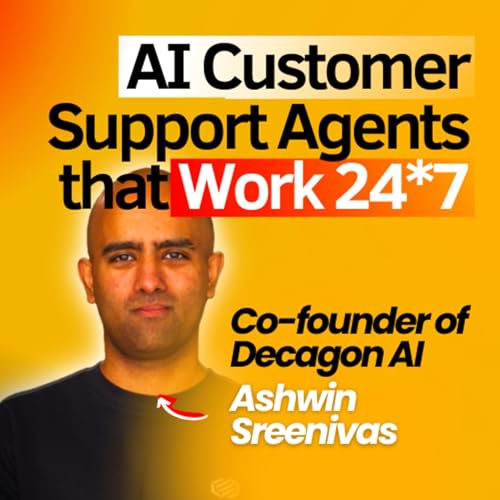
  • How Decagon Built Human-Level AI Support: Ashwin Sreenivas on customer obsession, early traction, enterprise complexity, and the AI concierge future
    Nov 24 2025

    Unlock the secrets to Decagon AI's $1.5 billion valuation and AI-powered customer support.

    Ashwin Sreenivas is the co-founder of Decagon AI, a company revolutionizing enterprise customer support with AI agents. Founded in 2023, Decagon has rapidly grown to a $1.5 billion valuation, automating support workflows for brands like Duolingo and Notion. Ashwin, previously co-founder of Helio (acquired by Scale AI), shares insights into Decagon's product-market fit, secret sauce, and tangible business impact, revealing how AI is transforming customer interaction. If you're curious about the future of AI in enterprise solutions, this episode is a must-listen.


    Listen now YouTube | Apple | Spotify


    Quotes from the episode

    • Traditional chatbots relied on rigid decision trees, leading to frustrating customer experiences, but Decagon's AI agents are trained like humans, enabling fluid, natural conversations.
    • Decagon's AI agents follow Agent Operating Procedures (AOPs), which are similar to human SOPs, and this allows them to handle customer interactions across chat, phone, SMS, and email.
    • The key is to focus on building AI agents that can follow instructions effectively, allowing businesses to offer personalized customer concierge services and seamless user experiences.
    • Instead of predicting what customers want, AI should learn customer preferences and remember them, making interactions more seamless and efficient, enhancing overall satisfaction.


    What you’ll learn

    • Understand how Decagon AI is transforming customer support by using AI agents that can handle conversations across various channels.
    • Learn about Agent Operating Procedures (AOPs) and how they enable AI agents to follow instructions and interact with customers like humans.
    • Discover how Decagon AI helps businesses expand their support offerings, leading to higher retention and happier customers through increased support access.
    • Explore the importance of solving customer problems quickly and seamlessly, regardless of whether the interaction is with a human or an AI agent.
    • See how Decagon AI is expanding beyond customer support to offer customer concierge services, enabling personalized and friction-free interactions.
    • Learn how focusing on customer needs and building something people will pay for can simplify early-stage company challenges.

    Takeaways

    • Decagon AI's agents use Agent Operating Procedures (AOPs) to mimic human-like interactions, which contrasts with older chatbot tech that relied on rigid decision trees.
    • Unlike traditional approaches, Decagon AI focuses on creating a single agent adept at following instructions, improving onboarding and iteration for customers.
    • Training smaller, fine-tuned models can outperform larger models on specific tasks, providing better performance and lower latency for customer interactions.
    • Customer support is evolving into a brand differentiator, with companies like Amazon and American Express setting the standard for excellent service and customer trust.
    • By making support more affordable, businesses can reinvest savings into providing more extensive support, leading to higher customer retention and satisfaction.
    • Early customer acquisition requires manual effort, including networking, cold emailing, and LinkedIn messaging, with a focus on charging for the software from day one.
    • Concentrating on building solutions that customers are willing to pay for within a short timeframe helps to validate business models and weed out unpromising ideas.


    Don’t forget to subscribe and leave us a review/comment on YouTube, Apple, or Spotify.


    It helps us reach more listeners and bring on more interesting guests.


    Stay Curious, Nataraj


    Show More Show Less
    49 mins
No reviews yet