• The Phantom Time Hypothesis: Did Someone Steal 297 Years of History? — Europe, 996
    May 27 2026

    In 1996, a German author named Heribert Illig published a theory that became a bestseller: that 297 years of human history were simply invented. The entire Carolingian period. The life and reign of Charlemagne. The Viking Age. The rise of Islam. All of it, according to Illig, fabricated by a Holy Roman Emperor, a Pope, and possibly a Byzantine Emperor — men who conspired to insert three centuries into the historical record so their own reigns would fall at the symbolically significant year one thousand.

    Host Shawn Spainhour walks you through the full theory — the calendar argument that started it, the archaeological gaps Illig pointed to, and the case for a fictional Charlemagne — and then through the evidence that dismantles it: astronomical records, tree rings, radiocarbon dating, and the meticulous calendars of the Islamic world, none of which were consulted by Illig and none of which cooperate with his timeline. The Phantom Time Hypothesis is wrong. But the question underneath it — how do we actually know what we know about the past? — is one worth sitting with.

    Strange Epochs tells true stories from history's stranger corners. Each episode is written for deep listening — slow, atmospheric, and immersive. Whether you're behind the wheel, unwinding after a long day, or settling in for sleep, this show is built to pull you in and carry you somewhere else.

    Sources are listed in the show notes:

    • Illig, Heribert. Das erfundene Mittelalter: Die größte Zeitfälschung der Geschichte. Econ Verlag, 1996.
    • Wikipedia contributors. Phantom time conspiracy theory. Wikipedia, Wikimedia Foundation, 2024.
    • Ethik und Sozialwissenschaften. Symposium on the Phantom Time Hypothesis. Volume 8, 1997.
    • Discover Magazine. What Is the Truth Behind the Controversial Phantom Time Hypothesis? 2023.
    • Big Think. Phantom time hypothesis: Did a power-hungry pope fabricate centuries of history? 2023.
    • Damn Interesting. The Phantom Time Hypothesis. Alan Bellows, 2005.
    • Sky History. The Phantom Time Conspiracy: Are three hundred years of human history made up? 2023.
    • Discovery UK. Phantom Time Hypothesis: Did We Really Invent Centuries of History? 2025.
    Show More Show Less
    47 mins
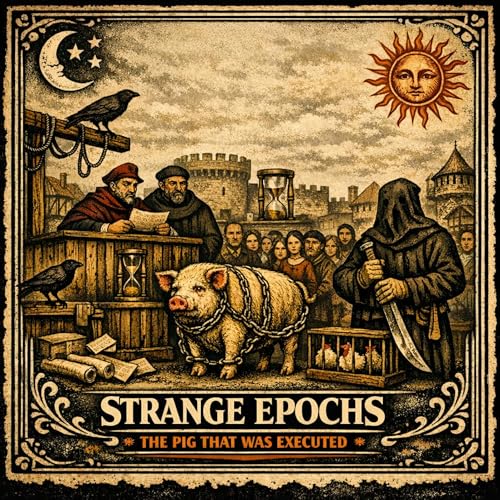
  • The Pig That Was Executed: Justice, Animals, and the Medieval Mind — France, 1457
    May 20 2026

    In medieval France, a pig was formally arrested, given a defense lawyer, brought before a judge, found guilty, dressed in human clothing, and publicly hanged. This was not an isolated incident. Between the thirteenth and eighteenth centuries, there are documented records of over two hundred animal trials across Europe — pigs, bulls, rats, weevils, caterpillars, and at least one rooster accused of the capital crime of laying an egg. Every proceeding was conducted with complete legal seriousness. Every sentence was carried out by a professional executioner who received new gloves afterward, as they did after hanging a human being.

    Host Shawn Spainhour takes you inside the worldview that made this not just possible but perfectly logical — a medieval understanding of justice, order, and humanity's place in creation that was coherent, deliberate, and deeply revealing about how an entire civilization understood itself. This is not a story about superstition or madness. It is a story about what law means, who it applies to, and what happens when a society draws the boundaries of moral responsibility around everything that lives.

    Strange Epochs tells true stories from history's stranger corners. Each episode is written for deep listening — slow, atmospheric, and immersive. Whether you're behind the wheel, unwinding after a long day, or settling in for sleep, this show is built to pull you in and carry you somewhere else.

    Sources are listed in the show notes:

    • Evans, E.P. The Criminal Prosecution and Capital Punishment of Animals. William Heinemann, 1896.
    • Cohen, Esther. Law, Folklore, and Animal Lore. Past and Present, Volume 110, 1986.
    • Dinzelbacher, Peter. Animal Trials: A Multidisciplinary Approach. Journal of Medieval History, Volume 32, 2006.
    • Gins, Sven. Casting Justice Before Swine: Late Medieval Pig Trials as Instances of Human Exceptionalism. University of Groningen, 2023.
    • Wikipedia contributors. Animal trial. Wikipedia, Wikimedia Foundation, 2024.
    • History Today. Pigs Might Try. Alexander Lee, 2020.
    • JSTOR Daily. When Societies Put Animals on Trial. 2020.
    • Popular Science. In Medieval France, Murderous Pigs Faced Trial and Execution. 2026.
    • Ancient Origins. Medieval Justice: Pig Was Tried in Court, Sentenced and Executed for Murder. 2022.
    Show More Show Less
    44 mins
  • The Year Without a Summer: When a Volcano Froze the World — Global, 1816
    May 12 2026

    In 1816, summer never came. Crops failed in June. It snowed in July. Families across the Northern Hemisphere watched their harvests die in the ground and had no idea why. A volcano on the other side of the world — Mount Tambora in Indonesia — had erupted the year before with a force so massive it put enough material into the atmosphere to change the climate of an entire hemisphere. The people starving in Vermont and Ireland and Bengal had never heard of it.

    Host Shawn Spainhour takes you through the full story: the eruption of Tambora in April 1815, the slow creep of its effects across the globe, the famines and food riots and mass migrations it triggered, the new strain of cholera it helped unleash, and the strange red sunsets that painters couldn't stop painting. And on the shores of Lake Geneva, a young woman named Mary Shelley — stuck indoors through a cold, dark Swiss summer — sat down and invented Frankenstein.

    Strange Epochs tells true stories from history's stranger corners. Each episode is written for deep listening — slow, atmospheric, and immersive. Whether you're behind the wheel, unwinding after a long day, or settling in for sleep, this show is built to pull you in and carry you somewhere else.

    Sources are listed in the show notes:

    • Wood, Gillen D'Arcy. Tambora: The Eruption That Changed the World. Princeton University Press, 2014.
    • Post, John D. The Last Great Subsistence Crisis in the Western World. Johns Hopkins University Press, 1977.
    • Wikipedia contributors. Year Without a Summer. Wikipedia, Wikimedia Foundation, 2024.
    • Wikipedia contributors. 1815 eruption of Mount Tambora. Wikipedia, Wikimedia Foundation, 2024.
    • National Park Service. 1816: The Year Without Summer. U.S. National Park Service, 2022.
    • Britannica editors. Mount Tambora eruption. Encyclopaedia Britannica, updated 2024.
    • Oppenheimer, Clive. Eruptions That Shook the World. Cambridge University Press, 2011.
    • Shelley, Mary. Frankenstein; or, The Modern Prometheus. Lackinton, Hughes, Harding, Mavor, and Jones, 1818.
    • U.S. Geological Survey. New England's 1816 Mackerel Year, Volcanoes and Climate Change Today. 2017.
    Show More Show Less
    47 mins
  • The Defenestration of Prague: Three Men, One Window, Thirty Years of War — Prague, 1618
    May 5 2026

    On the morning of May 23rd, 1618, a group of Protestant noblemen marched into the royal council chamber of Prague Castle and threw three men out of a window. The drop was seventy feet. All three survived. Catholics said it was angels. Protestants said it was a dung heap. Both sides immediately printed pamphlets. And within months, the Thirty Years War had begun — a conflict that would kill up to eleven million people and permanently reshape the relationship between religion and political power in the Western world.

    Host Shawn Spainhour takes you into the full story: the centuries of religious tension between Catholic and Protestant powers in central Europe, the fragile Bohemian nobility and their collision with Habsburg authority, and the three men who fell from that window and set an entire continent on fire. This episode follows the chain of consequence from a single morning in Prague all the way to the Peace of Westphalia in 1648 — the settlement that laid the foundation for the modern nation-state and the separation of church and state.

    Strange Epochs tells true stories from history's stranger corners. Each episode is written for deep listening — slow, atmospheric, and immersive. Whether you're behind the wheel, unwinding after a long day, or settling in for sleep, this show is built to pull you in and carry you somewhere else.

    Sources are listed in the show notes:

    • Wilson, Peter H. The Thirty Years War: Europe's Tragedy. Harvard University Press, 2009.
    • Parker, Geoffrey. The Thirty Years War. Routledge, second edition, 1987.
    • Wikipedia contributors. Defenestrations of Prague. Wikipedia, Wikimedia Foundation, 2024.
    • Britannica editors. Defenestration of Prague. Encyclopaedia Britannica, updated 2024.
    • German History in Documents and Images. The War Begins: The Defenestration of Prague, May 1618. German Historical Institute, Washington D.C., 2023.
    • Slavata, Wilhelm. Personal memoir and account of the defenestration, circa 1620–1630. Referenced in Wilson and Parker.
    • Public Domain Review. Windows Onto History: The Defenestrations of Prague. 2024.
    • Origins: Current Events in Historical Perspective. Out the Window: Religion, Politics, and a Defenestration in Prague. Ohio State University, 2018.
    Show More Show Less
    39 mins
  • The Great Emu War: Twenty Thousand Emus vs. the Australian Army — 1932
    Apr 28 2026

    In 1932, the Australian government deployed soldiers and machine guns to the Western Australian outback to deal with a crisis threatening the livelihoods of desperate farmers. The enemy: twenty thousand emus. What followed was one of the most absurd military operations in recorded history — and the emus won, decisively and without any apparent awareness that they had done so.

    Host Shawn Spainhour takes you into the full story: the First World War veterans who had been given land by a grateful government and then abandoned to the grinding economics of the Great Depression, the annual emu migration that had been crossing that same land for millions of years before anyone planted wheat on it, and the three-week campaign that produced nine hundred confirmed kills out of twenty thousand birds and became the national punchline of a story that started as a desperate plea for help.

    The Great Emu War is funny. It is also, if you sit with it long enough, quietly heartbreaking.

    Strange Epochs tells true stories from history's stranger corners. Each episode is written for deep listening — slow, atmospheric, and immersive. Whether you're behind the wheel, unwinding after a long day, or settling in for sleep, this show is built to pull you in and carry you somewhere else.

    Sources are listed in the show notes:

    • Wikipedia contributors. Emu War. Wikipedia, Wikimedia Foundation, 2024.
    • Serventy, Dominic. Observations on the Emu War. Referenced in ornithological records, 1932–1933.
    • Britannica editors. Emu War. Encyclopaedia Britannica, updated 2023.
    • National Geographic. The Bizarre Story of When Australia Went to War with Emus and Lost. 2024.
    • Beyer, Greg. The Great Emu War: When Australians Lost to Flightless Birds. The Collector, 2023.
    • Meredith, Major G.P.W. Official Report on the Emu Cull Operations, Campion District, Western Australia. Royal Australian Artillery, December 1932.
    • The Melbourne Argus. Various reports on the Emu War. November through December, 1932.
    • History Hit. The Great Emu War: How Flightless Birds Beat the Australian Army. 2023.
    Show More Show Less
    38 mins
  • The Mad Gasser of Mattoon: An Invisible Terror Stalks Mattoon, Illinois — 1944
    Apr 21 2026

    In September of 1944, residents of Mattoon, Illinois began reporting a prowler outside their windows — one who left no footprints, no face, and no trace. Only a smell. A sweet, sickening gas that paralyzed legs, caused vomiting, and sent families to the hospital. The local newspaper ran the story. Then more victims came forward. Then more. The town was terrified, the police were baffled, and the attacker was never caught — because some investigators came to believe there was never an attacker at all.

    Host Shawn Spainhour takes you into the anxious world of wartime small-town America — a community stretched thin by rationing, absent husbands, and factory fumes — and walks you through one of the most debated cases of mass psychogenic illness in modern history. Was the Mad Gasser real? A chemical leak? A copycat? Or something that spread not through the air, but through fear itself?

    Strange Epochs tells true stories from history's stranger corners. Each episode is written for deep listening — slow, atmospheric, and immersive. Whether you're behind the wheel, unwinding after a long day, or settling in for sleep, this show is built to pull you in and carry you somewhere else.

    Sources are listed in the show notes.

    Johnson, Donald M. The Phantom Anesthetist of Mattoon: A Field Study of Mass Hysteria. Journal of Abnormal and Social Psychology, Volume forty, nineteen forty-five.

    Maruna, Scott. The Mad Gasser of Mattoon: Dispelling the Hysteria. Swamp Gas Book Company, two thousand and three.

    Bartholomew, Robert E. and Goode, Erich. Mass Delusions and Hysterias: Highlights from the Past Millennium. Skeptical Inquirer, Volume twenty-four, two thousand.

    Mattoon Daily Journal-Gazette. Anesthetic Prowler On Loose. September second, nineteen forty-four.

    Mattoon Daily Journal-Gazette. Front-page coverage of the Mad Gasser incidents. September two through September fourteen, nineteen forty-four.

    Time Magazine. Mad Anesthetist of Mattoon. September eighteenth, nineteen forty-four.

    Daily Illini. Nocturnal Prowler Lists Thirty-Three Victims in Mattoon Scare. September twelfth, nineteen forty-four.

    Wikipedia contributors. Mad Gasser of Mattoon. Wikipedia, Wikimedia Foundation, two thousand and twenty-four.

    Show More Show Less
    43 mins
  • The Cadaver Synod: A Dead Pope on Trial
    Apr 14 2026

    In the year 897, the body of Pope Formosus was dug up, dressed in papal robes, propped on a throne, and put on trial before a room full of bishops in Rome. A deacon was appointed to speak on the corpse's behalf. The verdict was decided before the first word was spoken.

    Host Shawn Spainhour takes you into the unstable world of the ninth-century papacy — the collapse of Carolingian power, the Roman noble families pulling strings behind the throne, and the bitter rivalry that drove Pope Stephen VI to put a dead man on trial. This wasn't madness for its own sake. It was a calculated act of political erasure, an attempt to unmake a pope's entire legacy and rewrite the authority of the Church itself.

    The episode also covers the aftermath: the outrage that swept Rome, Stephen's own violent downfall, and the question of what bodies, relics, and legitimacy truly meant in the medieval world.

    Strange Epochs tells true stories from history's stranger corners. Each episode is written for deep listening — slow, atmospheric, and immersive. Whether you're behind the wheel, unwinding after a long day, or settling in for sleep, this show is built to pull you in and carry you somewhere else.

    Sources are listed below and in the show notes:

    • Duffy, Eamon. Saints and Sinners: A History of the Popes. Yale University Press, 1997.
    • Liutprand of Cremona. Antapodosis (Retribution), circa 958–962. Translated by Paolo Squatriti, Catholic University of America Press, 2007.
    • Mann, Horace K. The Lives of the Popes in the Early Middle Ages. Kegan Paul, 1902.
    • Moore, Michael Edward. The Attack on Pope Formosus: Papal History in an Age of Resentment, 875 to 897. In Ecclesia et Violentia, Cambridge Scholars Publishing, 2014.
    • Monroe, William S. The Trials of Pope Formosus. PhD dissertation, Columbia University, 2021.
    • Annales Alamannici. Contemporary chronicle entry for the year 897. Monumenta Germaniae Historica.
    • Kelly, J. N. D. The Oxford Dictionary of Popes. Oxford University Press, 1986.
    Show More Show Less
    33 mins
  • The Dancing Plague of 1518: Strasbourg’s Mass Hysteria
    Apr 10 2026

    In the summer of 1518, a woman named Frau Troffea stepped into the streets of Strasbourg and began to dance. She didn't stop for days. Within weeks, dozens of others had joined her — and the city of Strasbourg found itself in the grip of one of the strangest, most inexplicable events in recorded history.

    Host Shawn Spainhour guides you through the full story: the medieval world of famine, plague, and religious terror that made this outbreak possible; how city officials and physicians tried — and failed — to stop it; and the leading theories historians still debate today, from ergotism to mass psychogenic illness.

    Strange Epochs tells true stories from history's stranger corners. Each episode is written for deep listening — slow, atmospheric, and immersive. Whether you're behind the wheel, unwinding after a long day, or settling in for sleep, this show is built to pull you in and carry you somewhere else.

    Sources are listed below and in the show notes:

    • Waller, John. A Time to Dance, A Time to Die: The Extraordinary Story of the Dancing Plague of 1518. Icon Books, 2008.

    • Bartholomew, Robert E. Little Green Men, Meowing Nuns and Head-Hunting Panics: A Study of Mass Psychogenic Illness and Social Delusion. McFarland, 2001.

    • Strasbourg City Council Records, July through September 1518. Archives de la Ville et de la Communauté Urbaine de Strasbourg.

    • Bock, Hieronymus. Contemporary chronicle account of the dancing plague, circa 1518.

    • Agrippa, Heinrich Cornelius. Contemporary account of the Strasbourg outbreak, circa 1518.

    • Waller, John. “A Forgotten Plague: Making Sense of Dancing Mania.” The Lancet, Vol. 373, 2009.

    • Bartholomew, Robert E., and Wessely, Simon. “Protean Nature of Mass Sociogenic Illness.” The British Journal of Psychiatry, Vol. 180, 2002.

    Show More Show Less
    38 mins