Episodes

  • Five Years On – Navigating an Unpredictable World with Lord John Browne
    Feb 2 2026

    In this episode of Sustainability Talks, host and Managing Partner of ETF Partners Patrick Sheehan welcomes back a very special guest, Lord John Browne, Co-Founder and Chairman of BeyondNetZero, Senior adviser to General Atlantic and former CEO of BP. When we launched the Sustainability Talks podcast in 2021, Lord Browne was our very first guest. At that time the world looked very different, with President Trump’s term ending, the US pulling out of Iraq and before Russia invaded Ukraine.

    Now, Patrick and Lord Browne reunite to dissect the seismic shifts in geopolitics, climate and energy—offering a candid masterclass on how to lead, innovate, and find opportunity in a profoundly unpredictable environment.

    Tune in for a powerful, pragmatic and ultimately optimistic discussion on how to navigate the complex trade-offs facing business and politics today and secure a sustainable future.


    Chapters:

    00:00 The Evolution of Energy Perspectives

    08:59 Navigating Uncertainty in Energy Markets

    15:57 The Role of Technology in Energy Transition

    21:52 Entrepreneurship and Innovation in Energy

    28:48 Cultivating Courage and Leadership in Business


    About The Guest: Lord John Browne

    Lord Browne is the co-Founder and Chairman of BeyondNetZero, General Atlantic’s climate growth equity fund. The fund’s strategy is to invest in companies that contribute to the energy transition by reducing end-to-end costs; improving operational efficiency; reducing strategic risks and improving resilience; and enabling the development of new energy sources.

    He currently serves as Chairman of Avathon, an artificial intelligence technology company, and Chairman of Carbonplace, a global carbon credit transaction network. He also serves on the board of Venterra, an offshore wind energy services company which is part of BeyondNetZero’s investment portfolio.

    After retiring from BP in 2007, Lord Browne joined Riverstone, where he was co-head of a $3.4 billion renewable energy private equity fund, the world’s largest at the time. He was subsequently Executive Chairman of L1 Energy.

    He has previously served on the boards of Goldman Sachs, Intel, SmithKline Beecham, and DaimlerChrysler.

    From 2010 to 2015 he served as the UK Government first lead Non-Executive Director, working with Secretaries of State to appoint Non-Executive Directors to the board of each government department. In 2010, the report of an independent inquiry headed by Lord Browne was published under the title Securing a Sustainable Future for Higher Education, making recommendations for a more sustainable system of higher education funding.


    Find out more about Lord John Browne HERE

    Find out more about BeyondNetZero HERE

    Follow Lord John Browne HERE

    Follow Patrick Sheehan HERE

    Find out more about ETF Partners at: etfpartners.capital

    Show More Show Less
    33 mins
  • Driving the Future of Infrastructure with Sir Danny Alexander
    Jan 26 2026

    In this episode of Sustainability Talks, Rob Genieser, Managing Partner at ETF Partners, sits down with Sir Danny Alexander, CEO of Infrastructure Finance and Sustainability at HSBC. They explore the massive trends currently reshaping global infrastructure—from the energy security needs of developed markets to the rapid electrification of emerging economies.


    The conversation dives into the bank’s role in supporting “first-of-a-kind” projects, the critical need for blended finance in Southeast Asia, and why 95% of HSBC’s clients now view sustainability as a fundamental growth opportunity.


    In this episode, you’ll learn:

    The Infrastructure “Golden Age”: How energy security, digital transformation, and climate resilience are driving unprecedented demand for new assets.


    AI as an Energy Transition Catalyst: Why the massive power demand of data centres is actually accelerating the deployment of firm, clean power and grid innovation.


    Bridging the Bankability Gap: The specific criteria required to move sustainability from venture-backed innovation to large-scale project finance.


    Blended Finance & Partnerships: A look at Pentagreen Capital and how public and private capital work together to de-risk sustainable projects in Asia.


    Case Study—Sustainable Aviation Fuel (SAF): How HSBC supported the Infinium Roadrunner project in Texas to scale e-SAF production.


    The Necessity of Adaptation: Why we need to move beyond mitigation to develop financing models for resilience and nature-based solutions.


    About the Guest:

    Sir Danny Alexander is CEO of HSBC Infrastructure Finance and Sustainability, CIB. In this role, Danny leads on infrastructure finance and project finance advisory opportunities associated with the transition to net zero in our strategic markets. Danny also leads on sustainable finance and clean tech initiatives and oversees partnerships such as Pentagreen Capital, our joint venture with Temasek that targets marginally bankable clean energy and adaptation projects in Southeast Asia.


    Previously Sir Danny was Vice President, Policy and Strategy, Asian Infrastructure Investment Bank (AIIB). He joined the AIIB – the first new multilateral development bank of the 21st century and the first to be headquartered in Beijing - at its inception in 2016 and led the Bank through its start-up and growth phases. Sir Danny was responsible for AIIB’s strategic direction, including its thematic sectoral and country priorities. He led the Bank’s ambitious climate agenda and oversaw AIIB’s environmental and social and other operational policies. He represented AIIB at the G20 Finance Ministers meetings, climate COPs, and other international meetings. He led the Bank’s partnership with the World Bank and other multilateral, bilateral, and private sector partners.


    From 2010-2015, Sir Danny was Chief Secretary to the Treasury in the United Kingdom Cabinet. He led the Liberal Democrat negotiating team that established the Coalition that governed in that period and was one of the four member ‘Quad’ that provided the core political leadership of that government. In government, he was responsible for the UK’s deficit reduction, pension reform, and national infrastructure plan. He was a member of the National Security Council. He was MP for Inverness, Nairn, Badenoch and Strathspey from 2005 to 2015. He was Knighted by Her Majesty the Queen in 2015 for his services to government.


    He holds a BA in philosophy, politics and economics from the University of Oxford and is an honorary fellow of St Anne’s College, Oxford. He was born and brought up in the Highlands and Islands of Scotland.


    Follow Sir Danny Alexander on LinkedIn HERE

    Follow Rob Genieser on LinkedIn HERE

    Find out more about ETF Partners at etfpartners.capital

    Show More Show Less
    43 mins
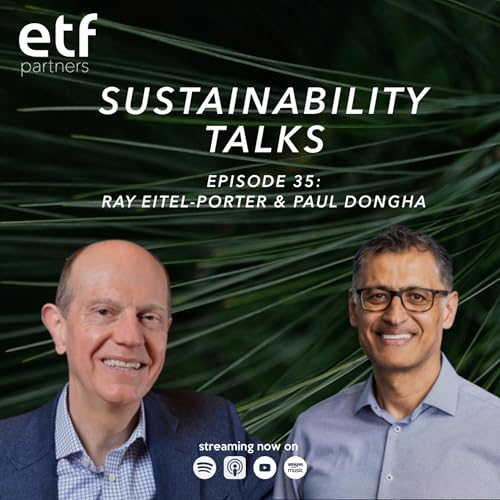
  • Building Ethical & Sustainable AI with Ray Eitel-Porter & Paul Dongha
    Dec 12 2025

    In this episode of Sustainability Talks, ETF Partners Managing Partner Rob Genieser sits down with two of the leading voices in responsible and ethical AI: Ray Eitel-Porter and Dr. Paul Dongha, co-authors of the new book Governing the Machine. Together, they explore one of the most urgent and overlooked questions in today’s technology landscape: What is the true environmental cost of AI, and how can responsible AI governance accelerate sustainable innovation?

    As AI adoption accelerates—and generative AI becomes embedded in everything from banking to everyday knowledge work—the conversation turns to the growing climate impact of data centers. Ray and Paul break down the hard truths behind AI’s footprint, from rising greenhouse gas emissions and soaring energy use to the escalating water demands required to cool data centers worldwide. They warn of a collision course between AI’s rapid expansion and global sustainability targets, urging companies to integrate environmental considerations directly into their AI governance and risk frameworks.

    But this episode isn’t just a wake-up call. It’s a roadmap. Ray and Paul share practical guidance for building trust in AI systems, insights into global regulatory approaches, and a look at how AI can also advance sustainability—from smarter energy grids to more efficient industrial systems.

    Whether you’re an AI builder, a sustainability leader, or simply trying to understand the future of responsible technology, this conversation is essential listening.


    In this episode you’ll hear:

    Why responsible and ethical AI must now include environmental sustainability

    The rising CO₂ emissions, energy consumption, and water depletion linked to AI

    How data center demand is driving new coal-powered generation in some regions

    The role of corporations and regulators in shaping ethical AI

    The promise of “sustainable AI” and how organisations can measure their AI footprint

    The future of AI governance and the rise of agentic AI systems


    Key takeaway:

    AI’s transformative potential can only be realised responsibly if its environmental impact is managed—ethics and sustainability must evolve together.


    Chapters:

    00:00 The Environmental Impact of AI

    02:44 Introduction to Responsible AI Governance

    06:25 The Evolution of Responsible AI

    09:39 Building Trust in AI Systems

    12:14 Transparency in AI Governance

    14:32 Global Perspectives on AI Regulation

    20:20 The Lag of Legislation Behind Technology

    22:49 The Role of Corporations in AI Ethics

    24:03 Trust in International AI Companies

    27:46 The Future of AI and Consumer Trust

    30:17 Sustainable AI: A New Paradigm

    34:42 AI's Role in Energy Efficiency

    37:03 The Future Landscape of AI Governance


    Read ‘Governing The Machine’ here: https://www.bloomsbury.com/uk/governing-the-machine-9781399426299

    Follow Ray Eitel-Porter here: https://www.linkedin.com/in/rayeitelporter

    Follow Dr. Paul Dongha here: https://www.linkedin.com/in/paul-dongha/

    Find out more about ETF Partners at: https://etfpartners.capital/


    Show More Show Less
    46 mins
  • How Data is Powering the Energy Transition with Thorsten Heller
    Oct 27 2025

    In this episode our partner Tomer Strikovsky sits down with Thorsten Heller, a pioneer in digital infrastructure for the energy transition. As the founder of Greenbird, an ETF Partners–backed company that became a global leader in data integration for utilities before being acquired by GE Vernova, Thorsten shares his journey from startup founder to corporate innovator — and what it takes to power the grids of the future.

    They discuss how data integration, AI, and real-time analytics are transforming the way utilities operate — shifting from a one-way to a bidirectional energy flow. Thorsten explains why the invisible layer of data is critical to enabling renewable energy, flexibility, and resilience in the modern grid, and why utilities can no longer operate without AI.


    In this episode you’ll learn about:


    Why the energy transition is no longer theoretical — it’s here and accelerating fast.
    Why Data infrastructure is as vital as physical infrastructure in building a resilient, sustainable grid.
    Why utilities need to evolve from management to orchestration, powered by AI.
    How startups can make a global impact — but sometimes joining a bigger platform scales that impact faster.
    How the next wave of innovation will come from AI-enabled, decentralised grid intelligence.


    Chapters

    00:00 The Shift to Bidirectional Energy Flow

    02:45 The Birth of Greenbird and Its Mission

    05:15 Understanding the Data Challenge in Utilities

    08:46 The Spaghetti Architecture of Data Integration

    11:07 Data's Role in Sustainability and Energy Transition

    13:10 AI's Impact on Utilities and Data Foundations

    15:31 The Evolution of Energy Data

    17:46 Greenbird's Journey to Acquisition

    22:40 Integration into GE Vernova and GridOS

    26:57 The Current State of the Energy Transition

    30:38 AI as a Necessity for Future Grid Management

    36:23 Advice for Future Energy Tech Founders


    About Thorsten Heller

    Thorsten Heller is Chief Innovation Officer at GE Vernova, where he leads efforts to build the next-generation software portfolio GridOS. He was the founder and CEO of Greenbird, a Norwegian startup that became a global leader in data integration for utilities (Utilihive) and was acquired by GE Vernova in 2023. Thorsten has worked with over 200 utilities worldwide and is a recognised thought leader on digital transformation in the energy sector.


    Follow Thorsten Heller here: https://www.linkedin.com/in/thorstenheller/


    Follow Tomer Strikovsky here: https://www.linkedin.com/in/tomerstrik/

    Find out more about GE Vernova here: https://www.gevernova.com/
    Find out more about ETF Partners here: etfpartners.capital

    Show More Show Less
    41 mins
  • Unlocking the Quantum Future with Steve Brierley
    Oct 9 2025

    Explore the extraordinary potential of quantum computing!

    In the latest episode of Sustainability Talks, ETF Partners’ Managing Partner Patrick Sheehan sits down with Steve Brierley, CEO & Founder of Riverlane, the world leader in Quantum Error Correction, to explore the extraordinary potential of quantum computing.

    For decades, quantum computing has felt like science fiction — powerful in theory but always just out of reach. That is beginning to change. As Steve explains, we are entering a new era where quantum computers will soon be able to solve problems that even the world’s most advanced supercomputers cannot.


    The conversation dives into:

    Why quantum computing is a radically new capability that can solve problems classical computers cannot

    How it could revolutionise drug discovery, materials design, and sustainable fertiliser production

    The role of error correction in making quantum computers commercially viable

    The huge market potential and environmental impact of this next frontier in technology

    How geopolitics and innovation are shaping the future of computing and AI

    As Steve notes, the next few years will be pivotal: the technology is advancing rapidly, investment is scaling, and the race to build a quantum future is intensifying across the globe.

    This episode paints an inspiring picture of how harnessing the laws of nature at the atomic level could unlock innovations critical to building a more sustainable world.


    Chapters

    00:00 The Foundations of Quantum Mechanics

    02:23 Introduction to Quantum Computing

    04:10 Understanding Quantum Computing

    06:32 The Progress and Future of Quantum Computing

    09:39 The Era of Mega-Qubits

    11:14 Applications of Quantum Computing

    13:49 The Market Potential of Quantum Computing

    16:33 Challenges in Quantum Computing

    19:42 The Role of Quantum Error Correction

    24:59 Current Status and Future Trends in Quantum Computing

    30:27 Geopolitical Implications of Quantum Technology

    34:51 The Future of Quantum Computing and AI


    About Steve Brierley

    Dr. Steve Brierley is founder and CEO of Riverlane, a quantum computing company with a difference. Riverlane is the global leader in what is called quantum error correction.

    Steve founded Riverlane in 2016 to build the error correction stack for quantum computers. Driven by his conviction that fault-tolerant quantum computers will accelerate human progress, Riverlane partners with leading quantum hardware companies to make that happen sooner.

    Steve has worked in quantum for over 20 years and is an expert advisor to the UK government. He holds a PhD in quantum information, spent a decade in the intelligence community and worked as a Senior Research Fellow at the University of Cambridge leading major research projects in quantum computing. In January 2024, Steve was awarded an OBE for his services to quantum computing.


    Find out more about Riverlane here: https://www.riverlane.com


    Follow Steve Brierley HERE


    Find out more about ETF Partners here: https://etfpartners.capital/


    Show More Show Less
    39 mins
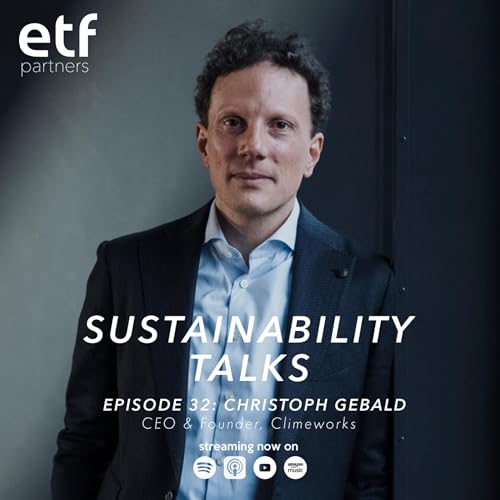
  • Navigating the Future of Carbon Capture with Christoph Gebald
    Sep 17 2025

    In this episode of our Sustainability Talks podcast, our Managing Partner Patrick Sheehan sits down with Christoph Gebald, CEO & Founder of Climeworks, the global leader in carbon dioxide removal. Together, they explore how direct air capture (DAC) is evolving from academic research to a commercially viable climate solution — and why it's becoming indispensable in the race to net zero.

    With over 15 years of experience building DAC technologies, Christoph shares how Climeworks is scaling the science of carbon removal into a business poised to operate at gigaton scale by 2050. Recognised by TIME as one of the most innovative leaders in climate action, he brings unique insight into the intersection of engineering precision, commercial ambition, and climate urgency.


    In this episode, we cover:

    What direct air capture is — and why it matters now more than ever

    The evolution of DAC from lab-scale prototypes to large-scale plants

    Key breakthroughs and cost-reduction strategies shaping the field

    The role of corporate partnerships in driving early adoption

    Financing climate infrastructure and aligning with impact investors

    How Europe’s regulatory leadership is shaping global carbon markets

    What it takes to turn climate science into scalable business models

    "We’re no longer just inventing technology — we're building the foundations of a trillion-dollar industry.


    Why it matters:

    Direct air capture is one of the few climate technologies that can physically remove CO₂ from the atmosphere. But making it economically viable requires innovation not just in engineering — but in business models, market design, and policy alignment. This episode dives into all three, offering valuable perspectives for investors, corporates, policymakers, and climate tech founders alike.

    Listen to this episode in full below or on your favourite podcast platform HERE


    Chapters

    00:00 Introduction to Direct Air Capture and Its Importance

    03:02 The Need for Mechanical Solutions in Carbon Removal

    05:59 Scaling Technology and Cost Reduction in Direct Air Capture

    08:59 Energy Consumption and Sustainability in Carbon Capture

    11:55 Market Dynamics and Business Models for Carbon Removal

    14:59 Cost Reduction Pathways and Future Projections

    17:56 Building a Business in the Carbon Removal Space

    25:23 The Trillion Dollar Climate Industry

    26:22 Understanding Customer Needs in Carbon Credits

    27:50 From Technology to Full Solutions

    28:37 The Role of Corporate Partnerships

    31:29 Navigating Market Volatility

    35:31 Europe's Market Dynamics and Regulation

    39:34 Optimism for the Future of Carbon Capture


    About Christoph Gebald

    Dr. Christoph Gebald is CEO & Founder of Climeworks, the global leader in carbon removal. With over 15 years of experience in direct air capture technology, Christoph is considered a pioneer in this growing and crucial industry. Under his leadership, Climeworks has developed groundbreaking direct air capture plants that physically remove CO2 from the atmosphere, working toward the ambitious goal of removing carbon dioxide on a gigaton scale by 2050.

    Recognised by TIME as one of the 100 most innovative leaders driving business climate action, Christoph brings a mechanical engineer's precision and a visionary's outlook to the challenge of climate change. Christoph is a mechanical engineer (ETH Zürich and UC Berkeley) and holds an MSc with distinction and a PhD from ETH Zürich.

    Find out more about Climeworks HERE

    Follow Christoph Gebald HERE

    Show More Show Less
    42 mins
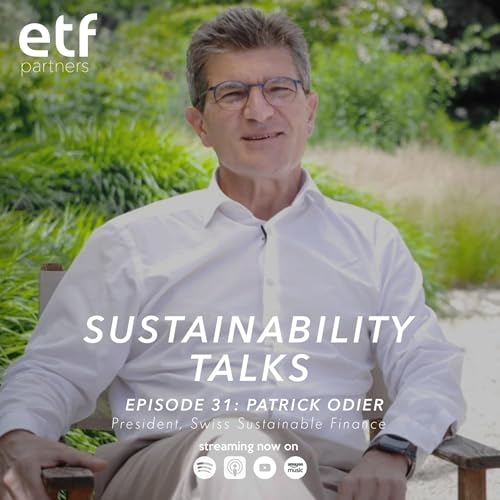
  • Sustainable Finance: A Necessity for the Future with Patrick Odier
    Sep 4 2025

    In this episode of Sustainability Talks, our Senior Partner Remy de Tonnac is joined by Patrick Odier — Chairman of Building Bridges, Chairman of the Supervisory Board of Lombard Odier Group and President of Swiss Sustainable Finance (SSF) — for a powerful discussion on the urgent need to embed sustainability at the heart of global finance.

    Patrick brings decades of leadership in the financial world and has emerged as a champion of sustainable investment. In this wide-ranging conversation, he reflects on his personal journey—from a traditional finance background to spearheading pioneering initiatives like Building Bridges, which connects public and private capital around sustainable development.

    Together, Remy and Patrick explore:

    Why global finance must become sustainable finance—or risk obsolescence

    How qualitative analysis has reshaped investment strategies over the past 30 years

    The role of metrics like “temperature contribution” in assessing corporate climate risk

    The importance of carbon pricing and accounting for environmental externalities

    The challenges—and opportunities—posed by political headwinds and regulatory fatigue

    How technology and innovation are essential to accelerating the sustainability transition

    Why optimism is a crucial tool in driving long-term systemic change

    This episode is a must-listen for anyone interested in the intersection of finance, sustainability, and innovation, and how collaborative leadership can unlock transformational change at scale.

    Chapters

    00:00 The Current State of Sustainability Discussions

    09:47 Patrick Odier's Journey into Sustainable Finance

    20:03 Metrics for Sustainable Investment

    30:00 The Role of Public and Private Capital

    32:46 Technology and Optimism in Sustainability

    About Patrick Odier

    Patrick Odier is Chairman of the Supervisory Board of Lombard Odier Group. He acted as Chairman of the Board of Directors of Bank Lombard Odier & Co Ltd. from 2014 -2022. Previously, he was Senior Managing Partner of the Lombard Odier Group from 2008 until 2022.

    He joined the Lombard Odier Group in 1982 and completed his training in Zurich, New York, and Montreal before becoming a Managing Partner in 1986. He holds an economics degree from the University of Geneva and an MBA in finance from the University of Chicago.

    Patrick Odier is president of Swiss Sustainable Finance (SSF). He is also Chairman of Building Bridges. He was Chairman of the Swiss Bankers Association from 2009 to 2016 and was a member of the Board of economiesuisse (Swiss Business Federation) from 2004 to 2022. He also serves on the boards of several academic and philanthropic organisations.


    Find out more about Lombard Odier Group HERE

    Find out more about Swiss Sustainable Finance HERE

    Find out more about Building Bridges HERE

    Show More Show Less
    36 mins
  • Revolutionising Space & The Open Cosmos Journey with Rafel Jorda Siquier
    Aug 18 2025

    In the latest episode of Sustainability Talks, ETF Partners’ Managing Partner Patrick Sheehan is joined by Rafel Jorda Siquier, founder and CEO of Open Cosmos, a company at the cutting edge of space innovation. This conversation takes us on a journey through the stars—exploring how satellites are fast becoming essential tools in the fight against climate change.

    Founded in 2015, Open Cosmos has quickly become one of the few companies capable of delivering end-to-end satellite missions—from design and build, to launch and operations. From monitoring deforestation and wildfires to enabling space-based AI and telecommunications experiments, Open Cosmos is making space technology more accessible and impactful than ever before.

    Rafel’s mission is bold: democratise access to space and make satellite data useful and available to organisations of all sizes. In this episode, he shares how Open Cosmos launched its first satellite within just eight months, has maintained a 100% mission success rate, and is now delivering multi-million euro satellite constellations and national geospatial platforms. He also reflects on the importance of collaboration across Europe to grow the space sector and deliver on global sustainability goals.

    Whether it’s responding to humanitarian disasters, monitoring essential climate variables, or building a 6G telecoms lab in orbit, this episode highlights how space can—and must—play a central role in addressing today’s most urgent planetary challenges.


    Listen now to learn about:

    The rapid rise of Open Cosmos and its unique position in the global space market

    How AI-powered satellites like Phisat-2 are enabling real-time climate data

    The Menut satellite and its role in monitoring deforestation and wildfires

    Why governments like Peru are turning to Open Cosmos for sustainable development

    How Europe can lead the future of space through ambition and cooperation


    Chapters:

    00:00 The Multipolar World and Europe's Strengths

    02:31 Open Cosmos: Revolutionizing Access to Space

    08:03 Innovations in Satellite Technology and Applications

    15:34 Real-World Impact of Satellite Data

    20:42 The Future of the Space Industry

    26:59 Europe's Role in Global Space Collaboration

    30:20 The Vision for Open Cosmos and Global Problem Solving


    About Rafel Jorda

    As CEO and founder, Rafel leads the Open Cosmos team. From leading the team to delivering the first satellite mission within eight months, to managing the expanding team and range of customers today, Rafel has overseen the overall company strategy and directed its execution, all whilst working towards the original mission of democratising access to space. After studying aerospace engineering at the Polytechnic University of Catalonia in Barcelona and completing an MBA, Rafel worked at large corporations, such as Airbus Defence and Space, as well as small innovative space start-ups, such as zero2infinity.

    Find out more about Open Cosmos here: https://www.open-cosmos.com

    Show More Show Less
    33 mins