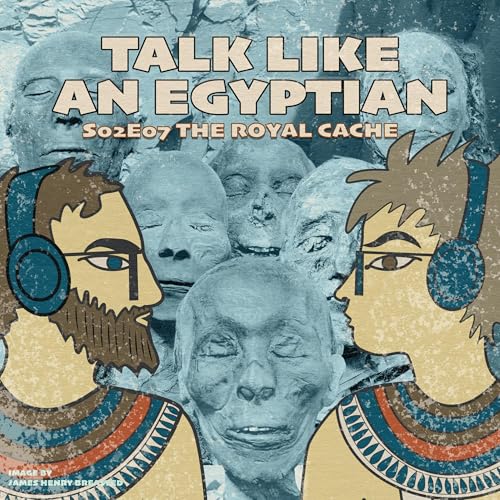
Talk Like An Egyptian cover art

Talk Like An Egyptian

Talk Like An Egyptian

Written by: Dr Chris Naunton and Iszi Lawrence
Listen for free

About this listen

A podcast about Ancient Egypt with Dr Chris Naunton and Iszi Lawrence2025 World
Episodes
  • S02E07 The Royal Cache
    Feb 17 2026

    Economic strife, migrating peoples, and potential climate issues led to the decline of the Egyptian Empire. The Valley of the Kings was abandoned, and the mummies of kings from the 17th to 20th dynasties were reburied in a secret cache to protect them from tomb robbers.

    This cache, discovered in the 19th century, contained the mummies of numerous kings, including those from the 18th, 19th, and 20th dynasties.

    The discovery of the royal tomb in the Valley of the Kings in 1881 revealed a complex story of mummy reburial and robbery. The mummies, stripped of their finery, were rewrapped and placed in new coffins, with the process spanning decades and involving multiple locations. The dockets found on the mummies provide valuable information about their identities and the reburial process.

    Please support the podcast: https://www.patreon.com/TalkLikeAnEgyptian

    Watch this episode on youtube: https://youtu.be/nxvShg1Wkas

    Show More Show Less
    49 mins
  • S02E06 The Battle of Kadesh
    Feb 10 2026

    Support the podcast and get extra content: https://www.patreon.com/TalkLikeAnEgyptian

    Ramesses II is not known as 'the great' for no reason: his life and reign were exceptionally long, he had an enormous number of wives and children, he built on a grand scale up and down the country and beyond his borders. And he was renowned as a great warrior - all great pharaohs were, to some extent, but at Qadesh we are led to believe that Ramesses was personally responsible for quite some heroics against his enemy, the Hittites. The Egyptians' battle against them at Qadesh is one of the best attested in ancient history and is depicted in the great detail on the walls of several of Ramesses' great temples. The peace treaty that eventually ended hostilities is documented in both Egyptian and Hittite sources. This is the story of one of the great battles, between two of the great powers of the ancient world.

    Show More Show Less
    51 mins
  • S02E05 Hatshepsut
    Feb 3 2026

    You can watch a video of this podcast here: https://youtu.be/Xz_x-QEli0Y

    Support the podcast and listen to bonus episodes: www.talklikeanegyptian.com/

    Hatshepsut features in The Cursed Tomb, Iszi's historical fiction novel for 9+ https://amzn.eu/d/1g3QNOX

    In the 1820s scholars began to notice something strange in the inscriptions of the great temple of Deir el-Bahri - some of the royal names and titles appeared to be grammatically feminine. Eventually, it became clear that there had been a pharaoh, previously unknown, who was female. Her name was Hatshepsut. She was the mother-in-law of Thutmose III who came to the throne as a very young boy, and was later renowned as one of the great warriors of the 18th Dynasty. Hatshepsut had initially ruled the country on her son-in-law's behalf as a regent but then she took the throne herself. For a long time this was seen as a dastardly power grab, but we now think Hatshepsut may have had no choice but to step up and become pharaoh as the country needed someone to play that role and she was best placed. In any case, not only has she become an icon of early female power, her reign was undoubtedly one of great achievements, in building, in particular her mortuary temple which is one of the greatest achievements of ancient Egyptian architecture, and in creating the myth of the divine birth of the pharaoh, which would endure for centuries.

    Show More Show Less
    53 mins
No reviews yet