Tech Threads: Weaving the Intelligent Future cover art

Tech Threads: Weaving the Intelligent Future

Tech Threads: Weaving the Intelligent Future

Written by: Baya Systems
Listen for free

About this listen

This podcast hosted by Baya Systems explores the cutting edge of technology, from AI acceleration to data movement and chiplet innovation. Each episode dives into groundbreaking advancements shaping the future of computing, featuring insights from industry experts on the trends and challenges defining the tech landscape. Tune in to stay ahead in the rapidly evolving world of technology.©2025 Baya Systems Politics & Government
Episodes
  • Beyond the CPU vs GPU War: Rethinking AI Compute at the System Level
    Apr 28 2026
    In this episode of Tech Threads, Nandan Nayampally, Baya Systems CCO, sits down with Ian Ferguson, Vice President of Vertical Markets and Business Development at SiFive, to unpack one of the most important shifts happening in modern computing: AI is no longer just about scaling compute, it’s about orchestrating complexity.

    As architectures fragment across accelerators, chiplets, and custom silicon, the real challenge is no longer building faster chips. it’s turning all of these elements into a cohesive, high-performance system.

    This conversation explores why the industry is moving beyond the traditional “CPU vs GPU” narrative and toward a system-level approach where performance is defined by how effectively compute, memory, interconnect and software work together.

    From the growing momentum behind RISC-V to the rise of heterogeneous compute environments, the discussion highlights a clear trend: the future won’t be defined by a single dominant architecture, but by optimized combinations of technologies tailored to specific workloads.

    That shift introduces a new layer of complexity.

    Key themes explored in this episode include:
    - Why data movement is emerging as the primary constraint in AI systems
    - How efficiency metrics like “tokens per dollar” are reshaping design priorities
    - The shift toward purpose-built architectures across data center, automotive, and edge applications
    - The role of open ecosystems and interoperability in accelerating innovation
    - Why competitive advantage is shifting from individual components to full system design

    If you’re interested in where AI is headed, this is a must-watch conversation on the forces shaping the future of compute and what it takes to stay ahead.
    Show More Show Less
    49 mins
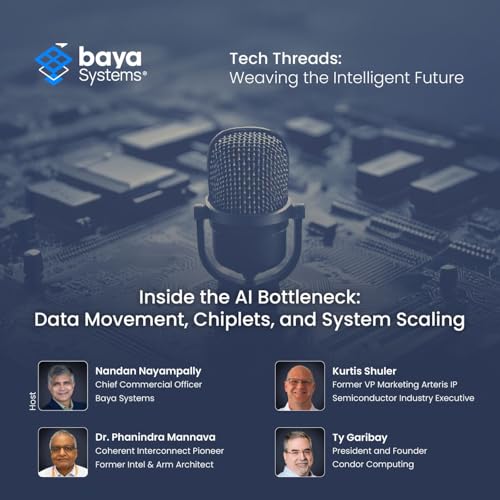
  • Inside the AI Bottleneck: Data Movement, Chiplets, and System Scaling
    Mar 27 2026
    For the last decade AI has been driven by one thing, more compute: bigger models, more accelerators, higher throughput.

    But as NVIDIA’s Jensen Huang recently highlighted at GTC, the industry is hitting a different kind of wall, one that hasn’t received nearly as much attention.

    The real constraint is no longer just compute. It’s data movement.

    To its credit, Nvidia has pushed this frontier with innovations like NVLink Fusion, and continued investment in connectivity AI dataflow architectures. But the challenge is bigger than any one company.

    As AI systems scale to hundreds - and even thousands - of processors, performance is increasingly defined by the ability to efficiently move, synchronize, and manage data across increasingly distributed architectures that can orchestrate data across chiplets, nodes, and entire racks.

    In this episode of Tech Threads, we bring together a panel of deeply experienced technologists, architects and leaders from companies like Intel, Arm, Altera, Texas Instruments, and Arteris - individuals who have helped shape modern compute, interconnect standards, and system architecture.

    Together they explore what is really changing beneath the surface: why traditional scaling approaches are breaking down, how coherent interconnects and network-on-chip architectures are evolving, and why system-level thinking is becoming essential.

    They also dive into the growing complexity introduced by chiplet-based designs, heterogeneous compute, and distributed memory systems and what it takes to maintain performance, efficiency, and programmability at scale.

    This is not just a technology shift, it’s an architectural reset.

    If you’re building or thinking about next-generation AI systems, this conversation gets to the heart of what matters next.
    Show More Show Less
    54 mins
  • From Arduino to AI Infrastructure: Scaling the Next Wave of Computingl
    Jan 21 2026
    What do Arduino, IoT, edge AI, and Nvidia-era data centers have in common? They all depend on ecosystems: people, platforms, and momentum.
    In this episode, Sander Arts joins Baya’s Chief Commercial Officer and Tech Threads host Nandan Nayampally for a wide-ranging, candid conversation on how breakthrough technology actually scales.
    Sander brings a rare operator’s perspective shaped by 25+ years scaling global technology companies across semiconductors, enterprise software, and AI. As the founder of Orange Tulip Consultancy, he serves as a Fractional CMO and growth advisor, helping leadership teams turn deep technology into real-world adoption.
    Together, Nandan and Sander explore how communities, developer access, and platform ecosystems turn deep technology into real-world adoption, and why timing and openness can be just as critical as technical performance.
    The discussion moves from the maker-era lessons of Arduino and IoT to today’s AI infrastructure boom, unpacking why scaling “long-tail” customers is both an opportunity and an operational challenge, and how edge AI and data center markets are evolving in parallel. They also debate the art of “opening the kimono,” how standardization and middleware shape adoption, and why capital intensity and speed often determine whether innovation stays local or becomes global.
    They close by looking ahead at emerging trends like robotics, neo-cloud architectures, quantum with real customers, and the networking backbone powering AI’s future, and how these shifts intersect with Baya’s view of increasingly complex, software-driven systems.
    Show More Show Less
    43 mins
adbl_web_anon_alc_button_suppression_c
No reviews yet