Episodes

  • EP 119 Fanatical Prospecting: The One Habit That Separates Closers from Strugglers
    Jan 9 2026
    Episode Summary

    In this episode of The Business Book Club, we break down the ultimate sales field manual: Fanatical Prospecting by Jeb Blount.

    It’s blunt, direct, and brutally honest — a wake-up call for anyone in sales, business development, or entrepreneurship. Blount’s central message is clear:

    Nothing happens until someone sells something. And nothing gets sold until you fill your pipeline — daily, consistently, relentlessly.

    Whether you're a seasoned closer or just trying to make your first cold call, this episode delivers the tools, tactics, and mindset shifts needed to beat the slump, crush procrastination, and prospect like a pro.

    Key Concepts Covered 💥 The Brutal Truth: Prospecting Failure = Sales Failure
    • The #1 reason most salespeople fail? Not lack of talent — but an empty pipeline.

    • It’s not a skill problem. It’s an activity problem.

    ❌ The 3 Ps That Kill Sales
    1. Procrastination – Avoiding the hard stuff until it's too late.

    2. Perfectionism – Obsessing over prep work instead of making the call.

    3. Paralysis from Analysis – Thinking too much. Doing too little.

    🔑 The 7 Core Mindsets of a Fanatical Prospector

    ✅ Optimistic & Driven – Show up daily with energy, regardless of yesterday. ✅ Competitive – Every touchpoint is a battle for attention. ✅ Confident – Expect to win. Embrace rejection. Push through fear. ✅ Efficient – Time block. Eliminate distractions. ✅ Adaptive – Don’t cling to old methods. Learn. Evolve. ✅ Resilient – Fail fast. Keep going. ✅ Systematic – Prospecting is a discipline, not a vibe.

    🧠 Pipeline Management: The 3 Laws 1. The 30-Day Rule
    • Miss prospecting today? You’ll feel it 90 days later.

    • Sales slumps are almost always due to prospecting lapses weeks ago.

    2. The Law of Replacement
    • Every deal that dies must be replaced.

    • If your close rate is 1 in 10, you need 10 new qualified leads just to stay even.

    3. The Law of Familiarity
    • The more people know you, the fewer touches it takes to convert.

    • Strangers = 20–50 touches.

    • Warm leads = 1–10 touches. → Familiarity reduces friction. Build it.

    ⏰ Time Management: Golden vs. Platinum Hours
    • Golden Hours: Mid-morning to mid-afternoon. Only for revenue-generating activity.

    • Platinum Hours: Early/late hours for admin, CRM updates, proposals.

    • Power Hours: Blocked time for focused prospecting. 🔒 Protect these hours ruthlessly.

    🔀 The Balanced Prospecting Framework

    Don't rely on just one channel. Use: 📞 Phone ✉️ Email 💬 Social Selling 🤝 Referrals A multi-channel approach = pipeline protection.

    🎯 The 4 Objectives of Every Prospecting Touch
    1. Set a firm appointment (with time, date, and place — no vague “call me later” brush-offs).

    2. Gather intel & qualify – Don’t waste time on bad fits.

    3. Close the sale – If the product allows for it.

    4. Build familiarity – Warm up the lead over time.

    📞 The 5-Step Phone Framework
    1. Get their attention (use their name).

    2. Identify yourself.

    3. Say what you want (e.g., "I need 7 minutes").

    4. Use because — anchor your ask to their pain.

    5. Ask clearly. Then pause — silence is your friend. 🚫 Don’t say “How are you?” 🚫 Don’t pause after your intro — it invites the brush-off.

    Actionable Takeaways

    ✅ Time block daily power hours for prospecting — every single day. ✅ Adopt mental toughness — prospecting will suck sometimes. Do it anyway. ✅ Sharpen your messaging — always answer “What’s in it for me?” ✅ Use multi-channel outreach — diversify to de-risk. ✅ Don’t let perfection kill momentum — messy action beats perfect hesitation.

    Top Quotes

    📌 “Nothing happens until someone sells something.” 📌 “Easy is the mother of mediocrity.” 📌 “Messy success is better than perfect mediocrity.” 📌 “Prospecting isn’t an event. It’s a lifestyle.” 📌 “Your future doesn’t lie in your past. It lies in your activity today.”

    Final Thought

    Sales slumps don’t start when the numbers fall. They start weeks earlier — the moment you stop prospecting. The cure isn’t a new script. It’s consistent, intentional effort.

    Prospecting is pain. But it’s the kind of pain that pays.

    Resources Mentioned

    📘 Fanatical Prospecting by Jeb Blount [Get the book here]

    Show More Show Less
    14 mins
  • Ep 118 Factfulness: What If Everything You Think About the World Is Wrong?
    Jan 7 2026
    Episode Summary In this episode of The Business Book Club, we explore a book that doesn’t just challenge your assumptions — it obliterates them: Factfulness: Ten Reasons We’re Wrong About the World — and Why Things Are Better Than You Think, by Hans Rosling, Ola Rosling, and Anna Rosling Rönnlund. This isn’t about blind optimism. It’s about correcting a systematic misreading of global reality. In boardrooms, strategy decks, and investor theses, smart people make bad decisions because they’re working from a distorted mental map of the world — one shaped by what the Roslings call dramatic instincts. In this episode, we break down those instincts, show how they quietly warp our worldview, and more importantly, how to fight them — so you can make smarter decisions with better data. If you're a founder, executive, investor, or strategist — this is essential thinking. Key Concepts Covered 🌍 A Broken Worldview Most people — even elite leaders — score worse than chance on basic questions about global progress. Our brains are wired to see drama, not data, which means most of our assumptions about global poverty, development, health, and opportunity are wildly outdated. 🔟 The Ten “Dramatic Instincts” (And How They Mislead Us) 1. The Gap Instinct We default to binary thinking: rich vs. poor, developed vs. developing. Reality: 75% of the world lives in the middle — income levels 2 and 3. Business takeaway: Don’t ignore the modernizing middle class — it’s the largest and fastest-growing market in history. 2. The Negativity Instinct We believe the world is getting worse because bad news is louder. Fact: Extreme poverty, child mortality, and disease are plummeting. Progress is slow, silent — and massive. You just don’t hear about it. 3. The Size Instinct Big numbers trigger big emotions. You must ask: “Compared to what?” Business lesson: Always normalize numbers — use per capita data, not just raw totals. 4. The Destiny Instinct We assume cultures, countries, or regions are static. Reality: Institutions, values, and behaviors change fast — especially with economic growth. Misreading this blinds you to emerging markets that are evolving quickly. 5. The Single Perspective Instinct One lens = bad decisions. Whether it’s pure capitalism or pure regulation, single-framework thinking leads to blind spots. Strategy tip: Build a toolbox, not a hammer. Cross-disciplinary thinking wins. 6. The Blame Instinct We want to assign a villain to every failure. That stops systems thinking dead in its tracks. Great leadership focuses on fixing systems, not shaming people. Actionable Takeaways Rebuild Your Mental Model of the World Learn the four income levels and where your target markets actually are. Don't use outdated labels like “developing” — they're meaningless. Target Levels 2 & 3 They’re not just aid recipients — they’re consumers, entrepreneurs, and value creators. Aim your product, pricing, and messaging at the real middle. Always Ask “Compared to What?” Context is everything. Is 4 million deaths a lot? Only compared to the past. Don’t react to numbers. React to rates and trends. Anticipate Market Shifts As countries move from level 2 to 3, they’ll price out low-cost production. Look ahead — not where labor is cheap now, but where it will be next. Use Per Person Data in Every Market Analysis Big countries ≠ big opportunity. High growth per capita + middle income = strategic goldmine. Avoid the “Hammer” Trap Don’t fall in love with a single worldview. Diversify your thinking the same way you diversify investments. Replace Outrage with Curiosity Being wrong isn’t a flaw. It’s a learning opportunity. When the data surprises you, lean in, don’t shut down. Top Quotes 📌 “Our intuition about global reality is not just outdated. It’s actively misleading.” 📌 “Being wrong is a signal, not a shame.” 📌 “Most of the world lives in the middle — not at the extremes.” 📌 “If you want to change your perspective, change the questions you ask.” Final Thought Factfulness isn’t about being optimistic. It’s about being accurate. And in a world drowning in information and driven by emotion, accuracy becomes a strategic superpower. So here’s the challenge: What strategic decision are you making right now — about markets, pricing, hiring, or investment — that’s based on a worldview you haven’t updated in 10 years? That’s where your competitive edge is hiding. Resources Mentioned 📘 Factfulness by Hans Rosling, Ola Rosling, and Anna Rosling Rönnlund [Get the book here]
    Show More Show Less
    14 mins
  • EP 117 The Five Dysfunctions of a Team: Why Your Team Is Failing—and What to Do About It
    Jan 5 2026
    Episode Summary In this episode of The Business Book Club, we dive into Patrick Lencioni’s classic: The Five Dysfunctions of a Team — a book that has quietly shaped the way high-performing executive teams operate behind closed doors. Lencioni flips the leadership script by arguing that the real competitive advantage isn’t strategy, finance, or tech. It’s teamwork — and not just any teamwork, but the kind forged in discomfort, debate, and shared accountability. We walk through Lencioni’s five-part framework, from the absence of trust to the inattention to results, and break down how dysfunction cascades through teams that look fine on the surface but are quietly failing underneath. This isn’t a theory-driven model. It’s behavioral. Simple to understand — brutally hard to practice. But if you get it right, you unlock speed, resilience, and alignment most companies only dream about. Key Concepts Covered 🔻 The Pyramid of Failure: The Five Dysfunctions Absence of Trust – Without vulnerability, there's no foundation. Fear of Conflict – Without trust, teams avoid healthy debate. Lack of Commitment – Without conflict, buy-in never happens. Avoidance of Accountability – Without commitment, no one holds anyone to high standards. Inattention to Results – Without accountability, personal egos overtake collective goals. ✅ Dysfunction 1: Absence of Trust Not about reliability — it’s about vulnerability-based trust. The willingness to say: I messed up. I need help. Leaders must go first and model vulnerability — or the team never will. Try the Personal Histories Exercise — a low-risk way to start humanizing your team. 🔥 Dysfunction 2: Fear of Conflict Without trust, teams default to artificial harmony. Real decisions happen after the meeting — in hallways or on Slack. Healthy conflict ≠ personal attack. It’s about ideological debate in service of the best idea. Leaders must mine for conflict and give “real-time permission” to disagree openly. 💬 Dysfunction 3: Lack of Commitment Teams don’t need consensus. They need clarity and buy-in. Principle: People don’t need to get their way — they need to feel heard. The tool here: Disagree and commit. Debate passionately, then back the decision 100%. Use Cascading Messaging: At the end of every meeting, confirm what was decided and how it will be communicated down the chain. 👀 Dysfunction 4: Avoidance of Accountability Peer-to-peer accountability is the gold standard. Leaders shouldn't be the only enforcers — the team must call each other out. Requires discomfort — but silence builds resentment, not safety. Shift from departmental loyalty to "First Team" thinking: the leadership team comes first, not your silo. 🎯 Dysfunction 5: Inattention to Results When ego, status, or departmental wins matter more than team goals, the whole system breaks. You need a clear, simple scoreboard — not a fuzzy mission statement. Example: “18 new customers by end of year.” Make it visible. Make it public. Make it matter. Results matter more than personal wins. Always. Actionable Takeaways Model Vulnerability – Say “I don’t know” or “I got it wrong” first. That’s what makes it safe for others to do the same. Cascading Messaging – Never leave a meeting without clearly stating what was decided and how it will be communicated down. Reward Team Over Self – Shift performance metrics and rewards from individual contributions to team-wide outcomes. Declare a Simple Result – Choose a clear, measurable team goal and make it public. Results must beat egos. Make the First Team Real – Your leadership team must come before your own department. And your actions need to prove it. Top Quotes 📌 “Most meetings are boring for the same reason bad movies are boring — they lack conflict.” 📌 “Consensus is a killer. Buy-in doesn’t require agreement — it requires clarity and commitment.” 📌 “Accountability isn’t top-down. It’s peer-to-peer.” 📌 “If the team loses, everyone loses. Period.” Final Thought It's easy to say your executive team is the “first team.” But what real sacrifices — of budget, power, or prestige — are you willing to make to prove it? That’s the litmus test. Because this model doesn’t live in your values statement. It lives in your reporting structures, rewards, and everyday behaviors. Resources Mentioned 📘 The Five Dysfunctions of a Team by Patrick Lencioni [Get the Book Here] Next Steps Start by asking: Where is your team faking alignment right now? Then ask: What would it take to have the real conversation instead? If this episode helped you rethink how your team works, subscribe to The Business Book Club. We give you the tools to turn ideas into actual results. #Leadership #PatrickLencioni #Teamwork #ExecutiveTeams #BusinessBookClub
    Show More Show Less
    11 mins
  • EP 116 Lean Customer Development: A Scientific Approach to Building What Customers Want
    Jan 2 2026
    Episode Summary

    In this episode of The Business Book Club, we dive into Lean Customer Development: Build Products Your Customers Will Buy by Cindy Alvarez—an essential guide for anyone building something new under conditions of extreme uncertainty.

    Forget guesswork. Alvarez shows how to systematically test your ideas, validate assumptions, and uncover real customer needs before you waste time, budget, or engineering cycles. Whether you're a solo founder, a product lead inside a Fortune 500 company, or a nonprofit innovator, this playbook applies.

    You’ll learn why most new ideas fail, how to talk to customers without bias, and how to avoid building “better features” that solve the wrong problems. This isn’t about surveys or market research—it’s about real conversations with people in pain, and using that insight to drive smarter decisions.

    Key Concepts Covered

    The Innovation Failure Rate: Why We Need a Better Method 🔹 Most new features—even at Microsoft or Amazon—fail to move the needle. 🔹 Your default success rate is worse than a coin flip. 🔹 Lean Customer Development (LCD) brings the scientific method to business risk.

    Reframe the Goal: Build Successful Customers, Not Just Better Products 🔹 Ask: “How can we make your business more successful?” 🔹 Customers aren’t buying engagement—they’re buying outcomes. 🔹 One team’s pivot from feature obsession to customer success tripled revenue.

    The 5-Step LCD Process: A Rapid Learning Loop

    1. Form a Hypothesis – Use the formula: I believe [type of person] experiences [type of problem] when doing [task].

    2. Find the Right People – Focus on early evangelists (not just early adopters).

    3. Ask the Right Questions – Avoid future hypotheticals; focus on past behavior.

    4. Analyze the Answers – Look for patterns, hidden constraints, and unmet needs.

    5. Decide: Pivot or Proceed – After 15–20 interviews, you’ll know where to go next.

    Ask Better Questions: What to Say—and What to Avoid 🔹 Avoid: “Would you use this?” or “How likely are you to buy?” 🔹 Use: “Tell me about the last time you [did the task]” 🔹 Focus on behavior, not intentions. Reality TV > documentaries.

    Real-World Tactics: How to Find & Engage Early Evangelists 🔹 People love to help, sound smart, and vent—use those instincts. 🔹 Go where they are: LinkedIn, Quora, conferences—even wine auctions (like the jerky founder did!). 🔹 Treat interviews as platforms for expertise—not sales calls.

    The Milkshake Example & Functional Fixedness 🔹 People often “hire” products for surprising jobs (commuters buying milkshakes for long drives). 🔹 Hidden workarounds (like insoles for shoes that don’t fit) reveal deep unmet needs.

    Invisible Stakeholders & Misleading Requests 🔹 Don’t forget IT, procurement, or anyone with veto power. 🔹 When customers suggest features, dig deeper: “If you had that, what would it help you do?”

    Actionable Takeaways

    ✅ Write it down – Don’t trust your gut. Form clear, narrow hypotheses first. ✅ Interview behavior, not dreams – Ground every question in the recent past. ✅ Involve the team – Invite skeptical engineers or designers to observe real pain. ✅ Use your listening posts – Train support and sales to ask why, not just log complaints. ✅ Invalidation is progress – Learning you’re wrong early is a massive win.

    Top Quotes

    📌 “The customer doesn’t want a better feature—they want a better outcome.” 📌 “The goal is not to validate your idea. It’s to learn what’s true.” 📌 “A wrong hypothesis disproven saves 10x the cost of building it.”

    Resources Mentioned

    Lean Customer Development by Cindy Alvarez – Get the book here

    Next Steps

    Ready to build something customers actually want? Start by writing down your assumptions, finding your early evangelists, and asking about their last problem, not their future intent. The truth is in their behavior—not their wishful thinking.

    If you found this deep dive helpful, subscribe to The Business Book Club and join us again soon for more powerful playbooks that take the guesswork out of business.

    #LeanStartup #CustomerDiscovery #ProductManagement #CindyAlvarez #Innovation #Entrepreneurship #BusinessBookClub

    Show More Show Less
    11 mins
  • Ep 115 Extreme Ownership: Why Leadership Is the Only Thing That Matters
    Dec 31 2025
    Episode Summary

    In this episode of The Business Book Club, we dive into Extreme Ownership: How U.S. Navy SEALs Lead and Win by Jocko Willink and Leif Babin—a modern leadership classic forged under the most extreme pressure imaginable.

    Drawing on their experience leading Task Unit Bruiser, the most highly decorated special operations unit of the Iraq War, Willink and Babin argue that leadership is the single most important factor in any team’s success or failure. At the center of it all is one uncompromising principle: extreme ownership.

    This episode translates battlefield-tested leadership lessons into practical frameworks for entrepreneurs, executives, and team leaders. From eliminating blame and building belief, to simplifying execution and making decisive calls under uncertainty, these ideas apply anywhere people are expected to perform at a high level.

    Key Concepts Covered

    Extreme Ownership: The Leader Owns Everything 🔹 Leaders take responsibility for all outcomes—especially failures. 🔹 Blame shuts down learning; ownership accelerates improvement. 🔹 When leaders own mistakes publicly, teams stop being defensive and start solving problems.

    There Are No Bad Teams, Only Bad Leaders 🔹 Performance is driven by leadership, not talent alone. 🔹 A simple leadership swap during SEAL training instantly turned the worst-performing team into the best—and vice versa. 🔹 If your team is failing, the first place to look is the mirror.

    Believe in the Mission—or You Can’t Lead It 🔹 Leaders must fully understand and believe in the why behind decisions. 🔹 If you don’t believe, you can’t inspire belief in others. 🔹 Explaining strategic purpose transforms resistance into commitment.

    The Four Laws of Combat (Execution Frameworks)

    1. Cover and Move (Teamwork) 🔹 Departments must support each other—no silos, no “us vs. them.” 🔹 Winning externally matters more than internal competition.

    2. Simple 🔹 Complexity creates confusion. Confusion kills execution. 🔹 If your plan or incentive system can’t be explained simply, it won’t work.

    3. Prioritize and Execute 🔹 When everything is urgent, identify the most important problem first. 🔹 Focus resources, solve it, then move to the next priority.

    4. Decentralized Command 🔹 Leaders must empower junior leaders to make decisions. 🔹 Clear intent enables speed, adaptability, and prevents catastrophic mistakes.

    Discipline Equals Freedom 🔹 Strict standards and repeatable processes create speed and flexibility. 🔹 Discipline eliminates chaos—and chaos is the enemy of freedom.

    Decisiveness Amid Uncertainty 🔹 Waiting for perfect information is a leadership failure. 🔹 Indecision is still a decision—and often the worst one.

    Leading Up the Chain of Command 🔹 If your boss doesn’t trust you, it’s your responsibility to fix that. 🔹 Leaders at every level must communicate clearly and proactively.

    Actionable Takeaways

    ✅ Practice extreme ownership – Own failures publicly, fix them relentlessly. ✅ Break down silos – Find one team you see as “them” and support them. ✅ Simplify everything – If it’s confusing, it won’t execute. ✅ Focus ruthlessly – Identify the top priority and dominate it. ✅ Empower junior leaders – Explain the why, then let them lead.

    Top Quotes

    📌 “There are no bad teams, only bad leaders.” 📌 “Discipline equals freedom.” 📌 “If you don’t believe in the mission, neither will your team.” 📌 “Indecision is a decision.”

    Resources Mentioned

    Extreme Ownership: How U.S. Navy SEALs Lead and Win by Jocko Willink & Leif Babin – Get the book here

    Next Steps

    Want to lead with clarity and confidence under pressure? Start by eliminating blame, simplifying your plans, and taking full ownership of outcomes—especially when things go wrong.

    If you found this deep dive valuable, subscribe to The Business Book Club for more leadership frameworks forged in real-world conditions.

    #ExtremeOwnership #Leadership #JockoWillink #TeamPerformance #Accountability #Execution #BusinessLeadership

    Show More Show Less
    12 mins
  • EP 114 Build It Like Fadell: The No-BS Playbook for Makers & Founders
    Dec 29 2025
    Episode Summary

    In this episode of The Business Book Club, we dive into Build by Tony Fadell—the man behind the iPod, the iPhone, and Nest. But this isn’t your typical Silicon Valley memoir. It’s a no-BS manual for makers, leaders, and builders at every stage of their career.

    Part memoir, part tactical playbook, Build is packed with raw, hard-won insights from Fadell’s 30+ years in tech. Whether you’re designing V1 of a new product, transitioning into leadership, or just trying to survive your first startup job, this book is a blueprint for building great things—and becoming someone who can.

    We unpack everything from navigating failure, choosing mentors, and managing teams, to balancing gut instinct vs. data, and designing the entire customer journey—not just the product. This is essential listening for anyone who wants to make things that actually matter.

    Key Concepts Covered

    Reframing Failure: School Trains You Wrong 🔹 In school, failure is punished. In life, failure is the feedback loop. 🔹 Fadell’s mantra: “Screw up until you learn how to screw up less.”

    Careers Should Prioritize Learning, Not Comfort 🔹 Don’t ask “How much will I earn?” Ask, “What will I learn?” 🔹 Work with your heroes. Join a company of 30–100 people where you can make real impact—not just blend into the crowd.

    Look Up, Look Around 🔹 Don’t get stuck in the weeds. Understand your product’s mission—and break out of your silo to connect with sales, marketing, and legal. 🔹 Innovation dies in isolation.

    Manager ≠ Super-IC 🔹 Great ICs often fail as managers because they keep doing their old job. 🔹 The manager’s new job is translation—bridging between technical, creative, and business teams.

    Data vs. Vision: Know When to Use Each 🔹 Data-driven decisions are great—when you have data. 🔹 For V1 of disruptive products, there is no data. Trust your gut. 🔹 For V2 and V3, listen to the customer relentlessly.

    The “Mission-Driven Ahole” Test** 🔹 Not all tough leaders are toxic. The difference? Intent. 🔹 If their push for excellence is about the product—not ego or politics—they might be raising your game.

    Prototype the Entire Customer Journey 🔹 Every touchpoint matters—from the ad to customer support. 🔹 Example: Nest included a screwdriver in the box to remove a moment of installation frustration—turning a pain point into a delight.

    The Rule of Three Generations 🔹 V1 = Learn. V2 = Fix. V3 = Optimize and scale. 🔹 It usually takes three versions and 6–10 years to build a sustainable business.

    Write the Press Release First 🔹 Before building, write the story you want to tell. 🔹 If your product fulfills that promise? Ship it.

    Actionable Takeaways

    ✅ Embrace productive struggle – Failure is feedback. Growth comes from discomfort. ✅ Solve real pain points – If your product is a nice-to-have, it’s already lost. ✅ Prototype the full journey – Don’t stop at the product. Design for delight across every touchpoint. ✅ Invest in people – Choose mentors and teammates who raise your standards. ✅ Lead with vision, then pivot to data – Your gut builds V1. Your customers build V2 and V3.

    Top Quotes

    📌 “If you fail, you learn.” 📌 “Don’t optimize for salary—optimize for learning.” 📌 “You’re not just building a product. You’re building a journey.” 📌 “If the idea keeps chasing you, even after you try to quit—it’s probably worth it.”

    Resources Mentioned

    Build: An Unorthodox Guide to Making Things Worth Making by Tony Fadell – Get the book here

    Next Steps

    Are you building something that won’t let you go? Start by writing the press release. Prototype the full journey. And don’t let data paralyze your vision.

    If this deep dive lit a fire under you, make sure to subscribe to The Business Book Club for more frameworks to turn great books into bold action.

    #BuildTheBook #TonyFadell #StartupLife #ProductDesign #Leadership #Innovation #CreativeProcess #MakerMindset

    Show More Show Less
    13 mins
  • EP 113 The Greatest Salesman: 10 Scrolls, 30 Days, and a Lifetime of Discipline
    Dec 26 2025
    Episode Summary

    In this episode of The Business Book Club, we explore The Greatest Salesman in the World by Og Mandino—an unexpected classic that’s less about selling and more about mastering yourself. Beneath its simple title lies a powerful personal philosophy, built around 10 ancient scrolls that teach the core principles of discipline, resilience, love, and action.

    Through the parable of Hafid—a poor camel boy turned wealthy merchant—we unpack the habits and mindset that Mandino claims lead not just to success, but to a life of meaning and contribution. This isn’t a book of sales techniques. It’s a manual for character development, wrapped in a story of spiritual and emotional transformation.

    If you're an entrepreneur, creative, or leader looking to go beyond tactics and build the person behind the performance, this episode delivers a timeless roadmap for becoming someone truly worth following.

    Key Concepts Covered

    It’s Not About Sales—It’s About Self-Mastery 🔹 Hafid’s journey to wealth begins with a test of character, not skill. His act of compassion—not closing a sale—proves his worth. 🔹 The message: Success is predictable if you commit to a life of disciplined principles.

    The 30-Day Scroll Method: Habits Through Repetition 🔹 You read one scroll three times a day for 30 days straight. 🔹 Silent reading in the morning and afternoon, and aloud at night to program your subconscious. 🔹 Scroll I’s core lesson: “I will form good habits and become their slave.”

    Scroll II: Love as a Competitive Advantage 🔹 Say silently before every meeting: “I love you.” 🔹 It’s not manipulation—it’s self-regulation. You change your state before interacting with others. 🔹 Love breaks down resistance faster than logic ever could.

    Scroll III: Reframing Rejection with the Law of Averages 🔹 Rejection isn’t failure—it’s math. If 1 in 10 says yes, each “no” is just progress. 🔹 Never end the day with a failure—make one more attempt.

    Scroll V & VI: Time and Emotional Mastery 🔹 “I will live this day as if it is my last.” Stop wasting energy on the past or future. 🔹 “Today I will be master of my emotions.” Use actions to shift your mood: sing when sad, act when afraid. Control your internal weather.

    Scroll X: I Will Act Now 🔹 Action is everything. Say this phrase the moment you hesitate. 🔹 A firefly only glows when flying—motion is what activates light and success.

    Scroll X: Praying for Ability, Not Outcomes 🔹 Don’t ask for gold—ask to be made equal to your opportunities. 🔹 Focus on becoming ready, not just wishing for results.

    Actionable Takeaways

    ✅ Commit to the scroll ritual – Choose one principle and follow the 30-day reading method exactly. ✅ Say “I love you” silently – Before tough conversations, shift your emotional state. ✅ Use “I will act now” as a trigger – Break procrastination by turning hesitation into motion. ✅ Master your mood through action – Sing, laugh, move—you create the emotional climate.

    Top Quotes

    📌 “I will form good habits and become their slave.” 📌 “I will persist until I succeed.” 📌 “I will act now.” 📌 “Failure will never overtake me if my determination to succeed is strong enough.”

    Resources Mentioned

    The Greatest Salesman in the World by Og Mandino – Get the book here

    Next Steps

    Want to go beyond reading and start living timeless success principles? Pick one scroll that resonates with your current challenge, and follow the 30-day loop. Mandino’s system is simple—but only works if you actually do it.

    Subscribe to The Business Book Club for more mindset-transforming frameworks.

    #OgMandino #GreatestSalesman #PersonalGrowth #Habits #Mindset #SelfDiscipline #SalesPhilosophy

    Show More Show Less
    11 mins
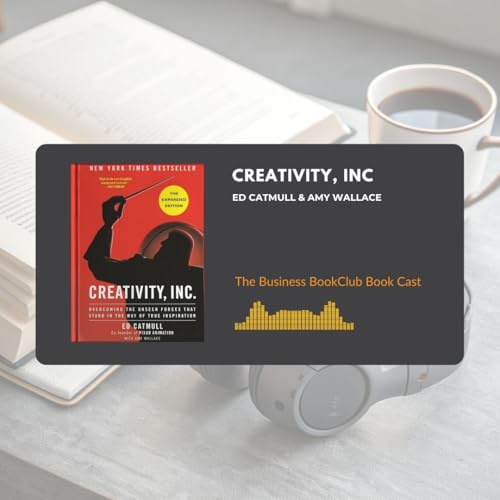
  • EP 112 Creativity, Inc.: How Pixar Built a Culture That Protects Fragile Ideas
    Dec 24 2025
    Episode Summary

    In this episode of The Business Book Club, we unpack Creativity, Inc. by Ed Catmull, the co-founder of Pixar and former president of Disney Animation. This is more than a book about creativity—it’s a blueprint for building a sustainable creative culture inside any organization.

    From inside the walls of Pixar, Catmull reveals how innovation isn’t crushed by competition—it’s destroyed from within, by fear, status management, outdated mental models, and unchecked success. This episode dives deep into the systems, mindsets, and leadership behaviors that allow creativity to flourish—even in high-stakes environments.

    Whether you’re a startup founder, a product lead, or a creative professional, this episode gives you the tools to build a culture where ideas thrive, feedback is fearless, and failure isn’t punished—it’s learned from.

    Key Concepts Covered

    Leadership Is Gardening, Not Genius 🔹 Your job as a leader isn’t to have all the ideas—it's to create the conditions where ideas can grow and be tested. 🔹 Innovation is fragile. It must be actively protected from fear, ego, and bureaucracy.

    Replace “Honesty” with “Candor” 🔹 Honesty feels moral and personal. Candor is organizational—it’s a lack of reserve. 🔹 Pixar’s “Braintrust” institutionalizes candor: deep feedback without ego, where the power to fix problems always stays with the creator.

    Trust People, Not Processes 🔹 Platitudes like “story is king” are suitcase handles—you grab them without the weight of the hard-earned wisdom they represent. 🔹 Don’t let slogans replace thinking. Ask: What real action does this require today?

    Fear of Failure Is the Real Killer 🔹 Avoiding failure kills risk-taking—and risk is the lifeblood of creativity. 🔹 Trust is built after mistakes, in how leaders respond. Focus on learning, not blame.

    The Beast vs. The Ugly Baby 🔹 “The Beast” is the weight of current production: cost, deadlines, bureaucracy. 🔹 “The Ugly Baby” is the new, fragile idea that needs protection and subsidy until it can prove its worth.

    Beware of Success Blindness 🔹 Success makes you defensive and resistant to change. Leaders must actively challenge their own assumptions. 🔹 The “first-draft” fallacy at Pixar blocked progress for years—until they rewrote the internal rulebook.

    Balance Is Dynamic, Not Static 🔹 It’s not about being still—it’s about staying responsive. Like a surfer or a point guard, great leaders adjust on the fly. 🔹 Hold your goals lightly, but your intentions firmly.

    Actionable Takeaways

    ✅ Prioritize the team – Great people will fix a broken idea. Bad teams will ruin a great one. ✅ Hire for potential – What someone can do tomorrow matters more than what they’ve done today. ✅ Institutionalize candid conflict – Build feedback loops that are fearless, consistent, and structured. ✅ Embrace risk and decisiveness – Make confident moves, correct course quickly, and don’t let perfection block progress.

    Top Quotes

    📌 “Trust people, not processes.” 📌 “If you’re not starting things that might fail, you’re not being creative—you’re being predictable.” 📌 “The most dangerous problems are the ones you don’t know you don’t know.”

    Resources Mentioned

    Creativity, Inc. by Ed Catmull and Amy Wallace – Get the book here

    Next Steps

    Want to build a team where creativity isn’t crushed by process or fear? Start by becoming the gardener: create space for ideas, protect the fragile, challenge your assumptions, and institutionalize fearless feedback.

    If you enjoyed this deep dive, be sure to subscribe to The Business Book Club for more essential insights that help you think, lead, and build better.

    #CreativityInc #EdCatmull #PixarLeadership #CreativeCulture #OrganizationalDesign #Innovation #FeedbackCulture

    Show More Show Less
    13 mins