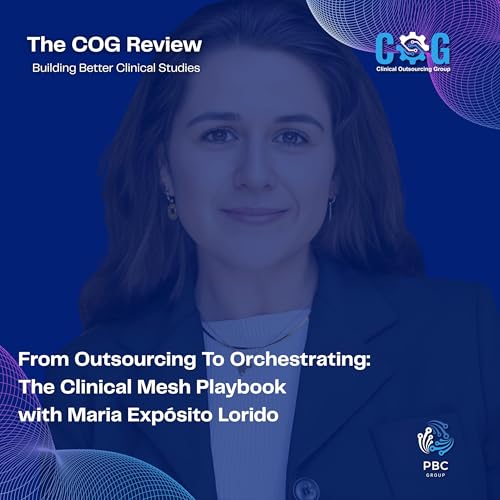
The COG Review: Building Better Clinical Studies cover art

The COG Review: Building Better Clinical Studies

The COG Review: Building Better Clinical Studies

Written by: The PBC Group
Listen for free

About this listen

This podcast is specifically designed for biopharma sponsors and CRO executives who are interested in clinical trial outsourcing. The COG Review delivers clinical operations best practices from Clinical Outsourcing Group conferences across the UK, Europe, and North America. Each 25-minute episode provides actionable insights on CRO selection, vendor management, clinical trial budget optimization, and study design from pharmaceutical and biotech leaders. Learn clinical trial technology strategies, AI integration, and sponsor-CRO relationship best practices from industry experts at COG UK, COG Europe, COG Bay Area, and COG CRO Summit. Essential listening for clinical operations professionals, biotech CMOs, and clinical development executives seeking clinical study optimization strategies. Produced by The PBC Group. Follow for new episodes and find your nearest meeting at thepbcgroup.com.Copyright 2026 The PBC Group Biological Sciences Economics Hygiene & Healthy Living Management Management & Leadership Physical Illness & Disease Science
Episodes
  • Leveraging Key Opinion Leaders in Clinical Research Strategy and Execution With Thierry Schulmann
    Feb 26 2026

    Discover how early engagement with key opinion leaders transforms clinical trial outsourcing decisions, reduces program risk, and optimizes clinical operations for higher-impact trial outcomes.

    Guest
    1. Thierry Schulmann, Senior Director, Medical Affairs Strategy, Sumitomo Pharma (LinkedIn)

    Episode Overview

    This episode—recorded live at COG Europe—features Thierry Schulmann, Senior Director, Medical Affairs Strategy at Sumitomo Pharma, in a highly practical session focused on the operational value of engaging key opinion leaders (KOLs) early in clinical research.

    Listeners will gain a clear framework for involving KOLs at each stage of clinical trial outsourcing, from initial design and feasibility to trial execution and market access. Drawing from real-world case studies, Thierry Schulmann illustrates how underestimating KOL input can lead to misalignment on endpoints, failed market launches, or unmet regulatory expectations—even in otherwise well-executed trials.

    The discussion covers:

    1. Why CRO selection should account for KOL expertise and therapeutic alignment
    2. How to use KOL engagement to build patient-centered protocols and enhance feasibility, recruitment, and retention
    3. The impact of KOLs on regulatory strategy, payer acceptance, guideline inclusion, and real-world implementation

    For clinical operations professionals, outsourcing leads, and vendor managers, the episode provides actionable strategies to protect trial value, avoid program pitfalls, and ensure the commercial relevance of new therapies through smarter stakeholder engagement and clinical study optimization.

    Key Moments

    00:02:10 – Framing the risks: Why approved products still fail to launch due to misaligned trial endpoints and weak stakeholder input

    00:03:13 – Case study: The commercial impact of not localizing active comparators for European market expectations

    00:04:58 – Why strategic KOL engagement is a form of "outsourcing" critical expertise beyond CRO selection

    00:07:13 – Clinical operations best practice: Focusing on endpoints that drive real-world adoption, not just statistical significance

    00:09:28 – Bridging gaps: KOLs as operational connectors between academic protocols, regulatory requirements, and patient needs

    00:10:40 – Regulatory navigation: How global KOL networks inform region-specific trial design and submission strategies

    00:13:19 – Leveraging KOL and patient group relationships for evidence generation in rare and serious diseases

    00:14:47 – Ensuring real-world effectiveness: The role of KOLs in validating trial design beyond controlled settings

    00:18:30 – Lessons learned: When missed KOL input on comparator choice, unmet need assessment, or side effect profiles led to program failures

    00:21:36 – When to engage KOLs: Practical recommendations for biotech and pharma, starting as early as Phase 1

    Top 3 Takeaways
    1. Proactive KOL engagement in early trial design is essential for successful clinical trial outsourcing and market access—don't wait until later phases to bring real-world and regulatory perspectives into protocol development.
    2. Aligning clinical study endpoints and comparators with both therapeutic practice and payer requirements optimizes trial relevance and supports smoother regulatory acceptance—a key consideration...
    Show More Show Less
    23 mins
  • Navigating Biotech’s First-in-Human Trial in Rare Disease With Jurate Lasiene
    Feb 19 2026

    Learn how small biotech’s can streamline clinical trial outsourcing, optimize CRO selection, and establish truly patient-centered operations for rare disease studies—while maintaining high data quality and speed.

    Guest
    1. Jurate Lasiene, VP Clinical Operations, North Sea Therapeutics
    2. LinkedIn: Jurate Lasiene

    Episode Overview

    This episode of The COG Review: Building Better Clinical Studies is recorded live at COG Europe in Amsterdam. Jurate Lasiene, VP Clinical Operations at North Sea Therapeutics, shares firsthand insights from managing a first-in-human, early-phase rare disease trial with a small, agile biotech team. The session explores critical decision points and real-world solutions in clinical trial outsourcing, CRO selection, and effective sponsor–vendor collaboration.

    Key topics include designing adaptive, patient-first protocols for challenging rare disease populations, the shift from traditional full outsourcing models to targeted FSP (Functional Service Provider) or hybrid approaches, and optimizing budget, speed, and quality by retaining operational control in-house where it matters most. Jurate Lasiene offers a practical breakdown of site and partner selection, early regulatory and KOL engagement, and hands-on clinical operations best practices.

    This episode equips clinical research professionals in biotech, pharma, and CROs with actionable frameworks for clinical study optimization—especially useful for those navigating complex trials with lean teams and limited resources. Listeners gain concrete guidance on the sponsor-side leadership choices and process refinements that reduce common failure points and accelerate study timelines.

    Key Moments

    00:01:40 – The unique operational challenges of rare disease trials: small, dispersed patient populations and high rates of trial discontinuation

    00:03:41 – Why small biotech’s are driving the majority of clinical trial starts and how their outsourcing strategies have evolved

    00:04:31 – Clinical trial protocol design: avoiding rigid endpoints and restrictive eligibility to improve enrollment and retention

    00:05:16 – The necessity of integrating patient and caregiver input early for truly patient-centered clinical trials

    00:06:45 – How to select clinical trial sites: speed, fit, and operational capacity versus academic prestige

    00:08:31 – Practical cost-savings from targeted FSP models: 30% budget reduction by outsourcing only specialty capabilities

    00:10:23 – Engaging KOLs and patient advocacy groups at the protocol development stage for better outcomes

    00:11:41 – Keeping oversight in-house with dedicated monitors/PMs: advantages for quality and site engagement

    00:13:27 – Building a “meshwork” of specialist partners to keep small teams agile, responsive, and in control

    00:16:46 – Simulating the patient journey to optimize protocol, logistics, and site operations for clinical study optimization

    Top 3 Takeaways
    1. Early and deep integration of clinical operations into trial and protocol design is essential for avoiding downstream roadblocks—making this a core clinical operations best practice.
    2. Targeted outsourcing and deliberate CRO selection (favoring fit and flexibility over scale alone) enables small teams to maintain control, ensure sponsor oversight, and optimize budgets.
    3. Mapping the exact patient (and caregiver) journey—through direct simulation and advocacy group...
    Show More Show Less
    26 mins
  • From Outsourcing to Orchestrating: The Clinical Mesh Playbook with Maria Expósito Lorido
    Feb 12 2026

    Discover operational strategies to move beyond traditional clinical trial outsourcing—learn how the clinical mesh approach can optimize study speed, oversight, and cost efficiency for today’s clinical operations leaders.

    Guest
    1. Maria Expósito Lorido (LinkedIn)
    2. Venture Partner, Vu Venture Partners
    3. Extensive experience in clinical development, clinical trial outsourcing, and operational leadership within pharma/biotech

    Episode Overview

    This live session from COG Europe in Amsterdam features Maria Expósito Lorido, a leading venture partner with hands-on experience designing and implementing innovative clinical outsourcing strategies. Maria offers a compelling presentation shifting the conversation from conventional CRO selection and outsourcing models to a new paradigm: sponsor-led orchestration through the clinical mesh playbook.

    Listeners gain practical guidance on clinical operations best practices by contrasting traditional outsourcing with platform and ecosystem-based models. Maria reveals why most studies fall short on recruitment, what it costs, and how an orchestrated mesh of specialized partners can reduce delays and increase value for sponsors and patients alike.

    Specific areas covered include how to tailor sourcing architecture to your study’s needs, which operational components to retain or externalize, and ways to apply clinical study optimization principles for faster, more flexible trial delivery. The episode also addresses implementation steps, measurable KPIs, and critical sponsor responsibilities in this emerging model.

    Ideal for clinical operations, outsourcing managers, and vendor strategy professionals seeking to future-proof their approach to CRO selection and clinical trial outsourcing.

    Key Moments

    00:03:00 – Why 80% of clinical studies miss recruitment targets and the financial impact of delays

    00:05:00 – Comparing small, agile biotech teams vs large pharma R&D models for clinical trial delivery

    00:06:55 – The Nvidia platform analogy: platform business models vs linear development pipelines

    00:07:10 – Introduction to the “clinical mesh” model: moving from fixed structures to reconfigurable networks

    00:08:33 – Three sourcing architecture types—full-service CRO, functional service provider, and clinical mesh—and when each works best

    00:11:23 – Governance challenges and sponsor responsibilities under the mesh model

    00:14:04 – Early-stage oncology case study: cost, timelines, and screen failure rate compared across outsourcing models

    00:16:27 – Quality management, risk, and safety oversight: what sponsors must own when orchestrating a clinical mesh

    00:18:57 – KPIs for clinical study optimization: measuring cost per qualified patient, time to first contact, and more

    00:19:43 – 90-day roadmap for piloting a clinical mesh approach with stepwise best practices

    Top 3 Takeaways
    1. Orchestrate, don’t just outsource: Sponsors retain strategy, quality, and data oversight even when leveraging a network of specialized vendors—this increases flexibility and operational control compared to traditional outsourcing.
    2. Match sourcing architecture to study needs: Evaluate each study to determine the best-fitting sourcing model (full-service CRO, hybrid/FSP, or clinical mesh), rather than defaulting to a single approach for all trials.
    Show More Show Less
    27 mins
No reviews yet