• Recurring Revenue, Real-World Results – Closing the Post-Sale Gap with Beth Skierski
    Feb 9 2026

    Recurring Revenue, Real-World Results – Closing the Post-Sale Gap


    Recurring revenue models are everywhere. But recurring value is still where many subscription, SaaS, and IoT businesses struggle.

    In this episode of The Climate Gap: Quick Cuts, Ben Muwoki sits down with Beth Skierski, founder of EGS Solutions, to explore why Customer Success often falls short and how companies can close the post-sale gap that quietly drives churn.


    Across climate tech, smart buildings, and enterprise SaaS, many teams invest heavily in product, sales, and onboarding. What happens after the contract is signed is often handled informally, reactively, or inconsistently. This is especially true for project-led businesses moving into subscriptions and IoT vendors shifting into software models.


    Beth shares a practical framework for treating the post-sale journey as something that can be deliberately designed, measured, and improved.


    In this episode, we cover:

    • Why recurring revenue is an operating challenge, not just a pricing decision
    • The difference between reactive account management and true Customer Success
    • How to design a proactive customer journey that supports adoption and outcomes
    • Why renewals are lagging indicators, and what leading indicators matter more
    • How IoT and hardware-led businesses can avoid common mistakes when moving into software
    • What customer health really looks like beyond renewals and dashboards

    If you are scaling a SaaS business, transitioning from project delivery to subscriptions, or leading Customer Success, Revenue, or GTM teams, this episode offers grounded, real-world insight into what actually drives retention and expansion.


    About Beth Skierski

    Beth Skierski is the Founder and Principal of EGS Solutions, where she helps B2B, SaaS, and IoT-driven companies build sustainable Customer Success organisations.

    With a background in engineering, Beth brings a methodical, outcome-focused approach to Customer Success. Her work sits at the intersection of technology, commercial execution, and customer outcomes, helping teams move beyond reactive account management toward proactive, repeatable value delivery.

    Beth partners with organisations navigating shifts from project delivery to subscriptions, and from hardware or IoT-led models into software, supporting them in designing customer journeys, defining success metrics, and improving retention and expansion through better post-sale structure.


    Watch now and subscribe for more conversations across smart buildings, energy, climate tech, and the teams turning performance into proof.

    The Climate Gap is powered by Element Six.


    Element Six specializes in addressing talent challenges across the built environment and climate technology sectors. Partnering with technology vendors and solutions providers delivering decarbonization solutions, helping them find the leaders and teams they need to scale.


    Decarbonizing the built environment takes bold ideas and brilliant people. Element Six brings them together.

    Hosted on Acast. See acast.com/privacy for more information.

    Show More Show Less
    16 mins
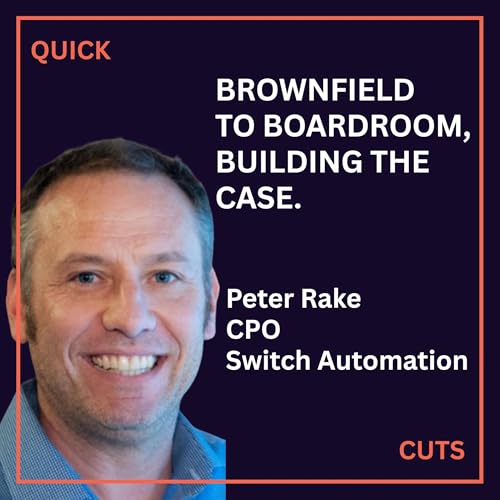
  • Brownfield to Boardroom: How to Make Smart Building Performance Visible to the C-Suite with Peter Rake
    Feb 4 2026

    Many “smart building” conversations still assume a clean slate at the start.

    New buildings, new systems, new budgets.


    That’s not how it usually plays out.


    Most of the buildings that will still be in use over the coming decades already exist today. And many of them were never designed for modern connectivity, analytics, or decarbonisation.


    In this episode of The Climate Gap: Quick Cuts, Ben Muwoki sits down with Peter Rake to talk about where real progress actually happens: brownfield portfolios.


    The buildings that already exist.

    The systems that are already stretched.

    The teams that are already firefighting.


    Peter has spent years in the trenches of brownfield modernisation, working with owners and operators who are trying to improve performance without ripping and replacing everything in sight.


    One theme kept surfacing in the conversation:


    - Upgrading the technology is only half the battle.

    - The harder part is getting results seen, trusted, and funded by the business.


    In this episode, we cover:


    * Why brownfield is where the real decarbonisation opportunity sits

    * What to look for when assessing a legacy building for digital enablement

    * How to decide what to integrate, what to retire, and what to leave alone

    * Why operational wins rarely reach the C-suite

    * How to translate comfort, energy, and maintenance into business language that resonates

    * Why starting with simple data builds credibility faster than ambitious pilots

    * What actually turns operational progress into repeatable investment


    About Peter Rake

    Peter Rake is a smart buildings and energy technology leader with deep, hands-on experience in modernising brownfield commercial real estate. He began his career on the tools as an electrician before moving into building systems, connectivity, and platform-led portfolio transformation.


    Over the past decade, he has worked closely with owners and operators across mixed-vendor estates, helping them improve legacy infrastructure, establish secure connectivity, and turn fragmented building data into credible, business-ready insight.


    Listen if you are:

    - An owner or operator managing brownfield or mixed-vendor portfolios

    - A facilities or operations leader trying to make outcomes visible to leadership

    - Trying to move from pilots to repeatable, portfolio-wide investment

    The Climate Gap is powered by Element Six.


    Element Six specializes in addressing talent challenges across the built environment and climate technology sectors. Partnering with technology vendors and solutions providers delivering decarbonization solutions, helping them find the leaders and teams they need to scale.


    Decarbonizing the built environment takes bold ideas and brilliant people. Element Six brings them together.

    Hosted on Acast. See acast.com/privacy for more information.

    Show More Show Less
    23 mins
  • What’s Actually Broken And How We Fix It
    Feb 4 2026

    In this episode of the Down Low with Joe, Lewis & Joe sit down with Ted Atwood at FutureBuilt.


    Ted has spent decades at the forefront of energy compliance, sustainability, and climate technology, building, scaling, and ultimately exiting a major platform in the space. Today, he advises companies across energy, real estate, and climate tech on what actually drives outcomes.


    We go deep on:


    • What’s fundamentally broken in the built environment, and why progress feels slow
    • The biggest false beliefs holding sustainability efforts back
    • Which technologies genuinely move the needl,e and which are just good marketing
    • The hard truth behind ESG targets and why most companies miss net zero
    • How policy really gets shaped and where industry influence often goes wrong
    • What “audit-proof” compliance actually means for CEOs and operators


    Plus a lightning round on overrated tech, underrated solutions, and bold predictions for the future of climate tech.

    The Climate Gap is powered by Element Six.


    Element Six specializes in addressing talent challenges across the built environment and climate technology sectors. Partnering with technology vendors and solutions providers delivering decarbonization solutions, helping them find the leaders and teams they need to scale.


    Decarbonizing the built environment takes bold ideas and brilliant people. Element Six brings them together.

    Hosted on Acast. See acast.com/privacy for more information.

    Show More Show Less
    41 mins
  • Understanding Utility grade AI at scale with Ana-Paula Issa, CEO of Encyle
    Jan 13 2026

    If your demand response program looks good on paper but fails under scrutiny, you don’t have a performance problem. You have a measurement problem.


    Ana-Paula Issa, CEO of Encycle, explains why.

    Utilities are offering more incentives than ever. AI, analytics, and advanced controls are being deployed across portfolios.

    And yet many operators still miss demand response targets, struggle to defend savings to finance, or confuse demand response with demand management.


    In this episode of The Climate Gap: Quick Cuts, Ben Muwoki sits down with Ana-Paula Issa, CEO of Encycle, to cut through the fog around “utility grade,” multi-site AI, and why scale breaks so many energy programs.


    Ana-Paula has been working directly with utilities and large retail portfolios since 2008. She explains what actually holds up when incentives, baselines, bids, and finance reviews are involved and why many programs fail quietly until the end of the year.


    We dig into:

    • What “utility grade” really means and why it leaves no place to hide
    • Why baselines are the most common failure point in M&V
    • How multi-site scale breaks single-building AI assumptions
    • The real difference between demand response, demand management, and consumption management
    • Why demand response targets are missed more often because of misalignment than technology
    • How portfolio thresholds can wipe out DR revenue even when most sites perform
    • Why incentives often fail to get credited to the right buildings or teams


    About Ana-Paula Issa

    Ana-Paula Issa is the CEO of Encycle. She has spent nearly two decades working at the intersection of building controls, demand management, and utility programs, partnering directly with utilities and large multi-site operators. At Encycle, she focuses on turning demand flexibility and efficiency programs into measurable, defensible outcomes at scale.


    Watch if you are:

    • An owner or operator managing large, multi-site portfolios
    • An energy or sustainability leader accountable to finance
    • A vendor selling AI, controls, or DR programs into portfolios
    • Trying to turn utility incentives into outcomes that survive scrutiny


    Utility programs do not fail because teams lack technology. They fail because measurement, alignment, and incentives are misunderstood.


    The Climate Gap is powered by Element Six.


    Element Six specializes in addressing talent challenges across the built environment and climate technology sectors. Partnering with technology vendors and solutions providers delivering decarbonization solutions, helping them find the leaders and teams they need to scale.


    Decarbonizing the built environment takes bold ideas and brilliant people. Element Six brings them together.

    Hosted on Acast. See acast.com/privacy for more information.

    Show More Show Less
    45 mins
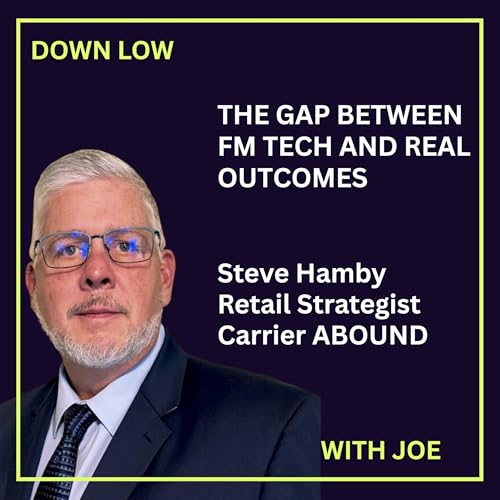
  • The Gap Between FM Tech and Real Outcomes
    Jan 9 2026

    Recorded live at FutureBuilt, Steve Hamby joins Joe Aamidor (Aamidor Consulting) and Lewis Martin (Element Six) to talk about what actually happens when facilities and real estate teams try to deploy technology at scale.


    Steve has spent his career working across facilities technology, IoT, and connected solutions. He has advised operators, vendors, and industry groups on how technology is adopted, where it breaks down, and why outcomes often lag behind capability.


    This conversation focuses on the gap between promise and execution. Why connected buildings are still hard to deliver. Why data ownership remains unclear. Why AI and IoT adoption continue to move more slowly than expected inside large portfolios.


    No theory. Just lived experience from someone who has been in the middle of it.


    Topics include:

    • What connected buildings really look like in practice
    • Where FM and real estate tech adoption stalls
    • Data ownership and accountability
    • What operators should demand from vendors
    • What actually drives measurable outcomes


    Recorded live at FutureBuilt.


    Hosted by Joe Aamidor and Lewis Martin.

    The Climate Gap is powered by Element Six.


    Element Six specializes in addressing talent challenges across the built environment and climate technology sectors. Partnering with technology vendors and solutions providers delivering decarbonization solutions, helping them find the leaders and teams they need to scale.


    Decarbonizing the built environment takes bold ideas and brilliant people. Element Six brings them together.

    Hosted on Acast. See acast.com/privacy for more information.

    Show More Show Less
    15 mins
  • Why Real Estate Tech Still Struggles to Deliver Real Value
    Jan 9 2026

    In this episode of the DLWJ, we’re joined by Maureen Ehrenberg, one of the most respected leaders in the global built environment.


    Maureen currently serves as Executive Managing Director of Strategic Growth and Solutions Development at Sireas Global Real Estate Advisors and is President Elect of the Royal Institution of Chartered Surveyors (RICS) for 2026. Her career spans decades of executive leadership at organisations like WeWork, JLL, CBRE and Grubb & Ellis, and she’s a recognised authority on strategic real estate operations, digital transformation, and facilities management at scale.


    In our conversation, Maureen cuts through the noise around technology in CRE and FM to focus on what actually drives value inside real portfolios.


    We explore:

    • Why data infrastructure still outpaces dashboards
    • How investors and operators talk past each other
    • What happens when you lean on AI without solving data readiness
    • The skills and organisational changes that actually move the needle


    A grounded discussion about what it really takes to move the built environment forward.

    The Climate Gap is powered by Element Six.


    Element Six specializes in addressing talent challenges across the built environment and climate technology sectors. Partnering with technology vendors and solutions providers delivering decarbonization solutions, helping them find the leaders and teams they need to scale.


    Decarbonizing the built environment takes bold ideas and brilliant people. Element Six brings them together.

    Hosted on Acast. See acast.com/privacy for more information.

    Show More Show Less
    23 mins
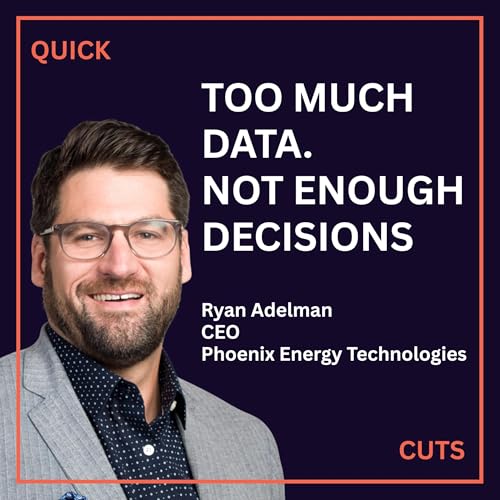
  • If your EMS creates more alerts than actions, you don’t have a data problem. You have a decision problem with Ryan Adelman CEO Phoneix Energy Technologies
    Dec 17 2025

    If your EMS creates more alerts than actions, you don’t have a data problem. You have a decision problem.

    Ryan Adelman, CEO of Phoenix Energy Technologies, explains why.


    Energy management systems promise visibility and control. In reality, many operators are overwhelmed by alarms, managing massive multi-site portfolios with small teams and data they do not always trust.


    In this episode of The Climate Gap: Quick Cuts, Ben Muwoki sits down with Ryan Adelman, CEO of Phoenix Energy Technologies, to unpack why data overload persists in commercial real estate and what it actually takes to build a culture where data leads to decisions, not paralysis.


    Ryan draws on years of experience working inside retail, grocery, and national portfolios to explain why alarm triage, system fragmentation, and optimization drift are so hard to escape, and what separates organizations that break through from those that stay reactive.

    We dig into:

    • Why small teams struggle to act even on timely, actionable data
    • How fragmented EMS platforms erode trust in data quality
    • What “optimization entropy” looks like in real buildings
    • The hidden costs of staying reactive, from comfort to credibility
    • Why decision culture starts with writing things down and assigning costs
    • Where AI genuinely helps, and where human judgement still matters most


    About Ryan Adelman

    Ryan Adelman is the CEO of Phoenix Energy Technologies. He has spent nearly two decades working across the built environment and distributed energy, from large enterprises to early-stage technology companies. At Phoenix, Ryan leads the company’s next phase of growth, helping large multi-site portfolios move from alarm-driven operations to decision-driven performance.

    Watch if you are:

    • An owner or operator managing large, distributed building portfolios
    • An FM or energy leader buried in alerts and dashboards
    • A technology leader trying to translate data into action
    • Exploring how AI fits into real-world building operations


    Smarter buildings are not built on more data. They are built on better decisions.

    The Climate Gap is powered by Element Six.


    Element Six specializes in addressing talent challenges across the built environment and climate technology sectors. Partnering with technology vendors and solutions providers delivering decarbonization solutions, helping them find the leaders and teams they need to scale.


    Decarbonizing the built environment takes bold ideas and brilliant people. Element Six brings them together.

    Hosted on Acast. See acast.com/privacy for more information.

    Show More Show Less
    25 mins
  • Market Updates With Joe
    Dec 16 2025

    In this market update episode, Lewis Martin is joined by analyst Joe Aamidor to break down what’s really happening across smart buildings, energy management, and OEM digital strategy.


    They dive into Siemens’ recent moves around Brightly, Setmetrics and XOI, and why this signals a deeper structural shift rather than a one-off acquisition. Joe explains how CMMS platforms are becoming a critical control layer, why asset intelligence and energy analytics are converging, and how OEMs are quietly scaling their digital services behind the scenes.


    The conversation also covers the rise of CMMS plus energy platforms, what the ECOTRAK and ENTOUCH Controls deal tells us about small commercial buildings, why residential HVAC softness matters to the wider market, and what Deloitte’s latest real estate AI survey reveals about stalled expectations and implementation challenges.


    They close with quickfire views on open versus closed systems, where real value is emerging in building tech, and whether multi-site retail or commercial real estate will see faster technology adoption over the next five years.


    A grounded, data-driven discussion for anyone building, buying, or investing in smart building and energy technology.

    The Climate Gap is powered by Element Six.


    Element Six specializes in addressing talent challenges across the built environment and climate technology sectors. Partnering with technology vendors and solutions providers delivering decarbonization solutions, helping them find the leaders and teams they need to scale.


    Decarbonizing the built environment takes bold ideas and brilliant people. Element Six brings them together.

    Hosted on Acast. See acast.com/privacy for more information.

    Show More Show Less
    48 mins