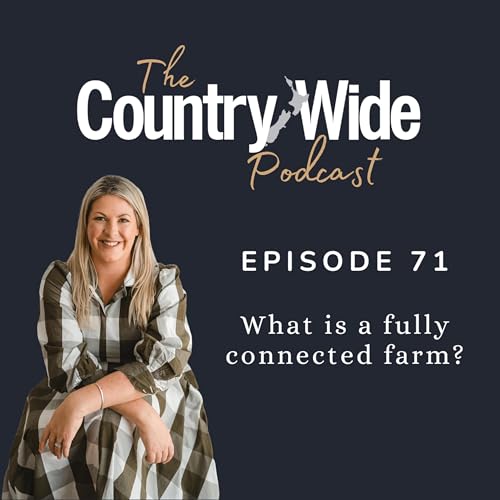
• Episode 71 - What is a fully connected farm?
    Jul 17 2025
    We improved horsepower by fuelling it with diesel rather than hay. We mechanised blade-shearing and hand-milking with electricity in the woolshed and milking shed. Every advancement in farming history has resulted in a productivity gain from a new source. The next shift is fully connected farms. In this episode, Sarah Perriam-Lampp talks with Melissa Andrews from Connected Farms and Craig Young from TUANZ about bridging rural connectivity gaps. Melissa shares practical on-farm tech solutions, while Craig unpacks the 3G shutdown, fibre limits, and why local, wireless networks are key to keeping farmers connected and future-ready across New Zealand’s rural communities. Guests: Melissa Andrews, Co-Founder, Connected FarmsCraig Young, CEO, TUANZ Host: Sarah Perriam-Lampp, CEO and Editor-in-Chief, Country-Wide Melissa Andrews, co-founder of Connected Farms, shares how a lack of connectivity while visiting family in rural South Canterbury sparked the expansion of their Australian telecommunications business into New Zealand. Originally focused on building infrastructure for emergency services, Melissa and her husband Tom saw first-hand the connectivity gaps farmers faced, and the productivity, safety and wellbeing gains better internet could unlock. She explains how Connected Farms delivers both fixed and mobile solutions, from point-to-point Wi-Fi linking farmyards and wool sheds, to vehicle-mounted routers that dynamically switch between cellular and satellite networks like Starlink. These tools are helping farmers operate more efficiently, access real-time data, and stay connected, whether it’s live streaming grain quality from a combine, video calling a mechanic, or reading bedtime stories from the cab. Melissa discusses the unique challenges of New Zealand’s telecommunications landscape, including patchy network coverage and limited appetite from major carriers to invest in rural areas. She highlights how Connected Farms is bridging that gap with scalable, secure infrastructure that makes a fully connected farm achievable, often at a lower cost than expected. Whether it’s enabling faster pregnancy scan results, remote monitoring, or simply improving mental health through everyday connection, Melissa believes rural connectivity is no longer a luxury, but a lifeline for modern farming. Craig Young, CEO of the Telecommunications Users Association of New Zealand (TUANZ), joins the conversation to unpack the realities behind rural connectivity in Aotearoa. With deep industry experience, including his time at Chorus, Craig explains why headlines promising 100% coverage often mislead. While some areas may soon support basic mobile or emergency calling, full internet connectivity across rural landscapes is still a work in progress, especially when it comes to enabling connected farms. He compares cellular strength and satellite latency to water pressure, something farmers instinctively understand, and explains how low-earth orbit satellites like Starlink and Amazon’s Project Kuiper are reducing delays and improving performance. But while these tools are transformative for home offices and basic farm connectivity, challenges remain for in-paddock devices, especially as 3G networks shut down and the copper landline network is phased out by 2030. Craig urges farmers to future-proof their technology and check whether their devices are 4G-compatible using a simple text tool (text ‘3G’ to 550). He highlights the need to support elderly or isolated neighbours who may rely on legacy services, and emphasises that connectivity must be treated as an essential utility, on par with water or electricity, requiring collaborative investment from government, telcos and rural communities alike. With fibre reaching its economic limits in many regions, Craig points to wireless ISPs (WISPs) and community-led broadband projects as affordable, scalable solutions. He explains how innovative co-funding models with providers like Chorus are helping rural groups bridge the “last mile” and why government policies, such as releasing unused spectrum, could unlock faster, more resilient internet in rural Aotearoa. For Craig, the answer lies not in one-size-fits-all fixes, but in a diverse toolkit of technologies, partnerships and local leadership, ensuring no rural community is left behind. Read the article from the Country-Wide Winter issue here. Subscribe to Country-Wide magazine for $89/year for four seasonal magazines including free postage annually: https://country-wide.co.nz/shop/ SUBSCRIBE TO THE COUNTRY-WIDE WEEKLY EMAILSee omnystudio.com/listener for privacy information.
    Show More Show Less
    56 mins
  • Episode 59 - How the Government can support catchment-level solutions
    Mar 13 2025

    In this episode, Sarah delves into an in-depth discussion with Geoff Simmons, Chief Economist for the Parliamentary Commissioner for the Environment. The conversation focuses on the report Going with the Grain: Changing Land Uses to Fit a Changing Landscape, which was published in May 2024. Geoff highlights the importance of adopting a catchment-level approach to land use changes, moving beyond a one-size-fits-all national regulation.

    Guest:

    1. Geoff Simmons, Chief Economist of the Parliamentary Commissioner for the Environment

    Host:

    - Sarah Perriam-Lampp, CEO and Editor-in-Chief, Country-Wide

    Geoff Simmons, Chief Economist at the Parliamentary Commissioner for the Environment, discusses the challenges and opportunities of changing land use in response to environmental pressures. With expertise in economic and environmental policy, the conversation explores how New Zealand can balance economic growth with sustainability in the face of climate change, biodiversity loss, and evolving farming practices. The discussion highlights innovative solutions such as regenerative agriculture, native forest restoration, and carbon farming, as well as the role of science-driven decision-making in shaping land-use policies. Geoff also examines the complexities of aligning government regulations, business interests, and community needs to create a more resilient future. The conversation touches on the importance of long-term strategies to ensure that land use changes support both productivity and ecological health, while emphasising the need for collaboration among policymakers, industry leaders, and local communities to drive sustainable progress in New Zealand’s landscapes.

    Subscribe to Country-Wide magazine for $79/year for four seasonal magazines including free postage annually: https://country-wide.co.nz/shop/

    SUBSCRIBE TO THE COUNTRY-WIDE WEEKLY EMAIL

    See omnystudio.com/listener for privacy information.

    Show More Show Less
    30 mins
  • Episode 55 - Lifting our game from woolshed to shop
    Feb 6 2025

    The hot topic at the moment is New Zealand’s wool quality challenges to position both merino and strong wool with a positive future. Following our release of the annual Merino Review magazine, Sarah Perriam-Lampp discusses merino clip tenderness and improvements through farmer education, the rise of female wool classers and wool research’s renewed mission to return better value to farmers.

    Guests include:

    1. Craig Smith, New Zealand general manager, Devold
    2. Emma O’Sullivan, Marlborough merino farmer and wool classer
    3. Andrew Morrison, Chairman, WRONZ

    Hosts:

    - Rebecca Greaves, Editor, Country-Wide

    - Sarah Perriam-Lampp, Managing Director, Country-Wide

    The 2024/25 season for merino growers has seen wool tenderness issues following a tough season. Craig “Smithy” Smith, General Manager of Devold, explains the importance of understanding wool metrics beyond micron, the role of genetics and nutrition in wool strength, and how Devold’s Sheep to Shop program ensures full traceability from farm to finished garment. He also introduces a new education initiative, ‘Sheep to Shop’ aimed at bridging the knowledge gap for the next generation of wool producers.

    Emma O'Sullivan, shares her passion for wool as a qualified wool classer and tutor as well as farming the Saxon merinos at her intergenerational family’s farming operation, Waihopai Downs in Marlborough.

    With the challenges facing the wool industry, Wool Research Organisation of New Zealand (WRONZ) has a new chairman, Andrew Morrison who is focused on the need for collaboration across the sector to drive profitability, reduce fragmentation, and ensure wool’s value is captured beyond the farm gate. He shares insights into WRONZ’s focus on post-harvest research and commercialization, highlighting a shift towards finding new uses for strong wool, such as deconstructing fibers into particles, powders, and pigments. Andrew also touches on sustainability, market positioning, and the importance of long-term research investment to secure the future of New Zealand’s wool industry.

    • Read the latest issue of the Merino Review here

    Subscribe to Country-Wide magazine for $79/year for four seasonal magazines including free postage annually: https://country-wide.co.nz/shop/

    SUBSCRIBE TO THE COUNTRY-WIDE WEEKLY EMAIL

    See omnystudio.com/listener for privacy information.

    Show More Show Less
    57 mins
  • Episode 44 - Making farm system transformation possible
    Oct 24 2024

    Changing a farm system is no small feat, and Banks Peninsula farmer George Masefield, and his wife Emma, have spent the past eight years making significant changes to the family’s farming operation. In almost a decade they’ve been able to transform the business, enabling them to finish all of their lambs on their dryland hill country and buy in trading stock.

    In this episode hear from George Masefield, and PGG Wrightson Technical Field Representative Robert Trott, who has been part of the farm transformation. We also catch up with AgResearch about their latest project: a brand new podcast exploring the big questions facing New Zealand agriculture, and Jasper Van Halder CEO of Agnition about the exciting opportunities available to farmers through their pilot farmer network.

    Guests include:

    1. George Masefield, Farmer, Banks Peninsula
    2. Jasper Van Halder, CEO, Agnition
    3. Robert Trott, Technical Field Representative, PGG Wrightson
    4. Eryn Breading, Senior Marketing and Communications Advisor, AgResearch

    Hosts:

    1. Rebecca Greaves, Editor, Country-Wide
    2. Sarah Perriam-Lampp, Managing Director, CountryWide Media

    George Masefield is a sixth generation sheep and beef farmer on Banks Peninsula, and is currently almost a decade into transforming the farm to get the most from their dryland system. He discusses the benefits of doing it yourself, rather than relying on contractors, and how as a family they’ve made their plans possible.

    • Read more about George Masefield’s story here

    CEO of Agnition Jasper Van Halder discusses the exciting opportunities available through Agnition. Agnition’s dual mission is to generate returns from innovations and to accelerate innovation in the ag sector in NZ. Agnition also facilitates a pilot farm network where twice a year, 100+ curious farmers and growers act as ‘beta tester’ for pre-commercial solutions ready for on-farm deployment.

    • Become part of the pilot farm network, simply enter your details at www.agnition.ventures/pilot-farm-network/join
    • Join the next webinar at 7pm on October 29th to learn more: http://www.agnition.ventures/join

    Agronomist Robert Trott from PGG Wrightson has been along for the journey with the Masefields while they transform their farm. He discusses the vast array of different crops they’re trying on the Masefield’s farm, and what he himself has learned along the way.

    ‘What’s Next? from AgResearch’ is a limited series podcast exploring the big questions facing New Zealand agriculture. Senior Marketing and Communications Advisor Eryn Breading discusses the work AgResearch is doing, covering everything from soil health and composition, to what lives and grows in that soil, to the wellbeing of the livestock that eat what grows in the soil, to the food and fibre produced by those animals and the health impacts on consumers.

    • Find the podcast wherever you listen to your favourite podcasts, or via the website www.agresearch.co.nz/podcast
    • If you’ve listened to the podcast and you’re interested in partnering with us – that could be funding research, participating in work, or commercial investment - visit our website www.agresearch.co.nz

    Read the Spring issue of Country-Wide Magazine here

    Subscribe to Country-Wide magazine for $59/four magazines plus postage annually: https://country-wide.co.nz/shop/

    SUBSCRIBE TO THE COUNTRY-WIDE WEEKLY EMAIL

    See omnystudio.com/listener for privacy information.
    Show More Show Less
    55 mins
  • Episode 27 - Utilising genetic tools on our farms
    Jun 27 2024

    It’s bull and sheep buying season, and advancements in the genetics space are continuing to develop, to provide sheep and beef breeders with better New Zealand specific data. But how do farmers make the most of this information?

    We talk to genetics specialists about projects running at the moment, what data they already have available, and how farmers can start using it in their systems.

    Guests include:

    1. Dr Shannon Clarke, AgResearch Principal Scientist & The Ovine Pangenome Project
    2. Gemma Jenkins, Programme Manager, INZB

    Hosts:

    1. Rebecca Greaves, Editor, Country-Wide
    2. Sarah Perriam-Lampp, Managing Director, CountryWide Media

    AgResearch’s Dr Shannon Clarke says the front of mind for genetics research with AgResearch is making sure overseas data and research is easily applicable for New Zealand farmers.

    One of these developments has been the “snip chips”, a genetic profiling tool, which allows farmers to view the DNA sample of a sheep to select the traits they want to breed using New Zealand data. This includes hard to measure traits such as meat quality and methane emissions, and as well as more accuracy with trait selection.

    Shannon gives us an overview of The Ovine Pangenome Project, an international project New Zealand is involved with.

    Gemma Jenkins says the whole focus of the INZB (Informing New Zealand Beef) programme is to set up tools to help select traits that are important to New Zealand farmers. Their first project has been creating three selection indexes for farmers; maternal, terminal, and beef on dairy indexes.

    At the moment they have 37 commercial farmers involved in the project, and they’re hoping to continue adding 10 new farmers each year over the seven-year programme. She explains some ways farmers can make the most of the data collected already by this project. Learn more about the programme here.

    Subscribe to Country-Wide magazine for $59/four magazines plus postage annually: https://country-wide.co.nz/shop/

    SUBSCRIBE TO THE COUNTRY-WIDE WEEKLY EMAIL

    See omnystudio.com/listener for privacy information.

    Show More Show Less
    42 mins
  • Episode 24 - Inspiring young farmers into the industry
    Jun 7 2024

    How do we keep the next generation and beyond engaged in the agriculture sector? In order to keep the agriculture sector growing, we have to get young people interested, from both rural and urban backgrounds.

    Hear from those across different programmes introducing agriculture to a whole new generation, from primary school children participating in Farmer Time for Schools through to skills-based onfarm cadetships, with the positive news that Waipaoa Farm Cadet Training Trust has found a new home and hopes to accept cadets again in 2026.

    Guests include:

    1. Tim Rhodes, Chairperson, Waipaoa Farm Cadet Training Trust
    2. Marie Burke, National Coordinator, Farmer Time for Schools

    Hosts:

    1. Rebecca Greaves, Editor, Country-Wide
    2. Sarah Perriam-Lampp, Managing Director, CountryWide Media

    Farmer Time in Schools aims to connect primary-aged children to the food and fibre industries, to foster a partnership between urban and rural communities. National Coordinator Marie Burke says it’s been really popular, and came about during lockdown, after seeing something similar in the UK. She says it's been brilliant for New Zealand children to learn about all aspects of the farming sector.

    The future of the Waipaoa Training Trust looked uncertain when Waipaoa Station was put on the market. The scheme has been providing structured onfarm training for young people since 2006, with a focus on sheep and beef. Trust Chairperson Tim Rhodes shares an update on an exciting new location and the future of the scheme, and says there’s certainly still a need for the training it provides.

    The cadets learn a holistic set of skills, from technical onfarm practices, to breaking in a horse and cooking and cleaning for themselves. Tim shares what the cadets get up to, and where the scheme will go in the future.

    Subscribe to Country-Wide magazine for $59/four magazines plus postage annually: https://country-wide.co.nz/shop/

    SUBSCRIBE TO THE COUNTRY-WIDE WEEKLY EMAIL

    See omnystudio.com/listener for privacy information.

    Show More Show Less
    37 mins
  • Episode 23 - Surviving tough times on farm
    May 30 2024

    There’s no denying times are tough right now for most farm businesses, and profitability is severely challenged. The key to surviving is being as solutions-focussed as possible.

    Cutting costs is the obvious solution, but it’s important to continue investing in your farm business, even during tough financial times. We hear from those in the rural business industry about what farmers can practically do now to keep afloat, and how to stay hopeful for the future when pressures ease again.

    Guests include:

    1. Ed Harrison, Agribusiness Consultant, Baker Ag
    2. Geordie McCallum, Director/Rural Business Consultant, Wairarapa Property Consultants

    Hosts:

    1. Rebecca Greaves, Editor, Country-Wide
    2. Sarah Perriam-Lampp, Managing Director, CountryWide Media

    BakerAg Agribusiness Consultant Ed Harrison says despite prices being poor, farmers still need to focus on capitalising on what they can get. He says part of this is planning ahead, and being adaptable to the situation at hand. He says cutting costs onfarm can only go so far; it’s important to balance being as lean as possible without undermining the farming asset. Ed also discusses the value of off-farm income when times are tight.

    Rural Business Consultant Geordie McCallum says everything is stacked against farmers at the moment but it’s important to remember that bad years and good years are cyclical, and pressures will ease again in the future. He says having resilience and hope is key to survival - believe there is something better coming in the future.

    Rebecca and Geordie also discuss the proposed inquiry into bank lending from Federated Farmers. With Geordie’s background in rural banking he provides useful advice for getting the most from your banker and cultivating a good relationship.

    Check out the Dairy Exporter episode on managing fertiliser costs

    Subscribe to Country-Wide magazine for $59/four magazines plus postage annually: https://country-wide.co.nz/shop/

    SUBSCRIBE TO THE COUNTRY-WIDE WEEKLY EMAIL

    See omnystudio.com/listener for privacy information.

    Show More Show Less
    45 mins
  • Episode 21 - Live exports - a question of reputation?
    May 16 2024

    Reinstating live animal exports from New Zealand is currently on the table under the new coalition government and is drawing attention from all sides of the debate.

    Sceptics are worried about how it will impact New Zealand’s reputation and protecting animal welfare, and question whether it’s giving away our valuable genetics.

    On the other side of the debate, those in the industry say it's a great opportunity to take leadership on setting a new gold standard.

    Guests include:

    1. Julia Jones, Agricultural industry commentator
    2. Dr Helen Beattie, Veterinarian, Veterinarians for Animal Welfare Aotearoa
    3. Brent Wallace, formerly worked in the live exports industry

    Hosts:

    1. Rebecca Greaves, Editor, Country-Wide
    2. Sarah Perriam-Lampp, Managing Director, CountryWide Media

    Rural commentator Julia Jones says we need to decide as a country what we want our brand to be, and what we want to be proud of. She says at the moment we’re missing the opportunity to have a proud New Zealand brand overseas with our animal products and, if we decide to remove the ban on live exports, it’s a vital consideration.

    She also says we need to think about our situation independently, and not compare ourselves to the likes of Australia, America and Europe.

    Veterinarian Dr Helen Beattie says protecting the live export ban isn’t just about the welfare of the animals during the voyage - it’s also about what happens when they get to the overseas destination; how they’re treated for the rest of their lives, and how they are slaughtered.

    Brent Wallace has worked first-hand in live exports, and says it’s the perfect opportunity for New Zealand to set a world leading standard, and to do a better job than Australia, which is currently considered the best in the live export industry.

    He says the key thing to get right is overseeing what is happening on-board live export ships. Having independent observers to oversee how each ship is managed from loading, to sea-passage, to the discharge point, is one possible step.

    Subscribe to Country-Wide magazine for $59/four magazines plus postage annually: https://country-wide.co.nz/shop/

    SUBSCRIBE TO THE COUNTRY-WIDE WEEKLY EMAIL

    See omnystudio.com/listener for privacy information.

    Show More Show Less
    50 mins