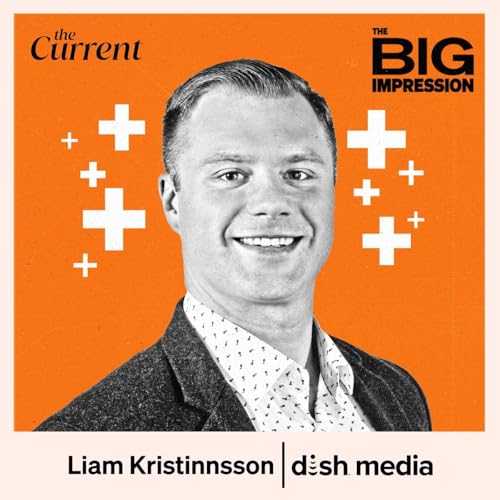
The Big Impression cover art

The Big Impression

The Big Impression

Written by: The Current
Listen for free

About this listen

The Big Impression returns for another season of insights and inspiration from leaders at the world’s most influential brands. Editors and co-hosts Damian Fowler and Ilyse Liffreing will look to uncover candid stories on game-changing campaigns from some of the world's biggest brands — including wins, losses, and lessons. New episodes are released every Wednesday.2023 The Current Podcast Careers Economics Leadership Management & Leadership Marketing Marketing & Sales Personal Success
Episodes
  • Pedigree’s Natalia Ball on turning an underdog into a Titanium Lion
    Feb 18 2026
    Natalia Ball, global chief growth officer at Mars Pet Nutrition joins The Big Impression podcast to talk about how Pedigree transformed a local Brazilian insight into a global business story. She also shares why she is now focused on the next frontier of growth: Connected commerce and making sure brands show up when AI agents, not just people, are making purchasing decisions. Episode TranscriptPlease note, this transcript may contain minor inconsistencies compared to the episode audio. Damian Fowler (00:00):I'm Damian Fowler.Ilyse Liffreing (00:01):And I'm Ilyse Liffreing.Damian Fowler (00:02):And welcome to The Big Impression.Ilyse Liffreing (00:09):This week we're joined by Natalia Ball Global Chief Growth Officer at Mars Pet Nutrition home to brands like Pedigree and Sheba.Damian Fowler (00:18):Last March, pedigree launched a bold, purpose-driven campaign in Brazil celebrating mixed breed dogs, especially the iconic Vela Caramelo.Ilyse Liffreing (00:27):It wasn't just a campaign, it became a movement boosting adoption and challenging long held bias.Damian Fowler (00:35):The work went on to win top honors at the 2025 cans. Lions including the titanium lionIlyse Liffreing (00:41):And its impact is still rippling across markets and media channels worldwide.Damian Fowler (00:45):So today we're unpacking what made it work with the person who helped drive it. Natalia, tell us about the Carello campaign and how you landed on the idea.Natalia Ball (00:57):Carmelos are mixed dogs that are beloved in Brazil. They are found on the streets everywhere. They are the subject of meme, street culture, and people just identify Carmelo as the Brazilian dog. However, the inside that we discover was that this dog is 90% less likely to get adopted than breed dogs. So it is the most popular dog in Brazil, but the most overlooked. And when we learned about that, we decided that we wanted to make a difference and that we wanted this dog to get the position it deserve and pedigree decided to champion the underdog and become the official brand of caramel's in Brazil.Damian Fowler (01:41):You talked about the caramel. Could you just describe a little bit more for people who don't really know the caramelo and that term Vita, where does that come from?Natalia Ball (01:52):Yes, so caramels are basically mixed breed dogs that you can find on the streets of Brazil everywhere they are called caramel because they are caramel color and that's what it is in Spanish and they tend to be that caramel color, short hair. But there are different ways that these dogs look and feel because they are mixed breeds. But like I said, they are beloved dogs in Brazil, but when it comes to getting a pet, getting a dog, they are not the ones that people are going for. They see them as street dogs, not a dog that you have in your house. And the whole campaign was about, like I said, championing these caramels, driving adoption of mixed breed dogs, not only breed dogs. And we did that by saying that if caramels were considered non breeded, pedigree was going to give them a breed and who better to give them a breath than pedigree.Ilyse Liffreing (02:48):Great. And then at what point did you connect that insight to the campaign itself?Natalia Ball (02:54):What you need to know about pedigree? Pedigree is one of the largest dog brands in the world. Pedigree feeds more dogs than any other brand, and it has been there for many years and for the past 20 years or more, pedigree has been driving adoption, encouraging people to adopt pets everywhere. We have had a lot of iconic campaigns so much which maybe you would've heard, like for example, docs on Zoom during COVID or the child replacement program, which was a very interesting one. And we were talking about adoption in Brazil, but other local brands were talking about adoption too. So we were not cutting through and it was only when this insight came to us, which was a very deeply local insight that we made the connection, if we want to drive adoption in Brazil, this is going to be the way in and we're going to make this as big as it can possibly be.(03:51):Because we, from the very beginning saw we understood this idea of the vi Lata. You mentioned it before by the way, the vi lata is how you call mixed breed dogs in Brazil. And so when we had these conversations about this insight, the injustice of this beautiful dog not getting adopted, but also the cultural impact that it would have on resilience themselves, who could see themselves related in the fact that they were being championed, we decided to go really big on this campaign and not only do just an activation, but actually we are doing this campaign. We did it all of last year and we continue activating through this year. And some of the ways in which we championed this was actually by creating a caramel kennel club by creating the first ever caramel DNA testing. And it's the largest ever DNA test done in mos in all of history, kept creating a...
    Show More Show Less
    26 mins
  • Diadora’s Antonio Gnocchini on the power of discovery
    Jan 22 2026
    Heritage sports brands may be tempted to rely on their history to appeal to a new generation that wasn’t there to see it. But in the fast-moving digital attention economy, that’s a mistake, says Antonio Gnocchini, chief marketing officer at Diadora.He joins The Big Impression podcast to explain how the iconic Italian brand is reclaiming its spot in the performance market. By leaning into a challenger brand mindset during the Paris 2024 Olympics — without the price tag of official sponsorship — Gnocchini and his team are shifting the focus from nostalgia to high-performance innovation. Episode TranscriptPlease note, this transcript may contain minor inconsistencies compared to the episode audio.Damian Fowler (00:00):I'm Damian Fowler, and welcome to this edition of The Big Impression. Today, we're looking at how a heritage sportswear brand carved out its own spotlight at the Paris 2024 Olympics without being an official sponsor. My guest is Antonio Gnocchini, Chief Marketing Officer at Diadora, the iconic Italian brand known for its made in Italy craftsmanship. In the lead of the Paris, Antonio and his team launched a global brand campaign built around Diadora's roster of Italian athletes from Trackstar, Larissa, Yapacino, defensers and speed skaters, all while showcasing innovations like the Atomo Running Shoe. That's the first high mileage running shoe made in Italy in three decades. We're going to break down how Diadora timed its campaign to maximize the Olympic moment, how it differentiates itself from giants like Nike and LVMH, and what this strategy says about building awareness in a crowded high-stakes marketing landscape. So let's get into it.(01:07):Antonio, can you tell us about why the Paris Olympics was such an important moment for Diadora as it sought to elevate its brand name again?Antonio Gnocchini (01:18):So if you are a multi-category sport brand, Olympics is certainly the big event, the main event, your main catwalk of the main show. And you prepare for it for a long time because you need to be in one of the most competitive environment with the best product, competitive athletes. Everything needs to be perfect. And it's also one of those moments in which you can go deeper with attention, with messages. If you are serious about sport and you want to communicate, sport brand values, what you really stand for, it's not easy, especially today in moments in which the attention is not much, few seconds from everybody. Channels are very fast and flattened messages very easily. The Olympics is a moment in which for a few weeks you have the attention. You have people connected and engaged. You have people who care. And so it's a perfect environment to talk again about what you stand for.(02:41):And so going back to the Olympics was a statement to say, we actually are a competitive sport brands, a performance brand, not only lifestyle of it. And so yeah, it was such an important environment for us. Also, these Olympics was maybe one of the first ones that I've seen since I started doing this job when you could see some challengers brands activating and being visible.(03:15):In the past, this was really an event only for main sponsors and official sponsors mostly. Now this is a moment of challengers. And if you find the right way and if you had a good connection with your outlets, you could be doing a successful marketing campaigns and actions.Damian Fowler (03:35):That's really interesting to hear you say that. And I think, and I'm curious to hear your thoughts on this. Is the kind of media environment that we exist in now, does that make it possible for challenger brands to find a way to reach audiences that they otherwise might not be able to find back when it was the main TV channels and big glossy mags, there are more niches now in many ways.Antonio Gnocchini (04:00):There's a very interesting report that Business of Fashion and McKinsey release every year. And the most recent one was a study from McKinsey, which they were showing displaying how the sport market, which was dominated by only few incumbents. And you could see that at Olympics, still today, the most recent one, the usual suspects are dominated most of the sports. But in this past few years, there is a change going on in which incumbents are really under pressure from Challengers brand in the sport industry. They're gaining momentum. Challenges are gaining space, gaining market share, and also visibility. And you can say that maybe this is linked to the explosion of running as a global movement, but it's not only that. Running certainly as contributed, because running is one of those categories that is really extremely democratic. And yeah, sure, track and field main athletes, famous names help, but you can become a successful running brand without having only the most amazing hundred meters runners.(05:37):You can be successful by working in other ways. And you see brands starting to become more visible through ...
    Show More Show Less
    29 mins
  • Dish Media’s Liam Kristinnsson on how linear and programmatic TV are converging
    Jan 14 2026
    As Dish Media’s new head of programmatic partnerships, Kristinnsson is helping turn advanced TV into a single, addressable marketplace. Episode TranscriptPlease note, this transcript may contain minor inconsistencies compared to the episode audio.Damian Fowler (00:00):I'm Damian Fowler.Ilyse Liffreing (00:01):And I'm Ilyse Liffreing.Damian Fowler (00:02):And welcome to this edition of The Big Impression.Ilyse Liffreing (00:09):Today, we're joined by Liam Kristinnsson, head of programmatic partnerships at Dish Media, where he's helping shape how the company connects advertisers with premium audiences across both linear and digital environments.Damian Fowler (00:23):Dish has been pushing hard into the programmatic space. From Dish Connected, it's addressable solution across the ecosystem to Advantage, which links programmatic buying with linear inventory in real time. It's all part of a broader move to bring automation and accountability to advanced TV.Ilyse Liffreing (00:39):We'll talk with Liam about how Dish is tackling fragmentation, what premium really means in a mixed green world, and where the next phase of programmatic growth is headed.Damian Fowler (00:51):So let's get into it.Liam Kristinnsson (00:57):Dish Connected has really revolutionized our product in the marketplace. We've been able to convert an additional four million to five million households into tangible CTV devices across real-time bidding systems across the industry. And it's kind of given us a leg up against some of our more linear competition where we now have full autonomy over our inventory and can enable and provide transparency downstream to any client.Damian Fowler (01:28):That's amazing. I mean, there was a moment there where there was a sort of either all linear or CTV, but this is something that's kind of connecting thoseLiam Kristinnsson (01:38):Two worlds. I think this is the start of the convergence. I know it probably truly started post-pandemic, I would say, but the reality is now that what is perceived as underutilized impression-based audiences are now becoming tangible and kind of overlapping with their traditional legacy linear purchases. And there's much more value to it because we are not enabling people to find attribution in a more roundabout extrapolated way, but we can provide meaningful real time results to third party attribution vendors or measurement vendors.Damian Fowler (02:20):And that brings us to Advantage, which you introduced in May to Power Programmatic and Linear at the same time. Could you tell us a little bit more about that?Liam Kristinnsson (02:30):Yeah. So the beauty of Advantage is it really expands upon what we've already built for Programmatic in Disconnected, but it provides solutions across the whole suite of products we have. Our addressable business can tap into real-time kind of innovations, real-time optimizations against audiences, ensure that we are better delivering across the target audience and finding that incremental reach that in the past may have been next to impossible to verify. And now we have all that inventory in one place. It's kind of like a grocery store when I think the industry has become accustomed to going to a bodega. That's very New York with me, I understand. I like that. But sometimes bodegas have eggs, they have a deli, they might have milk, but they might not always have milk and seltzer and all the little things that you want on a day-to-day basis. And the reality is something lacking when it comes to you being able to actually fill your fridge.(03:35):Now we have all those components that the customer or the client is looking for.Damian Fowler (03:40):Yeah. I like that analogy.Ilyse Liffreing (03:41):It's a good one. Yeah, no, I like that. And now Liam, I'm curious about the advertisers you're working with. Is there a new segment of buyers that Programmatic is really opening the door to here? What is basically your sense of that cohort?Liam Kristinnsson (03:58):Yeah, I think it really has grown overnight programmatic in general, but I think it allows us to have expanded exposure across all clients that are looking for that more meaningful kind of results. I think we are seeing a lot of success in generating a lot of traction across the CPG world, the direct to consumer world. And I think we're finding a nice overlap from a category perspective of what we traditionally looked at as direct IO or addressable business, but maybe not all those brands or clients in maybe like a pharmaceutical vertical would tap or earmark dollars for commitments early in their planning phase. Now they have the liberty and the luxury to find that right audience and enable dollars downstream where we're just not hunting in that lane and now we can kind of, instead of spreading ourselves thin, the technology can enable us to really kind of tap into all those brands, whether it be the CPG or the pharmaceuticals.(05:05):Now on the CPG side, I would double down further. I ...
    Show More Show Less
    28 mins
No reviews yet