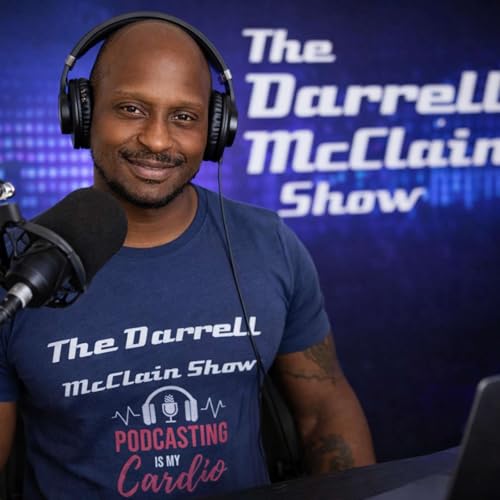
The Darrell McClain show cover art

The Darrell McClain show

The Darrell McClain show

Written by: Darrell McClain
Listen for free

Independent media that won't reinforce tribalism. We have one Planet; nobody's leaving, so let’s reason together!! Darrell McClain is a Military veteran with an abnormal interest in politics, economics, religion, philosophy, science, and literature. He's a Doctor of Philosophy in Human Services, and the author of Faith and the Ballot: A Christian's Guide to Voting, Unity, and Witness in Divided Times. Darrell is a certified Counselor. He focuses primarily on relationships, grief, addiction, and PTSD. He was born and raised in Jacksonville, FL, and went to Edward H white High School, where he wrestled under Coach Jermy Smith and The Late Brian Gilbert. He was a team wrestling captain, District champion, and an NHSCA All-American in freestyle Wrestling. He received a wrestling scholarship from Waldorf University in Forest City, Iowa. After a short period, he decided he no longer wanted to cut weight, effectively ending his college wrestling journey. Darrell McClain is an Ordained Pastor under the Universal Life Church and remains in good standing, as well as a Minister with American Marriage Ministries. He's a Believer in The Doctrines of Grace, Also Known as Calvinism. He joined the United States Navy in 2008 and was A Master at Arms (military police officer). He was awarded several medals while on active duty, including an Expeditionary Combat Medal, a Global War on Terror Medal, a National Defense Medal, a Korean Defense Medal, and multiple Navy Achievement Medals. While in the Navy, he also served as the assistant wrestling coach at Robert E. Lee High School. He's a Black Belt in Brazilian Jiu-Jitsu under 6th-degree black belt Gustavo Machado. Darrell Trains At Gustavo Machado Norfolk under the 4th-degree black belt and Former Marine Professor Mark Sausser. He studied psychology at American Military University and criminal justice at ECPI University.

© 2026 The Darrell McClain show
Political Science Politics & Government Social Sciences
Episodes
  • The Affordability Reckoning
    Oct 15 2026

    Send us Fan Mail

    A campaign promise that sounded simple is now running into hard numbers: prices were supposed to fall fast, but the latest inflation report says the squeeze is still on. We break down what the data actually shows, from the monthly jump in consumer prices to the categories people feel most, especially gasoline, fuel oil, and travel. When affordability is the message that wins elections, inflation becomes more than a statistic. It becomes a test voters apply every time they open their wallet.

    We also get specific about causes. Yes, presidents do not control every price, and global oil markets, supply shocks, and central bank policy all matter. But we talk through why certain choices can still push costs higher, including tariffs that raise import costs and ripple into consumer goods, and foreign policy decisions that can disrupt energy markets and amplify price spikes at the pump. Then we connect those pressures to the Federal Reserve response, where higher interest rates can make everyday borrowing more expensive for households and businesses already struggling.

    The bigger story is political: inflation has a psychological punch that GDP can’t match, and voters remember “day one” promises when “day 634” shows up on the calendar. We dig into why midterm elections often become a referendum on the sitting president, how polling suggests responsibility is being reassigned, and why the blame game has an expiration date when receipts keep piling up. If this helped you think more clearly about inflation, affordability, and the 2026 midterms, subscribe, share the episode, and leave a review. What price increase has changed your day-to-day the most?

    Support the show

    Show More Show Less
    13 mins
  • How The Houthis Became A Regional Missile Power
    Oct 15 2026

    Send us Fan Mail

    Saudi airports getting hit by cruise missiles should shatter a lot of comforting stories about “stability” in the Middle East. We sit down with Eric Sproling of Just Foreign Policy to connect the dots between the long Saudi-led war in Yemen, the way the Houthis built real missile and drone capabilities, and how US support over multiple administrations helped shape the battlefield we’re watching now.

    We get specific about what people forget: the Obama-era backing for the Saudi campaign, the catastrophic humanitarian crisis created by bombing and blockade, and the stalled 2022 ceasefire that never turned into a final peace deal. From there, we talk about why the Iran war and the Gaza fallout raise the temperature across the region, and why the biggest threat to US partners may be the simple math of modern warfare: cheap drones versus expensive interceptors, plus dwindling missile defense stockpiles.

    Then we widen the lens to Israel’s regional strategy, normalization politics, and the split inside pro-Israel circles over force versus a managed “two-state” rebrand. Finally, we shift to Pakistan: Imran Khan’s removal, the military-backed government’s tightening authoritarian control, and why Washington appears more comfortable with repression than with a strategically independent democracy.

    If you care about Yemen, Saudi Arabia, the Houthis, US foreign policy, the Iran war, Israel normalization, and Pakistan’s political crisis, this conversation is for you. Subscribe, share the episode with a friend, and leave a review with your biggest takeaway.

    Support the show

    Show More Show Less
    47 mins
  • Mormon Soulcraft And The Courage To Tell Truth
    Oct 15 2026

    Send us Fan Mail

    Two public intellectuals with real differences walk onstage and do something most of us say we want but rarely practice: they disagree without demeaning each other, and they treat truth like the goal rather than the trophy. From the first minutes, Robert P. George and Cornel West tell the story of how a Princeton faculty acquaintance became a brotherhood through long arguments, shared teaching, and an unshakable respect for integrity. The result is a live, funny, and deeply serious lesson in dialogue across differences.

    We dig into teaching as vocation, not career, and what it means to form students into determined truth seekers and courageous truth speakers. George argues that exhortation matters, but modeling matters more: students learn how to think by watching how we face criticism, admit fallibility, and debate without a will to victory. West adds a spiritual vocabulary for character formation, naming piety as remembrance, reverence, and resistance, then connects it to what he calls “Mormon soulcraft,” a way of sustaining joy, empathy, service, and moral courage in a grim world.

    The conversation goes wide but stays grounded: the role of art in shaping the soul, the student’s duty to live an examined life, and the provocative charge to “learn how to die” as a daily practice of letting go of ego and falsehood so something better can be reborn. We also confront modern power politics by separating “how the world often is” from “how the world ought to be,” then return to Genesis and the Old Testament as a foundation for human dignity, the imago Dei, and the moral roots of justice, mercy, and family life.

    If you care about civil discourse, moral philosophy, faith and public life, liberal arts education, or simply how to keep loving people you disagree with, listen through to the end. Subscribe, share this with a friend who loves a good argument, and leave us a review with the biggest idea you’re taking away.

    Support the show

    Show More Show Less
    1 hr and 15 mins
adbl_web_anon_alc_button_suppression_t1
No reviews yet