• Breaking Carbon’s Monopoly: The First Aromatic Silicon Ring Synthesized
    Feb 20 2026

    For more than a century, aromatic chemistry has belonged to carbon. Flat benzene rings and delocalized π-electrons defined stability, elegance, and molecular design. Silicon—carbon’s heavier neighbor—was considered fundamentally incompatible with this architecture due to weak π-bonds and a strong preference for σ-bonding.

    Until now.

    In a landmark breakthrough, researchers have synthesized the first stable five-membered aromatic silicon ring. Despite adopting a puckered, nonplanar geometry driven by the Pseudo-Jahn-Teller effect, the molecule sustains a true 6π electron system, confirmed by NMR and NICS analyses.

    Through strategic steric engineering, scientists destabilized the σ-form and flipped the energetic script—allowing the π-aromatic system to prevail.

    This discovery challenges long-held assumptions about heavier elements and opens new frontiers in organometallic chemistry, catalysis, and functional materials.

    Aromaticity is no longer carbon’s exclusive domain. 🔬⚡

    #Aromaticity #SiliconChemistry #InorganicChemistry #Organometallics #MolecularDesign #MaterialsScience #QuantumChemistry #ScientificBreakthrough #deepdivelab

    For more than a century, aromatic chemistry has belonged to carbon. Flat benzene rings and delocalized π-electrons defined stability, elegance, and molecular design. Silicon—carbon’s heavier neighbor—was considered fundamentally incompatible with this architecture due to weak π-bonds and a strong preference for σ-bonding.

    Until now.

    In a landmark breakthrough, researchers have synthesized the first stable five-membered aromatic silicon ring. Despite adopting a puckered, nonplanar geometry driven by the Pseudo-Jahn-Teller effect, the molecule sustains a true 6π electron system, confirmed by NMR and NICS analyses.

    Through strategic steric engineering, scientists destabilized the σ-form and flipped the energetic script—allowing the π-aromatic system to prevail.

    This discovery challenges long-held assumptions about heavier elements and opens new frontiers in organometallic chemistry, catalysis, and functional materials.

    Aromaticity is no longer carbon’s exclusive domain. 🔬⚡

    #Aromaticity #SiliconChemistry #InorganicChemistry #Organometallics #MolecularDesign #MaterialsScience #QuantumChemistry #ScientificBreakthrough #deepdivelab

    📄 Source paper:
    Silicon cyclopentadienides featuring a nonplanar 6π aromatic Si₅ ring.
    Science, 5 Feb 2026, Vol 391, Issue 6785, pp. 587–591.

    Show More Show Less
    14 mins
  • Sunlight in a Bottle: The Molecular Fuel That Stores Heat for 3 Years ☀️🧪
    Feb 18 2026

    While solar panels dominate the renewable conversation, they solve only half the problem. Nearly 50% of global energy demand is heat, and two-thirds of that still comes from fossil fuels. Batteries store electricity — but what about warmth?

    In this episode, we explore a groundbreaking study published in Science (12 Feb 2026, First Release):
    “Molecular solar thermal energy storage in Dewar pyrimidone beyond 1.6 MJ/kg.”

    Researchers have developed a Molecular Solar Thermal (MOST) system based on engineered Dewar pyrimidone, capable of storing solar energy directly inside chemical bonds — like a rechargeable liquid fuel for heat.

    ✨ Record energy density: 1.65 MJ/kg
    ✨ Half-life up to 1,240 days (3.4 years)
    ✨ Boils water in one second when triggered
    ✨ Fully recyclable, closed-loop system

    Inspired by DNA photodamage and nature’s repair enzyme photolyase, scientists transformed a biological “error” into a high-efficiency solar heat battery. Unlike lithium-ion batteries (~0.9 MJ/kg), this system stores energy in strained chemical bonds that do not leak over time.

    Is this the future of decentralized heating?
    Could we charge heat in summer and release it three winters later?

    Let’s dive into the chemistry shaping a post-fossil-fuel future.

    📚 Source Paper:
    Molecular solar thermal energy storage in Dewar pyrimidone beyond 1.6 MJ/kg.
    Science, 12 Feb 2026 (First Release).

    Show More Show Less
    17 mins
  • The Human Brain on Hope: Why We’re Built for the “Not-Yet” 🧠🌅
    Feb 17 2026

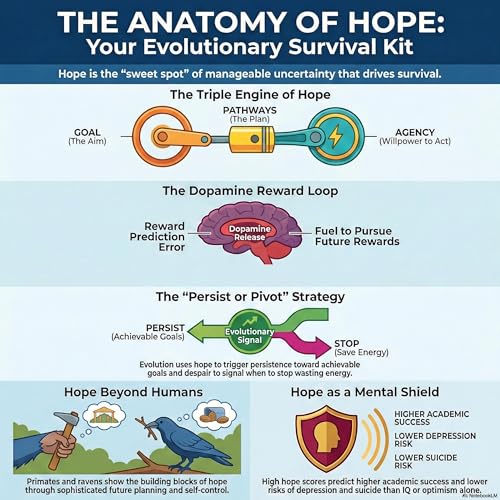
    To be human is to live suspended between what is and what could be. We endure uncertainty, setbacks, and friction because our brains are wired to project forward — to imagine a future that does not yet exist and act as if it might.

    Hope is not poetic decoration. It is a cognitive survival system.

    Neuroscience shows that individuals with high trait hope exhibit greater neural efficiency in the medial orbitofrontal cortex — the brain region responsible for reward valuation and goal tracking. The hopeful brain is not louder. It is quieter, more focused, less hijacked by anxiety.

    Psychologist Charles Snyder reframed hope as a structured mental framework built on:
    🎯 Goals — clear, meaningful targets
    🛤 Pathways — flexible strategies when obstacles arise
    ⚡ Agency — the willpower to keep going

    Hope is distinct from optimism. Optimism says, “Things will work out.”
    Hope says, “Here’s how I’ll make them work.”

    Even despair plays a role — acting as an adaptive signal to redirect effort when a goal is truly unattainable.

    In therapy, increases in hope often precede recovery. Hope is not the result of healing. It is the engine of healing.

    In a world defined by systemic uncertainty, cultivating hope is not naïve — it is neurologically strategic.

    What future are you actively building?

    #HumanNature #Neuroscience #HopeTheory #MentalHealth #CognitiveScience #Resilience #deepdivelab

    Show More Show Less
    15 mins
  • Pomelo vs. Pharmacy: When Superfoods Become Wildcards
    Feb 15 2026

    We celebrate pomelo as a vitamin C titan — delivering up to 400% of your daily needs. 💪🍊

    But what if that same fruit can:

    🔬 Permanently disable key metabolic enzymes
    💊 Spike or crash drug levels unpredictably
    ⏳ Leave a 72-hour metabolic “hangover”
    ⚖️ Turn precision medicine into guesswork

    Regulators warn about grapefruit — yet pomelo often escapes the label. Your prescription bottle may say “avoid grapefruit,” but your body doesn’t care about semantics.

    In this deep dive, we explore:

    • The science behind “suicide inhibition”
    • Why timing your fruit intake won’t save you
    • The irony of promising rodent studies vs. limited human evidence
    • Whether natural foods and modern medicine are quietly colliding

    Are we bringing a 19th-century diet into a 21st-century pharmacy?

    #SuperfoodScience
    #DrugMetabolism
    #CitrusChemistry
    #HealthMyths
    #Pharmacology
    #MetabolicScience
    #BiochemistryExplained
    #deepdivelab

    Show More Show Less
    16 mins
  • The Sour Science of Sugar
    Feb 15 2026

    For years, sugar was dismissed as “empty calories” — a simple cause of cavities and weight gain. But modern nutritional science tells a far more complex story. 🧪

    Sugar isn’t just fuel. It functions as a metabolic signal, capable of bypassing ancient regulatory checkpoints in the body.

    In this episode, we explore:

    🍬 Why the “sugar rush” may be largely psychological
    🧠 The emerging link between high sugar intake and depression
    🧪 How fructose overwhelms the liver and drives fat production
    🥤 Why liquid sugar is metabolically more dangerous
    🍎 And why whole fruit is biologically different

    Science is no longer asking whether sugar is harmful.
    The real question is: how low must we go to protect long-term health?

    Sweetness may feel harmless in the moment.
    But biology keeps the score.

    It’s time to rethink sugar — not as a treat, but as a powerful metabolic message.


    #SugarScience #MetabolicHealth #NutritionResearch #HealthPodcast #deepdivelab

    Show More Show Less
    14 mins
  • 🧬 Dipids: The DNA Origami Breakthrough That Builds Cell-Sized Robots
    Feb 13 2026

    Life is defined by its borders. Without membranes, the chemistry of a cell would dissolve into chaos. For decades, synthetic biologists faced a brutal trade-off: build rigid, virus-scale DNA cages with atomic precision—or large, messy lipid vesicles with no programmability.

    A landmark 2025 study from the Technical University of Munich, published in Nature Materials, shatters that barrier. By merging DNA origami precision with lipid-like fluidity, researchers created “Dipids”—DNA-lipid hybrid membranes capable of self-assembling into containers ranging from virus scale (119 nm) to bacterial scale (1.2 μm).

    These isotropic “sticky discs” bypass rigid Caspar–Klug viral geometry, introducing structural compliance through flexible oligo-dT domains. The result? A programmable DNA fabric that is as soft as a biological membrane yet as addressable as a microchip.

    Even more astonishing: scaling from small to XXL requires only minor design tweaks—costing roughly $160 in new strands. With built-in porosity, Dipid membranes act as nanofactories, demonstrated by in-vitro transcription experiments where T7 polymerase freely entered to activate fluorescent RNA inside the container.

    We are witnessing the birth of cell-scale soft robotics—where molecular computation, motors, and membrane topography converge.

    📖 Source paper: Self-assembled cell-scale containers made from DNA origami membranes. Nature Materials (2025).

    #DNAOrigami #SyntheticBiology #Nanotechnology #SoftRobotics #CellEngineering #BottomUpBiology #NatureMaterials #FutureOfLife #deepdivelab

    Show More Show Less
    17 mins
  • It’s Not Just a Sad Song: The Neuroscience of One-Sided Love 💔🧠
    Feb 12 2026

    We’ve all been there. The text left on “seen.” The “You’re such a good friend.” The emotional damage playlist on repeat. 🎧💀

    But unrequited love isn’t just rom-com material or a Taylor Swift bridge—it’s a full-blown neurobiological event. Brain scans show rejection activates the same region as physical pain. Yes, your heart didn’t just feel broken—your brain literally processed it like a wound. 🧠⚡

    In this episode, we unpack:
    • Why men statistically experience one-sided love nearly twice as often (hello, Love Gap 👀)
    • Why the person saying “no” might secretly suffer more
    • Why uncertainty (“maybe they like me?”) is psychological gasoline 🔥
    • How dopamine withdrawal after rejection resembles addiction
    • Why your attachment style determines whether you “bounce back” or spiral

    Plus: parasocial heartbreak, celebrity crush meltdowns, and whether science might one day prescribe something for heartbreak. (Yes, oxytocin nasal spray is being studied 👃💊)

    This isn’t just emotional drama. It’s biology, evolution, and psychology colliding on the one-way street of romance.

    Because sometimes the pain is real—not poetic.

    #UnrequitedLove #Neuroscience #HeartbreakScience #LoveGap #PsychologyPodcast #BrainOnLove #Dopamine #AttachmentTheory #deepdivelab

    Show More Show Less
    15 mins
  • Can You Really Grow Taller? The Science Parents Are Never Told 🧬📏
    Feb 11 2026

    Height pills, stretching gadgets, hanging bars, protein overloads—everywhere you look, someone promises “a few extra centimeters.” But what actually works… and what is pure marketing fiction?

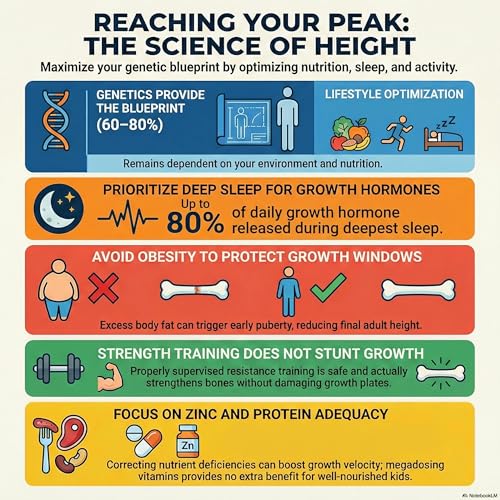
    In this episode, we break down decades of longitudinal data and medical research to reveal how human growth really works. From the critical first 1,000 days of life, to the obesity paradox that can shorten final height, to why deep sleep matters more than supplements.

    You’ll learn:
    • Why genetics sets the ceiling—but lifestyle shapes how close you get
    • How excess weight can trigger early puberty and stop growth sooner
    • Whether weight training actually stunts growth (spoiler: it doesn’t)
    • Why hanging only makes you “temporarily taller”
    • When parents should stop guessing—and see an endocrinologist

    This isn’t about hacking biology. It’s about removing the brakes and letting growth do its job.

    🧠📊 Evidence over hype.
    🎧 Parents, teens, and skeptics—this one’s for you.

    #HumanGrowth #HeightMyths #ParentingScience #SleepAndGrowth #BoneHealth #PediatricEndocrinology #SciencePodcast #deepdivelab

    Show More Show Less
    18 mins