• Neural Whispers
    Feb 17 2026

    A direct, intimate connection to an artificial mind.

    Show More Show Less
    2 mins
  • The 'one good tool' rule for AI beginners
    May 10 2026

    Episode summary: The people getting the most from AI aren't using the most tools. They're using one or two really well. Today we talk about what that looks like, and introduce the concept of Original Intelligence.

    In this episode:

    • What "Original Intelligence" means and why it matters more than ever
    • Why one reliable tool beats ten flashy ones
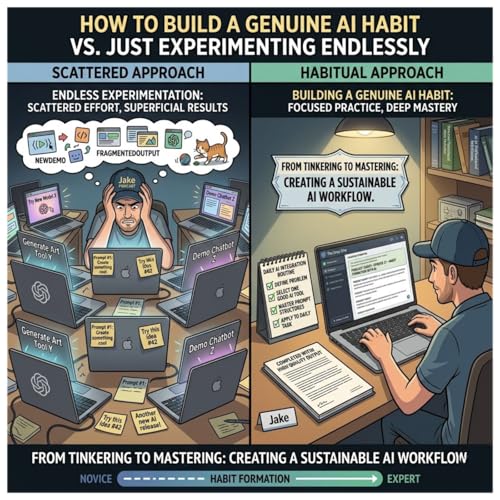
    • How to build a genuine AI habit vs. just experimenting endlessly
    • The 10% improvement challenge for this week
    • Why your judgment is the real asset, not the tool

    Your homework this week: Pick one AI task you already do. This week, try to do it with 10% more intention, better prompt, better review, better judgment on what to keep. That's the whole exercise.

    Show More Show Less
    3 mins
  • When AI gets it wrong: the 40% problem
    May 9 2026

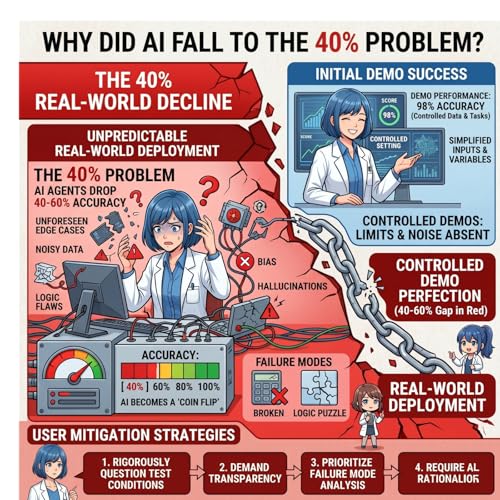
    AI that's built in a hurry fails in the real world. Today we look at how badly, and what it means for how you evaluate any AI tool before you rely on it.

    In this episode:

    • How rushed AI deployments can drop to 40–60% accuracy in real-world settings
    • Why demos almost always look better than reality
    • The difference between a tool that works and a tool that works reliably
    • Three questions to ask before trusting any AI tool with something important
    • Why your skepticism is a feature, not a bug
    Show More Show Less
    1 min
  • Is AI making us worse at our jobs? An honest look.
    May 6 2026

    In this episode:

    • The study that found a 17% drop in concept mastery among heavy AI users
    • The difference between using AI to think faster vs. using it to avoid thinking
    • "Why did this save me time?" is only half the question worth asking
    • The calculator analogy that reframes everything about AI dependency
    • One simple habit that keeps your skills sharp while still using AI

    Key takeaway: How you use AI matters as much as whether you use it. AI as a thinking partner builds you up. AI as a thinking replacement quietly hollows you out. The difference is a small shift in intention, and it's completely in your control.

    Your homework this week: Notice one moment today where you reach for AI out of habit. Pause and ask: am I using this to learn and think better, or to skip the thinking entirely? Just noticing is enough to start.

    Mentioned in this episode:

    • Study on AI use and concept mastery (17% lower retention among production-focused users)
    • The "thinking partner vs. thinking replacement" framework
    • Getting Smart: research on AI and cognitive laziness in education

    Next episode: When AI gets it dangerously wrong, we look at real-world failure rates and the one question you should ask before trusting any AI tool with something important.

    Show More Show Less
    7 mins
  • Why most AI tools fail (and nobody talks about it)
    May 5 2026

    Episode summary: Everyone's talking about how powerful AI is. But here's what the hype machine skips over: most AI projects never make it into real use. In this episode, we look at why, and what it means for you as a beginner trying to figure out which tools are actually worth your time.

    In this episode:

    Why over 80% of enterprise AI projects never make it past the demo stage

    The difference between AI that impresses and AI that actually works

    What "built for a demo" looks like vs. built for real life

    The one question that makes you a smarter AI user immediately

    Why being a careful, intentional beginner is a genuine advantage right now

    Key takeaway: More AI doesn't mean better AI. The tools that change people's lives are specific, tested, and built to solve one real problem really well, not to look good in a meeting.

    Your homework this week: Think of one tool or app you already use. Ask yourself: does it work reliably every time, or just most of the time? That question is the beginning of thinking like a smart AI user.

    Next episode: Is AI quietly making us worse at our jobs? We look at a surprising study — and what it means for how you use these tools day to day.

    Show More Show Less
    2 mins
  • Unlocking AI: Your Friendly Digital Assistant Awaits
    May 2 2026

    In this episode, hosts Jake Shinto and Jessica pull back the curtain on artificial intelligence to reveal that it isn’t nearly as intimidating as sci-fi movies make it out to be. Far from being a "scary robot brain," AI is a practical tool already woven into our daily lives, from the directions we follow on Google Maps to the timers we set with Siri.

    Whether you're an AI enthusiast or a total skeptic, this episode offers a grounded, approachable perspective on how to view these new digital assistants as helpers rather than miracle workers.

    Show More Show Less
    7 mins
  • The Crystal Bowl Conundrum: Validating AI Intelligence Forecasts
    May 3 2026

    This podcast evaluates a 2024 research paper by Klaus Solberg Soilen regarding the efficacy of AI in intelligence forecasting. The source examines how well large language models have performed against human analysts, noting that while AI now outperforms the average person, elite human superforecasters still maintain a slight competitive edge. Key challenges identified include the "Crystal Bowl Conundrum," which describes the persistent difficulty of verifying AI-generated information and its lack of transparent sourcing. The discussion also validates the necessity of separating the creative prompting process from rigorous information quality control to mitigate errors. While Soilen’s broad theories on technological integration proved accurate, his specific geopolitical predictions regarding China’s economic dominance were overly optimistic. Ultimately, the text illustrates that the U.S. leads in computational power, though the primary hurdle remains the trustworthiness of automated insights.

    Show More Show Less
    12 mins
  • "The Uncanny Valley: Why We Keep Building Ourselves (And Why We Should Stop)"
    Mar 26 2026

    Today we critique the tech industry’s fixation on building humanoid robots. While companies design robots with two legs to fit existing human infrastructure and utilize imitation learning, This approach is mechanically inefficient and prohibitively expensive. I highlight that bipedal movement requires immense computational power and battery life compared to simpler, more stable designs like wheeled or quadruped robots. Ultimately, specialized modular tools and robot-friendly environments are more practical than creating expensive machines that mirror the human form. The pursuit of human-like robots is driven more by venture capital and ego than by sound engineering principles.

    Show More Show Less
    7 mins