Episodes

  • The Future of Insurance – Jason Cass, Leading Voice amongst Independent Insurance Agents
    May 19 2026
    Episode Info Jason Cass is the co-owner of The Insurance Alliance, co-owner of Virtual Intelligence, founder of Agency Intelligence, and one of the most recognized voices in the independent insurance industry. A veteran agency owner, speaker, and podcaster, he built a profitable three-location agency that runs both virtually and digitally. He was named Illinois Young Agent of the Year in 2005, served as Chairman of the National Young Agents Council from 2011 to 2013, and authored Customer Service is Just Foreplay in 2013. His newest book, Future Ready: The Strategic Case for Structure, Routing, and Scale, co-authored with Mitch Gibson, lays out how independent agencies must evolve in the age of AI and automation. Jason hosts the Agent's Influence and Agency Intelligence podcast series and continues to be a leading advocate for independent agents across the country. Episode Overview: This episode of The Future of Insurance features Jason Cass, a prominent voice in the independent insurance agent channel, as he discusses the transformative impact of AI on the industry. Cass, who has been in the insurance industry since 2002 and owns multiple companies, shares his insights on how AI, particularly "agentic AI," is poised to reshape the role of agents and brokers. Key Takeaways: AI as a Disruptor and Enabler: Cass emphasizes that while AI won't eliminate agents, it will fundamentally change how they operate. He draws parallels to past technological shifts like the internet, noting that while agents feared obsolescence, the channel adapted and evolved. AI, however, presents a more significant shift. Efficiency and Cost Reduction: AI's primary impact will be on operational efficiency, significantly reducing the cost of labor within agencies. Cass predicts that within two to three years, agencies adopting AI could see their people costs drop from 55-65% of revenue to 20-30%. This translates to substantial savings, enabling agencies to reinvest or grow. The Evolving Workforce: The adoption of AI will lead to a shift in agency staffing. While immediate layoffs are unlikely, there will be a transition. Smart agencies will retrain existing staff, focusing on tasks that AI cannot perform. The "swing efficiency score" will be crucial in measuring this transition. Shift in Licensed vs. Virtual Roles: Cass forecasts a significant change in the makeup of agency staff. Agentic bots, costing around $3,000-$5,000 annually, will replace some licensed roles that currently command salaries of $80,000+. Agencies will likely hire more virtual employees at lower costs to manage these bots, leading to a reduction in the number of highly paid, licensed individuals within an agency. Regulatory and Licensing Considerations: The question of whether AI can be licensed as an agent is a complex one. Cass believes that currently, AI cannot be licensed, and there are significant regulatory hurdles to overcome. He speculates that this may evolve in the future but emphasizes the current need for licensed human oversight. Opportunities Created by AI: Beyond cost savings, AI opens up new avenues for growth. Cass highlights the potential for AI to help agents better understand risk quality, align clients with the right markets, and navigate the complexities of policy forms and carrier appetites. The emergence of AI itself is also creating a need for new insurance coverages, similar to the rise of cyber insurance. The Importance of Adoption and Education: Cass stresses that agents who embrace AI will thrive, while those who resist will be left behind. He advocates for education and training within agencies to help staff become comfortable with AI tools like Claude. The "Artificial Intelligence Utilization Score" (AIU) will become a key metric for success. The Role of Carriers and Technology Providers: Carriers need to adapt by developing their own AI solutions and partnering with agents to facilitate AI adoption. Technology providers must focus on creating practical, integrated solutions that solve real agency problems, such as routing engines that effectively manage the workflow between humans and AI. Beyond Fear: Embracing the Future: Cass acknowledges the fear surrounding AI but encourages a proactive approach. He believes that embracing AI will lead to greater job satisfaction, improved client service, and a more robust and attractive insurance industry overall. The key is to focus on the opportunities and develop a culture of adaptation. This episode is brought to you by The Future of Insurance book series (future-of-insurance.com) from Bryan Falchuk. Follow the podcast at future-of-insurance.com/podcast for more details and other episodes. Music courtesy of Hyperbeat Music, available to stream or download on Spotify, Apple Music, and Amazon Music and more.
    Show More Show Less
    35 mins
  • The Future of Insurance – Meg McKeen, Host of Bound & Determined
    May 12 2026

    Episode Info

    Celebrating her 26th year in the insurance industry, Meg McKeen, CIC, founded Adjunct Advisors LLC in 2018 with the essential belief that we can do more, and better, to support the professionals who choose a career here. Throughout her own career, working as an underwriter, agent, and leader within the industry, Meg has held a seat at the table during thousands of insurance negotiations. As an independent consultant, Meg now holds space at the crossroads of personal and professional development, for individuals and organizations as they grow their sales and leadership acumen through private coaching, consulting engagements, and the podcast she hosts, Bound & Determined℠. Known for her relatability and storytelling, Meg is a sought after speaker for insurance related conferences and events, as well as a regular columnist for Rough Notes magazine, and Meg's contributions to the insurance industry have been recognized with her inclusion in Insurance Business America's Hot 100 and Elite Women for 2021.

    A graduate of Illinois Wesleyan University, Meg is currently a digital nomad in the midst of a thoughtful travel adventure. When she's not supporting insurance professionals, you can find Meg putting the "practice" into yoga practice, searching for the best vegan bakery, or cheering on her favorite independent musicians. Learn more at www.adjunctadvisors.com.

    Episode Overview:

    • Meg's Industry Journey: From 26 years in insurance, including a pivotal moment of burnout and transition, to founding Bound & Determined.

    • The "Bound & Determined" Podcast: Its genesis, purpose to support women in insurance by discussing life beyond the industry, and its evolution into live events and retreats.

    • Culture and Connection: The significance of authentic connection and community in professional and personal life, contrasting with corporate environments that can stifle open dialogue.

    • Personal Evolution and Success: How personal growth and changing definitions of success shape our professional paths and the importance of honoring that evolution.

    • Navigating Change: Strategies for individuals seeking more intentionality and freedom in their careers, even when bound by traditional structures.

    • The Human Element in Business: Emphasizing that despite technological advancements like AI, human connection and emotional well-being are paramount for organizational success.

    • The Nomad Lifestyle: Meg's experience with a mobile lifestyle and how it has unlocked business opportunities and facilitated personal experiences.

    • Advice for Creating Change: Practical steps for embracing curiosity, setting boundaries, seeking supportive communities, and prioritizing action over perfection when launching new ventures.

    This episode is brought to you by The Future of Insurance book series (future-of-insurance.com) from Bryan Falchuk.

    Follow the podcast at future-of-insurance.com/podcast for more details and other episodes.

    Music courtesy of Hyperbeat Music, available to stream or download on Spotify, Apple Music, and Amazon Music and more.

    Show More Show Less
    40 mins
  • The Future of Insurance – Scott White, Virginia Commissioner of Insurance; President, NAIC
    May 5 2026
    Episode Info Scott A. White was appointed Commissioner of the Virginia State Corporation Commission's Bureau of Insurance in 2018. He was elected NAIC President in December 2025. White joined the Bureau as a research analyst in 1998. From 1999 until 2011, he worked as an attorney advising the Bureau on all major insurance regulatory and compliance matters. In 2011 he became head of the Commission's financial services legal division, expanding his practice areas to include securities and banking. At the NAIC, White has chaired the Financial Condition (E) Committee, the Long-Term Care Insurance (EX) Task Force, and the Southeast Zone. He is a member of the International Association of Insurance Supervisors (IAIS) Executive Committee, Macroprudential Committee, and Insurance Capital Standard Task Force. White earned a Bachelor of Arts degree from the University of Virginia and a law degree from the University of Missouri. He and his wife, Jodi, have two grown daughters. Episode Overview: Key Issues in Virginia: Affordability and Availability: While Virginia generally has good market availability, the state is addressing rising premiums and legislative interest in healthcare and property insurance. Natural Catastrophes: The discussion touches on the impact of weather-related events, with a focus on windstorms, hurricanes, and the often-overlooked risk of flooding. Risk Mitigation Programs: Virginia is exploring programs to incentivize hardening homes against perils like severe convective storms, including hail and wind. Litigation and Tort Reform: The conversation addresses the impact of litigation activity on insurance rates and the legislative considerations surrounding tort reform. The National Conversation on AI: Industry Adoption: Commissioner White observes that the insurance industry often lags in adopting new technologies like AI, partly due to its inherent risk aversion and the paramount importance of trust. Consumer Concerns: A significant concern is the potential for AI to be perceived as making critical decisions about healthcare authorization, leading to a growing distrust among consumers. NAIC's Approach: The NAIC has adopted an iterative approach, starting with principles and moving to guidance through an AI bulletin. Their focus is on compliance, transparency, accountability, and safe systems. AI Systems Evaluation Tool: The NAIC is piloting a tool to help state insurance departments assess how companies are using AI, focusing on governance and risk management. This aims to identify potential gaps in current laws. Bias in AI: The discussion highlights the concerns around algorithmic bias and proxy discrimination, while also acknowledging that bias exists in current, non-AI-driven processes. The importance of data protection and operational resiliency against cyber threats is also emphasized. The Future of Market Regulation: Modernization Efforts: The NAIC is undertaking an ambitious "Future of Market Regulation" initiative to modernize its approach, recognizing that market regulation has not progressed as rapidly as financial solvency regulation. Real-Time Surveillance: The goal is to move towards more real-time surveillance of companies, leveraging enhanced data and analysis, rather than relying solely on lengthy, complaint-driven examinations. Training and Resources: There is a recognized need for regulators to develop new skills and obtain adequate training to effectively oversee AI and other emerging technologies. This episode is brought to you by The Future of Insurance book series (future-of-insurance.com) from Bryan Falchuk. Follow the podcast at future-of-insurance.com/podcast for more details and other episodes. Music courtesy of Hyperbeat Music, available to stream or download on Spotify, Apple Music, and Amazon Music and more.
    Show More Show Less
    27 mins
  • The Future of Insurance – Craig Weber, Head of Insurance Strategy, Cognizant
    Apr 28 2026

    Episode Info

    Craig Weber is a thought leader and management consultant with extensive insurance specialization, having worked for a major carrier and then leading an analyst firm. At Cognizant, he leads a team responsible for the firm's insurance strategy and bringing its portfolio of insurance offerings to the market.

    Episode Overview:

    AI is at a critical inflection point, poised to profoundly transform the insurance industry. While carriers are at varying stages of adoption, a key challenge is scaling AI from pilots to production.

    Key Areas of Focus:

    • Data Utilization: AI needs proprietary data to unlock its full potential, necessitating robust data protection strategies.

    • Distribution Enhancement: AI can automate agent administrative tasks, boosting productivity and addressing talent shortages, rather than solely displacing agents.

    • Customer Experience: AI can streamline services, but must be balanced with human empathy, especially for complex issues. Customer comfort with AI is growing, influenced by their insurance knowledge.

    • Future Strategy: A proactive "AI builder strategy" is crucial. Insurers should focus on developing skills and adapting to the rapid, self-reinforcing evolution of AI.

    AI represents a fundamental shift, not just an efficiency play. Proactive investment and adaptation are essential to navigate this "innovation arms race" and remake the insurance landscape.

    The conversation concluded by stressing the importance of a collaborative, monitored approach to AI implementation, ensuring it serves to enhance both efficiency and the human element in the insurance claims process.

    This episode is brought to you by The Future of Insurance book series (future-of-insurance.com) from Bryan Falchuk.

    Follow the podcast at future-of-insurance.com/podcast for more details and other episodes.

    Music courtesy of Hyperbeat Music, available to stream or download on Spotify, Apple Music, and Amazon Music and more.

    Show More Show Less
    34 mins
  • The Future of Insurance – Joe Zuk, Operating Partner, Altamont Capital
    Apr 21 2026

    Episode Info

    Joe Zuk is an Operating Partner for Altamont Capital Partners, bringing a dedicated focus to corporate and business development across existing ACP portfolio companies within the Property & Casualty insurance vertical. Most recently, Joe served as Managing Director of Corporate Development & Strategy for Orchid Underwriters, a private equity-backed catastrophic personal and commercial lines property managing general underwriter. During his tenure he successfully executed upon the stated strategy for the firm including formation and launch of a proprietary segregated cell captive reinsurance facility, sourcing additional carrier partners, development of operational strategy, recruitment of human capital, and sourcing of M&A opportunities.

    Prior to Orchid, Joe served as Board Manager at Atlas General Holdings. At Atlas, he led the organic development and growth of Atlas's commercial property & casualty divisions as well as directing its corporate development initiatives. Prior to Atlas, Joe was an accomplished reinsurance broker and underwriter with over a decade of experience in treaty and facultative property and casualty reinsurance. During that time, he developed an extensive network of relationships across the industry landscape in both domestic and international markets.

    Joe is a graduate of New York University, earning a Bachelor of Arts with concentrations in finance, history and cinema. Joe enjoys dedicating his time to mentoring and encouraging young professionals to enter and advance within the broader insurance industry.

    Episode Overview:

    • Talent Shortage: The industry faces an aging workforce and difficulty attracting new talent, impacting core functions like claims and underwriting. Solutions involve structured knowledge transfer and mentorship.

    • AI Transformation: AI is not replacing jobs but changing them. It offers tools to enhance efficiency, improve risk assessment, and personalize customer interactions.

    • Evolving Distribution: AI may automate simpler insurance sales, shifting the focus for human agents towards complex advisory roles.

    • Navigating Risks: While AI offers significant benefits, challenges like inaccuracies and potential liability must be managed.

    The insurance sector is adapting, emphasizing the need for continuous learning and strategic adoption of new technologies.

    The conversation concluded by stressing the importance of a collaborative, monitored approach to AI implementation, ensuring it serves to enhance both efficiency and the human element in the insurance claims process.

    This episode is brought to you by The Future of Insurance book series (future-of-insurance.com) from Bryan Falchuk.

    Follow the podcast at future-of-insurance.com/podcast for more details and other episodes.

    Music courtesy of Hyperbeat Music, available to stream or download on Spotify, Apple Music, and Amazon Music and more.

    Show More Show Less
    35 mins
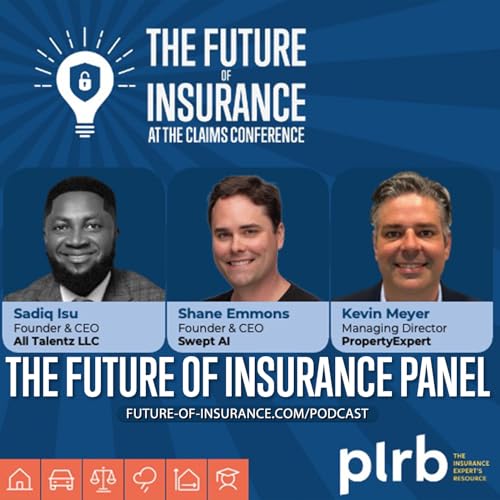
  • The Future of Insurance Panel on AI & Claims at PLRB 2026
    Apr 14 2026
    Episode Info How is AI shaping the future of claims, and even the present of it? Join Bryan Falchuk as he hosts a panel featuring audience questions on the dynamics and technology shaping where insurance is headed. The panel includes: Sadiq Isu, Founder & CEO, All Talentz LLCKevin Meyer, Managing Director, PropertyExpertShane Emmons, Founder & CEO, Swept AI This discussion explores the evolving landscape of insurance claims, focusing on the integration of Artificial Intelligence (AI) with human expertise. The conversation highlights the critical need for a balanced approach, the inherent challenges of AI, and the strategic considerations for its implementation. This discussion was recorded live on March 24th at the 2026 PLRB Claims Conference at the Gaylord National Harbor Hotel in Washington DC, and was held right after the panelists shared this views on how things like AI are changing the ways claims can be handled – not just in the future, but right now. Episode Overview: The AI-Human Dichotomy: The presentations emphasized a common thread: the necessity of overseeing both AI and human actions within the claims process. The concept of "eyes on you" applies to both AI and human agents, ensuring accountability and adherence to procedures. AI as a Tool – Strengths and Weaknesses: AI can be applied across various settings and languages to handle claims, but requires careful management. The quality of data fed into AI directly dictates the quality of its output, mirroring human learning. Concerns around "drift" (AI deviating from its intended path) and "heresy" (AI holding onto incorrect information) were raised. Empowering Human Adjusters: A significant focus was on how AI can empower humans, rather than replace them, by handling routine tasks. This allows experienced professionals to concentrate on complex cases and the empathetic aspects of claims handling. Agentic AI: Potential and Peril: Agentic AI, capable of independent action, is still viewed with caution, especially in emotionally charged claims scenarios. The emotional impact of claims on policyholders necessitates human interaction and empathy, areas where current AI may fall short. While agentic AI is being deployed for specific tasks (e.g., document analysis, payment processing), its use in direct customer interaction is debated. Mitigating Risks and Ensuring Compliance: The importance of internal and external compliance remains paramount, with AI needing robust monitoring. The potential for class-action lawsuits stemming from AI-driven coverage decisions highlights the need for defensible AI models and careful prompt engineering. Addressing Industry Challenges: The discussion touched on staffing shortages and how AI can help, but also warned against creating future problems by reducing entry-level training opportunities. The need to train experts effectively, without relying solely on years of less engaging tasks, was emphasized. Emerging Trends and Observations: Active Pilots: Agentic AI is being piloted in areas like commercial insurance for coverage determinations and in managing long-running claims by summarizing information. Policyholder Trust: In some instances, policyholders are interacting with agentic AI systems from restoration companies, viewing them as more trustworthy than traditional insurance processes. The "Gap" in Expertise: The industry faces a challenge in developing skilled professionals, and AI's role in training needs careful consideration to avoid widening this gap. Legal Scrutiny: The legal implications of AI in decision-making are significant, with a need to understand model underpinnings and ensure unbiased outcomes. The conversation concluded by stressing the importance of a collaborative, monitored approach to AI implementation, ensuring it serves to enhance both efficiency and the human element in the insurance claims process. This episode is brought to you by The Future of Insurance book series (future-of-insurance.com) from Bryan Falchuk. Follow the podcast at future-of-insurance.com/podcast for more details and other episodes. Music courtesy of Hyperbeat Music, available to stream or download on Spotify, Apple Music, and Amazon Music and more.
    Show More Show Less
    29 mins
  • The Future of Insurance – Kyle Nakatsuji, Founder & CEO, Dearborn Labs
    Apr 7 2026

    Episode Info

    Kyle Nakatsuji is the Founder and CEO of Dearborn Labs and Clearcover. He joined the show during Season 1 to talk about Clearcover (which is the subject of one of the case studies in The Future of Insurance – Volume II. The Startups). He rejoins the show to share about their latest venture, Dearborn Labs. Here is the detail on the launch of Dearborn Labs from their press release:

    Clearcover, Inc. Launches Dearborn Labs to Deploy Production AI Inside Carriers and MGAs

    Backed by nearly a decade of proven results, the firm's AI concierge model designs, builds and deploys customized AI infrastructure into insurers' existing operations to eliminate fragmented pilots

    CHICAGO, March 5, 2026 — Clearcover, an AI-native auto insurance carrier, today announces the launch of Dearborn Labs, a forward-deployed AI practice that builds and operates AI systems inside property and casualty insurance carriers and MGAs.

    "Most carriers have already invested in AI. The problem isn't the tools," said Dearborn Labs Founder Kyle Nakatsuji. "It's that the landscape changes faster than any single solution can keep up with, and nobody's connecting the data and context across operations to make those tools compound. That's not a software problem. It's an operating problem."

    Unlike traditional SaaS, Dearborn Labs adds an operational layer to customize AI within a company's unique model, driving measurable business outcomes.

    "We don't hand over a strategy deck. We deploy into your operation and ship production systems in weeks," said Nakatsuji, adding that modern insurers need to turn isolated AI capabilities into a growth engine. "Your claims data should make your underwriting smarter. Your underwriting context should shape your distribution. We build the infrastructure that makes that happen."

    While the insurance industry has invested heavily in AI, most carriers and MGAs have not yet seen system-level returns.

    Nakatsuji's team at Clearcover integrated AI into nearly every core function of daily production across multiple states and significantly improved results: Over 90% of claims intake runs through AI agents, 93% of policies are bound digitally and claims handling operates at three times the efficiency of traditional carriers.

    Episode Overview:

    • Clearcover's Tech Foundation: Built on a decade of tech innovation for better customer experiences and efficiency in insurance.
    • Dearborn Labs' Mission: A new venture focused on helping insurers adopt AI, offering a hybrid service and technology approach.
    • Urgency of AI Adoption: The current AI advancements necessitate immediate action; waiting means falling behind.
    • Beyond Off-the-Shelf Solutions: Dearborn Labs focuses on tailored AI strategies and team deployment, not just software sales.
    • The Critical Data Layer: Effective AI requires a unified data foundation to provide context across all business functions.
    • Incremental Steps, Exponential Gains: While the industry is incremental, AI allows for rapid progress and significant results.
    • AI as "Employees": AI agents can act as specialized "staff," drastically changing operational efficiency and economics.
    • Future Uncertainty, Present Action: The pace of AI change is unprecedented, making immediate engagement crucial for future relevance.

    This episode is brought to you by The Future of Insurance book series (future-of-insurance.com) from Bryan Falchuk.

    Follow the podcast at future-of-insurance.com/podcast for more details and other episodes.

    Music courtesy of Hyperbeat Music, available to stream or download on Spotify, Apple Music, and Amazon Music and more.

    Show More Show Less
    29 mins
  • The Future of Insurance – Megan Linkin, Head of Parametric Nat Cat Americas, Swiss Re Corporate Solutions
    Mar 31 2026
    Episode Info Dr. Megan Linkin is the Head of Parametric Nat Cat Americas for Swiss Re Corporate Solutions, based in New York City. She has extensive expertise in parametric and structured insurance and reinsurance solutions. Megan's primary responsibility is the origination, development, structuring and underwriting of parametric insurance solutions that protect corporates and governments against losses incurred due to natural catastrophes or other disruptive events. Before joining CorSo in 2019, Megan worked for Swiss Re's Public Sector Solutions team, focusing on the development of insurance products to address the unique financial needs of public sector entities, from federal governments to municipal service providers. Prior to re-joining Swiss Re in 2012, she worked as a weather derivative underwriter and catastrophe bond analyst at Allianz Risk Transfer, structuring weather solutions for the energy, agricultural and tourism industries. Between 2008 and 2011, she was an atmospheric perils specialist for the Swiss Re Cat Perils team; her responsibilities included assessing the insurance risk posed by hurricanes, tornadoes, hail and winter storms globally and developing pricing tools and techniques for underwriters, actuaries and insurance-linked security traders. Megan has designed several award-winning parametric insurance solutions, such as Swiss Re STORM, awarded the Business Insurance Insurtech Initiative of the Year in 2020, and Swiss Re HAIL, awarded the Business Insurance Innovation Award in 2021, and Inside P&C's Underwriting Initiative of the Year in 2022. She is one of Swiss Re's experts on climate change science, natural catastrophes and the innovative insurance solutions that exist to address them. Megan has given invited presentations to the state of New Jersey, the New York Academy of Science, Rutgers University, and the University of Maryland. Her manuscripts have been published in Climatic Change, the Journal of Climate and Weatherwise magazine; she has also authored publications that assess the present-day financial impacts of the 1821 Norfolk-Long Island hurricane and Hurricane Andrew. Megan was profiled by the New York Times in 2010 and NJ Biz in 2013, and has been interviewed by NBC News, the New York Times, the Washington Post, the Wall Street Journal and Huffington Post. She has testified before the United States Senate regarding the impacts of climate change on the insurance industry, and has appeared on The Weather Channel. Megan was named one of Reactions Rising Stars of the insurance industry in 2014. Megan received her Ph.D. and Masters of Science in atmospheric and oceanic science from the University of Maryland and graduated magna cum laude from Rutgers University with a Bachelor of Science in meteorology and a minor in mathematics. She received her Certified Consulting Meteorologist Seal from the American Meteorological Society in February 2013. She is an active member of the American Meteorological Society, the American Geophysical Union and the New Jersey Climate Adaptation Alliance. Episode Overview: Introduction to Parametric Insurance Parametric insurance is a type of index-based insurance where payouts are determined by the intensity of an event rather than the actual incurred loss. This pre-agreed value policy uses specific event metrics to trigger claims. Background and Evolution The concept of parametric insurance has roots in weather derivatives from the late 1990s. Initially focused on natural catastrophe risks like hurricanes, tornadoes, and hail, it has evolved significantly. Swiss Re, with its deep involvement in this space for over 15 years, has seen a shift towards insurance contracts rather than purely derivatives. Parametric Insurance for Governments and Corporations Parametric insurance has resonated with government buyers due to their role as first responders and insurers of last resort after natural disasters. It provides a mechanism to cover immediate costs like infrastructure repair and emergency responder salaries, which traditional policies often don't address. In the late 2010s, after significant hurricane activity, there was a surge in interest from the corporate sector, particularly in hospitality and heavy industry, highlighting the value of parametric solutions for business continuity. How Parametric Insurance Works as an Insurance Policy While distinct from traditional insurance, parametric policies function as insurance contracts. They require a proof of loss and include a broad definition of "ultimate net loss" to encompass direct or indirect, physical or financial losses traceable to the event. Clients attest that their incurred losses exceed the parametric payout, ensuring there's no windfall. The triggers are set to cover catastrophic and disruptive events, aligning with the core purpose of natural catastrophe insurance. Addressing ...
    Show More Show Less
    23 mins