Episodes

  • The Validity of Facial Emotion Recognition Technologies: The Impact of Emotion AI on Human Behavioral Research
    May 24 2023

    Today’s episode features a Q&A with our own Graham Page. Graham leads the Media Analytics business Unit as Global Managing Director of Media Analytics at Affectiva, a Smart Eye company. He pioneered the integration of biometric and behavioral measures to mainstream brand and advertising research for 26 years as Executive VP and Head of Global Research Solutions at Kantar.

    Over the course of the last year or so, there has been a thread of debate in the media regarding the validity and ethics of facial emotion recognition. This has often reflected the point of view of some data privacy groups who are concerned about the use of facial technologies across several use cases, or the opinions of commercial interests who offer alternative biometric technologies, or traditional research methodologies.

    Scrutiny of emerging technologies is vital, and the concerns raised are important points for debate. Affectiva has led the development of the Emotion AI field for over a decade, and the use of automated facial expression analysis in particular. Listen in to learn more.

    Links of interest:

    • [Podcast Episode] Lisa Feldman Barrett on Challenges in Inferring Emotion from Human Facial Movement: https://podcasts.apple.com/us/podcast/lisa-feldman-barrett-on-challenges-in-inferring-emotion/id1458361251?i=1000446966899
    • [Blog] Face Value: The Power of Facial Signals in Human Behavioral Research: https://blog.affectiva.com/face-value-the-power-of-facial-signals-in-research

    Additional Sources Referenced:

    [1] Barrett, Lisa Feldman, et al. "Emotional expressions reconsidered: Challenges to inferring emotion from human facial movements." Psychological science in the public interest 20.1 (2019): 1-68.

    [2] Ekman, Paul, and Wallace V. Friesen. "Facial action coding system." Environmental Psychology & Nonverbal Behavior (1978).

    [3] Rosenberg, Erika L., and Paul Ekman, eds. What the face reveals: Basic and applied studies of spontaneous expression using the Facial Action Coding System (FACS). Oxford University Press, 2020.

    [4] Martinez, Brais, et al. "Automatic analysis of facial actions: A survey." IEEE transactions on affective computing 10.3 (2017): 325-347.

    [5] McDuff, Daniel, et al. "AFFDEX SDK: a cross-platform real-time multi-face expression recognition toolkit." Proceedings of the 2016 CHI conference extended abstracts on human factors in computing systems. 2016.

    [6] Bishay, Mina, et al. "AFFDEX 2.0: A Real-Time Facial Expression Analysis Toolkit." arXiv preprint arXiv:2202.12059 (2022). Accepted at the FG2023 conference.

    [7] McDuff, Daniel, et al. "Predicting ad liking and purchase intent: Large-scale analysis of facial responses to ads." IEEE Transactions on Affective Computing 6.3 (2014): 223-235.

    [8] Koldra, Evan, et al. Do emotions in advertising drive sales? https://ana.esomar.org/documents/do-emotions-in-advertising-drive-sales--8059.

    [9] McDuff, Daniel, and Rana El Kaliouby. "Applications of automated facial coding in media measurement." IEEE transactions on affective computing 8.2 (2016): 148-160.

    [10] Teixeira, Thales, Rosalind Picard, and Rana El Kaliouby. "Why, when, and how much to entertain consumers in advertisements? A web-based facial tracking field study." Marketing Science 33.6 (2014): 809-827.

    [11] McDuff, Daniel, et al. "Automatic measurement of ad preferences from facial responses gathered

    Show More Show Less
    27 mins
  • Emotion AI in Journalism: Trust me, I’m Human…Virtually
    Apr 19 2022

    Would you watch the news online or via a mobile app if it were presented by something that looks human, but is in fact an artificially intelligent virtual human?

    Today’s episode features Leon Hawthorne. Leon is a media executive, journalist and academic; a former CEO of two satellite TV channels, three cable stations, a TV production company and a dozen web channels. He created web TV channels for Boot’s, Borders and Waterstones, and advised the CEOs of Hearst Magazines, the Independent and London Evening Standard on digital content strategies.

    In his journalistic career, he was a World News Anchor for both CNN International and CNBC Europe. For BBC News, he was a member of the parliamentary lobby, attending daily briefings at 10 Downing Street, reporting politics and producing current affairs documentaries for BBC One and BBC Radio 4. Leon is presently on an academic sabbatical, researching for a PhD at City, University of London, while lecturing in Media and Corporate Communication.

    In our conversation, we discussed his PhD Research: ‘Talking Heads: The use of virtual human presenters in the delivery of personalised news content’. The experiment itself uses AI to detect how participants really feel about the images they see, instead of relying wholly on answers participants give on a questionnaire. After being granted permission, the cloud-based software accesses the participant’s webcam to analyse their microexpressions, as they watch the videos. Microexpressions are small, rapid movements of the facial muscles that psychologists believe betray subconscious emotional reactions.

    The technology for the experiment was developed by Affectiva Inc., the pioneer of Emotion AI. The research is interested particularly in seeing how opinions vary, depending on the age and sex of participants, and also on how much they use smartphones and other new technologies. Anyone aged over 18, who has access to a computer with a webcam, can take part in the 10-minute online experiment.

    Links of interest:

    • AITalkingHeads.com - http://www.aitalkingheads.com
    • LeonHawthorne.com
    • Affectiva Emotion AI
    • Full link to participate in online experiment - https://cityunilondon.eu.qualtrics.com/jfe/form/SV_a3glSZjvos49rw2
    Show More Show Less
    21 mins
  • Unlocking Ad Success: The Role of Emotion AI in Creative Campaigns
    Jul 24 2024

    Today’s episode features Lynn Deason, Head of Creative Excellence at Kantar. Kantar is the world’s leading data, insights and consulting company. They understand more about how people think, feel, shop, share, vote and view than anyone else. Combining their expertise in human understanding with advanced technologies, Kantar’s 30,000 people help the world’s leading organizations succeed and grow. Lynn is a trusted advisor to the most senior levels in major client organisations who is passionate about brands, brand communications and brand experience. A recognised high achiever with proven impact to clients as individuals, their brands and their organisations overall, Lynn provides a very informed perspective as a result of wide experience internationally and across sectors.

    Lynn talked about the secrets behind creating impactful and memorable ad campaigns. We also explored the creative strategies behind brand McDonald's and Cadbury campaigns, the role of Emotion AI technology in advertising, and the future trends shaping the industry. Listen to learn more.

    Links of interest:

    • [Watch] Attention Beyond Views for Creative Effectiveness: https://go.affectiva.com/attention-beyond-views-for-creative-effectiveness-webinar
    • [Listen] Secrets of Ad Creative Effectiveness: Insights from Kantar’s 2024 Awards: https://www.smarteye.se/podcasts/secrets-of-ad-creative-effectiveness-insights-from-kantars-2024-awards/
    • [Learn] Emotion AI for ad testing: https://www.affectiva.com/product/ad-testing/
    • [Watch] Ad: Cadbury Secret Santa Postal Service
    Show More Show Less
    28 mins
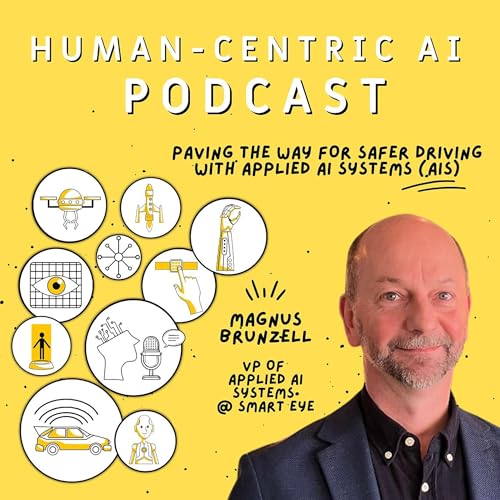
  • Paving the Way for Safer Driving with Applied AI Systems (AIS)
    Apr 10 2022

    Today’s episode features Magnus Brunzell, Vice President and head of business unit Fleet & Aftermarket at Smart Eye. With a Masters in engineering, Magnus has years of experience working with automotive tier-1 suppliers such as Delphi/Aptiv. He has had roles in project management, engineering, sales & marketing and managing director. I invited him to talk today about Smart Eye’s latest Product, Applied AI Systems, or AIS.

    AIS is actually more of a line of products, with several variants to meet different needs. It is a Driver Monitoring System that detects the driver's face, eyes and gaze while driving and can give warnings for behaviors such as distraction and drowsiness, and fills a void in the market for namely commercial vehicles and the aftermarket. Listen in to learn more.

    Links of interest:

    • More about AIS: https://smarteye.se/applied-ai-systems/
    • Applied AI Systems (AIS): https://smarteye.se/ais/
    • Pre-order AIS: https://order.smarteye.se/
    • We’re hiring! Careers page: https://smarteye.se/career-2/
    Show More Show Less
    21 mins