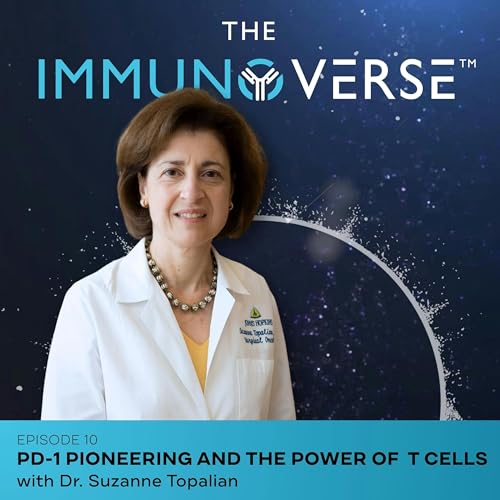
The ImmunoVerse™ cover art

The ImmunoVerse™

The ImmunoVerse™

Written by: Moffitt Cancer Center
Listen for free

About this listen

The ImmunoVerse™ is a monthly podcast exploring the past, present and future of immunotherapy and delving into every intricacy of the body's immune system. Hosted by Moffitt Cancer Center President and CEO, Dr. Patrick Hwu, each episode highlights the trailblazing visionaries who are pushing boundaries in this ever-evolving, world-changing field. Biological Sciences Hygiene & Healthy Living Science
Episodes
  • Decoding the Tumor Microenvironment, ft. Dr. Drew Pardoll
    Jan 29 2026
    Dr. Patrick Hwu speaks with Dr. Drew Pardoll, a pioneering leader in tumor immunology and director of the Bloomberg-Kimmel Institute for Cancer Immunotherapy at Johns Hopkins. Dr. Pardoll reflects on his early path into immunology and the scientific discoveries that helped establish immunotherapy as a transformative approach to cancer treatment. The conversation explores how tumors suppress immune responses within the tumor microenvironment and how understanding these immune “brakes” led to the development of immune checkpoint inhibitors, including anti–PD-1 therapies. Dr. Pardoll discusses the importance of learning from early clinical failures, the promise of combination therapies, and advances in engineered T cells. Looking ahead, the episode highlights emerging technologies such as single-cell analysis and artificial intelligence, which are accelerating discoveries across cancer research and beyond. Dr. Pardoll also shares insights on mentorship, collaboration, and the importance of sustained investment in science to continue reducing cancer mortality. What You’ll Learn from Dr. Pardoll How early clinical observations from bone marrow transplantation helped reveal the curative potential of T-cell–mediated anti-tumor immunity Why many early cancer vaccines failed clinically, and how those failures directly led to the discovery of immune checkpoint pathways The critical role of the tumor microenvironment in suppressing effective immune responses, even when tumor-specific T cells are present Why combination therapies (immunotherapy + chemotherapy, targeted therapy, or cell therapy) are essential to overcoming tumor escape and resistance Emerging advances in engineered adoptive cell therapies, including logic-gated T cells designed for improved specificity and safety How single-cell and spatial transcriptomic technologies are transforming our ability to dissect the tumor ecosystem The growing role of AI in analyzing massive immunologic datasets and accelerating discovery
    Show More Show Less
    25 mins
  • Pioneering PD-1 Immunotherapy and Tumor-Infiltrating Lymphocytes, ft. Dr. Suzanne Topalian
    Dec 18 2025
    Dr. Patrick Hwu welcomes Dr. Suzanne Topalian, Bloomberg-Kimmel Professor of Cancer Immunotherapy at Johns Hopkins and Director of the Melanoma Program at the Sidney Kimmel Comprehensive Cancer Center. Dr. Topalian shares her journey from surgical residency to groundbreaking research in tumor-infiltrating lymphocytes (TILs) and immune checkpoint blockade. She discusses the evolution of PD-1 inhibition, her contributions to biomarker discovery, and her work expanding immunotherapy to rare cancers like Merkel cell carcinoma. Dr. Topalian also explores the promise of neoadjuvant immunotherapy, the importance of persistence in research, and the role of mentorship in shaping the next generation of cancer scientists. Throughout the conversation, she emphasizes the collaborative, patient-centered approach that has defined her career and continues to drive advances in cancer immunotherapy. Key Takeaways Immunotherapy translation is a marathon - TIL development required decades from concept to FDA approval. Persistence, infrastructure scaling, and multi-disciplinary collaboration were critical. Helper T cells and other immune subsets deserve continued focus - early CD4 work opened the door to a broader understanding of immune network contributions beyond cytotoxic T cells. Checkpoint inhibitors transformed expectations for advanced disease - first-in-human PD-1 trials demonstrated tumor regression in treatment-refractory melanoma, lung, and renal cancers—creating a new standard of care and catalyzing pharmaceutical development. Neoadjuvant immunotherapy offers biological and clinical advantages - treating tumors in situ may better prime tumor-resident T cells and reduce microscopic metastases before surgical resection. Manufacturing scale and technological innovation matter - transitioning from wells to bioreactor-type systems enabled effective TIL dosing thresholds and clinical response.
    Show More Show Less
    23 mins
  • From KRAS to CD40: Advancing Pancreatic Cancer Immunotherapy, ft. Dr. Robert Vonderheide
    Nov 21 2025
    Dr. Patrick Hwu welcomes Dr. Robert Vonderheide, director of the Abramson Cancer Center and Vice Dean for Cancer Programs at the University of Pennsylvania’s Perelman School of Medicine. Dr. Vonderheide shares his journey from early skepticism about cancer immunotherapy to pioneering work in tumor antigen discovery, vaccine development, and activating the CD40 pathway. He discusses the unique challenges of pancreatic cancer, including its suppressive microenvironment and the role of the KRAS oncogene, and explores strategies combining targeted therapy with immunotherapy to generate effective T-cell responses. Dr. Vonderheide also highlights the promise of early detection and interception, the potential of CD40 agonists, and the importance of mentorship in training the next generation of cancer researchers, emphasizing the collaborative, innovative spirit that continues to drive advances in the field.
    Show More Show Less
    23 mins
No reviews yet