The idea of 14,000 satellites in low earth orbit sounds pretty scary but in context there’s over a million cars on the road in the UK alone and low earth orbit is a really big 3D space. So, should people be worried about space sustainability? Shouldn’t they just relax and remember there’s loads and loads of space out there?
Or should they still be scared? What happens when satellites do cross paths? If they’re all part of the SpaceX Starlink constellation they’ll talk to each other instantaneously and get out of the way. But what if the contact is with a satellite from another country? Is it fair to say they’re on the equivalent of email or telephone? And what if they do collide? Will it be like the experiment in 2007 when the Chinese fired a missile at a defunct weather satellite? On the one hand, “great shot lads, you’ve hit something moving at 4km per second” but on the other, “you’ve probably caused a millennia worth of debris problems”.
If it’s within our capabilities to move bikes and cars and trains and planes around the world in an ordered fashion, shouldn’t it be well within human capabilities to extend the use of space? Is there a role for the UK in being “the AA” of space and is the UK-New Zealand debris removal agreement a useful step down this road?
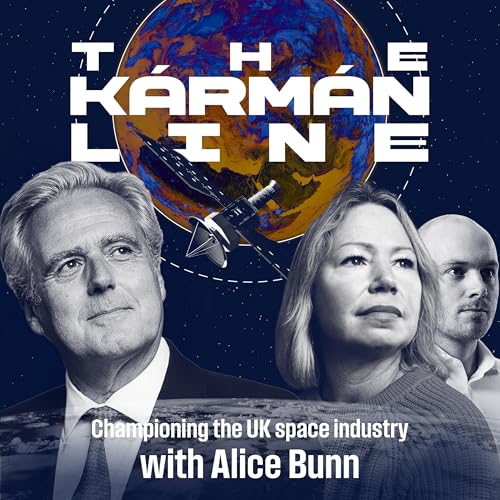
Join Alice and Jonners as they talk to Phil Buckley, partner at the Public Service Consultants and a specialist in space sustainability, about the perils and pitfalls of satellite traffic jams and an opportunity that the UK “could be absolutely brilliant at”.
Contributors:
Alice Bunn, President of UKspace
Dr Alice Bunn OBE FIMechE FRAeS CEng | LinkedIn
UKspace: Overview | LinkedIn
Jonathan Daves, The Karman Line
Jonathan Daves | LinkedIn
Phil Buckley, Partner at the PSC
Phil Buckley | LinkedIn
Key topics covered:
- Space sustainability
- The Kessler effect
- Space debris
- Starlink
- UK-New Zealand agreement
- Space traffic
- The Fengyun weather satellite
- Refuelling
- Servicing
Hosted on Acast. See acast.com/privacy for more information.


 15 mins
 28 mins
 May 18 202635 mins
 38 mins
 32 mins
 33 mins
 26 mins
 20 mins