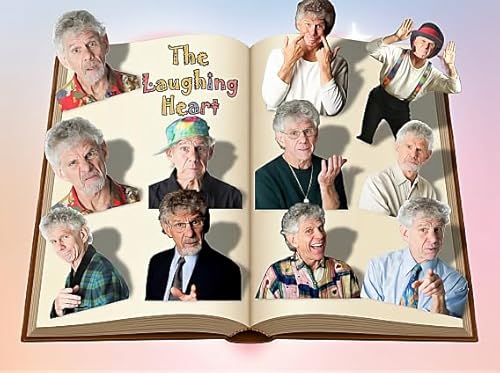
The Laughing Heart cover art

The Laughing Heart

The Laughing Heart

Written by: Errol Strider
Listen for free

The Laughing Heart--a podcast Humor, story, and spoken word for insight, inspiration, and connection Hosted by Errol Strider, poet, performer, and non-prophet.Copyright 2026 Errol Strider Art Entertainment & Performing Arts Parenting Relationships
Episodes
  • The Laughing Heart, July 5, 2026
    Jul 6 2026
    The Laughing Heart with Errol Strider Wholeness, Baggage, and the Comedic Search for What It’s All About Errol Strider Reframes the Journey In this episode of The Laughing Heart, host Errol Strider explains that after a few experimental podcasts, he is shifting toward a more personal format built around insights, discoveries, language, and reflection. After using the song “What’s It All About, Alfie?” as a thematic doorway, he playfully says he has “found” Alfie and asked him the central question. The answer becomes the foundation of the episode: life begins with the self, but the deeper question is how the self relates to everything else, how value is created, and how people move toward wholeness. Alfie, Meaning, and the Question of Wholeness Errol explores meaning through questions such as who we are, where we are, why we are here, and how we all get along. He suggests that real value is whatever furthers wholeness, or the ability to integrate successfully with reality. In this view, wholeness is both the reason and the destiny of life. Errol describes life as a kind of hide-and-seek in which wholeness hides in tiny parts and evolves through adaptation, forgiveness, integration, and creativity. When one “little wholeness” meets another, resistance appears, and the task becomes learning how two wholes can create a greater whole. “Little Shop Between Heaven and Earth” The episode then shifts into a comic sketch called “Little Shop Between Heaven and Earth,” from Family Baggage, the Recovery Show, written by Errol Strider and Lou Montgomery. In the sketch, Errol performs as a shopkeeper who prepares a person about to be born, played by Rochelle, for life on Earth. The shopkeeper warns that life is difficult because of all the “meshugenas” running around, then offers scripts, tapes, excuses, blame lists, coping kits, and addictions as tools people use to survive. The sketch humorously exposes the emotional baggage, learned patterns, denial, guilt, busyness, and “I’m fine” performances people carry through life. Cleaning Up the Mess and Finding Real Choice After the sketch, Errol returns to the question of what life is about and suggests that perhaps it involves cleaning up the mess. He includes war, poverty, illness, bodily life, and daily labor among the many forms of messiness. He also turns inward, saying that in his own current work, he must clean up physical messes like pots, pans, food, and sandwich stations while learning to find joy in the cleanup. That becomes a metaphor for restoring wholeness: reuniting parts, clearing what has been scattered, and discovering real choice. For Errol, true choice is not compulsion or addiction, but awareness that allows growth. Love as Harmonic Adaptation Errol then expands the discussion through a line he attributes to Yeshua from Love Without End: “Love is the harmonic adaptation to the environment.” He reflects that the universe moves in two directions at once: toward greater diversity through evolution and toward the harmonizing of that diversity into unity. As a dancer, he compares this to a ballet, where expansion and unity must both remain alive. Too much chaos loses coherence, but too much tight unity leaves no room for discovery. This balance becomes another way of understanding love, creativity, evolution, and wholeness. Creativity, Presence, and “The Creator” The episode’s reflective center deepens when Errol turns to creativity. He says religious living can be understood as devoted living, and devoted living as creative, original, and spontaneous living. He connects creativity to being in the now, where the artist is fully engaged with a photograph, dance piece, poem, or other subject. He then reads his poem “The Creator,” which describes stepping aside from time, traffic, expectation, and ordinary perception in order to notice hidden gems, unrealized images, and unborn poems. The poem presents creativity as the act of noticing what might otherwise remain unseen and giving it life. The Journey Back Into the Wholeness of Being Errol closes by returning to Alfie’s final thought: real value is that which furthers the recognition of wholeness. He repeats that wholeness is both reason and destiny, hidden in seemingly separate parts that evolve toward reintegration. When individual “wholeness thingies” meet resistance, they can either resist back or adapt through forgiveness, creativity, and integration. Errol ends by encouraging listeners to move consciously on the journey toward awareness, evolution, and discovery of the wholeness already within themselves. He gives contact information for TheLaughingHeart.org, the show email, and the Strider Entertainment YouTube channel.
    Show More Show Less
    30 mins
  • The Laughing Heart, June 28, 2026
    Jun 29 2026
    The Laughing Heart with Errol Strider Money, Matter, and the Sacred Shift From Having to Being Money as Promise, Illusion, and Temptation In this episode of The Laughing Heart, host Errol Strider explores money as both a practical necessity and a psychological illusion. He begins by questioning the familiar phrase that money is the root of all evil, suggesting instead that greed may be the deeper problem. For Errol, greed is not only about money, but about trying again and again to satisfy a need in a way that never truly works. The episode examines the assumptions people place on money: that it will provide security, pleasure, protection, freedom, prestige, amusement, or liberation. “Money Talks” and the Bargain With More Errol introduces a live performance piece titled “Money Talks,” in which his wife personifies money as Mora Money, while Errol plays a man named Henry Simpson who comes seeking security, pleasure, prestige, power, freedom, and protection from death. Through comic dialogue, Mora offers only partial guarantees: limited security, limited pleasure, the illusion of self-worth, the appearance of power, mobility instead of true freedom, and no help after death. The piece humorously exposes how money can seduce people with numbers, promises, and contracts while quietly excluding joy, love, service, presence, true worth, happiness, and spiritual freedom. Measurable Value Versus Immeasurable Love After the performance, Errol reflects on the difference between what money promises and what love offers. He shares one of his “wisdom nuggets,” contrasting money as the promise of measurable value with love as that which carries immeasurable value. He then tells a comic story about his cat being hospitalized and worrying over the bill, using the absurdity of a cat fretting about costs to highlight how deeply financial anxiety can shape human perception. Even life-and-death situations can become filtered through expense, debt, and what things cost. Matter, Money, and What Really Matters The episode continues with another performed piece titled “Matter and Money,” featuring two British characters, Lord and Lady Umbridge. Their dialogue plays with the circular logic of whether money matters because it buys matter, whether matter matters because it exists before money, and whether people matter more when they have money. The comic wordplay ultimately points toward a deeper question: if neither money nor possessions can fully define worth, what truly matters? The answer, gently offered through the piece, is relationship, presence, and the recognition that a person matters beyond money or material things. Errol’s Personal Struggle With Money Errol then turns inward and speaks candidly about his own lifelong tension around money. As an artist, he says he has rarely had the security of a guaranteed paycheck, which has contributed to tightness and caution around spending. He also reflects on childhood memories of waking up to his parents arguing about money, wondering whether that early conflict shaped his own stress and pain around finances. While he does not minimize the real importance of money, especially for people living in poverty or financial uncertainty, he presents his own struggle as part of the broader human challenge of learning how not to be ruled by money. Things, Possession, and Seeing Beyond Need Errol reads a poem titled “Things,” a dense poetic meditation on objects, perception, attachment, desire, and the possibility of seeing the world without possessiveness. The poem reframes things as more than utilities or possessions; they become “vibrant vagabonds,” partners in experience, and participants in a creative reality beyond old categories. Rather than treating objects as extensions of need, fear, or ownership, Errol invites listeners to see things freshly, with innocence and imagination, as part of a larger creative field. From “It” to “Thou” The episode closes by moving from money and matter into relationship. Errol reminds listeners that human beings are not things, but “whos,” and he draws on Martin Buber’s I and Thou to describe the difference between treating people as objects or means to an end and meeting them as sacred, personal beings. He suggests that joy and richness come from seeing others in the present moment as beautiful souls rather than as instruments of use. The episode ends with an invitation to continue exploring the mysteries of human experience through The Laughing Heart and Errol’s wider creative work.
    Show More Show Less
    30 mins
  • The Laughing Heart, June 21, 2026
    Jun 22 2026
    The Laughing Heart with Errol Strider Inside, More, Grace, and the Strange Invitation to Come In A Poetic Journey Into the Inner World In this episode of The Laughing Heart, host Errol Strider invites listeners into a reflective program centered on poetry, inwardness, grace, love, and the strange comedy of human consciousness. He says he has several pieces to share from his own journey, each approaching the inner life from a different direction. The episode includes his works “An Inside Job,” “More, or Is This It?” “Within,” and “Grace,” along with spoken reflections on Teilhard de Chardin, spiritual perception, meditation, suffering, universal light, love, and the desire to be truly seen. “An Inside Job” Loitering in the Vacant Lot of the Mind Errol opens with “An Inside Job,” a gritty and surreal poem about turning inward and discovering not a polished sanctuary, but a weathered inner city of impressions, old habits, loneliness, and defensive postures. The speaker imagines himself loitering inside his own mind like a transient, watching “high-heeled people” pass by with briefcases and purses, as if they know who they are. The poem plays with the tension between inside and outside, self-protection and exposure, and the strange way people try to convince one another that their versions of reality are real. It ends with a longing to be let in, away from the outsider’s life of the mind. “More, or Is This It?” Teilhard, Lord and Lady Ubridge, and the Question of Becoming Errol then shifts into a humorous philosophical piece inspired by Teilhard de Chardin, whom he describes as a mystic, scientist, and philosopher capable of holding both material and spiritual perception at once. “More, or Is This It?” is performed as an ironic dialogue between Lord and Lady Ubridge, who debate whether reality has arrived at its final state or whether there is always “more” still unfolding. Their comic exchange circles around growth, change, wholeness, parts and wholes, whether more means better, and whether the journey is still underway. Through humor, the piece explores spiritual evolution, uncertainty, and the human suspicion that life cannot be finished yet. “Within” Turning Away From the Outer Dazzle After reflecting on the vastness of the universe and the mysterious idea that divine allness can somehow be condensed into individual consciousness, Errol introduces “Within.” This poem is a direct invitation to turn away from the glittering world of sights, sounds, time, space, stimulation, and momentary delight, and to enter the inner world where miracles occur. Its repeated call — “Come in” — becomes almost meditative, urging the listener toward a place where heaven and earth meet, deserts become gardens, stars and thoughts collide, and the ordinary laws of perception are transformed. The poem reflects Errol’s belief that stillness and inward attention open a deeper reality. “Grace” The Gift That Keeps Arriving Errol’s next major piece, “Grace,” offers an expansive meditation on grace as presence, rescue, softness, surprise, replenishment, and divine goodness. The poem presents grace as something that touches the speaker at the point of disappearance, witnesses to presence when he is tempted to shout “nothing,” lifts him when he falters, holds him when he threatens to fly apart, and offers endless chances to choose again. Grace is described as rain, oasis, beacon, exit door, familiar voice, and the goodness of God showing up inside a person. The piece treats grace not as a doctrine but as a living force asking only to be received and lived. Love, Seeing Others, and Letting the Gift Flow Through Near the end, Errol reflects on love as the force beneath grace and awakening. He says love cannot really be defined, comparing it to a fish trying to define water or a light beam trying to define light. What matters, he suggests, is allowing love, light, power, and life to flow through him so that others may receive and recognize it. He shares that even when he is personally in darkness, being with other people often brings love forward, especially through simple acts like asking someone’s name. Drawing on Martin Buber’s idea that “all real living is meeting,” Errol suggests that everyone wants to be seen. Gathering Again in the Divine and the Absurd Errol closes by acknowledging that the episode has moved across many themes, but says it is the best he could offer in the moment. He thanks listeners for joining him and directs them to TheLaughingHeart.org, his YouTube channel with his spouse Rachel at Strider Entertainment, and his Substack writings. The episode ends with an invitation to gather again and “plummet into both the divine and the absurdities of our existence,” capturing the show’s signature blend of poetry, spirituality, humor, vulnerability, and wonder.
    Show More Show Less
    35 mins
adbl_web_anon_alc_button_suppression_t1
No reviews yet